By (circle of) Pierre Mignard
Located in London, GB
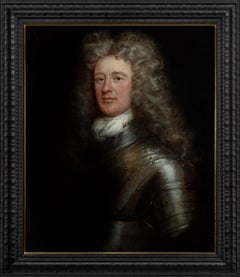
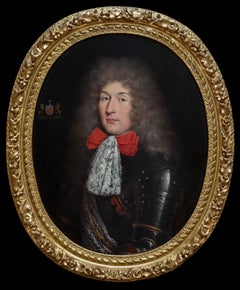
Titan Fine Art presents this portrait of a brave and chivalrous character. The gentleman has been depicted in armour, an elaborate full wig, and in accordance with the latest French fashion, an elaborate type of Venetian Gros point lace cravat and large silk bow (also called a cravat-string) – a type that were popular across Europe in the 1680’s. Point lace was fabulously expensive - a cravat was equivalent to six weeks income for a gentleman - and therefore indicative of a wearer's wealth and social class. A nobleman riding onto the battlefield would wear a lace cravat over his armour to demonstrate his status. The attire, along with the coat-of-arms, help to proclaim to every onlooker that the gentleman is a superior being. The depiction of the lace, apart from denoting the wealth of the sitter, was a deliberate way for the artist to demonstrate his own artistic ambition and technical skills
Argent seasoned gule with three lozenges sable are those of the Crois family, who were minor nobility, originating from the Boulogne region in the north of France. The fact that the sitter is a high ranking noble excludes him as a member of the Crois family. As is so commonly the case, the coat of arms was a later addition, probably in the nineteenth century, by a family who sought to glorify their pedigree by adding their arms to the portrait. These arms are now an interesting part of the portraits history.
The artist has captured a sense of the sitter’s character and the features of the sitter’s face have been rendered with great sensitivity. His confident gaze perhaps reflecting the near invincibility afforded by this steel suit.
The work is a very good example of French portraiture from the period.
Presented in an exquisite hand-carved and gilded seventeenth century frame - which is an exceptional work of art in itself.
Pierre Mignard, known as le Romain, was a French painter of the court of the French King Louis XIV and was, with Charles Le Brun (1619-90), one of the most successful painters during the reign of Louis XIV. After training in Troyes, where he was born, and in Bourges, Mignard joined the studio of Simon Vouet in Paris in 1627. He went to Italy in 1636 and remained there until 1657. He studied the work of Correggio and Pietro da Cortona in Rome as well as copying Annibale Carracci's frescoes in the Palazzo Farnese. On Le Brun's death in 1690 he succeeded him as its Director and as First Painter to the King painting...
Category
17th Century Old Masters Portrait Paintings