Philippe Bertho
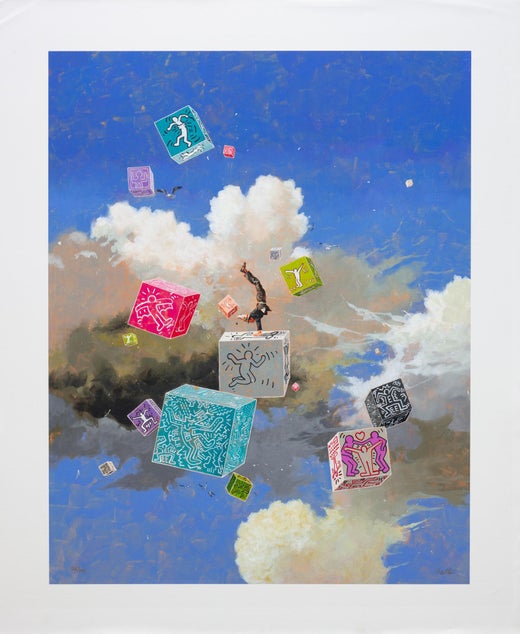
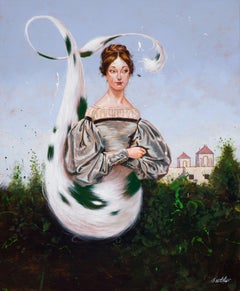
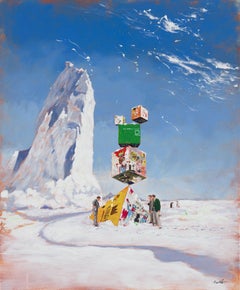
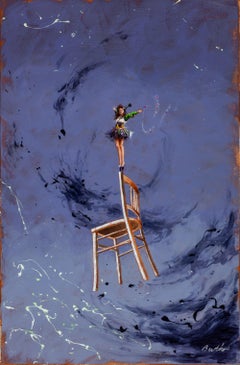
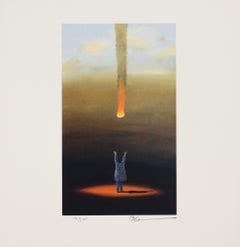
The works of Philippe Bertho are characterized by his innovative approach to both subject matter and materials. In his earlier works, he show-cased his ingenuity by depicting individuals in comical and precarious situations, and incorporating unusual materials such as rusty metal boxes, old light bulbs, and corrugated iron in his paintings. Despite bizarre settings that often conjure up uncertainty or peculiarity, his subjects exude an air of nonchalance, evoking a light-hearted atmosphere. Born in France in 1964, Philippe Bertho is a classically trained artist who has worked as a sales representative for household appliances, as a packer, as a lumberjack until eventually finding what he was looking for as fine art painter. After graduating first in his class from the Art Institute of Reims, he gained notoriety painting murals, ceilings, and posters until 1993. He also taught his trompe l’œil style to young artists and practiced regularly at copying great paintings from the masters, honing his technique. At that time, he was greatly inspired by famous contemporary trompe-l’oeil artists, such as Jacques Poirier, and focused on painting industrial sites and materials. Everything people throw in the garbage and that is destined to be recycled - corrugated iron, rusted metal boxes, light bulbs that will never light up again, the detritus he found in the old disused mines of his native country - fascinated him. “I recycle them my way, in art; I like what is damaged; I have always liked places where there is nobody, yet marks of something are remaining.” In 1995, Bertho was noticed and invited to the Lamballe “Look on Art” salon. His artwork shifted from a trompe l’œil focus to realist painting, creating imaginary but hyper-realist tableaus and worlds. In time, he became more interested in American Pop as well as ‘narrative figuration,’ inspired by artists like Norman Rockwell and the characters from the traditional European world of commedia dell’art. The desire to find balance is one of the richest themes of this work. Some works are specifically about finding balance, and there is a repetitive opposition that could be translated as “a time to act, and a time to refrain from acting.” Bertho finds balance in the same way that he puts his characters to the test and often makes them sweat in impossible situations, but he just as often paints them at rest. His paintings are endless stories; you are invited to imagine all kinds of situations for a character. They are all valid, because we all know from personal experience how complicated and varied life is. Today, Bertho’s ‘Pop Surrealist’ artworks continue their fresh and invigorating variations on his consistent theme of ‘modern humanity’ interacting daily with ordinary life. The visual situations that Bertho stages seem impossible and absurd, and yet the character, our surrogate, encounters them and tries to master them, encouraging optimism in the face of adversity. Bertho’s works have generated acclaim and garnered accolades in Europe and the United States. His art is widely collected by institutions and individual collectors worldwide.