On 1stDibs, you can find the most appropriate arman brush for your needs in our varied inventory. In our selection of items, you can find
abstract examples as well as a
contemporary version. Finding the perfect arman brush may mean sifting through those created during different time periods — you can find an early version that dates to the 20th Century and a newer variation that were made as recently as the 21st Century. On 1stDibs, the right arman brush is waiting for you and the choices span a range of colors that includes
gold,
beige and
gray. There have been many interesting arman brush examples over the years, but those made by
Arman,
Lynne Golob Gelfman,
André Thomkins and
Yves Klein are often thought to be among the most thought-provoking. Frequently made by artists working in
paint,
acrylic paint and
synthetic resin paint, these artworks are unique and have attracted attention over the years.
Arman was born in Nice, France, in 1928, and showed a talent for painting and drawing as a child. He studied at the the Ecole Nationale des Art Décoratifs in Nice followed by studies at the École du Louvre in Paris.
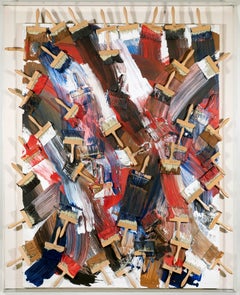
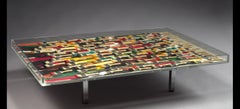
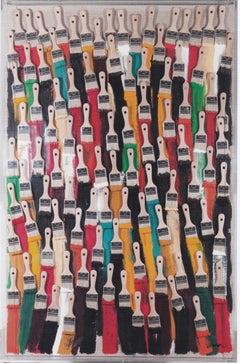
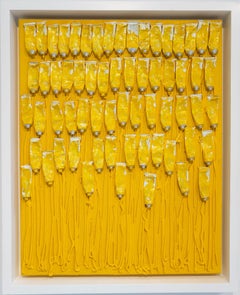
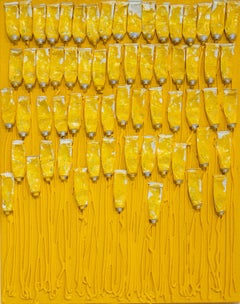
In his early years he focused on abstract paintings. Then, in 1957, he became interested in common objects as works of art. He first did what came to be called his "allures d"objet" (object impressions), where he would dip an object into paint and press it on canvas thus leaving the object's shadow or impression. Then he decided the object itself was worth paying attention to and started to treat them in his own way. His intention was to remove the material purpose of an object so that its only remaining function was to "feed the mind" as a work of art. What better way to achieve that result than by breaking, slicing or even burning objects such as violins, telephones, typewriters or even whole cars? He also made objects useless by accumulating them, such as 2,000 wristwatches in a Plexiglass box that all kept different time.
Once emotionally detached from the circumstances associated with a broken object, the viewer could grow to appreciate its abstract beauty; so, in a sense, Arman was literally teaching that things one never thought could be regarded as attractive could indeed turn out to be so. Through this achievement, Arman gained worldwide recognition and is regarded as one of the most prolific and inventive creators of the late 20th century.
His work can be found in the collections of numerous museums including the Metropolitan Museum of Art in New York, the Tate Gallery in London and the Centre Pompidou in Paris.
Arman’s work has also been exhibited in galleries, museums and public spaces worldwide including the Musée D’Art Contemporain in Tehran, Iran; the Museum of Art in Tel Aviv, Israel; the Musée Des Arts Decoratifs and Opéra De Paris in France; the La Jolla Museum of Contemporary Art in California; and the Museum of Arts and Design and the Guggenheim in New York
He died in 2005 in New York.