Hudson River School Paintings

HUDSON RIVER SCHOOL STYLE

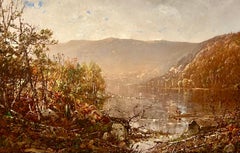
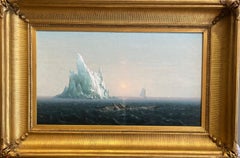
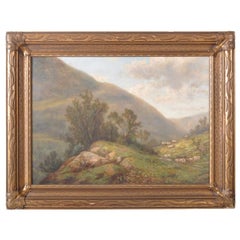
Considered the first major American painting movement, the Hudson River School emerged in the first half of the 19th century with landscape paintings that celebrated the young country’s natural beauty. Most of its leading painters were based in New York City where they exchanged ideas and traveled to the nearby Hudson River Valley and Catskills Mountains to re-create their vistas. At a time when the city was increasingly dense, the Hudson River School artists extolled the vast and pristine qualities of the American landscape, a sentiment that would inform the conservation movement.

American art was dominated by portraiture and historical scenes before Thomas Cole, the founder of the Hudson River School, began painting the Catskill Mountains in 1825. While the Hudson River School was informed by European art aesthetics, particularly the British focus on the sublime in nature, it was a style imbued with nationalism. The landscape painters who followed and studied under Cole would expand their focus from the Northeastern United States to places across the country, their work shared through prints and portfolios promoting an appreciation for the American wilderness — Niagara Falls, the mountain ranges that dot the American West and more — as the style blossomed during the mid-19th century.

Cole’s student Frederic Edwin Church as well as painters such as Albert Bierstadt, John Frederick Kensett, Asher Brown Durand and others became prominent proponents of the Hudson River School. The American art movement also had close ties to the literary world, including to authors like William Cullen Bryant, Henry David Thoreau and James Fenimore Cooper who wrote on similar themes. Although by the early 1900s the style had waned, and modernism would soon guide the following decades of art in the United States, the Hudson River School received renewed interest in the late 20th century for the dramatic way its artists portrayed the world.

Find a collection of authentic Hudson River School paintings, drawings and watercolors and more art on 1stDibs.

to
38
89
40
45
29
20
Overall Width
to
Overall Height
to
1
192
23
7
5
1
3
1
2
1
1
40,620
36,520
22,378
8,742
4,647
3,440
3,292
2,508
1,196
1,168
983
892
429
272
168
51
2
75
73
57
28
28
24
22
21
21
18
16
14
10
9
8
8
7
7
7
6
221
215
144
137
37
6
4
4
4
3
176
3
220
3
Style: Hudson River School
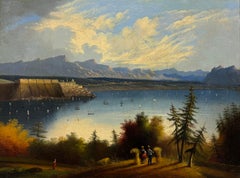
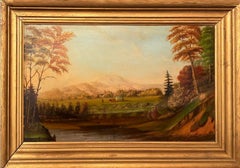
Catskill Mountains from Germantown NY

Catskill Mountains from Germantown NY

By Thomas Cole

Located in Wilton Manors, FL

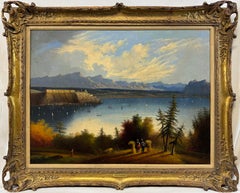
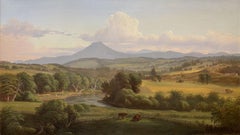
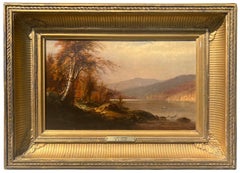
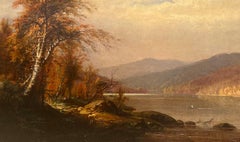
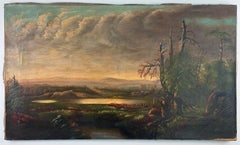
Gorgeous panoramic sunset landscape by unknown artist, ca. 1890. Oil on canvas measuring 20 x 34 inches. Depicted are the Catskill Mountains facing west from somewhere in Dutchess County NY...

Category

Late 19th Century Hudson River School Paintings

Materials

Canvas, Oil

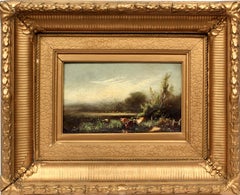
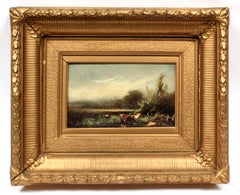
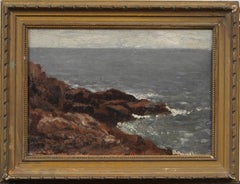
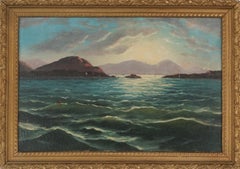
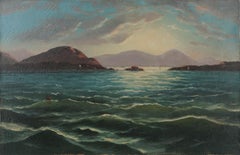
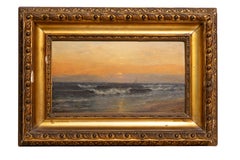
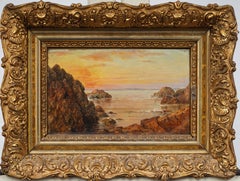
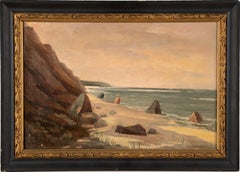
Antique American Hudson River School Coastal Sunset Seascape Framed Oil Painting

Antique American Hudson River School Coastal Sunset Seascape Framed Oil Painting

Located in Buffalo, NY

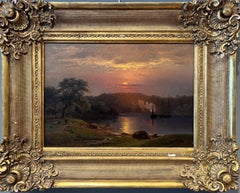
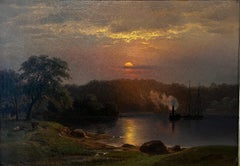
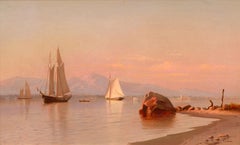
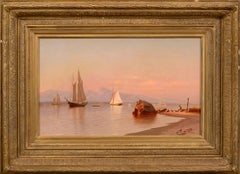
Antique American sunset seascape beach scene oil painting. Oil on board. Framed. Signed. Measuring: 15 by 21 inches overall, and 9 by 15 painting alone.. In excellent original cond...

Category

1870s Hudson River School Paintings

Materials

Oil, Board

19th Century Hudson River School Bucolic Landscape

19th Century Hudson River School Bucolic Landscape

By John Frederick Kensett

Located in Soquel, CA

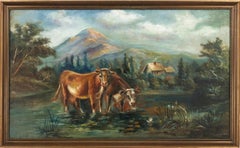
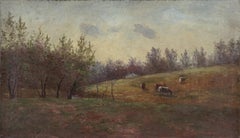
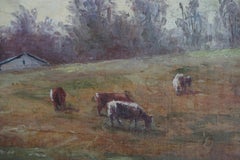
Beautiful example of the Hudson River School romantic bucolic New York autumn landscape with cows foraging. Illegible artist signature on stretcher bar (See enhanced images). Condition: very good; professionally cleaned and minor restoration upper right hand corner where paint was missing. Unframed. Image size: 14"H x 24"W x .75"D Hudson River School was an informal association was America's first so-called school of painting and the dominant landscape style until the Civil War. The name derives from a group of 19th-century landscape painters working in New York state. With realistic composition, they depicted romantic views of unsettled areas of the Hudson River Valley especially lakes, rocky gorges, and forests in the Catskill Mountains. About a fourth of these artists utilized luminism or effects with special lighting techniques to convey lofty emotions through contrasts of light and dark. Included in this Hudson River luminist category were Washington Allston, Albert Bierstadt, William Hart, and Frederic Edwin Church...

Category

1870s Hudson River School Paintings

Materials

Linen, Oil

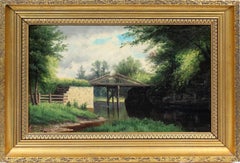
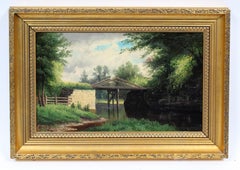
Hudson River Valley Bridge Antique American Oil Painting Framed NYC 19th Century

Hudson River Valley Bridge Antique American Oil Painting Framed NYC 19th Century

Located in Buffalo, NY

This atmospheric antique American landscape depicts a rustic wooden covered bridge spanning a quiet river, surrounded by dense foliage and dappled summer light. Painted in oil, the c...

Category

1910s Hudson River School Paintings

Materials

Canvas, Oil

Sunset - A Sketch
Sunset - A Sketch

Sunset - A Sketch

By Martin Johnson Heade

Located in Bryn Mawr, PA

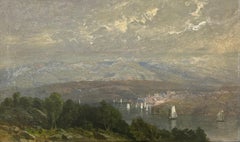
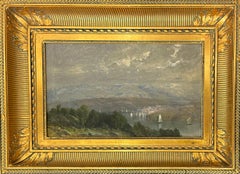
Sunset - A Sketch, 1895 Oil on board 6 x 12 inches (15.2 x 30.5 cm) Framed dimensions: 13 1/8 x 19 3/8 inches Signed and dated lower right: M.J.H. 95 Provenance Frederick Mont and ...

Category

1890s Hudson River School Paintings

Materials

Oil, Board

Late 19th Century Tonalist Landscape -- Afternoon by the Pond

Late 19th Century Tonalist Landscape -- Afternoon by the Pond

Located in Soquel, CA

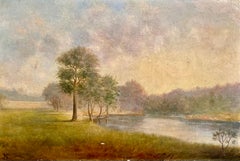
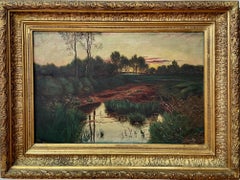
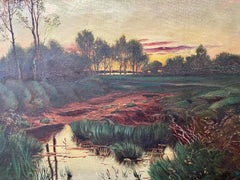
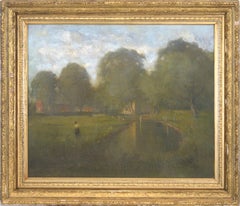
Gorgeous tonalist oil painting woman walking in field by pond with home in background by Willis Seaver Adams (American, 1844-1921), circa 1880. Trees and an amazing sky in the background add depth and interest to this beautiful piece. Signed "W. S. Adams" lower right corner. Condition: Previous restoration includes relining of canvas. Frame is vintage gilt molded and wood frame and shows previous repair of molding losses. Image size: 20"H x 24"W. Auctions records for the artist exceed $6,000. Willis Seaver Adams was known for his landscapes of the Connecticut River Valley. A relative recluse for much of his artistic life, his loneliness can be seen in much of his works. Oil miniatures were the focus for almost all of his later works. He is credited with over 425 oils, watercolors, and drawings. Willis Seaver was born in 1844 on a farm in Suffield, near the Connecticut River. He intermittently attended the Suffield Academy, and always wanted to be a painter. A wealthy doctor became his patron, and financed his studies in 1868 at the Royal Academy in Antwerp. When the doctor passed away, Adams returned home and struggled to make a living painting. After working for a photographer for three years, he opened his own studio. Adams helped organize Cleveland's first watercolor exhibit in 1876. Soon thereafter, he completed a portrait of Rutherford B. Hayes, then governor of Ohio, prior to his becoming President of the United States. This portrait enhanced Adams notoriety. In 1878, Adams traveled to Italy where he opened a studio in Venice, and became friendly with neighbor James Whistler. Prior to returning to Springfield, Adams lived in Florence, Italy for three years. He returned to became an instructor for the Springfield Art Association, and began to exhibit his works at the galleries of James D. Gill. His first one-man exhibit was held there in 1894. Other successful exhibitions took place in Chicago, New York, and Boston. Although his works garnered respectable prices and reflected his success, Adams felt he was due more recognition. In 1906, he moved to Greenfield, Massachusetts and converted a barn into a studio. There, he fell into relative obscurity, accompanied mainly by his dog, Collie. In 1921, Adams passed away. Examples of Willis Adams works can be seen at the Kent Memorial Library, the Wadsworth Atheneum, and the Suffield Academy. Several Suffield residents are thought to own Adams paintings.

Category

1880s Hudson River School Paintings

Materials

Linen, Oil

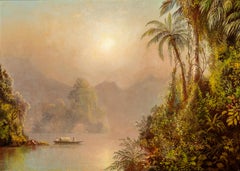
Morning in the Tropics

Morning in the Tropics

By Frederic Edwin Church

Located in Milwaukee, WI

According to the catalogue raisonne of Church's work, the artist only produced one painting titled Morning in the Tropics (1858). This painting currently resides at the Walters Art M...

Category

Late 19th Century Hudson River School Paintings

Materials

Oil, Canvas

Gone Fishing
Gone Fishing

Gone Fishing

Located in North Clarendon, VT

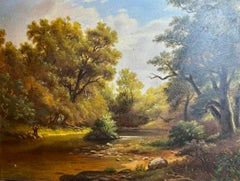
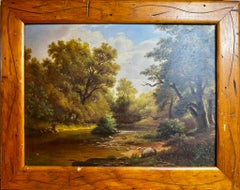
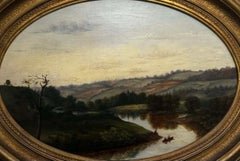
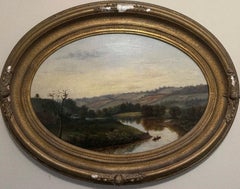
Wonderful Hudson River School oil on board of a fisherman in a peaceful River scene. Monogram and dated on reverse. 9.25" x 12.25" housed in a carved frame measuring 11.5" x 14.5".

Category

1870s Hudson River School Paintings

Materials

Oil

Antique American Hudson River School Mountain Landscape Framed Signed Painting

Antique American Hudson River School Mountain Landscape Framed Signed Painting

By George Herbert McCord

Located in Buffalo, NY

This atmospheric 19th-century oil painting by George H. McCord (1848–1909) depicts a wooded riverbank under a dynamic sky, rendered with the crisp naturalism and luminist subtlety as...

Category

1870s Hudson River School Paintings

Materials

Oil, Board

In the Afterglow (Contemporary Atmospheric Landscape Color Field Painting)

In the Afterglow (Contemporary Atmospheric Landscape Color Field Painting)

By Jane Bloodgood-Abrams

Located in Hudson, NY

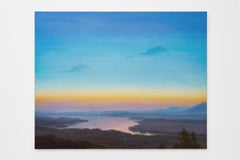
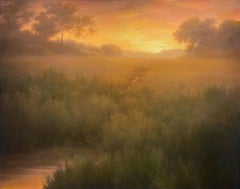
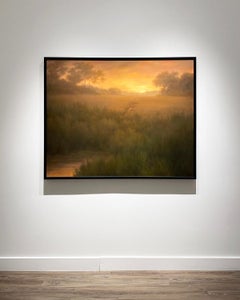
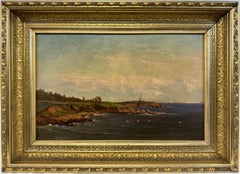
Modern Luminist, Hudson River School landscape painting on canvas of the expansive view over the Hudson River as observed at the top of Olana, the historic home of Frederic Church "In the Afterglow" by Jane Bloodgood-Abrams, painted in 2021 Horizontal landscape painting, 48 x 60 x 1 inches unframed with white painted sides wired on reverse for easy hanging Artist's signature is located on lower left Acclaimed artist of the Hudson Valley, Jane Bloodgood, takes her painting to a new level with a new work entitled "In the Afterglow". Her interpretation of this very iconic view (observed from the top of Olana, the historic home of Frederic Church located near Hudson, NY) is set during the very quiet moments of a summer's evening when the sun has dipped beyond the mountains. The crystal blue sky illuminates with the sun's setting rays; a golden band of yellow haze otherwise known as "The Venus Belt" is an atmospheric phenomenon only visible shortly before sunrise or right before sunset. The water reflects the pink and purple glow that forms near the horizon; the dusty shadows of trees tower over the water's edge. We marvel at how simply Jane captures a complex phenomenon, evidence of her unparalleled ability to paint light and endow her work with luminosity. Yet this painting succeeds not only in its representation of the actual landscape and the awe produced by the experience, but also in its contemporary abstraction of atomsphere. The big, open blue sky is stacked with the colors of the sunset against the horizon, calling to mind a Rothko or the other great color field painters who achieve mood and depth from singular color. About the work: Painter Jane Bloodgood-Abrams has become one of the area’s most celebrated artists, gracing viewers with her compositions of sky, river, and earth. Being less concerned with documenting specific scenes, Bloodgood-Abrams is focused on capturing nature’s essence, “the deeply profound moments, where there is a connection to a vital energy.” Her process begins with being in nature, where she allows the emotional energy of the landscape to filter through her psyche. The memory is then translated onto canvas after being worked over a period of time with layers of paint that is applied, wiped away, and reworked. The result is a radiantly dramatic remembrance of Bloodgood-Abram’s encounter with “something beyond everyday life”. The artist’s final hope is for these images to evoke remembrances within the viewer's own personal relationship with nature. Artist Biography: Jane Bloodgood Abrams was born in Queens, New York. She received her Bachelor’s of Fine Arts from the College of Saint Rose in Albany, in 1985. Three years later, she earned a Master’s of Fine Arts at the State University of New York in New Paltz. Now she paints in the Hudson River Valley and the Berkshires. EDUCATION Master of Fine Arts Painting - (cum laude) State University of New York at New Paltz 1988 Bachelor of Studio Arts - (cum laude) College of Saint Rose, Albany 1985 SELECTED SOLO EXHIBITIONS: 2015 Carrie Haddad Gallery, Hudson, NY 2014 Mark Gruber Gallery, New Paltz, NY Carrie Haddad Gallery, Hudson, NY 2013 Christopher Clark Fine Art, San Francisco, CA The Harrison Gallery, Williamstown, MA 2012 Carrie Haddad Gallery, Hudson NY River Gallery, Chattanooga, TN The Storefront Gallery, Kingston, NY "Beyond the Real" 2011 The Harrison Gallery, Williamstown, MA Carrie Haddad Gallery, Hudson, NY Locust Grove State Historical Site, Poughkeepsie, NY 2010 Carrie Haddad Gallery, Hudson, NY 2009 Carrie Haddad Gallery, Hudson, NY 2008 DFN Gallery, New York, NY 2007 Meyer East Gallery, Santa Fe, NM The Harrison Gallery, Williamstown, MA Carrie Haddad Gallery, Hudson, NY 2006 Mendenhall-Sobieski Gallery, Los Angeles, CA DFN Gallery, New York, NY Carrie Haddad Gallery, Hudson, NY 2005 Carrie Haddad Gallery, Hudson, NY River Gallery, Chattanooga, TN 2004 Albert Shahinian Galleries, Poughkeepsie, NY Carrie Haddad Gallery, Hudson, NY 2003 Carrie Haddad Gallery, Hudson, NY Living Room Gallery, Kingston, NY River Gallery, Chattanooga, TN 2002 Carrie Haddad Gallery, Hudson, NY 2001 Carrie Haddad Gallery, Hudson, NY Artforms Gallery, Albany, NY 2000 Carrie Haddad Gallery, Hudson, NY Mark Gruber Gallery, "Romancing the Landscape" New Paltz, NY 1999 River Gallery, Chattanooga, TN 1998 Alan Sheppard Gallery, Piermont, NY "New Traditions" 1997 Coffey Gallery, Kingston, NY SELECTED JURIED AND INVITATIONAL MULTI-ARTIST EXHIBITIONS: 2016 Byrdcliffe’s Legacy: An ode to Nature and Place, Kleinert Art Center, Woodstock, NY Artists of the Mohawk-Hudson Region, Hyde Collection Museum, Glens Falls, NY ARTBAR Gallery, Kingston, NY 2015 The Laffer Gallery, Schuylerville, NY Jessica Hagen Fine Art, Newport, RI 2014 Jessica Hagen Fine Art, Newport, RI “Riverscapes,” The Harrison Gallery, Williamstown, MA "Far and Wide" Regional Juried Exhibition, Woodstock Art Association and Museum, Woodstock, NY 2013 Artists of the Mohawk-Hudson Region, Hyde Collection Museum, Glens Falls, NY Far and Wide" Regional Juried Exhibition, Woodstock Art Association and Museum, Woodstock, NY 2012 "Riverscapes," The Harrison Gallery, Williamstown, MA “The Great Hudson River Exhibition,” Mill Street...

Category

2010s Hudson River School Paintings
Materials

Oil, Canvas

Camel Back - Summer
Camel Back - Summer

Camel Back - Summer

Located in Milford, NH

A fine Vermont landscape oil painting by American artist Charles Louis Heyde (1822-1892). A prominent New England landscape painter, Charles Heyde lived in Vermont from the early 185...

Category

19th Century Hudson River School Paintings

Materials

Canvas, Oil

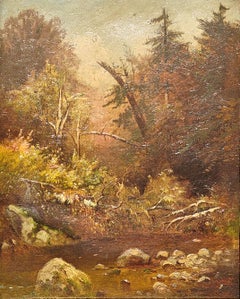
Hudson River School Adirondack Landscape

Hudson River School Adirondack Landscape

By Alexander Helwig Wyant

Located in Fredericksburg, VA

This serene Adirondack landscape is a significant and deeply moving example of the work of Alexander Wyant, whose career marked a critical transition from the Hudson River School tow...

Category

Mid-19th Century Hudson River School Paintings

Materials

Oil, Board

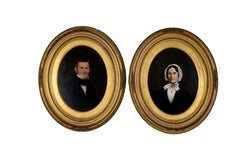
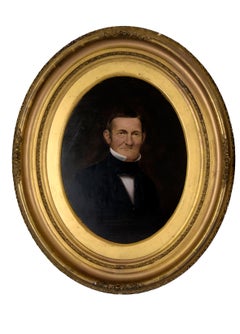
Portraits of a man and Woman Circa 1850-1860 Original Oil on Paper

Portraits of a man and Woman Circa 1850-1860 Original Oil on Paper

Located in Soquel, CA

Portraits of a man and Woman Circa 1850-1860 Original Oil on Paper Early American portraits in the style of and possibly by Henry Bryan Hall (English/American, 1808-1861) Later in hi...

Category

Mid-19th Century Hudson River School Paintings

Materials

Oil, Laid Paper

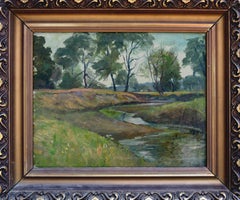
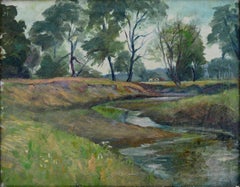
1920s Century Country Creek Landscape

1920s Century Country Creek Landscape

Located in Soquel, CA

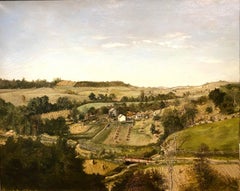
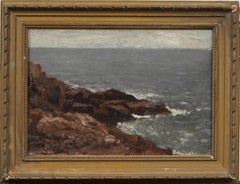
Serene early 20th century landscape of a winding creek in verdant country side with a distant farmhouse in the background, by an unknown artist (American, 20th Century), c. 1920. Pre...

Category

1920s Hudson River School Paintings
Materials

Canvas, Oil

Dawn at the River
Dawn at the River

Dawn at the River

Located in North Clarendon, VT

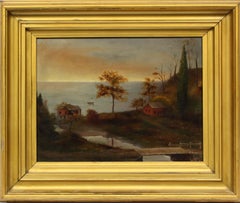
Wonderful Hudson River School painting, oil on canvas. Obviously painted by a talented artist, unsigned and a mystery for you to solve. Canvas stamped Edward Dechaux NY. An amazing...

Category

1850s Hudson River School Paintings
Materials

Oil

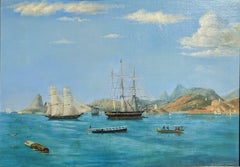
"Harbour of Rio de Janeiro, Brazil, " Julius Montalant, Maritime Port Trade

"Harbour of Rio de Janeiro, Brazil, " Julius Montalant, Maritime Port Trade

Located in New York, NY

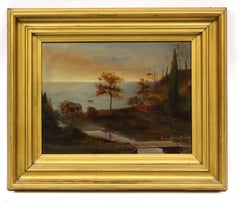
Julius Montalant (1823 - 1898) Harbour of Rio Janeiro, 1843-1850 Oil on canvas 17 x 24 inches Signed and dated lower right; conservator's inscription on the reverse Born in Virginia, probably Norfolk, Julius Montalant is known for his drawings and paintings inspired by his travels on board navy ships. Attached to the USS St. Louis around 1844-45, he sketched ports of call he visited, including Brazil, Chile, New Zealand, Australia, and China. Many of his works are held in the Museum of the U.S. Naval Academy. Navy records indicate his rank as 'C. Clerk', which may mean that he held a civilian position. During the 1850s he lived in Philadelphia, and in 1851-61 he exhibited at the Philadelphia Art Union and the Pennsylvania Academy of the Fine Arts. Included were paintings of North America, Greece...

Category

1850s Hudson River School Paintings
Materials

Canvas, Oil

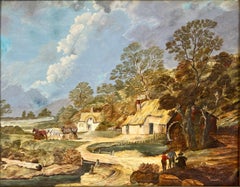
Hudson River School Style - The Homestead and Grist Mill 1942

Hudson River School Style - The Homestead and Grist Mill 1942

By A. Mathieu

Located in Soquel, CA

Hudson River School Style - The Homestead and Grist Mill 1942 In the Hudson River School style by A (K) Mathieu (American, 19th-20th C). Harvest time at the Homestead with a hay wago...

Category

1940s Hudson River School Paintings
Materials

Oil, Illustration Board, Stretcher Bars

The Trout Pool
The Trout Pool

The Trout Pool

By Worthington Whittredge

Located in Bryn Mawr, PA

Provenance Collection of Mrs. Victor R. Bieber, Gwynedd, Pennsylvania Born in Ohio, Worthington Thomas Whittredge began his career as a sign and portrait painter in Cincinnati, wher...

Category

1870s Hudson River School Paintings
Materials

Canvas, Oil

Water Lilies
Water Lilies

Water Lilies

By George Henry Hall

Located in Bryn Mawr, PA

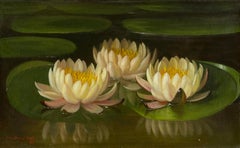
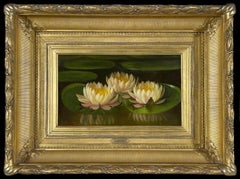
Water Lilies, 1881 Oil on canvas, 7 1/2 x 12 inches (19.1 x 30.5 cm) Framed dimensions: 16 1/8 x 21 1/8 inches Signed and dated lower left: Geo. Henry Hall '81 George Henry Hall was...

Category

1880s Hudson River School Paintings
Materials

Canvas, Oil

"Coastal Scene" George Henry Smillie, Hudson River School, Rocky Coast, Cloudy

"Coastal Scene" George Henry Smillie, Hudson River School, Rocky Coast, Cloudy

By George Henry Smillie

Located in New York, NY

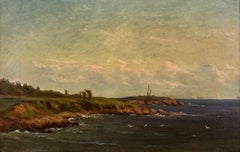
George Henry Smillie Coastal Scene Signed lower right Oil on canvas 20 x 30 inches Provenance Collection of Sylvia and Saverio Giammalva, Houston, Texas The career of George Smill...

Category

1880s Hudson River School Paintings
Materials

Canvas, Oil

Late 19th Century Oil Painting San Francisco Bay Sunset

Late 19th Century Oil Painting San Francisco Bay Sunset

By William Alexander Coulter

Located in Soquel, CA

San Francisco Bay Sunset Hudson River School circle of William Alexander Coulter Luminous San Francisco Bay 1870s landscape of sunset over water with red buoy in foreground and sail...

Category

1880s Hudson River School Paintings
Materials

Linen, Oil

Large Scale Early 20th Century Bucolic Mt. Hood Landscape Oil Painting

Large Scale Early 20th Century Bucolic Mt. Hood Landscape Oil Painting

By William M. Lemos

Located in Soquel, CA

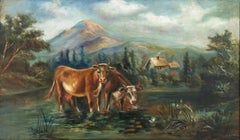
Gorgeous landscape with two cows drinking water in a pond with Mt. Hood in background by listed artist William M. Lemos (American, 1861-1942). Signed "W.M. Lemos" lower right. Presented in vintage gilt-toned frame that shows wear (included as-is). Condition: Good: previously owned and used, with little or no signs of wear and is in good condition. No structural issues. Image size: 29"H x 49"W. Born in New York, Professor Lemos moved to San Francisco in 1887 where he established a studio at 106 Geary Street. He later moved to Santa Cruz in 1896, where he settled, painting murals for many local businessmen and the Santa Cruz Beach Boardwalk. As a boy Lemos earned money by wandering the streets and painting on request. Arriving in San Francisco in 1887, he established a studio at 106 Geary. With his wife Mabel, he worked in Los Angeles for a few years in the 1890s. After settling in Santa Cruz in 1896, he painted murals for many local businessmen. When the original Beach Casino was built there at the Boardwalk in 1904, Lemos was the first concessionaire and worked there for nearly 40 years. On his platform in the Casino, Lemos did paintings of redwoods, still lifes, forest fires, beach scenes, and marines. Many of his oils were done on redwood slabs which were popular with the tourists; in the early days these paintings sold for one dollar and up depending on the size of the work. After his vision failed and he was unable to paint, his last years were mostly spent fishing off the Municipal Pier with a friend who baited his hook for him because he could no longer see. In the March 27, 1941 Santa Cruz Sentinel News Lemos reminisced, "Them were the days when the Boardwalk was only twelve feet long and when business got slow I picked up my shotgun and went across the street and shot ducks where the Casa del Rey Hotel now stands." Exhibited: Calif. State Fair, 1885; Mechanics' Inst. (SF), 1889. In: Santa Cruz City Museum; Wawona Hotel (Yosemite). Edan Hughes, "Artists in California, 1786-1940" His mother was Julia Lemos, a Chicago artist famous for her depiction of the Chicago fire, “Two of Julia’s children became successful artists. Her eldest son, William, was a naïve still life, landscape, and mural painter. As a young boy in New York, he would wander the streets, earning money for the family, by ‘painting on request.’ At age 26, William moved to San Francisco, California. He opened an art studio and kept it running until he moved to Santa Cruz with his wife, Mabel, in 1896. During this period, he worked as a fresco artist painting ‘murals for many local businessmen.’ Exhibited California State Fair, Sacramento, 32nd annual, per Sacramento Daily Union, September 9, 1885. and article goes on to say “William Lemos and wife, Sacramento – Art school exhibits in which are shown such a variety of designs in decorative art, flower painting, and ornamentation, that one must give time to the examination.” Exhibited Mechanics Institute, San Francisco, 1889. “Lemos and his wife were in Fresno California 1890...

Category

Early 20th Century Hudson River School Paintings
Materials

Canvas, Oil, Stretcher Bars

Sunset Along the Front Range, Colorado, 1900s Traditional Landscape Painting

Sunset Along the Front Range, Colorado, 1900s Traditional Landscape Painting

By Charles Partridge Adams

Located in Denver, CO

This stunning, original signed landscape watercolor on paper painting by Charles Partridge Adams (1858-1942) captures the breathtaking beauty of a Colorado sunset along the Front Ran...

Category

Early 20th Century Hudson River School Paintings
Materials

Watercolor

Sunset Boating Landscape

Sunset Boating Landscape

Located in Fredericksburg, VA

Paul Weber was a German born artist that painted beautiful American Landscapes. He exhibited his works in New England, specifically Philadelphia and Boston. After his famed period of...

Category

Mid-19th Century Hudson River School Paintings
Materials

Canvas, Oil

Woodland Tranquility

Woodland Tranquility

Located in Saratoga Springs, NY

Henry Walcott Boss (American, 1820-1916) Woodland Tranquility Oil on canvas, signed “Boss” lower right & dated 1896 In Woodland Tranquility, Henry Walcott Boss offers a masterfully ...

Category

1890s Hudson River School Paintings
Materials

Canvas, Oil

Polar Sea Landscape
Polar Sea Landscape

Polar Sea Landscape

By George Curtis

Located in Fredericksburg, VA

George Curtis transcended the typical Hudson River School style with this painting. While in the Hudson River School, painters often created warmer landscapes of the American country...

Category

Mid-19th Century Hudson River School Paintings
Materials

Canvas, Oil

Hudson River School Landscape titled "A View of the White Mountains"

Hudson River School Landscape titled "A View of the White Mountains"

By William Louis Sonntag Sr. 1

Located in Fredericksburg, VA

This finely realized landscape by William Louis Sonntag presents a serene and expansive view of the White Mountains, a region that held enduring appeal for 19th-century American arti...

Category

Late 19th Century Hudson River School Paintings
Materials

Canvas, Oil

Early Antique American School New England Sunset Sailboat Marine Oil Painting

Early Antique American School New England Sunset Sailboat Marine Oil Painting

Located in Buffalo, NY

Up for sale here is a really impressive mid 19th century painting. Very fine quality and great color! Unsigned. Framed. Image size, 13 by 17.

Category

1850s Hudson River School Paintings
Materials

Canvas, Oil

Oil Sunset Forest Scene titled "Autumn Sunset"

Oil Sunset Forest Scene titled "Autumn Sunset"

Located in Fredericksburg, VA

Paul Gottlieb Weber (1823-1916) was a German-American painter renowned for his landscape and genre scenes. Settling initially in Philadelphia from Germany, he quickly gained recognit...

Category

Mid-19th Century Hudson River School Paintings
Materials

Canvas, Oil

High Bridge and Croton Waterworks (Harlem River)

High Bridge and Croton Waterworks (Harlem River)

Located in Wilton Manors, FL

Stunning Hudson River School landscape by George Lafayette Clough (1824-1901). High Bridge and Croton Waterworks, Harlem River, ca. 1870. Oil on canvas measures 14 x 21 inches; 26 x 33 inches in original frame. Signed lower left. Old repair of small diagonal puncture measuring 1/2 inch in length to the right of ship sail. Otherwise no damage or conservation to painting. Original frame has several areas of damage and loss and will require conservation. George Lafayette Clough was born September 18, 1824, in Auburn, New York, and was that city's leading landscapist and, known as a Hudson River School painter, became Auburn's most noted resident painter of the mid-century. His mother was widowed shortly after his birth, and he was raised without paternal influence. He had little formal education and was employed by the age of ten. By age fifteen he had taken up painting, and his first and informal art influence came from the portraitist, Randall Palmer. In 1844 Clough opened his own studio in Auburn. About that time Charles Loring Elliott...

Category

19th Century Hudson River School Paintings
Materials

Oil

Jamestown, Virginia Landscape

Jamestown, Virginia Landscape

Located in Fredericksburg, VA

John A Mooney is a Virginian artist who has been known to paint trompe loeil and landscape paintings. Born in Buffalo, New York, John A. Mooney (1843-1918) traveled to Georgia to enl...

Category

Early 20th Century Hudson River School Paintings
Materials

Canvas, Oil

Mount Hood From Clear Lake, Early 20th Century Large-Scale Panoramic Landscape

Mount Hood From Clear Lake, Early 20th Century Large-Scale Panoramic Landscape

By William Lemos

Located in Soquel, CA

Mount Hood From Clear Lake, Early 20th Century Large-Scale Panoramic Landscape Large-scale panoramic oil painting landscape of Mount Hood from Clear Lake by William M. Lemos (Ameri...

Category

1930s Hudson River School Paintings
Materials

Oil, Linen, Stretcher Bars

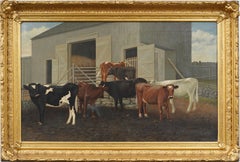
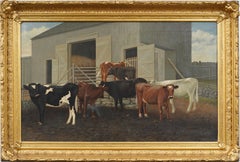
Antique American Realist Cow Farm Large 19th Century Landscape Framed Painting

Antique American Realist Cow Farm Large 19th Century Landscape Framed Painting

Located in Buffalo, NY

Antique American realist cow farm landscape oil painting. Oil on canvas. Framed. Measuring: 29 by 41 inches overall, and 24 by 36 painting alone.. In excellent original condition. ...

Category

1890s Hudson River School Paintings
Materials

Oil, Canvas

"Portrait of an Italian Fencer, " John Frederick Kensett, Hudson River School

"Portrait of an Italian Fencer, " John Frederick Kensett, Hudson River School

By John Frederick Kensett

Located in New York, NY

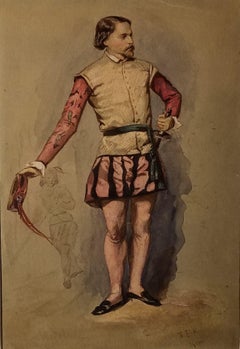
John Frederick Kensett (1816 - 1872) Portrait of an Italian Fencer, circa 1845-47 Watercolor on wove paper 13 1/8 x 8 1/8 inches Signed with initials and inscribed lower right "J.F.K. Rome" From October 1845 through the spring of 1847, Kensett lived in Rome. He attended classes where he sketched from live models, and he sketched in the countryside outside Rome and around Florence, Perugia, and Venice, places he visited with his artist friends. He fulfilled commissions for paintings from Americans in Italy, and by 1847 his career was well established. Son of an English immigrant engraver, John Kensett lacked enthusiasm for that medium and became one of the most accomplished painters of the second generation of Hudson River School painters. His reputation is for Luminism, careful depiction of light, weather, and atmosphere as they affect color and texture of natural forms. He was particularly influenced by the painting of Asher Durand in that he focused on realism and detail rather than the highly dramatic views associated with Thomas Cole. Going to the western United States in the mid 1850s and the 1860s, he was the first of the Hudson River School painters to explore and paint the West. Kensett was born and raised in Cheshire, Connecticut, and learned his engraving from his father, Thomas Kensett with whom he worked in New Haven, Connecticut until 1829. He continued working until 1840 as an engraver of labels, banknotes and maps and was employed part of that time by the American Bank Note Company in New York City. There he met Thomas Rossiter, John Casilear, and other artists who urged him to pursue painting. In 1840, he and Rossiter, Asher Durand, and Casilear went to Europe where Kensett stayed for seven years and supported himself by doing engraving but became accomplished in landscape painting. Having sent canvases of Italian landscapes back to New York, he had a reputation for skillful painting that preceded him. When he returned to New York City in 1847, he was an "instant success" and very sought after by collectors. Two of his Italian landscapes had already been purchased by the American Art Union. By 1849, he was a full member of the National Academy of Design and was generally popular among his peers. His studio was a gathering place with travelers stopping by to see his canvases and to identify "precise locations in the Catskills or Newport or New England in the oil sketches and drawings that covered his walls." (Zellman 170). For the women, he was a popular bachelor, "romantic looking with high forehead and sensitive expression." (Samuels 262) He was also sought after by many organizations. Among his activities were serving on the committee to oversee the decoration of the United States Capitol in Washington DC, and becoming one of the founders of the Metropolitan Museum in New York. An inveterate traveler, Kensett spent summers on painting excursions away from New York City. One of these trips was a special painting excursion with fifteen other artists sponsored by the B & O Railroad from Baltimore, Maryland to Wheeling, West Virginia. Unlike many of the Hudson River painters...

Category

1840s Hudson River School Paintings
Materials

Paper, Watercolor

Reflections of Trees at Dusk

Reflections of Trees at Dusk

Located in San Francisco, CA

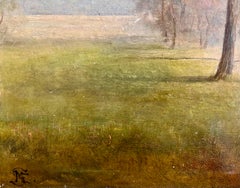
Much about this late 19th-century painting remains a mystery, including the name of the artist who only left their identity in a single-letter monogram. But the work's moody embrace ...

Category

Late 19th Century Hudson River School Paintings
Materials

Canvas, Oil

Tree Study, Lake George

Tree Study, Lake George

By Worthington Whittredge

Located in New York, NY

A remarkably fresh, naturalistic and rare depiction of the environs of Lake George! It is possibly from the late 1860’s, after the Civil War when his work became more naturalist in m...

Category

Mid-19th Century Hudson River School Paintings
Materials

Canvas, Oil

"Building the Allegheny Railroad, Pennsylvania" Alfred Wall, Scalp Level School

"Building the Allegheny Railroad, Pennsylvania" Alfred Wall, Scalp Level School

Located in New York, NY

Alfred S. Wall (American, 1825-1896) Untitled (Building the Railroad), 1859 Oil on canvas 14 1/2 x 18 1/2 inches Signed and dated lower left For Christmas, 2008, the Pittsburgh Post-Gazette featured Alfred Wall's painting, Old Saw Mill from the collection of the Westmoreland Museum of American Art in Greensburg, PA. It was painted in 1851 in the town of Lilly, Pennsylvania in the Allegheny Mountains. The newspaper description stated that "though the saw mill is long gone, it still conveys all the warmth and coziness of this time of year. The article, written by Patricia Lowry, continued: At first glance, Alfred S. Wall's painting of a saw mill in snowy woods triggers nostalgia for the coziness of a log cabin, the smell of a wood-burning fire and the warming of chilled hands and feet beside it. But as sentimental as it seems on the surface, Mr. Wall's painting has a deeper and unexpected context. This is more than a painting about sled-riding children and early industry planted in the middle of virgin forest. Intended or not, this is a painting about conquering the great divide of the Allegheny Mountains. For the third consecutive year, the Post-Gazette features a winter-scene painting on the cover of the Christmas Day newspaper. This year's painting, Old Saw Mill, was selected by co-publisher and editor-in-chief John Robinson Block and executive editor David Shribman during a visit to the Westmoreland Museum of American Art in Greensburg. Mr. Wall, listed as a portrait painter in the 1850 census, was about 26 when he painted Old Saw Mill in 1851. The self-taught artist was born in Mount Pleasant, Westmoreland County, to William and Lucy Wall, who'd emigrated from England around 1820. An artistic sensibility ran in the family: William was a sculptor who carved ornate tombstones here; Alfred's children, A. Bryan and Bessie, were landscape painters, as was Alfred's older brother, William Coventry Wall. For more than a century the Walls formed a prominent art dynasty in Pittsburgh, and Alfred, eventually a partner in the city's most prestigious art gallery, was well known as a painter, dealer and restorer. In Old Saw Mill, two wood cutters, each holding an axe, meet outside the mill; one points in the direction of the forest. On the other side of the stream, one child pulls another down the hillside on a sled. Just behind the hill's slope, the roof of a building appears, perhaps the home of the sawyer. The luminous, late afternoon light comes from the northwest, casting lengthening shadows on the snow under a darkening sky. The saw mill in "Old Saw Mill" likely would have been impossible to track down had Mr. Wall, presumably, not written on the back of the painting: "old saw mill near Jct. 4, Portage RR, Pa." "There was no Junction 4," said Mike Garcia, park ranger at the Allegheny Portage Railroad National Historic Site, about 90 miles east of Pittsburgh near Gallitzen, Cambria County. "But there was an Inclined Plane No. 4 at Lilly, and there was a saw mill there." In fact, there were at least six saw mills at Lilly over the years, said longtime resident Jim Salony, president of the Lilly-Washington Historical Society. But when he saw an image of the painting, Mr. Salony had no trouble coming up with a location. While there are no known photographs of the saw mill, he believes it stood near the intersection of Portage and Washington streets, next to Bear Rock Run. Mr. Salony, retired academic dean at Mount Aloysius College, didn't know exactly when the mill was torn down, but it's been gone since at least the late 1800s. He was pleased to learn of the painting, even though that knowledge came too late for inclusion in a new book about Lilly, The Spirit of a Community, for which he served as primary author and editor. It runs to more than 700 pages. For a little town -- population 869 last year -- Lilly has a lot of history. Nestled in a bowl on the western slope of the Allegheny Mountains about 3 miles south of Cresson, Lilly was first settled in 1806 by Joseph Meyer and his family, who named their 332-acre land patent Dundee. Although the Meyers had left by 1811, other settlers followed, but the community didn't flourish until the 1830s, when the Allegheny Portage Railroad began its 23-year-run through the town. For 200 years the Alleghenies had stood as an impediment to trade and travel between Pittsburgh and the east. A canal from Philadelphia to Pittsburgh would change that and compete with New York's Erie Canal. But a portage railroad would have to be built, on which teams of horses would lead the canal boats over the mountains. Engineer Sylvester Welch began his surveying from the small settlement at Lilly. The railroad would require 10 inclined planes, some quite steep, between Hollidaysburg and Johnstown. To build it, trees had to be cut along a 120-foot-wide right-of-way for 36 miles, along which track and engine houses had to be built. William Brown, who owned the saw mill on Bear Rock Run, built at least one of the engine houses at Inclined Plane No. 4; an 1834 contract also included fencing the dwelling lots at the head and foot of the plane. Lilly is located at what was the foot of Inclined Plane No. 4., giving the community one of its early informal names, Foot of Four. Named in 1883 for Richard Lilly, who'd completed the grist mill there, Lilly had another early name: Hemlock, so dubbed by a Portage Railroad traveler who smelled the bark stripped from the trees at the saw mill. Because there isn't another Allegheny Portage Railroad location like it, where a cut in the mountains opens into a bowl, Mr. Salony thinks it was Lilly that Charles Dickens wrote about following his trip from Harrisburg to Pittsburgh on the Pennsylvania Canal in late March 1842, describing what he saw after emerging from "the bottom of the cut": "It was very pretty while traveling, to look down into a valley full of light and softness, catching glimpses through the tree-tops of scattered cabins; children running to the doors; dogs bursting out to bark, who we could see without hearing; terrified pigs scampering homeward; families sitting out in their rude gardens; cows gazing upward with a stupid indifference; men in their shirt-sleeves looking on at their unfinished houses, planning out to-morrow's work; and we riding onward, high above them, like a whirlwind." To get to Lilly, Mr. Wall may have taken the Pennsylvania Canal from his home in Allegheny City, now the North Side. He'd married young, at 21, to Sarah Carr in 1846, the same year he began his career as an artist. By 1880 they were living in a brick townhouse at 104 (later 814) Arch St., now demolished. Across the river in Pittsburgh he shared a studio at 67 Fourth Ave. with his brother William; they later moved to Burke's Building, today the city's oldest office building at 209-211 Fourth. But often they worked outdoors, sometimes as part of the colony of artists that grew up around painter George Hetzel beginning in the late 1860s at Scalp Level...

Category

1850s Hudson River School Paintings
Materials

Canvas, Oil

Little Girl Reading by House

Little Girl Reading by House

By Edward Lamson Henry

Located in Fredericksburg, VA

"Reading After School," attributed to Edward Lamson Henry, offers a glimpse into the everyday moments of 19th-century American life. Known for his meticulous detail and his ability t...

Category

Late 19th Century Hudson River School Paintings
Materials

Oil, Board

“Woodland Study”
“Woodland Study”

“Woodland Study”

Located in San Francisco, CA

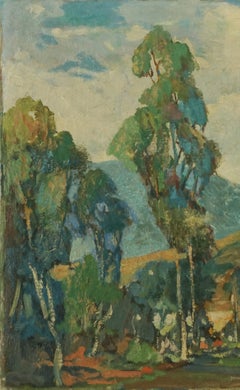
Remarkably, this painting tells its own story on the verso. To save your eyesight, here's what it reveals: James McDougal Hart (1828-1901) Landscape, animal, and portrait painter. A ...

Category

1860s Hudson River School Paintings
Materials

Canvas, Linen, Oil

Woodland Scene
Woodland Scene

Woodland Scene

By William Bliss Baker

Located in Bryn Mawr, PA

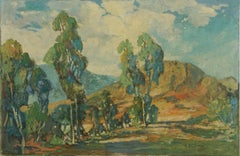
Woodland Scene, 1885 Oil on canvas, 38 x 50 inches (96.5 x 127 cm) Framed dimensions: 49 3/8 x 61 3/8 inches Signed and dated lower left: W Bliss Baker 1885 Provenance Albert E Clue...

Category

1880s Hudson River School Paintings
Materials

Canvas, Oil

"West Point" John Ferguson Weir, Hudson River School Landscape with Sailboats

"West Point" John Ferguson Weir, Hudson River School Landscape with Sailboats

By John Ferguson Weir

Located in New York, NY

John Ferguson Weir West Point, 1873 Signed and dated lower left Oil on panel 12 1/8 x 20 1/8 inches Provenance: Sotheby's Arcade, American Paintings, December 19, 2003, Lot 1091 Spanierman Gallery, New York Private Collection, New York (acquired directly from the above) Exhibited: Roslyn, Nassau County Museum of Fine Art, William Cullen Bryant, The Weirs and American Impressionism, April 24, 1983-July 31, 1983. A painter, sculptor, writer, and teacher, John Weir was a highly talented man whose painting was overshadowed by his father, Robert Weir, the long-time West Point Academy drawing teacher, and his brother, J Alden Weir, well-known impressionist painter. His distinguished reputation was primarily based on his accomplishments as a teacher and administrator. For many years, from 1869 to 1913, John Weir was the Director of the Yale University School of Fine Arts. He was also a commissioner of the art exhibition at the Centennial Exposition in Philadelphia. Weir was born at West Point, New York, and by age 20, had a studio in New York City in the Tenth Street Studio Building, the first building in America dedicated to art studios, and there he associated with many leading painters of the day. He earned attention early in his career for paintings of industrial scenes...
Category

1870s Hudson River School Paintings
Materials

Oil, Panel

Distant Horizon
Distant Horizon

Distant Horizon

By Edward Moran

Located in Saratoga Springs, NY

Edward Moran (American, 1829 - 1901) Boy with Dog on Dock Oil on canvas Signed lower left 22 x 36 inches Provenance: Sotheby's Sale no. 3255 Oct. 27-28, 1977 Page 58 Price on reques...

Category

Late 19th Century Hudson River School Paintings
Materials

Canvas, Oil

Early 20th Century Plein Air Study for Homesteader Colorado Mountain Painting

Early 20th Century Plein Air Study for Homesteader Colorado Mountain Painting

By Frank Tenney Johnson

Located in Soquel, CA

Robert Azensky Fine Art is pleased to offer original 1909 sketch study of oil painting "Homesteader Colorado Mountain" painting by Frank Tenney Johnson. It's always special to see the evolution of a painting through the plein air sketches ("studies") by the artist prior to its painting. Frank Tenney Johnson traveled throughout the Colorado Rockies sketching and painting western landscapes and native American and cowboy figurative art. Medium: Charcoal on paper Signature: Lower left corner Date: "1909" below signature Condition: Tonal aging and minor edge wear consistent with age and use. See images. Presented in black painted wood frame Mat size: 14"H x 11"W Paper size: 9"H x 6"W Image size (visible with mat): 8"H x 5.25"W Frank Tenney Johnson was born in Coucil Bluffs, Iowa, in 1874 not far from the Overland Trail. During his childhood, he saw the steady stream of people heading west in all forms of horse-drawn conveyance. This early exposure to the American West was critical in leading Johnson towards the Western landscape as an inspiration for his work. The resulting body of work is a moody and romantic depiction of a long-gone America, rendered in a style that has become practically a genre all its own. At the age of ten, Johnson moved from Iowa to Milwaukee, WI. There, he took an apprenticeship with F.W. Heinie, a prominent panoramic painter. After a year with Heinie, Johnson apprenticed for Richard Lorenz, a painter and former Texas Ranger who specialized in depictions of horses and western scenes. It was probably during his time with Lorenz that Johnson decided to focus on western subjects himself. He also started illustrating for regional papers and publications, in order to save money for further training. Further training, as with many of the artists who populated New Mexico in the early twentieth century, took place at the Art Students League in New York, where Robert Henri, William Merritt Chase, John Twachtman, Kenneth Hayes Miller and F. Louis Mora were in the process of teaching perhaps the last great batch of pre-modernists. Though highly stimulated by the training, Johnson was only able to stay for five months, after which he returned to Milwaukee to work and save money in an effort to return to New York. He was able to do so after a time and, upon returning, established an important professional relationship with Emerson Hough, the editor of "Field & Stream" magazine. At Hough's urging (and on Hough's dime), Johnson traveled to Hayden, Colorado, where he tagged along with a group of cowpunchers in order to sketch their way of life. Though primarily an artist, Johnson also wrote accounts of his time in Colorado for "Field & Stream." After Colorado came Cheyenne, Wyoming, where Johnson attended a "Frontier Days" celebration; after Wyoming, Johnson traveled to New Mexico, where he observed the Navajos and their threatened way of life. This trip changed Johnson from an academic artist with an appreciation for the west to a truly western artist. Of particular interest to him, in stark contrast to other western artists of the time like Frederic Remington and C.M. Russell, were the more quotidian scenes of the West. Specifically, Johnson focused upon scenes featuring horses, especially at night. Johnson painted a great number of pieces that featured horses tied up outside of saloons, inns or trading posts for the night, the moonlit night punctuated by the warm glow from the lamps inside. In this, he can be considered a pioneer, as his night pieces still serve as the archetype for such work in western art. Johnson became quite successful through his work for "Field & Stream." He was chosen to illustrate books by the prominent writer Zane Grey, and his gallery shows sold briskly. In fact, one particular show, at the Grand Central Art Galleries at the Biltmore Hotel in New York, sold out opening night. In fact, one man had bought out the entire show: Amon Carter. Having achieved financial security and comfort, Johnson followed his good friend Clyde Forsythe to Alhambra, CA, where the two established residency and shared a studio. California treated Johnson well. He and Forsythe founded the gallery at the Los Angeles Biltmore...

Category

Early 1900s Hudson River School Paintings
Materials
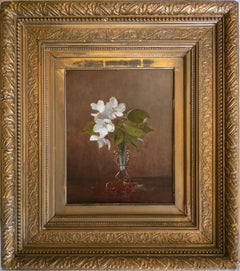
Oil Crayon, Laid Paper

Hudson River School paintings for sale on 1stDibs.
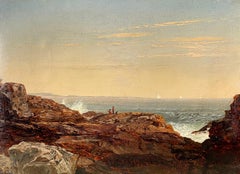
Find a wide variety of authentic Hudson River School paintings available for sale on 1stDibs. Works in this style were very popular during the 21st Century and Contemporary, but contemporary artists have continued to produce works inspired by this movement. If you’re looking to add paintings created in this style to introduce contrast in an otherwise neutral space in your home, the works available on 1stDibs include elements of blue, orange, purple and other colors. Many Pop art paintings were created by popular artists on 1stDibs, including Ralph Albert Blakelock, Jane Bloodgood-Abrams, Jasper Francis Cropsey, and John Frederick Kensett. Frequently made by artists working with Paint, and Oil Paint and other materials, all of these pieces for sale are unique and have attracted attention over the years. Not every interior allows for large Hudson River School paintings, so small editions measuring 4 inches across are also available. Prices for paintings made by famous or emerging artists can differ depending on medium, time period and other attributes. On 1stDibs, the price for these items starts at $400 and tops out at $875,000, while the average work sells for $14,933.