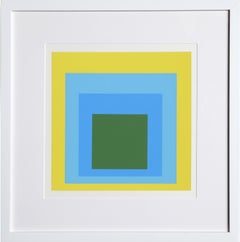
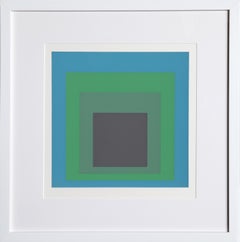
(after) Piet Mondrian Art

Dutch, 1872-1944
Piet Mondrian (1872–1944) was a Dutch painter and theoretician, a pioneer of 20th-century abstract art. He transitioned from figurative painting to a minimalist, geometric style, focusing on primary colors (red, blue, yellow), black, white, gray, and horizontal and vertical lines. His art, rooted in nature, sought universal values and aesthetics. Mondrian was a key figure in the De Stijl movement and his work influenced major art styles like Color Field painting, Abstract Expressionism, and Minimalism, as well as design, architecture, and fashion. Design historian Stephen Bayley described Mondrian as a totem of Modernism.
to
2
Overall Width
to
Overall Height
to
2
2
1
1
2
3
10,138
2,779
1,375
1,367
2
Artist: (after) Piet Mondrian
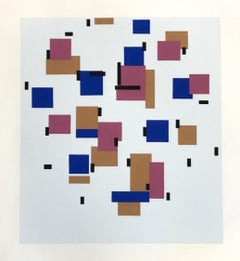
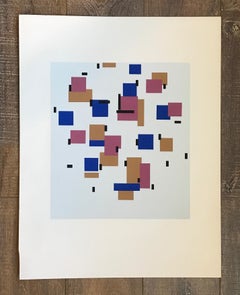
"Composition en bleu b" serigraph
By (after) Piet Mondrian
Located in Henderson, NV
Medium: serigraph (after the 1917 painting). Printed in a limited edition of 300 in 1957 at the atelier Arcay and issued by Galerie Denise René. Printed on Bristol San Francisco smoo...
Category

1950s (after) Piet Mondrian Art

Materials

Screen

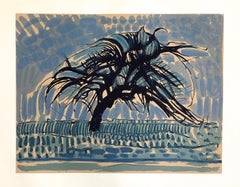
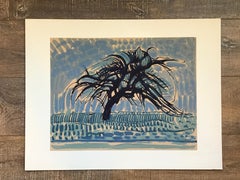
"L'arbre bleu" serigraph
By (after) Piet Mondrian
Located in Henderson, NV
Medium: serigraph (after the 1911 watercolor). Printed in a limited edition of 300 in 1957 at the atelier Arcay and issued by Galerie Denise René. Printed on Bristol San Francisco sm...
Category

1950s (after) Piet Mondrian Art

Materials

Screen

Related Items
Fiesta
By Roy Ahlgren
Located in San Francisco, CA
This artwork titled "Fiesta" 1982 is a color serigraph on Wove paper by noted American artist Roy Ahlgren, 1927-2011 It is hand signed, titled, dated and numbered 66/130 in pencil by...
Category

Mid-20th Century Op Art (after) Piet Mondrian Art

Materials

Screen

Fiesta
Fiesta
$525
H 22.25 in W 29.75 in D 0.01 in
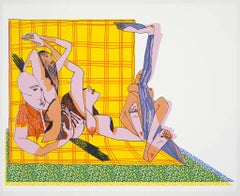
Tango Dancers, Art Deco Screenprint by Igor Galanin
By Igor Galanin
Located in Long Island City, NY
Artist: Igor Galanin Title: Tango Dancers Year: circa 1985 Medium: Screenprint, signed and numbered in pencil Edition: 100 Image Size: 29.5 x 39.5 inches ...
Category

1980s Art Deco (after) Piet Mondrian Art

Materials

Screen

Pianissimo - P1, F12, I1, Abstract Geometric Screenprint by Josef Albers
By Josef Albers
Located in Long Island City, NY
From the portfolio “Formulation: Articulation” created by Josef Albers in 1972. This monumental series consists of 127 original screenprints that are a definitive survey of the artis...
Category

1970s Abstract Geometric (after) Piet Mondrian Art

Materials

Screen

1920 League of Women Voters, OP Art Screenprint by Richard Anuszkiewicz
By Richard Anuszkiewicz
Located in Long Island City, NY
The 50th Anniversary of the League of Women Voters Screenprint Poster from 1970, designed by Richard Anuszkiewicz (1930 - 2020) printed in 1969,...
Category

1960s Op Art (after) Piet Mondrian Art

Materials

Screen

Laudis End
By Roy Ahlgren
Located in San Francisco, CA
This artwork titled "Laudis End" 1981 is a color serigraph on Wove paper by noted American artist Roy Ahlgren, 1927-2011 It is hand signed, titled, dated and numbered 90/99 in pencil...
Category

Mid-20th Century Op Art (after) Piet Mondrian Art

Materials

Screen

Laudis End
Laudis End
$575
H 22.25 in W 29.85 in D 0.01 in
Left Bank Cafe, Paris
By LeRoy Neiman
Located in San Francisco, CA
This artwork titled "Left Bank Cafe, Paris" 1987 is an original color serigraph by noted American artist LeRoy Neiman, 1921-2012. It is hand signed and numbered H.C 166/175 in pencil by the artist. The image size is 26 x 38 inches, sheet size is 32.25 x 44 inches. With the blind stamp of the printer Styria Studio at the lower left corner margin. It is in excellent condition, two small pieces of hanging tape remain on the back. About the artist: Mr. Neiman's kinetic, quickly executed paintings and drawings, many of them published in Playboy, offered his fans gaudily colored visual reports on heavyweight boxing matches, Super Bowl games and Olympic contests, as well as social panoramas like the horse races at Deauville, France, and the Cannes Film Festival. Quite consciously, he cast himself in the mold of French Impressionists like Toulouse-Lautrec, Renoir and Degas, chroniclers of public life who found rich social material at racetracks, dance halls and cafes. Mr. Neiman often painted or sketched on live television. With the camera recording his progress at the sketchpad or easel, he interpreted the drama of Olympic Games and Super Bowls for an audience of millions. When Bobby Fischer and Boris Spassky faced off in Reykjavik, Iceland, to decide the world chess championship, Mr. Neiman was there, sketching. He was on hand to capture Federico Fellini directing "8 ½" and the Kirov Ballet performing in the Soviet Union. In popularity, Mr. Neiman rivaled American favorites like Norman Rockwell, Grandma Moses and Andrew Wyeth. A prolific one-man industry, he generated hundreds of paintings, drawings, watercolors, limited-edition serigraph prints and coffee-table books yearly, earning gross annual revenue in the tens of millions of dollars. Although he exhibited constantly and his work was included in the collections of dozens of museums around the world, critical respect eluded him. Mainstream art critics either ignored him completely or, if forced to consider his work, dismissed it with contempt as garish and superficial — magazine illustration with pretensions. Mr. Neiman professed not to care. Maybe the critics are right," he told American Artist magazine in 1995. "But what am I supposed to do about it — stop painting, change my work completely? I go back into the studio, and there I am at the easel again. I enjoy what I'm doing and feel good working. Other thoughts are just crowded out." His image suggested an artist well beyond the reach of criticism. A dandy and bon vivant, he cut an arresting figure with his luxuriant ear-to-ear mustache, white suits, flashy hats and Cuban cigars. "He quite intentionally invented himself as a flamboyant artist not unlike Salvador Dalí, in much the same way that I became Mr. Playboy in the late '50s," Hugh Hefner told Cigar Aficionado magazine in 1995. LeRoy Runquist was born on June 8, 1921, in St. Paul. His father, a railroad worker, deserted the family when LeRoy was quite young, and the boy took the surname of his stepfather. He showed a flair for art at an early age. While attending a local Roman Catholic school, he impressed schoolmates by drawing ink tattoos on their arms during recess. As a teenager, he earned money doing illustrations for local grocery stores. "I'd sketch a turkey, a cow, a fish, with the prices," he told Cigar Aficionado. "And then I had the good sense to draw the guy who owned the store. This gave me tremendous power as a kid." After being drafted into the Army in 1942, he served as a cook in the European theater but in his spare time painted risqué murals on the walls of kitchens and mess halls. The Army's Special Services Division, recognizing his talent, put him to work painting stage sets for Red Cross shows when he was stationed in Germany after the war. On leaving the military, he studied briefly at the St. Paul School of Art (now the Minnesota Museum of American Art) before enrolling in the School of the Art Institute of Chicago, where, after four years of study, he taught figure drawing and fashion illustration throughout the 1950s. When the janitor of the apartment building next door to his threw out half-empty cans of enamel house paint, Mr. Neiman found his métier. Experimenting with the new medium, he embraced a rapid style of applying paint to canvas imposed by the free-flowing quality of the house paint. While doing freelance fashion illustration for the Carson Pirie Scott department store in Chicago in the early 1950s, he became friendly with Mr. Hefner, a copywriter there who was on the verge of publishing the first issue of a men's magazine. In 1954, after five issues of Playboy had appeared, Mr. Neiman ran into Mr. Hefner and invited him to his apartment to see his paintings of boxers, strip clubs and restaurants. Mr. Hefner, impressed, showed the work to Playboy's art director, Art Paul, who commissioned an illustration for "Black Country," a story by Charles Beaumont about a jazz musician. Thus began a relationship that endured for more than half a century and established Mr. Neiman's reputation. In 1955, when Mr. Hefner decided that the party-jokes page needed visual interest, Mr. Neiman came up with the Femlin, a curvaceous brunette who cavorted across the page in thigh-high stockings, high-heeled shoes, opera gloves and nothing else. She appeared in every issue of the magazine thereafter. Three years later, Mr. Neiman devised a running feature, "Man at His Leisure." For the next 15 years, he went on assignment to glamour spots around the world, sending back visual reports on subjects as varied as the races at Royal Ascot, the dining room of the Tour d'Argent in Paris, the nude beaches of the Dalmatian coast, the running of the bulls at Pamplona and Carnaby Street in swinging London. He later produced more than 100 paintings and 2 murals for 18 of the Playboy clubs that opened around the world. "Playboy made the good life a reality for me and made it the subject matter of my paintings — not affluence and luxury as such, but joie de vivre itself," Mr. Neiman told V.I.P. magazine in 1962. Working in the same copywriting department at Carson Pirie Scott as Mr. Hefner was Janet Byrne, a student at the Art Institute. She and Mr. Neiman married in 1957. She survives him. A prolific artist, he generated dozens of paintings each year that routinely commanded five-figure prices. When Christie's auctioned off the Playboy archives in 2003, his 1969 painting Man at His Leisure: Le Mans sold for $107,550. Sales of the signed, limited-edition print versions of his paintings, published in editions of 250 to 500, became a lucrative business in itself after Knoedler Publishing, a wholesale operation, was created in 1975 to publish and distribute his serigraphs, etchings, books and posters. Mr. Neiman's most famous images came from the world of sports. His long association with the Olympics began with the Winter Games in Squaw Valley in 1960, and he went on to cover the games, on live television, in Munich in 1972, Montreal in 1976, Lake Placid in 1980, and Sarajevo and Los Angeles in 1984, using watercolor, ink or felt-tip marker to produce images with the dispatch of a courtroom sketch artist. At the 1978 and 1979 Super Bowls, he used a computerized electronic pen to portray the action for CBS. Although he was best known for scenes filled with people and incident, he also painted many portraits. Athletes predominated, with Muhammad Ali and Joe Namath among his more famous subjects, but he also painted Leonard Bernstein, the ballet dancer Suzanne Farrell...
Category

21st Century and Contemporary American Modern (after) Piet Mondrian Art

Materials

Screen

Left Bank Cafe, Paris
$7,000
H 32.25 in W 44 in D 0.01 in
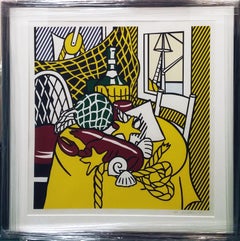
Rose, Cover from 1 Cent Life
By Roy Lichtenstein
Located in Austin, TX
Artist: Roy Lichtenstein Title: Rose, Cover from 1 Cent Life (Rose) Screenprint in green over yellow linen and (1 Cent Life) Screenprint in pink over blue lettering on board of unbound book Year: 1964 Medium: Silkscreen on linen on heavy board Size Edition : 2000 Dimensions: 16.31" x 25.32" (Full cover) Dimensions of Image: 16.31 x 11.88 References : Corlett # III.3 Provenance: Private Collection, Berlin Printed by Maurice Beaudet in Paris and published by E. W. Kornfeld, of Bern, Switzerland. Edition of 2000, unsigned as issued in the regular edition of Walasse Ting's '1¢ Life' portfolio of 1964. Superb impression with good strong colors. This iconic piece was executed by Lichtenstein and printed onto stiff paperboard to serve as the front cover of 1 Cent Life, published in 1964 by Kornfeld in an edition of 2000. The image is printed to the edge of the board, with the Lichtenstein silkscreen...
Category

1960s Pop Art (after) Piet Mondrian Art

Materials

Linen, Screen

I am Very Beautiful, But I Am Also Obliged To Tell You I Am Poisonous
By David Shrigley
Located in London, GB
Artist David Shrigley (British, b. 1968) Title: I am Very Beautiful, But I Am Also Obliged To Tell You I Am Poisonous Year: 2025 Medium: Multi-layer colour screenprint with hand-pull...
Category

2010s Contemporary (after) Piet Mondrian Art

Materials

Screen

After the Party (F. & S. II.183)
By Andy Warhol
Located in Beverly Hills, CA
This is an unsigned and unnumbered unique trial proof (without the colored plates), aside from the edition of 1000. Printer: Rupert Jasen Smith, New York Publisher: Grosset and Dunl...
Category

1970s Pop Art (after) Piet Mondrian Art

Materials

Screen

City 360, Contemporary Geometric Abstract Screenprint by Risaburo Kimura
By Risaburo Kimura
Located in Long Island City, NY
Artist: Risaburo Kimura, Japanese (1924 - ) Title: City 360 Year: 1971 Medium: Screenprint, signed and numbered in pencil Edition: AP 35 Image Size: 25.5 x 20 inches Size: 29 ...
Category

1970s Abstract Geometric (after) Piet Mondrian Art

Materials

Screen

City 88, Geometric Abstract Screenprint by Risaburo Kimura
By Risaburo Kimura
Located in Long Island City, NY
Artist: Risaburo Kimura, Japanese (1924 - ) Title: City 88 Year: 1969 Medium: Screenprint, signed in pencil Edition: AP Size: 25 x 18.75 in. (63.5 x 47.63 cm)
Category

1960s Conceptual (after) Piet Mondrian Art

Materials

Screen

"Ada Four Times #2" Modern Figurative Silkscreen & Lithograph AP Edition 6/6
By Alex Katz
Located in Houston, TX
Modern figurative silkscreen and lithograph by renowned artist Alex Katz. The work features a portrait of Ada, Katz's wife and muse, turned to face the left. The work is part of a se...
Category

1970s Modern (after) Piet Mondrian Art

Materials

Lithograph, Screen

Previously Available Items
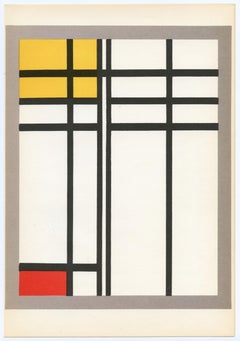
"Opposition of Lines, Red and Yellow" lithograph
By (after) Piet Mondrian
Located in Henderson, NV
Medium: lithograph (after the painting). Printed in 1956 on thin wove paper and published in Stockholm for a Swedish survey of Concrete Art. Size: 10 1/2 x 7 3/8 inches (270 x 188 mm...
Category

1950s (after) Piet Mondrian Art

Materials

Lithograph

(after) Piet Mondrian art for sale on 1stDibs.

Find a wide variety of authentic (after) Piet Mondrian art available for sale on 1stDibs. You can also browse by medium to find art by (after) Piet Mondrian in screen print, lithograph and more. Not every interior allows for large (after) Piet Mondrian art, so small editions measuring 8 inches across are available. (after) Piet Mondrian art prices can differ depending upon medium, time period and other attributes. On 1stDibs, the price for these items starts at $400 and tops out at $2,000, while the average work can sell for $2,000.
Questions About (after) Piet Mondrian Art
  • 1stDibs ExpertApril 22, 2024
    Piet Mondrian's style of art varied over the course of his career. His early works display the characteristics of Post-Impressionism, but his paintings grew more abstract over time. Art historians classify many of his later works as Expressionism or Cubism. Find a selection of Piet Mondrian art from some of the world's top galleries and dealers on 1stDibs.
  • 1stDibs ExpertSeptember 9, 2024
    How much a Piet Mondrian painting is worth will depend on its history, size, condition and other characteristics. In 2022, his Composition No. II sold for $51 million, establishing a new auction record for the Dutch painter's work. The painting is an example of the colorful geometric compositions that made Mondrian an acclaimed artist. These works helped to define the De Stijl movement, a Dutch abstract art movement that emerged during the early 20th century. If you own a Mondrian, a certified appraiser or knowledgeable art dealer can help you with the valuation process. On 1stDibs, explore a wide variety of paintings.
  • 1stDibs ExpertApril 5, 2022
    Yes, Mondrian’s art is believed to be one of the great inspirations for the mid-century modern approach to minimalism. His artworks were not just a departure from figurative works, but a new look at abstract art as well. On 1stDibs, find a variety of original artwork from top artists.

Still Thinking About These?

All Recently Viewed