By Albert Eugene Gallatin
Located in Houston, TX
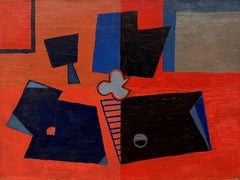
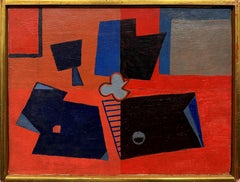
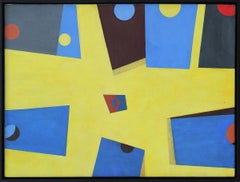
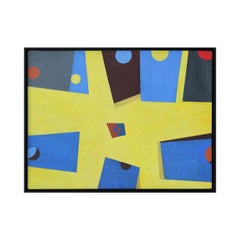
Early modern Cubist geometric abstract painting by American artist Albert Eugene Gallatin. The work features the illusion of three dimensional blue and black rectangular shapes floating against a yellow background. Heavily influenced by the work of Picasso, Braque, and Gris, this work embodies his non-objective style. Signed and dated on reverse. Currently hung in a black wooden floating frame.
Dimensions Without Frame: H 30.18 in. x W 40 in.
Artist Biography: Born in 1882 in Villanova, Pennsylvania into a prominent banking family of Swiss descent, Albert Eugene Gallatin inherited a family fortune upon his father's death in 1902. His great-grandfather Albert Gallatin (1761-1849) had served as U.S. Secretary of the Treasury under Presidents Jefferson and Madison before founding the New-York Historical Society and New York University.
A. E. Gallatin moved to Park Avenue in New York and became one of the most eligible bachelors in Manhattan. He also became a passionate and knowledgeable collector and patron of modernist art after World War I. "His collection brought together paintings by American modernists including Charles Demuth, Charles Sheeler, and John Marin, and works by Picasso, Braque, Mondrian, Miró, and Juan Gris, fusing European and American development." (Hollis Taggert Galleries).
Gallatin began painting in 1926, studying with Robert Henri and in Paris, France. His style was strongly influenced by the Cubist work of Picasso, Braque, and Gris; with his artist colleagues George L. K. Morris, Suzy...
Category
1940s Cubist Albert Eugene Gallatin Art
MaterialsCanvas, Oil, Board