Alfred Boulot Art

French, d. 1925

Alfred Boulot was a renowned French artist and engraver. He was active from 1883 to 1925.

to
1
Overall Width
to
Overall Height
to
1
1
1
1
1
1
1
1
10,254
2,810
2,500
1,403
Artist: Alfred Boulot
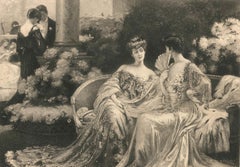
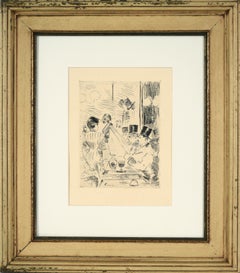
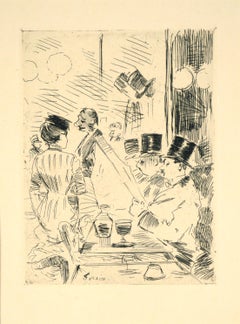
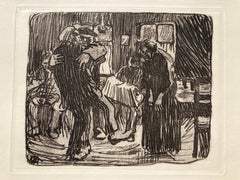
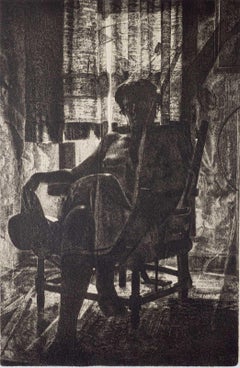
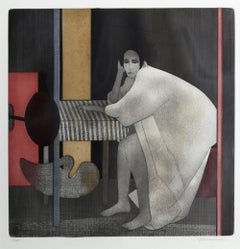
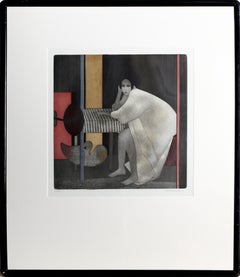
Confidences - Etching by Alfred Boulot - First Half of 1900

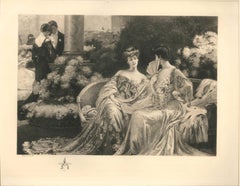
Confidences - Etching by Alfred Boulot - First Half of 1900

By Alfred Boulot

Located in Roma, IT

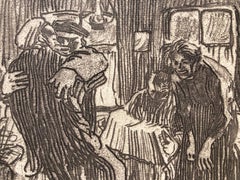
Confidences is an original artwork realized by Alfred Boulot in the first years of the XX Century. Original Etching on paper. Passepartout included (cm 35 x 50). Signed on plate ...

Category

Early 20th Century Alfred Boulot Art

Materials

Etching

Related Items
Don Juan
Don Juan

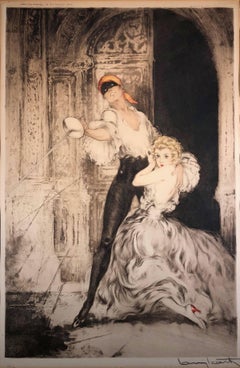
Louis IcartDon Juan, 1928

$2,800Sale Price|20% Off

H 28 in W 20.5 in

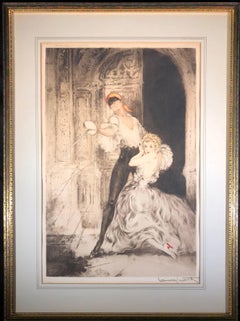
Don Juan

By Louis Icart

Located in Missouri, MO

Aquating Engraving Image Size: approx. 20 1/4 x 13 3/8 Framed Size: 28 x 20.5 inches Pencil Signed Lower Right Louis Justin Laurent Icart was born in Toulouse in 1890 and died in Paris in 1950. He lived in New York City in the 1920s, where he became known for his Art-Deco color etchings of glamourous women. He was first son of Jean and Elisabeth Icart and was officially named Louis Justin Laurent Icart. The use of his initials L.I. would be sufficient in this household. Therefore, from the moment of his birth he was dubbed 'Helli'. The Icart family lived modestly in a small brick home on rue Traversière-de-la-balance, in the culturally rich Southern French city of Toulouse, which was the home of many prominent writers and artists, the most famous being Henri de Toulouse-Lautrec. Icart entered the l'Ecole Superieure de Commerce de Toulouse in order to continue his studies for a career in business, particularly banking (his father's profession). However, he soon discovered the play writings of Victor Hugo (1802-1885), which were to change the course of his life. Icart borrowed whatever books he could find by Hugo at the Toulouse library, devouring the tales, rich in both romantic imagery and the dilemmas of the human condition. It was through Icart's love of the theater that he developed a taste for all the arts, though the urge to paint was not as yet as strong for him as the urge to act. It was not until his move to Paris in 1907 that Icart would concentrate on painting, drawing and the production of countless beautiful etchings, which have served (more than the other mediums) to indelibly preserve his name in twentieth century art history. Art Deco, a term coined at the 1925 Paris Exposition des Arts Decoratifs, had taken its grip on the Paris of the 1920s. By the late 1920s Icart, working for both publications and major fashion and design studios, had become very successful, both artistically and financially. His etchings reached their height of brilliance in this era of Art Deco, and Icart had become the symbol of the epoch. Yet, although Icart has created for us a picture of Paris and New York life in the 1920s and 1930s, he worked in his own style, derived principally from the study of eighteenth-century French masters such as Jean Antoine Watteau, François Boucher and Jean Honoré Fragonard. In Icart's drawings, one sees the Impressionists Degas...

Category

1920s Art Deco Alfred Boulot Art

Materials

Engraving, Aquatint
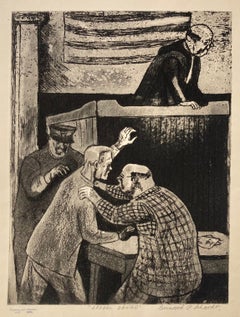
"Sanity Hearing" Satirical Etching

"Sanity Hearing" Satirical Etching

By Charles Bragg

Located in Soquel, CA

"Sanity Hearing" Satirical Etching Satirical etching by Charles Bragg (American, 1931-2017). This scene depicts a chaotic courtroom, ostensibly the location of this "Sanity Hearing." A man wearing a suit of armor sits with his hand raised taking an oath of honesty on top of three books labeled "Bible," "Holy Bible," and "Cookbook." The judge sits behind him, holding a fly swatter with a glass tankard of beer in front of him. A man in the bottom right corner reads the Bill of Rights but he holds it upside down. Other guests of the courtroom include multiple kittens, a man gnawing on the bench, and a toucan on a leash. Numbered as "104/300" in bottom left corner. Titled "Sanity Hearing" in center edge. Signed "Charles Bragg" in bottom right corner. Frame size: 20.32" H x 22.63" W Image size: 10.27" H x 12.75" W Charles Bragg (American, 1931-2017) was a painter, sculptor, and illustrator of commentary on human behavior, based out of Los Angeles, California. Bragg often injected his sense of humor and appreciation of satire into his subjects, many of which are cartoonish and seem half human and half animal. He also depicted serious subjects, ones that become poignant commentaries on the human condition. Bragg was born in St. Louis Missouri in 1931. His parents were vaudeville performers, and he spent most of his young life traveling on tour with them. During his teenage years, he went to New York's High School of Music & Art in Harlem. At 18, he ran away with his high school sweetheart, fellow artist Jennie Tomao...

Category

1980s Other Art Style Alfred Boulot Art

Materials

Paper, Ink, Etching

THE RAG GATHERERS
THE RAG GATHERERS

THE RAG GATHERERS

By James Abbott McNeill Whistler

Located in Santa Monica, CA

JAMES ABBOTT McNEILL WHISTLER (1834-1903) THE RAG GATHERERS 1858 (Glasgow 29 v/v, - K.23) Etching on laid paper, signed and dated in the plate, image 5 7/8” x 3 ½”, full sheet 8 x...

Category

1850s Impressionist Alfred Boulot Art

Materials

Etching

"Waiting for Rehearsal"

"Waiting for Rehearsal"

By Paul Cadmus

Located in Astoria, NY

Paul Cadmus (American, 1904-1999), "Waiting for Rehearsal", Etching, 1984, signed in pencil lower right, titled and numbered edition "140/175" lower left, and blind stamped "Pelavin ...

Category

1980s Modern Alfred Boulot Art

Materials

Etching

HAMBURGER KNIEPPE
HAMBURGER KNIEPPE

HAMBURGER KNIEPPE

By Käthe Kollwitz

Located in Santa Monica, CA

KATHE KOLLWITZ (1867-1945) HAMBURGER KNIEPPE, 1901) (K.58 IIIb) Soft Ground Etching, Plate 9 ¾ x 8 ¼ sheet 10 ½ x 13 ¾. With the von de Becke blind stamp in the lower right. Prin...

Category

Early 1900s Expressionist Alfred Boulot Art

Materials

Etching

Jan Oytenbogaert
Jan Oytenbogaert

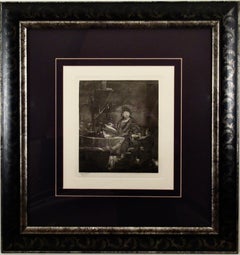
Rembrandt van RijnJan Oytenbogaert, 1639

$950

H 25.25 in W 24 in D 1 in

Jan Oytenbogaert

By Rembrandt van Rijn

Located in San Francisco, CA

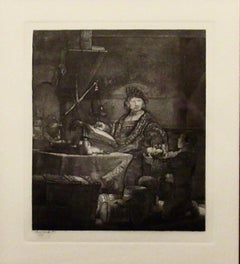
This artwork titled Jan Uytenbogaert" 1639 is an etching on paper After Rembrandt Van Rijn, 1606-1669, plate engraved By French renown engraver Charles Armand Durand, 1831-1905. Sign...

Category

17th Century Realist Alfred Boulot Art

Materials

Etching

Backlighting
Backlighting

Backlighting

By Paolo Ciampini

Located in New Orleans, LA

"Backlighting" was issued in an edition of 50. Paolo Ciampini was born in Montopoli in Val d'Arno in 1941. After graduating from the Art Institute of Cascina (Pisa) in 1962, he com...

Category

1990s Contemporary Alfred Boulot Art

Materials

Etching

Le Legacy from Historia de Don Quichotte de la Mancha, Etching by Salvador Dali

Le Legacy from Historia de Don Quichotte de la Mancha, Etching by Salvador Dali

By Salvador Dalí­

Located in Long Island City, NY

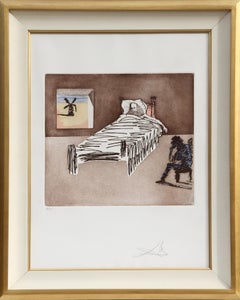
Artist: Salvador Dali, Spanish (1904 - 1989) Title: Le Legacy from Historia de Don Quichotte de la Mancha Year: 1981 Medium: Etching on Arches, signed and numbered in pencil Edition:...

Category

1980s Surrealist Alfred Boulot Art

Materials

Etching

Interiors VII: The Train from Munich

Interiors VII: The Train from Munich

By Peter Milton

Located in Middletown, NY

Interiors VII: The Train from Munich Robert E. Townsend, 1991. Resist ground etching and engraving with hand refinement in charcoal, pencil, stabilo, and eraser on BFK Rives white wove paper, 20 x 36 inches (507 x 914 mm), full margins. Signed, titled, dated and numbered 51/175 by the artist in pencil, lower margin. A brilliant, inky impression with luminous light and gradient tones. In excellent condition with one extremely minor and superficial spot of light tan adhesive residue on the verso, unobtrusive and not visible on the recto, with no other visible defects. With the blind stamp of the printer, Robert E. Townsend in the lower left margin. An especially fine impression in superb condition. [Milton 113]. When asked about this work in particular, Milton expressed that his favorite images were his darkest images, in theme, mood, and in ink. Milton, who has said that his work is infused with a postmodern awareness of the past, has focused here in a deeply personal way on a segment of history that continues to haunt us all. The work, published in 1991, evokes one of the darkest periods of European history, the eroding and erasing of European culture under fascism, and the eventual total loss of humanity. The Train from Munich is an especially relevant and emotional work for Milton, who created the piece for his wife, Edith, who escaped Munich in 1939 as a child on the fabled Kinderstransport. The Kinderstransport was a desperate rescue effort on the part of the British government to save as many Jewish children as possible by railway before borders closed on the precipice of the Second World War. Children left their parents behind, and boarded the trains alone, leaving the impending doom of Nazi Germany, they arrived in Great Britain as refugees. More than 10,000 children escaped the holocaust via the Kinderstransport. In Train from Munich, the image itself holds an almost immeasurable amount of symbolism; each inch of the matrix is a successful effort to confront this history in a way that is poignant through a series of motifs. We see the Café disappearing into a ghostlike memory of the past, an allegory to the disintegration of culture, while through the windows we can see a rampant, snarling dog; a portrait of Hitler's shepherd, Blondi. Blondi isn't the only notable figure in the composition. Milton has pointed out that the fading figure of the doorman at the Hotel Metropole is modeled after the artist and intellectual Marcel Duchamp, and the face of the young girl peering...

Category

1990s American Modern Alfred Boulot Art

Materials

Charcoal, ABS, Engraving, Etching

"Fete Champetre" - 20th Century Framed Antique Cubist Etching

"Fete Champetre" - 20th Century Framed Antique Cubist Etching

By Jacques Villon

Located in New Orleans, LA

Jacques Villon, pseudonym of Gaston Émile Duchamp, (born July 31, 1875,Damville, Normandy, France—died June 9, 1963, Puteaux,near Paris), French painter and printmaker who was involved in the Cubist movement; later he worked in realistic and abstract styles. Villon was the brother of the artists Suzanne...

Category

Early 20th Century Alfred Boulot Art

Materials

Etching

Nu couché. Intérieur à la lampe vénitienne

Nu couché. Intérieur à la lampe vénitienne

By Henri Matisse

Located in London, GB

Henri Matisse Nu couché. Intérieur à la lampe vénitienne 1929 Etching on Chine appliqué on Arches Velin paper, Edition of 25 Paper size: 28 x 38 cms (11 x 15 ins) Plate size: 9.1 x 1...

Category

1920s Modern Alfred Boulot Art

Materials

Etching

Alfred Boulot art for sale on 1stDibs.

Find a wide variety of authentic Alfred Boulot art available for sale on 1stDibs. You can also browse by medium to find art by Alfred Boulot in etching and more. Not every interior allows for large Alfred Boulot art, so small editions measuring 18 inches across are available. Customers who are interested in this artist might also find the work of Yves Alix, Charles Courtry, and Paul Vera. Alfred Boulot art prices can differ depending upon medium, time period and other attributes. On 1stDibs, the price for these items starts at $250 and tops out at $250, while the average work can sell for $250.

Artists Similar to Alfred Boulot