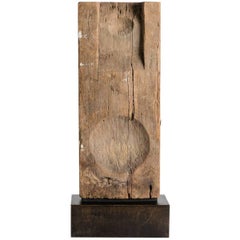
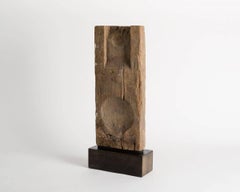
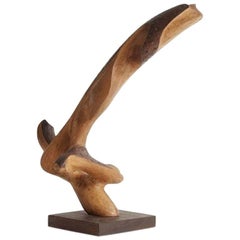
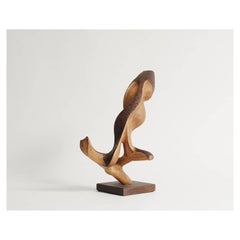
By Yongjin Han
Located in New York, NY
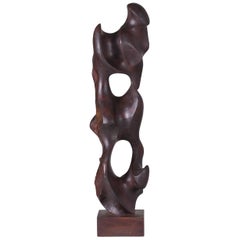
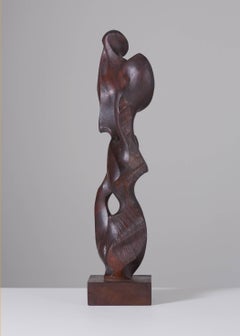
Yongjin Han was born in Seoul, South Korea in 1934. After the Korean War—in which he fought, lying about his age in order to enlist—he was one of six students admitted to the sculpture program at the Seoul National University. At the time of his enrollment little of his native city remained intact; nonetheless, he had never felt more responsible to his work, firm in the conviction that artistic expression is every bit as essential to life and human nature as eating, drinking, or breathing.
One of Han’s teachers was Kim Chong Yung, a pioneer of Korean abstract sculpture, and by the time of his graduation he had adopted the abstraction that had seized both Europe and the United States several years before. . In 1967 he relocated to the USA, where he studied at Dartmouth and Columbia. Over the course of his long career the artist returned to Korea with frequency and made extended stays in Japan and Europe.
Trips to Korea signified something more than mere homesickness: Han’s work, though made largely in America, remained grounded in his rich cultural heritage. Korea rests on a bedrock of granite, and freestanding sculpture produced of the stone has for centuries demarcated sites of historical and religious significance. Han’s sculpture bridges this past with modernity. Richard A. Born, former Curator at the Smart Museum at the University of Chicago, has said that Han “brought Korea’s tradition of direct stone carving out of figuration into a refined, non-objective abstraction.”
For his part, Han put very little stock in designations; his focus, instead, was on the stone itself. His pieces explore a certain harmonization with nature. Han, when describing his work, said, "As stone has been around since the beginning of time, it has much to teach us if we care to slow down and listen." He believed that each stone has its own history, character, and energy and that his task was to draw out these inherently spiritual qualities. He described his process as a “dialogue” with his material: "The stone tells me it has an itch in a certain spot, so I scratch it—and we both feel better!"
Han worked alone and with manual tools, and the process is arduous. Carving stone this way takes time, and, what’s more, required great force—yet Han’s sculptures, even the monumental ones, are, as friend and fellow artist David Parker...
Category
Late 20th Century American Allan McCollum Sculptures