By Burgoyne Diller
Located in New York, NY
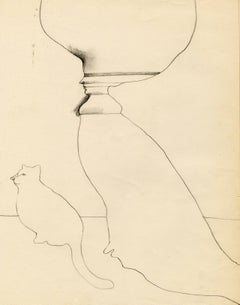
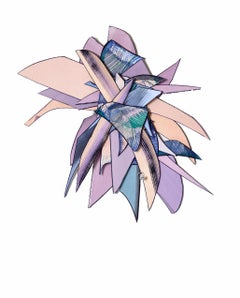
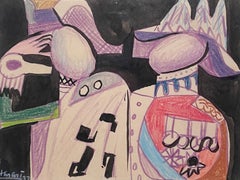
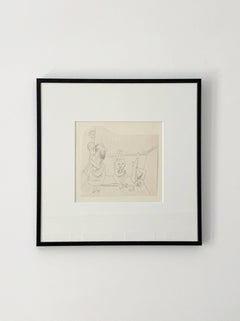
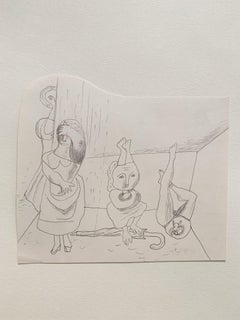
"Second Theme" 1949 Abstract Mid 20th Century Geometric Non-Objective Hard Edge
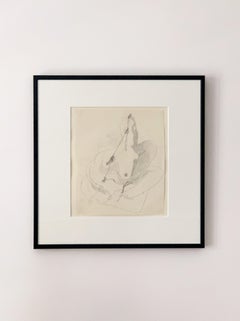
Burgoyne A. Diller (American, 1906-1965) "Second Theme" 1949. Pencil and crayon on paper. Signed and dated 'D. 49' (lower right). Image: 9 1/2 x 5 1/2 in. Andre Emmerich Gallery, New York. Martha Jackson Gallery, New York. Anderson Gallery, Buffalo, New York. David K. Anderson Grandchildren's Trust.
BURGOYNE DILLER (1906-1965) Recognized as the first American painter to embrace the tenets of Neo-Plasticism, Burgoyne Diller made an important contribution to the development of non-objective art in the United States. Working in a hard-edged geometric style, he produced paintings, drawings, and collages that paved the way for the development of American Minimalism during the 1960s and 70s.
Born in New York City in 1906, Diller began painting and drawing as a teenager growing up in Battle Creek, Michigan. Later, while attending Michigan State University in East Lansing on an athletic scholarship, he made weekend visits to the Art Institute of Chicago, where he familiarized himself with Impressionist and Post-Impressionist painting. He was especially drawn to the landscapes and still lives of Paul Cézanne, who modeled color to create structure and volume.
In 1929, Diller moved to Manhattan and enrolled at the Art Students League, where his teachers included such progressive-minded painters as Jan Matulka, Hans Hofmann, and George Grosz. Hofmann's concept of the "push-pull" effect of form and color exerted a strong influence on his early work, as did his growing familiarity with Analytical and Synthetic Cubism, German Expressionism, and other vanguard European styles. Diller had the opportunity to see some of this work firsthand, but he also kept abreast of developments abroad by reading journals such as Cahiers d'Art.
Diller completed his studies at the League in 1933, the year he had his first solo exhibition at the Contemporary Arts Gallery in New York. It was around this time that his paintings began to show the influence of the reductive, pared-down geometric compositions of the Dutch Constructivist Piet Mondrian and the equally restrained compositions of Kasimir Malevich and El Lissitsky...
Category
1940s Abstract Art Venti
MaterialsPaper, Crayon, Pencil