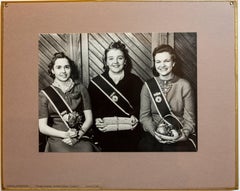
By Arthur Rothstein
Located in Surfside, FL
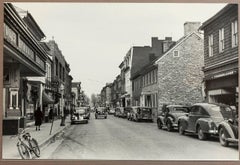
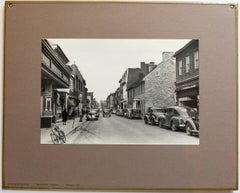
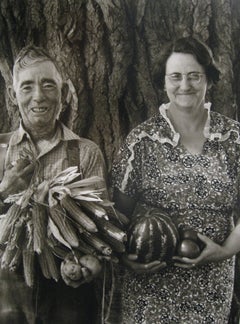
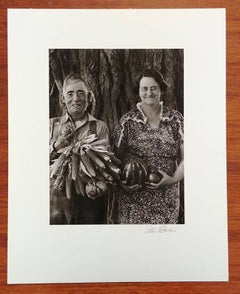
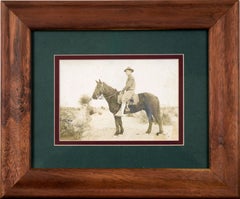
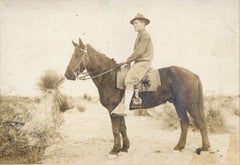
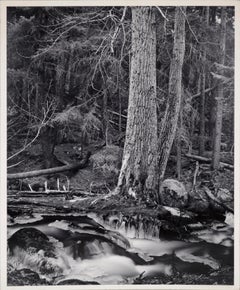
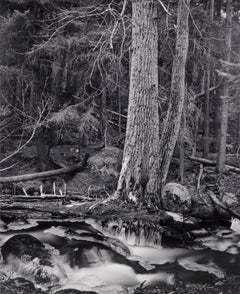
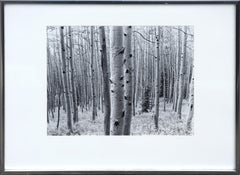
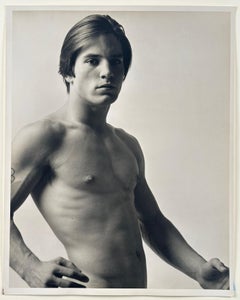
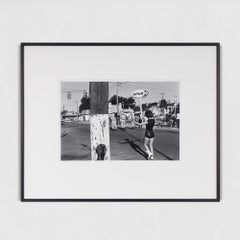
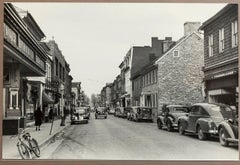
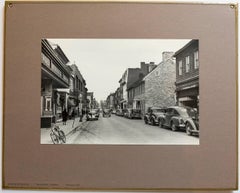
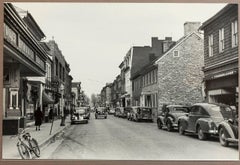
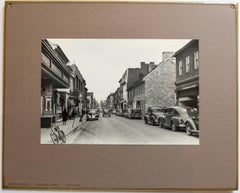
photo is 9X13.5 (image size), 16X20 is the mat. Mounted to original mat. Vintage photograph.
Main Street, Winchester, Virginia. February, 1940.
Arthur Rothstein ( 1915 – 1985) was an American photographer. Rothstein is recognized as one of America’s premier photojournalists. During a career that spanned five decades, he provoked, entertained and informed the American people. His photographs ranged from a hometown baseball game to the drama of war, from struggling rural farmers to US Presidents. Rothstein was born in Manhattan, New York City, and he grew up in the Bronx. He was a graduate of Columbia University, where he was a founder of the University Camera Club and photography editor of the Columbian. Following his graduation from Columbia during the Great Depression, Rothstein was invited to Washington DC by one of his professors at Columbia, Roy Stryker. Rothstein had been Stryker's student at Columbia University in the early 1930s.
Stryker hired Rothstein to set up the darkroom for Stryker's Photo Unit of the Historical Section of the Resettlement Administration (RA).
Perhaps Rothstein's most famous photo, and an icon of the Dust Bowl: a farmer and his two sons during a dust storm in Cimarron County, Oklahoma, 1936
Arthur Rothstein became the first photographer sent out by Roy Stryker, the head of the Photo Unit. During the next five years he shot some of the most significant photographs ever taken of rural and small-town America. He and other FSA WPA New Deal photographers, including Esther Bubley, Marjory Collins, Marion Post Wolcott, Walker Evans, Russell Lee, Gordon Parks, Jack Delano, John Vachon, Carl Mydans, Dorothea Lange and Ben Shahn, were employed to publicize the living conditions of the rural poor in the United States. The Resettlement Administration became the Farm Security Administration (FSA) in 1937. Later, when the country geared up for World War II, the FSA became part of the Office of War Information (OWI).
The photographs made during Rothstein's five-year stint with the Photo Unit form a catalog of the agency's initiatives. One of his first assignments was to document the lives of some Virginia farmers who were being evicted to make way for the Shenandoah National Park and about to be relocated by the Resettlement Administration, and subsequent trips took him to the Dust Bowl and to cattle ranches in Montana.
The residents of Gee's Bend symbolized two different things to the Resettlement Administration. On the one hand, reports about the community prepared by the agency describe the residents as isolated and primitive, people whose speech, habits, and material culture reflected an African origin and an older way of life.
Unlike the subjects of many Resettlement Administration and Farm Security Administration photographs, the people of Gee's Bend are not portrayed as victims. The photographs do not show the back-breaking work of cultivation and harvest, but only offer a glimpse of spring plowing. In 1940 Mr. Rothstein became a staff photographer for Look magazine but left shortly thereafter to join the OWI and then the US Army as a photographer in the Signal Corps. He remained at Look until 1971 when the magazine ceased publication. Mr. Rothstein joined Parade magazine in 1972 and remained there until his death.
He was the author of numerous magazine articles and a staff columnist for US Camera and Modern Photography magazines and the New York Times, Mr. Rothstein wrote and published nine books.
Mr. Rothstein’s photographs are in permanent collections throughout the world and have appeared in numerous exhibitions. A selection of this one-man shows include shows at the International Museum of Photography at George Eastman House, Rochester NY the Smithsonian Institution, Washington DC; Photokina, Cologne, Germany; Corcoran Gallery of Art, Washington, DC; Royal Photographic Society, London, England, as well as traveling exhibitions for the United States Information Service and for Parade magazine.
He was a member of the faculty of the Columbia University Graduate School of Journalism and a Spencer...
Category
1940s American Realist Arthur Rothstein