By Bella Feldman
Located in Surfside, FL
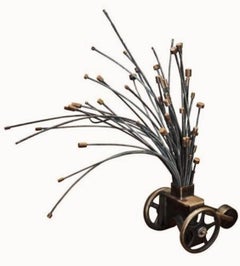
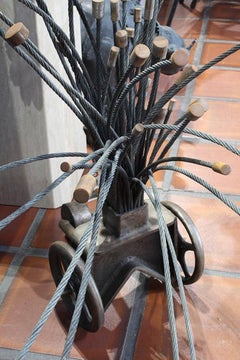
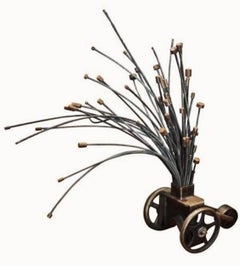
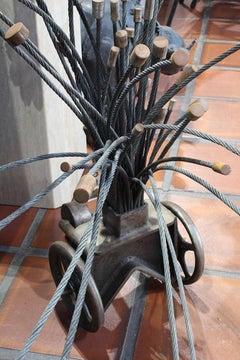
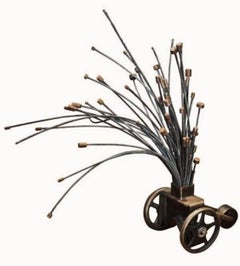
Bella Feldman (American, b. 1930), Untitled, metal 2-wheeled cart with metal cables, (Provenance: Allan Stone Gallery, New York, NY) gallery label affixed affixed verso, overall: 37"h x 48"l x 37"w. Provenance: Private Collection
Bella Feldman is an American sculptor whose work addresses the themes of sexuality, war, and the persistent anxiety of the industrial age. Feldman is known for pioneering the use of glass with steel. Her work has affinities with Surrealism, Post-Minimalism, and the Feminist art movement, although she has no formal affiliation with these. A Professor Emeritus at the California College of the Arts, Feldman lives and works in Oakland, CA and London, England.
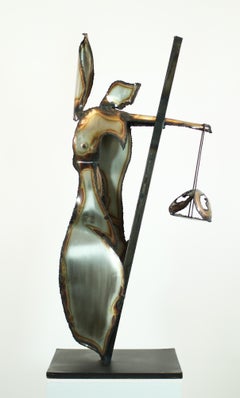
Bella Feldman was born in 1930 in New York City to a family of working-class Jewish immigrants from Poland. She grew up in the Bronx tenements. Feldman attended The High School of Music & Art in Manhattan during World War II. Students were required to visit museums and galleries as part of the curriculum. When Feldman was thirteen, she visited her first art museum, the Museum of Modern Art. There, she saw Meret Oppenheim’s Object (1936), the fur-lined cup and saucer, and was struck by her strong psychological response to this work. Other early influences included Alberto Giacometti’s The Palace at 4 a.m. (1932) and the sculpture of David Smith. One of Feldman’s earliest sculptures Warrior (1952) pays tribute to Giacometti.
During the Holocaust, Feldman lost numerous family members who remained in Poland, an experience that helped shape her worldview. This includes her life-long preoccupation with war, and the overwhelming effects of the military-industrial complex.
Feldman received a BA from Queens College, City University of New York. She married Leonard Feldman at age 18, and moved to California with him in 1951 where they both accepted teaching positions. Feldman has two children, Nina Feldman, born 1954 and Ethan Feldman, born 1956.
In 1965, Feldman started teaching at the California College of the Arts. In 1971 she and her family moved to Uganda, East Africa on a grant from the E. L. Cabot Trust Fund at Harvard University. Feldman spent two years teaching art in Uganda prior to the genocidal war in that country. Upon her return to CCA, she faced gender discrimination and a threat to her job. Her successful fight to retain her position prompted her to later become an advocate for other women faculty, who she helped to achieve equity and job security. Feldman was awarded an MA in 1973 from San Jose State University. Her teachers were Sam Richardson, John Battenberg and Fletcher Benton.
In the 1970s, Feldman completed several installations portraying different stages of animal metamorphosis. These featured hybrid, mutant creatures, reminiscent of Hieronymus Bosch’s triptych The Garden of Earthly Delights—rats transformed into fish, and turtles with human features. The small-scale sculptures were displayed in large clusters, their multitude invoking aggression and infestation. Birds (1970), a cast metal flock of dead birds, preceded Kiki Smith’s Jersey Crows (1995) while Metamorphic Turtles (1973-75) anticipated Smith’s Sirens and Harpies (2002).
War Toys and War Toys Redux
War Toys (1992) is a series created in response to the first Gulf War. Feldman was incensed by the tone of admiration she heard in President George Bush’s voice when he referred to the Patriot missile. These works mocked the allure of weaponry and perceived glory in violence. The War Toys series relates to Magdalena Abakanowicz War Games' sculptures (1989), giant monstrous weapons made of metal and wood. However, the scale and sensuality of Feldman’s War Toys strip them of power. The series is in the tradition of contemporary women artists’ critique of war that entwines images of male sexuality and military aggression. Examples include Nancy Spero The War Series (1966–70), a response to the Vietnam War, and Judith Bernstein’s Iraq Travel...
Category
20th Century Contemporary Bella Feldman