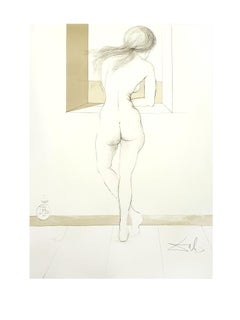
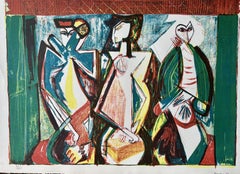
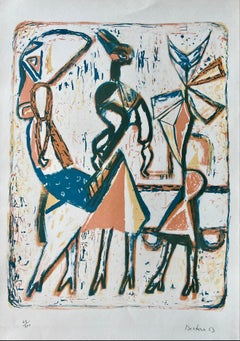
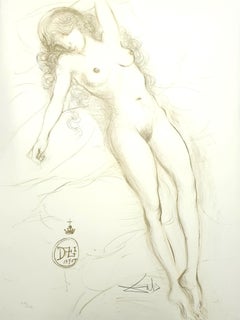
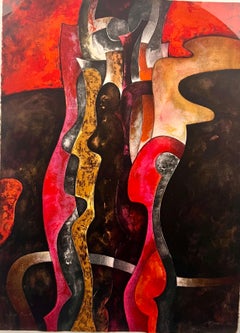
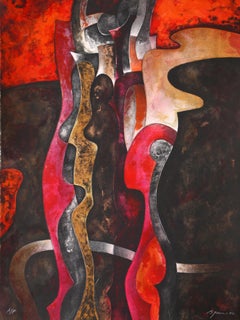
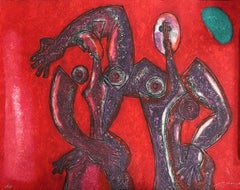
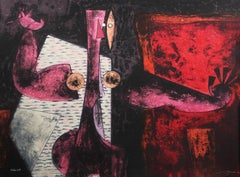
By Byron Gálvez
Located in Surfside, FL
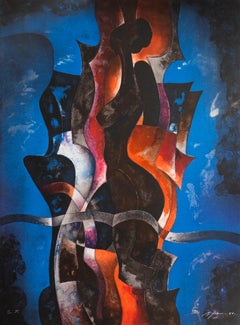
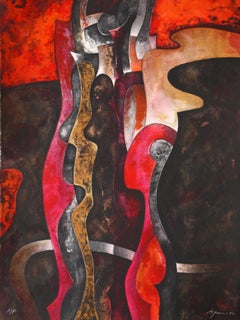
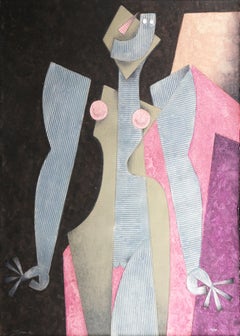
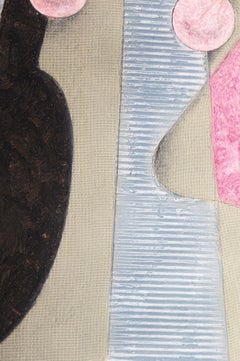
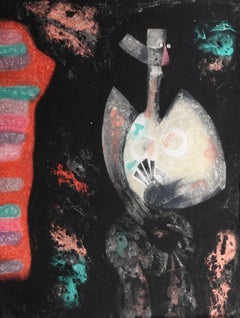
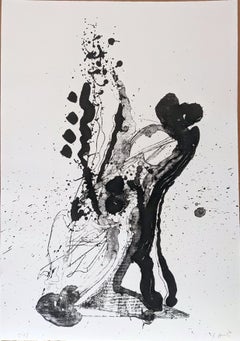
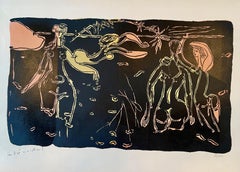
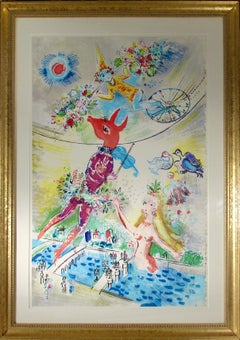
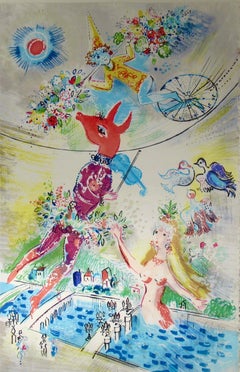
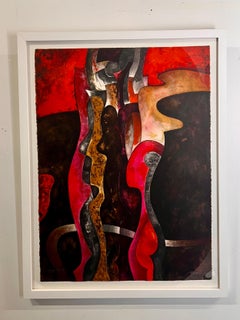
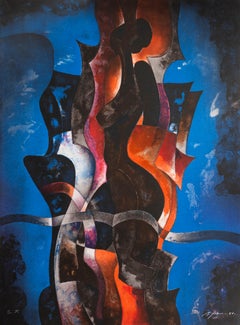
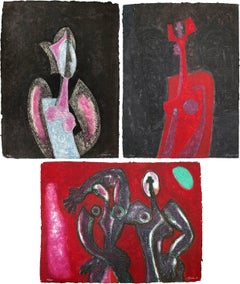
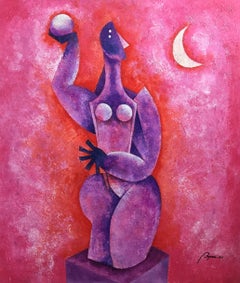
Gálvez is best known for his oils on canvas. During his career, he exhibited individually and collectively in over sixty venues in Mexico, various cities in the United States, Europe and Latin America. In 1964, he had his first individual exhibition at the ENAP Gallery, after showing in collective exhibitions at the Palacio de Bellas Artes and private galleries along with more prominent painters such as José Chávez Morado, Alfredo Zalce, José Clemente Orozco, Diego Rivera, Carlos Orozco Romero and David Alfaro Siqueiros. Before the opening of this exhibit, his work was severely criticized by art historian Justino Fernández. Despite this, the paintings for the exhibit were bought in advance, most by American actor Vincent Price, who called Gálvez a “Mexican Picasso.”The paintings were taken out of the country one week before the exhibit, but Gálvez was not concerned about not having paintings for the show, rather he was satisfied about his work being recognized and supported. He managed to create forty five more paintings in the remaining time in order to have the exhibit.
After this individual exhibit, Gálvez had over 55 more over he career, along with participated in other 75 collective exhibits.[4] Important exhibits include the Solar 68 collective exhibition at the Palacio de Bellas Artes (1968), the Sterenberg Galleries, Chicago (1972), Eye Corporation in various US cities (1973), Polyforum Cultural Siqueiros (1978), Museo de Arte Moderno in Mexico City (1982), Harcourts Contemporary Gallery in San Francisco (1983, 1990), Art-Forum Gallery in Mexico City (1984), Bishop Gallery in Phoenix (1989), Merryl Chase Gallery in Washington, DC (1991, 1992), Suhan Galleries in San Diego (1992), Misrachi Gallery (1994) and San Francisco Theater in Pachuca (1995) .[2][4] After his death, the Secretaría de Relaciones Exteriores sponsored an exhibition of his work in Tainan, Taiwan in 2011.[12]
His works can be found in major collections in both Mexico and the United States. The strongest demand has been for his figurative work especially that produced later in his life.
Gálvez also created murals and sculptures, both small and monumental. His first mural was sculpted done in 1968 in Los Angeles. However, most of his monumental work was produced later in his career as he concentrated on painting in the 1970s and 1980s. These include a mural at the National Conservatory of Music in Mexico City (1970), a thirty-foot high sculpture in Unidad Morelos in Mexico City (1971), a hand hammered copper triptych for a private residence in Mexico City (1984), a sculpted door for a private residence (1985), a sculpture for a private home in New York (1986), Reclined Torso at the Hotel Nikko Mexico (1998), Torso I a five-foot high sculpture for the city of Pachuca (1999), Torso II a nineteen foot high sculpture at the Altiva Building, Mexico City (1999), Millennium, a bronze sculpture/fountain at the highway entrance to Pachuca (2000), a sculpture garden for Mixquiahuala, Hidalgo (2005) and the master plan and central mosaic for the David Ben Gurion Cultural Park in Pachuca (2005) .[3][4][9] The park project, the last before his death, included not only the creation of the central mosaic, the largest pedestrian mural in the world at 345,000ft2, but also the design of the 65-acre park itself.
His other activities included the teaching of drawing at his alma mater, the creation of a program for the radio ministry of Mexico in 1973, participation in a documentary about lithography in Mexico in 1980 and the creation of several special programs for the office Radio...
Category
21st Century and Contemporary Contemporary Byron Gálvez Art