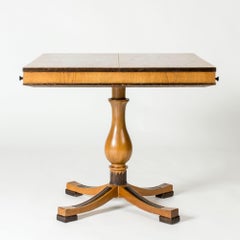
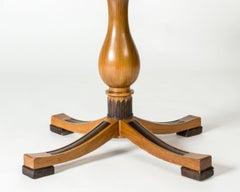
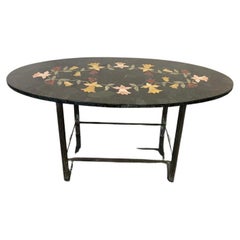
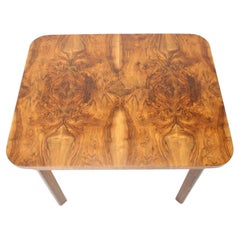
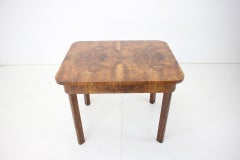
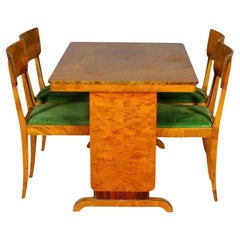
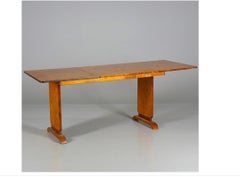
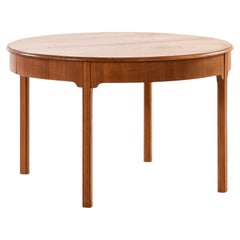
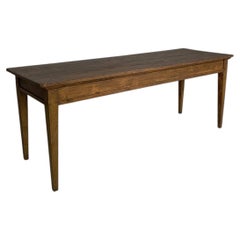
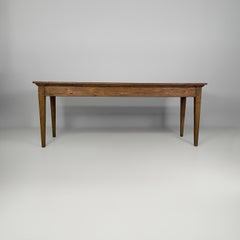
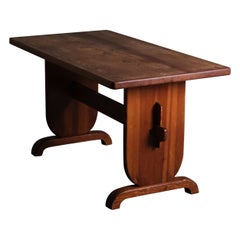
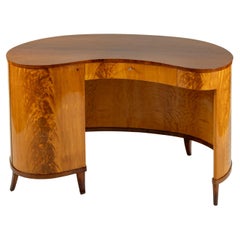
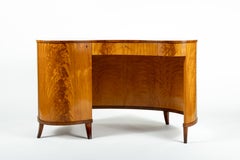
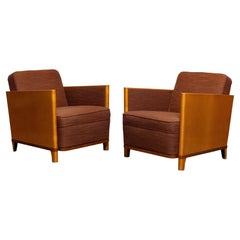
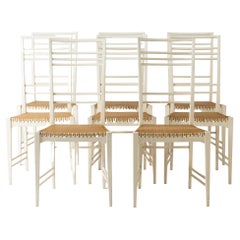
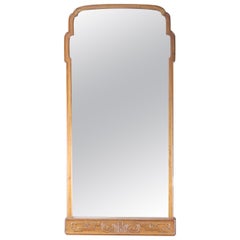
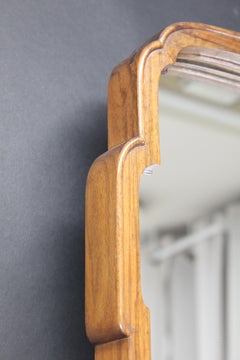
Unusual mirror by Erik Chambert for Chamberts Möbelfabrik in Norrköping.
Really good quality and perfect condition.
Erik Chambert (1902-1988) was one of the first interior designers to graduate from Högre Konstindustriella Skolan (now the University College of Arts, Crafts, and Design, Konstfack) in 1925. Before that, he had been awarded a silver medal for his apprentice piece in cabinet-making. He and his brother, the master cabinet-maker Otto, ran the family furniture-making business AB Chamberts Möbelfabrik in Norrköping, with Erik as the artistic director. The company had been founded in 1883 by their father, Axel Chambert.
As an interior designer, Erik Chambert’s first major assignment was for the Stockholm Exhibition in 1930, where he designed the functionalist interior for an apartment by the recently-appointed municipal architect of Norrköping, Kurt von Schmalensee. Gotthard Johansson expressed his opinion on Chambert’s participation in the daily paper Svenska Dagbladet: “where simplicity has not become indigent, nor functionalism dogmatic”. The senior curator for the Stockholm Exhibition, Gregor Paulsson, commented on the apartment in an appreciative letter to Erik Chambert: “As for my personal opinion, I would like to say unconditionally that I consider it to be the biggest success of the entire exhibition. It is in keeping with the spirit we wished to achieve.”
Erik Chambert designed practical, comfortable and timeless furniture in a functionalist style that gave a blond, sober impression. Helena Dahlbäck Lutteman has called the style “humane functionalism”. Study trips around Europe after his graduation acquainted Erik Chambert with the Bauhaus school and Art Concrete. He was influenced by contemporary trends but reformulated what he saw and experienced in his style. For the Stockholm Exhibition, he designed a folding recliner with light wood construction and red varnished armrests in steel. This was the only time he used this particular material that was fashionable during that period. Källemo AB in Värnamo began making replicas of the recliner and other classics by Erik Chambert in recent decades. One of these new recliners is currently standing in the library of Arkitektur- och designcentrum (earlier Arkitekturmuseet) in Stockholm. Erik Chambert believed that a piece of furniture should be functional and blend with the surroundings. A work desk with a reversible pine top, one side for work and the other for more festive occasions, with a shelf construction of wood slats underneath for paper and drawings, was shown at an exhibition in Zurich in 1949. Usually, his designs were only produced in one or very few copies. The chair “Poem” from 1953 is a rare exception.
The year before he died, Erik Chambert said, “Exhibitions have been my life.” As a furniture designer, he participated in numerous prestigious international exhibitions together with AB Chamberts Möbelfabrik: Chicago in 1933, the world fairs in Brussels and Paris in 1935 and 1937 respectively, the international crafts exhibition in Berlin in 1938 and the world exhibition in New York in 1939.
Erik Chambert gave vent to his visual creativity when he designed furniture. This is evident, for instance, in the rich marquetry he made to order or for exhibitions. He took a delight in creating entire pictures, not just patterns, in marquetry, depicting figures or cityscapes in different woods. He often combined these with shimmering mother of pearl and metals. In 1945, he designed the cabinet “The Scales of Life”, now in the Nationalmuseum collection. The marquetry inlayer was Manne Manning. The cabinet was based on an eponymously titled gouache from 1943.
As an interior designer, Erik Chambert was frequently commissioned for public spaces and private homes. Most assignments were from institutions and private companies in and around Norrköping, but his clients also included Haga Palace and the Tessin Palace, through the National Board of Public Buildings. In addition to suggesting furniture and textiles, he was involved in deciding the color schemes for walls, designing fabrics, sometimes for specific purposes, composing tapestries and a few larger curtains with appliqué work. In the book “Svenska Textilier 1890-1990” (Swedish Textiles 1890-1990), Anne-Marie Ericsson writes, “An interesting example is the furniture designer Erik Chambert, who allowed both his disciplines, as an artist and a designer, to merge in his rhythmically distinct patterns for textile prints.” Erik Chambert collaborated with Jobs Handtryck and Tabergs Yllefabrik, among others. A textile with stylized Norrköping scenes for the foyer walls of the municipal theatre in Norrköping and also the textile ”Skyttlarna” was recently revived and put into production by Stadsmuseet in Norrköping. The museum also has the Chambert company’s archives in its collection.
In the 1920s and 1930s, Erik Chambert made many exquisite watercolored sketches of furniture set in their imagined context in the furnishing of a room. As studies for cabinet embellishments, wall paintings, and wallpaper he painted grass and flowers. Towards the end of the 1930s, the gouaches developed and began to feature figurative elements and organic non-figurative billowing forms. In 1943, Erik Chambert made his debut at the Liljevalchs autumn exhibition. He was subsequently represented in several exhibitions at Liljevalchs. In the 1950s, Erik Chambert painted abstracts which he initially called Compositions, followed by a number of capital letters. Bo Sylvan writes that Erik Chambert’s paintings tended towards “geometrically pruned shapes and a fastidious palette”. Up until 1959, Erik Chambert painted in gouache, but in 1960 he went over to oils.
In the mid-1960s, Erik Chambert abandoned his flat compositions and began creating reliefs in white, black or red paper or silver paper and gold foil, in a striving to achieve tension with a spatial effect. The viewer was encouraged to move in front of the work to perceive how light and shade enhanced the impression. The reliefs were built into boxes of Plexiglas, which were part of the work of art. “Lady with Dog” is an early example of this technique. The work was produced in 100 identical copies. It was included in the art society Konstfrämjandet’s exhibition “Multikonst” (Multi-Art) which was shown at 100 venues throughout Sweden simultaneously in 1967.
Erik Chambert has been regarded as a Concretist but, as Staffan Carlén points out in the foreword to the catalog to the solo exhibition at Millesgården in 1990, “Erik Chambert did not want to label his works as Concrete, and it would therefore perhaps be more Apt to speak of geometric abstraction.” His works were nearly always based on an experience or impression, such as thoughts on life, as in “The Scales of Life”, the triptych “Life Cycle” from 1963, now in Norrköpings konstmuseum, or series I-X from “A Life” or other pictures from the same, often made in connection with annual summer trips to European destinations, for instance “Les Halles” (1965), “Pointe du Raz” (1967) or “Gibraltar” (1980).
In the late 1960s, throughout the 1970s and in the early 1980s, Erik Chambert pursued his exploration of light and refraction, using only Plexiglas sheets and rods, occasionally with additions of paint to enhance the motif. In his speech at the opening of the exhibition at Millesgården, Bo Sylvan called the crystal-clear Plexiglas relief sculptures from the early 1980s “light organs”. All the Plexiglas works with their accompanying boxes were sawn, honed and joined by hand with aesthetic ingenuity. As a young cabinetmaker’s apprentice, he had learned to handle wood with great skill. Likewise, the mature artist used his inventiveness and craftsmanship to find technical solutions when working with Plexiglas. All the boxes are square, the largest measuring 1×1 meter. Erik Chambert enjoyed the Challenge of achieving expansive tensions in a square.
Otto G. Carlsund and Gösta Adrian Nilsson...
Category
1930s Swedish Scandinavian Modern Vintage Chamberts Möbelfabrik Furniture