Charles-Dominique-Joseph Eisen Art
Charles-Dominique-Joseph Eisen was a French painter and engraver. He was the son and the pupil of Frans Eisen, born at Valenciennes. In 1741, he went to Paris, and in the following year entered the studio of Le Bas. He became painter and draftsman to the King, and drawing-master to Madame de Pompadour. In 1777, he retired to Brussels, where he died in poverty in 1778.
to
1
1
1
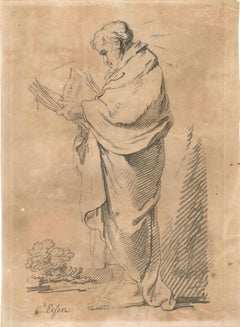
The Patriarch - Original Lithograph on Paper - Late 18th Century
By Charles-Dominique-Joseph Eisen
Located in Roma, IT
The Patriarch is an original artwork realized by Charles Eisen in the second half of the XVIII Century. Original lithograph on paper.
Signed on plate o...
Category
Late 18th Century Modern Charles-Dominique-Joseph Eisen Art
Materials
Lithograph
Related Items
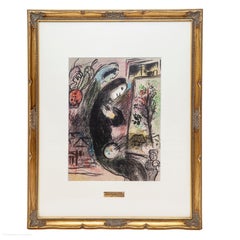
Flying Head
By Mihail Chemiakin
Located in San Francisco, CA
This artwork titled "Flying Head" c.1990, is an original colors lithograph by renown Russian artist Mihail Chemiakin, b.1943. It is hand signed and numbered 173/260 in pencil by the ...
Category
Late 20th Century Modern Charles-Dominique-Joseph Eisen Art
Materials
Lithograph
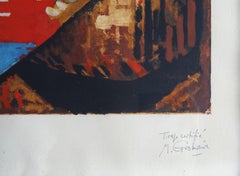
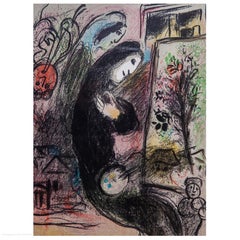
Original Marc Chagall Lithograph Exhibition Poster
By Marc Chagall
Located in Pasadena, CA
Marc Chagall (1887-1985) was a Belarusian-French artist. An early modernist, he was associated with several major artistic styles and created works in a wide range of artistic format...
Category
Early 20th Century Modern Charles-Dominique-Joseph Eisen Art
Materials
Lithograph
$450 Sale Price
62% Off
H 26.75 in W 20.5 in D 0.88 in
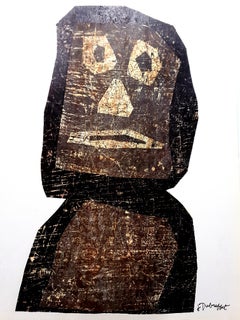
Mascara Roja
By Rufino Tamayo
Located in San Francisco, CA
This artwork titled "Mascara Roja" 1969 is an original colors lithograph on B.F.K. Rives paper by renown Mexican artist Rufino Tamayo, 1899-1991. It is hand signed and inscribed H.C. (Hors Commerce) in pencil by the artist. The image size is 21 x 27.25 inches, framed size is 37.25 x 42 inches. Published by Touchtone Publisher, New York, printed by Ateliers Desjobert, Paris. Referenced and pictured in the artist's catalogue raisonne by Pereda, plate #124. Custom framed in a wooden gold leaf frame, with gold and red spacer and fabric matting. It is in excellent condition.
About the artist:
A native of Oaxaca in Southern Mexico, Rufino Tamayo's father was a shoemaker, and his mother a seamstress. Some accounts state that he was descended from Zapotec Indians, but he was actually 'mestizo' - of mixed indigenous/European ancestry. (Santa Barbara Museum of Art). He began painting at age 11. Orphaned at the age of 12, Tamayo moved to Mexico City, where he was raised by his maternal aunt who owned a wholesale fruit business.
In 1917, he entered the San Carlos Academy of Fine Arts, but left soon after to pursue independent study. Four years later, Tamayo was appointed the head designer of the department of ethnographic drawings at the National Museum of Archaeology in Mexico City. There he was surrounded by pre-Colombian objects, an aesthetic inspiration that would play a pivotal role in his life. In his own work, Tamayo integrated the forms and tones of pre-Columbian ceramics into his early still lives and portraits of Mexican men and women.
In the early 1920s he also taught art classes in Mexico City's public schools. Despite his involvement in Mexican history, he did not subscribe to the idea of art as nationalistic propaganda. Modern Mexican art at that time was dominated by 'The Three Great Ones' : Diego Rivera, Jose Clemente Orozco, and David Alfaro Siqueros, but Tamayo began to be noted as someone 'new' and different' for his blending of the aesthetics of post Revolutionary Mexico with the vanguard artists of Europe and the United States.
After the Mexican Revolution, he focused on creating his own identity in his work, expressing what he thought was the traditional Mexico, and refusing to follow the political trends of his contemporary artists. This caused some to see him as a 'traitor' to the political cause, and he felt it difficult to freely express himself in his art. As a result, he decided to leave Mexico in 1926 and move to New York, along with his friend, the composer Carlos Chavez. The first exhibition of Tamayo's work in the United States was held at the Weyhe Gallery, New York, in that same year. The show was successful, and Tamayo was praised for his 'authentic' status as a Mexican of 'indigenous heritage', and for his internationally appealing Modernist aesthetic. (Santa Barbara Museum of Art).
Throughout the late thirties and early forties New York's Valentine Gallery gave him shows. For nine years, beginning in 1938, he taught at the Dalton School in New York.
In 1929, some health problems led him to return to Mexico for treatment. While there he took a series of teaching jobs. During this period he became romantically involved with the artist Maria Izquierdo...
Category
Mid-20th Century Modern Charles-Dominique-Joseph Eisen Art
Materials
Lithograph
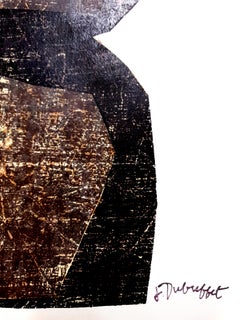
Acrobats
By Mihail Chemiakin
Located in San Francisco, CA
This artwork titled "Acrobats" c.1990, is an original colors lithograph by renown Russian artist Mihail Chemiakin, b.1943. It is hand signed and numbered 283/300 in pencil by the art...
Category
Late 20th Century Modern Charles-Dominique-Joseph Eisen Art
Materials
Lithograph
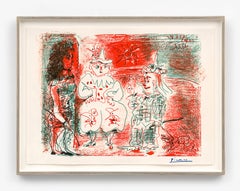
Pablo Picasso, The Rehearsal, original lithograph, hand signed
By Pablo Picasso
Located in Chatsworth, CA
Pablo Picasso
The Rehearsal, (La Répétition)
Original Lithograph, (litho crayon composition on transfer paper, transferred to stone)
Hand signed in ink in lower left corner
Numbered ...
Category
1950s Modern Charles-Dominique-Joseph Eisen Art
Materials
Lithograph
$45,000
H 19.75 in W 25.75 in
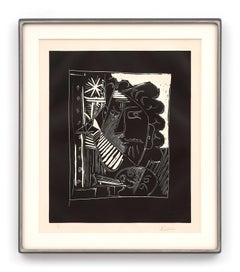
Les Petit Rats, Ballerinas VI
By Graciela Rodo Boulanger
Located in San Francisco, CA
This artwork titled "Les Petit Rats, Ballerinas VI" c.1980 is an original color lithograph on Japan paper by noted Bolivian artist Graciela Rodo Boulanger, b.1935. It is hand signed and numbered XLII/C in pencil by the artist. The image size is 22.75 x 18 inches, sheet size is 30 x 22.15 inches.
About the artist:
Born in La Paz, Bolivia in 1935, Graciela Rodo Boulanger was raised in an artistic environment. Her mother, a concert pianist, and her father, a businessman and art connoisseur, nurtured her talents. She studied the piano and at age 11 enrolled in the School of Fine Arts. At 17 she went to Vienna to study both art and music, and at 22 shetravelled to Argentina for the stimulating artistic environment of Buenos Aires. Continuing to study both piano and painting...
Category
Late 20th Century Modern Charles-Dominique-Joseph Eisen Art
Materials
Lithograph
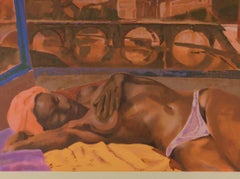
La Negra (The Black Woman)
By Rufino Tamayo
Located in San Francisco, CA
This artwork titled "La Negra (The Black Woman)" from the suite "The Mujeres File" 1969 is an original colors lithograph on B.F.K. Rives paper by renown Mexican artist Rufino Tamayo, 1899-1991. It is hand signed and numbered 150/150 in pencil by the artist. The image size is 26.85 x 21.25 inches, sheet size is 29.5 x 22.15 inches, framed size is 42 x 35 inches. Published by Touchtone Publisher, New York, printed by Ateliers Desjobert, Paris. Referenced and pictured in the artist's catalogue raisonne by Pereda, plate #109 page 107. Custom framed in a wooden silver frame, with silver spacer and fabric matting. It is in excellent condition.
About the artist:
A native of Oaxaca in Southern Mexico, Rufino Tamayo's father was a shoemaker, and his mother a seamstress. Some accounts state that he was descended from Zapotec Indians, but he was actually 'mestizo' - of mixed indigenous/European ancestry. (Santa Barbara Museum of Art). He began painting at age 11. Orphaned at the age of 12, Tamayo moved to Mexico City, where he was raised by his maternal aunt who owned a wholesale fruit business.
In 1917, he entered the San Carlos Academy of Fine Arts, but left soon after to pursue independent study. Four years later, Tamayo was appointed the head designer of the department of ethnographic drawings at the National Museum of Archaeology in Mexico City. There he was surrounded by pre-Colombian objects, an aesthetic inspiration that would play a pivotal role in his life. In his own work, Tamayo integrated the forms and tones of pre-Columbian ceramics into his early still lives and portraits of Mexican men and women.
In the early 1920s he also taught art classes in Mexico City's public schools. Despite his involvement in Mexican history, he did not subscribe to the idea of art as nationalistic propaganda. Modern Mexican art at that time was dominated by 'The Three Great Ones' : Diego Rivera, Jose Clemente Orozco, and David Alfaro Siqueros, but Tamayo began to be noted as someone 'new' and different' for his blending of the aesthetics of post Revolutionary Mexico with the vanguard artists of Europe and the United States.
After the Mexican Revolution, he focused on creating his own identity in his work, expressing what he thought was the traditional Mexico, and refusing to follow the political trends of his contemporary artists. This caused some to see him as a 'traitor' to the political cause, and he felt it difficult to freely express himself in his art. As a result, he decided to leave Mexico in 1926 and move to New York, along with his friend, the composer Carlos Chavez. The first exhibition of Tamayo's work in the United States was held at the Weyhe Gallery, New York, in that same year. The show was successful, and Tamayo was praised for his 'authentic' status as a Mexican of 'indigenous heritage', and for his internationally appealing Modernist aesthetic. (Santa Barbara Museum of Art).
Throughout the late thirties and early forties New York's Valentine Gallery gave him shows. For nine years, beginning in 1938, he taught at the Dalton School in New York.
In 1929, some health problems led him to return to Mexico for treatment. While there he took a series of teaching jobs. During this period he became romantically involved with the artist Maria Izquierdo...
Category
Mid-20th Century Modern Charles-Dominique-Joseph Eisen Art
Materials
Lithograph
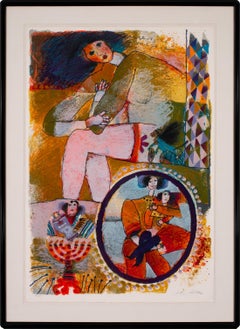
Cabeza con Pajaros
By Rufino Tamayo
Located in San Francisco, CA
This artwork titled "Cabeza con Pajaros" 1958, is an original colors lithograph on Wove paper by renown Mexican artist Rufino Tamayo, 1899-1991. It is hand signed and numbered 273/30...
Category
Mid-20th Century Modern Charles-Dominique-Joseph Eisen Art
Materials
Lithograph
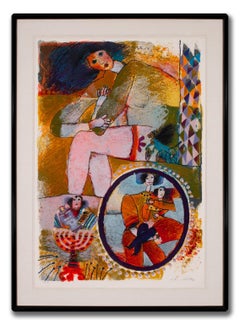
Demoiselle Blasonee, from the suite Pleni Luna.
By Wifredo Lam
Located in San Francisco, CA
This artwork titled "Demoiselle Blasonee from the suite, Pleni Luna" 1974, is an original color lithograph on watermarked Arches paper by Cuban artist Wilfredo Lam, 1902-1982. It is...
Category
1970s Modern Charles-Dominique-Joseph Eisen Art
Materials
Lithograph
$1,650
H 25.35 in W 19.5 in D 0.01 in
Moses Sees the Sufferings of his People, from the suite, The Story of Exodus
By Marc Chagall
Located in San Francisco, CA
This artwork Titled "Moses Sees the Sufferings of his People" 1966 from the suite " The Story of Exodus" is an original lithograph on Arches paper ...
Category
Mid-20th Century Modern Charles-Dominique-Joseph Eisen Art
Materials
Lithograph
$2,500
H 31.5 in W 25.75 in D 2 in
Barbados Children.
By Emilio Sanchez
Located in New York, NY
Emilio Sanchez (1921-1999) created this color lithograph entitled “Barbados Children” in 1996. This signed impression came to us directly from the Sanchez estate. Estate stamped on v...
Category
Late 20th Century American Modern Charles-Dominique-Joseph Eisen Art
Materials
Lithograph
Carnaval De Saint Petersbourg
By Mihail Chemiakin
Located in San Francisco, CA
Artist: Mihail Chemiakin (Russia/France/US, born 1943)
Title: Carnaval De Saint Petersbourg
Medium: Color lithograph
Edition: Numbered 243/275 i...
Category
Late 20th Century Modern Charles-Dominique-Joseph Eisen Art
Materials
Lithograph
Previously Available Items
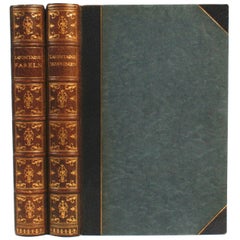
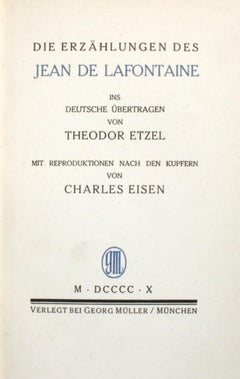
Die Fabeln des Jean de La Fontaine and Die Erzählungen des Jean de La Fontaine
By Charles-Dominique-Joseph Eisen, Jean-Baptiste Oudry, Jean de La Fontaine
Located in valatie, NY
1.) Die Fabeln des Jean de La Fontaine (The Fables of Jean de La Fontaine) Munich: Georg Müller, 1800. German text. 166 pp. Antique calf leather and cloth bound books with gilt top edge of the Fables of Jean de La Fontaine translated from French to German with reproductions of the original copper plate illustrations by the famous French Rococo painter and engraver Jean Baptist Oudry. 2.) Die Erzählungen des Jean de La Fontaine (The Stories of Jean de La Fontaine.) Munich: Georg Müller, 1800. Limited edition leather bound hardcover. German text. 229 pp. Limited run number 523. An antique leather bound...
Category
Early 19th Century German Antique Charles-Dominique-Joseph Eisen Art
Materials
Paper
H 8.75 in W 5.75 in D 2.5 in
Charles-dominique-joseph Eisen art for sale on 1stDibs.
Find a wide variety of authentic Charles-Dominique-Joseph Eisen art available for sale on 1stDibs. You can also browse by medium to find art by Charles-Dominique-Joseph Eisen in lithograph and more. Much of the original work by this artist or collective was created during the 18th century and is mostly associated with the modern style. Not every interior allows for large Charles-Dominique-Joseph Eisen art, so small editions measuring 11 inches across are available. Customers who are interested in this artist might also find the work of Louis Legrand, Romeyn de Hooghe, and Pierre Quentin Chedel. Charles-Dominique-Joseph Eisen art prices can differ depending upon medium, time period and other attributes. On 1stDibs, the price for these items starts at $279 and tops out at $279, while the average work can sell for $279.