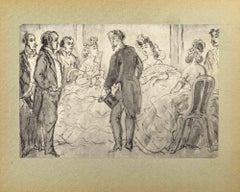
Ernest Adolphe Hyacinthe Constantin Prints and Multiples

French, 1802-1892

Constantin Guys, Ernest-Adolphe-Hyacinthe-Constantin, was a Dutch-born French Crimean War correspondent, a talented watercolor painter and an illustrator for British and French newspapers. His father had been appointed civilian chief of the French Navy in Rochefort in 1795 and was stationed in Vlissingen from 1800–06, after which the family moved to Calais. At the age of 20, Guys served in the cavalry, but only a little later toured in Greece with Lord Byron. His career as an artist didn't start until he was about 40 years old. Baudelaire called him the painter of modern life and wrote a long essay on Guys in which he extensively praised his works, under the pseudonym, Monsieur G. Robert de Montesquiou wrote a review of Guys that acknowledged Baudelaire's essay, compared Guys favorably to Whistler, and emphasized his portrayal of details of women's clothing, and horse carriages. His subjects were Second French Empire life. In the Dutch novel Au pair by W. F. Hermans, one of the main characters is fascinated by Constantin Guys. Guys died in Paris, aged 90.

to
1
4
Overall Width
to
Overall Height
to
1
5
1,258
968
910
867
1
3
2
2
4
4
4
2
1
1
2
1
1
1
4
Artist: Ernest Adolphe Hyacinthe Constantin
The Feast - Lithograph after Constantin Guys - Early 20th Century

The Feast - Lithograph after Constantin Guys - Early 20th Century

By Constantin Guys

Located in Roma, IT

The Feast is a photolithograph print on ivory-colored paper, glued on a greenish Passepartout realized in the early 20th century After Constantin Guys  Good conditions. The artwork...

Category

Early 20th Century Modern Ernest Adolphe Hyacinthe Constantin Prints and Multiples

Materials

Lithograph
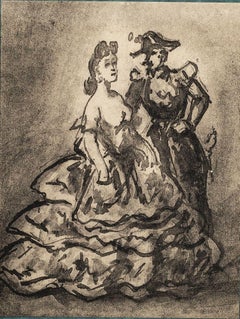
Le Militaire et l'élègante - Heliogravure After C. Guys - Early 20th Century

Le Militaire et l'élègante - Heliogravure After C. Guys - Early 20th Century

By Constantin Guys

Located in Roma, IT

Le Militaire et l'élègante is a beautiful original print on paper, realized by the French artist, Constantin Guys (1802 -1892). In very good condition, including a petrol-green colo...

Category

Early 20th Century Symbolist Ernest Adolphe Hyacinthe Constantin Prints and Multiples

Materials

Engraving

Meeting - Original Photogravure by Constantine Guys - 1850s

Meeting - Original Photogravure by Constantine Guys - 1850s

By Constantin Guys

Located in Roma, IT

Meeting is a wonderful original print on brownish paper, realized by the French artist, Constantin Guys (1802 -1892). In very good condition, including a pet...

Category

1850s Symbolist Ernest Adolphe Hyacinthe Constantin Prints and Multiples

Materials

Photogravure

La Danseuse - Heliogravure After C. Guys - Early 20th Century

La Danseuse - Heliogravure After C. Guys - Early 20th Century

By Constantin Guys

Located in Roma, IT

La Danseuse is an heliogravure on paper, realized by the French artist, Guys Constantin (1802 -1892). In very good condition, including petrol-green colored cardboard passepartout, ...

Category

Early 20th Century Symbolist Ernest Adolphe Hyacinthe Constantin Prints and Multiples

Materials

Engraving

Related Items
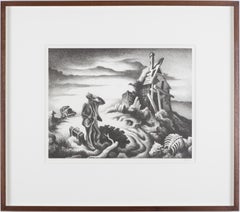
Adolf Dehn, Commodore Peak, 1940-42, mid-century lithograph of Colorado mountain

Adolf Dehn, Commodore Peak, 1940-42, mid-century lithograph of Colorado mountain

By Adolf Dehn

Located in New York, NY

Adolf Dehn (1895-1968) was an American painter, printmaker and draftsman. A native of Waterville, Minnesota, he attended the Minneapolis School of Art where he met colleague Wanda Ga...

Category

1940s American Modern Ernest Adolphe Hyacinthe Constantin Prints and Multiples

Materials

Lithograph
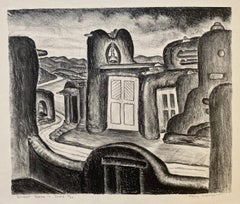
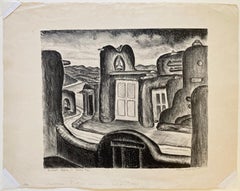
Mary Lightfoot, Street Scene in Taos

Mary Lightfoot, Street Scene in Taos

Located in New York, NY

Mary Lightfoot was born in Ravenna, Texas. She studied at the College of Industrial Arts in Denton and the North Texas State Teachers College prior to receiving a master of arts degree from Columbia University. Her entire teaching career was with the Dallas Public School system; she summered in Europe...

Category

Mid-20th Century American Modern Ernest Adolphe Hyacinthe Constantin Prints and Multiples

Materials

Lithograph
Le Fondeur Paris  [Steel Worker]

Le Fondeur Paris [Steel Worker]

By Eugène Carrière

Located in New York, NY

Carriere, Eugene. Le Fondeur, Paris 1900 [Steel Worker], Color lithograph. Ref: Das Fruhe Plakat 134. 51 x 34 3/4 inches. Eugène Anatole Ca...

Category

Early 1900s Symbolist Ernest Adolphe Hyacinthe Constantin Prints and Multiples

Materials

Lithograph
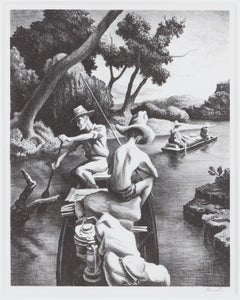
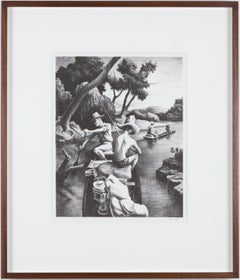
Adolf Dehn, Lake Tarryall, 1941 mid-century lithograph of Colorado mountain lake

Adolf Dehn, Lake Tarryall, 1941 mid-century lithograph of Colorado mountain lake

By Adolf Dehn

Located in New York, NY

Lake Tarryall, a 1941 lithograph by Adolf Dehn (1895-1968) was made while he was teaching in Colorado. A native of Waterville, Minnesota, Dehn attended the Minneapolis School of Art ...

Category

1940s American Modern Ernest Adolphe Hyacinthe Constantin Prints and Multiples

Materials

Lithograph
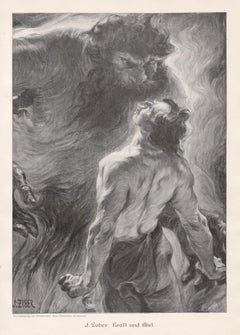
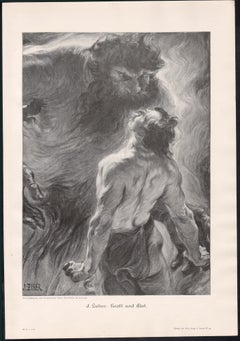
Kraft und Mut (Courage and Strength), German antique engraving

Kraft und Mut (Courage and Strength), German antique engraving

Located in Melbourne, Victoria

'Kraft und Mut' (Courage and Strength) German wood-engraving, 1903. 320mm by 230mm (image) 280mm by 410mm (sheet)

Category

Early 20th Century Symbolist Ernest Adolphe Hyacinthe Constantin Prints and Multiples

Materials

Engraving

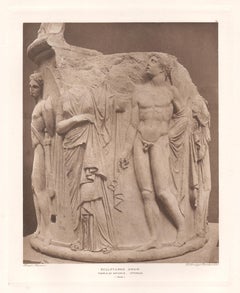
The Portland Vase, British Museum Roman antiquity photogravure

The Portland Vase, British Museum Roman antiquity photogravure

Located in Melbourne, Victoria

'The Portland Vase' Photogravure after Donald Macbeth (1865-1943). Donald Macbeth was a commercial photographer who seems to have held a quasi-official position at the British Muse...

Category

1910s Other Art Style Ernest Adolphe Hyacinthe Constantin Prints and Multiples

Materials

Photogravure

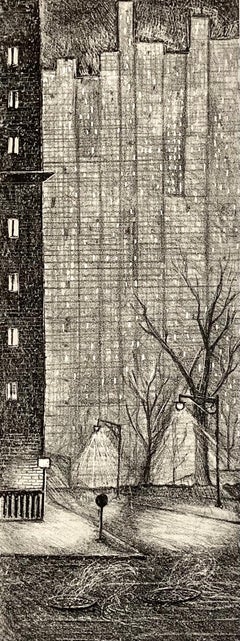
Jack McClain, (Evening in the City) (NYC)

Jack McClain, (Evening in the City) (NYC)

Located in New York, NY

A moody evening in New York City. The buildings capture the quiet that New York sometimes achieves. Signed and dated in pencil.

Category

Mid-20th Century American Modern Ernest Adolphe Hyacinthe Constantin Prints and Multiples

Materials

Lithograph
Nude - XXI century, Figurative print, Black and white

Nude - XXI century, Figurative print, Black and white

By Anna Mikke

Located in Warsaw, PL

Limited edition, 8/20. ANNA MIKKE (born in 1950) She graduated from the Academy of Fine Arts in Łódź in 1975. After graduation, she was engaged in graphic design, including designing...

Category

2010s Other Art Style Ernest Adolphe Hyacinthe Constantin Prints and Multiples

Materials

Paper, Photogravure

Illustrations From The Book of Job - "The Fire of God is Fallen From Heaven"

Illustrations From The Book of Job - "The Fire of God is Fallen From Heaven"

By William Blake

Located in Soquel, CA

"Illustrations of the Book of Job" Engraving "The Fire of God is Fallen From Heaven...And the Lord said unto Satan Behold All that he hath is in thy Power" Engraving, third printing...

Category

1870s Symbolist Ernest Adolphe Hyacinthe Constantin Prints and Multiples

Materials

Handmade Paper, Engraving

"Chestnut Tree" Copper Plate Heliogravure

"Chestnut Tree" Copper Plate Heliogravure

By Ferdinand Hodler & R. Piper & Co.

Located in Palm Beach, FL

2018 marks the centenary anniversary of Ferdinand Hodler’s death. In that 100 years time, the art world’s esteem of this important artist has proved fickle. It has shifted from extolling his artistic merits during his lifetime to showing something of a feigned disdain- more reflective of the world political order than a true change of heart for Hodler’s work. After years of Hodler being all but a footnote in the annals of art history and generally ignored, finally, the pendulum has righted itself once again. Recent retrospective exhibitions in Europe and the United States have indicated not only a joyful rediscovery of Hodler’s art but a firm conviction that his work and world view hold particular relevance today. DAS WERK FERDINAND HODLERS is not only a collection of printed work reflecting the best of all of his painted work created up to 1914 just before the outbreak of World War I, the portfolio itself is an encapsulation of Hodler’s ethos, Parallelisme. Hodler developed his philosophy of Parallelisme as a unifying approach to art which strips away detail in search of harmony. By means of abstraction, symmetry and repetition, Hodler sought ways to depict Nature’s essence and her fundamental, universal order. He believed these universal laws governing the natural, observable world extend to the spiritual realm. Symbolist in nature with Romantic undertones, his works are equally portraits of these universal concepts and feelings governing all life as they are a visual portrait in the formal sense. Whether his subject is a solitary tree, a moment in battle, mortal fear, despair, the awe inspired by a vast mountain range, a tender moment or even the collective conviction in a belief, Hodler unveils this guiding principle of Parallelisme. Several aspects of Hodler’s portfolio reinforce his tenets of Parallelisme. The Table of Contents clearly preferences a harmonious design over detail. The two columns, consisting of twenty lines each, list the images by order of appearance using their German titles. The abbreviated titles are somewhat cryptic in that they obscure the identities of the sitters. Like the image Hodler presents, they are distillations of the sitter without any extraneous details. This shortening was also done in an effort to maintain a harmonious symmetry of the Table of Contents, themselves, and keep titles to a one-line limit. The twenty-fourth title: “Bildnis des Schweizerischen Gesandten C.” was so long, even with abbreviation, that it required two lines; so, for the sake of maintaining symmetry, the fortieth title: “Bauernmadchen” was omitted from the list. This explains why the images are not numbered. Hodler’s reasoning is not purely esoteric. Symmetry and pattern reach beyond mere formal design principles. Finding sameness and imposing it over disorder goes to the root of Hodler’s identity and his art. A Swiss native, Hodler was bi-lingual and spoke German and French. Each printed image, even number forty, have titles in both of Hodler’s languages. Certainly, there was a market for Hodler’s work among francophones and this inclusion may have been a polite gesture to that end; however, this is the only place in the portfolio which includes French. With German titles at the lower left of each image, Hodler’s name at bottom center and corresponding French titles at the lower right of each image, there is a harmony and symmetry woven into all aspects of the portfolio. This holds true for the page design, as it applies to each printed image and as it describes the Swiss artist himself. Seen in this light, Hodler’s portfolio of printed work is the epitome of Hodler’s Parallelisme. DAS WERK FERDINAND HODLERS is also one of the most significant documents to best tell the story of how Hodler, from Switzerland, became caught between political cross-hairs and how the changing tides of nations directly impacted the artist during his lifetime as well as the accessibility of his art for generations to come. The Munich-based publisher of the portfolio, R. Piper & Co., Verlag, plays a crucial role in this story. Publishing on a wide range of subjects from philosophy and world religion to music, literature and the visual arts; the publisher’s breadth of inquiry within any one genre was equal in scope. Their marketing strategy to publish multiple works on Hodler offers great insight as to what a hot commodity Hodler was at that time. R.Piper & Co.’s Almanach, which they published in 1914 in commemoration of their first ten years in business, clearly illustrates the rapid succession- strategically calculated for achieving the deepest and broadest impact - in which they released three works on Hodler to hit the market by the close of 1914. DAS WERK FERDINAND HODLERS was their premier publication. It preceded C.A. Loosli’s Die Zeichnungen Ferdinand Hodlers, a print portfolio after 50 drawings by Hodler which was released in Autumn of 1914 at the mid-level price-point of 75-150 Marks; and a third less expensive collection of prints after original works by Hodler, which had not been included in either of the first two portfolios, was released at the end of that year entitled Ferdinand Hodler by Dr. Ewald Bender. The title and timing of DAS WERK FERDINAND HODLERS' debut leaves little doubt as to the connection it has with another avant-garde portfolio of art prints, Das Werk Gustav Klimts, released in 5 installments from 1908 -1914 by Galerie Miethke in Vienna. Hodler, himself, was involved in Klimt’s ground-breaking project. As the owner of Klimt’s 1901 painting, “Judith with the Head of Holifernes” which appears as the ninth collotype print in the second installment of Das Werk Gustav Klimts, Hodler was obliged to grant access of the painting to the art printers in Vienna for them to create the collotype sometime before 1908. Hodler had been previously invited in 1904 to take part in what would be the last exhibition of the Vienna Secession before Klimt and others associated with Galerie Miethke broke away. In an interview that same year, Hodler indicated that he respected and was impressed by Klimt. Hodler’s esteem for Klimt went beyond the art itself; he emulated Klimt’s method aimed at increasing his market reach and appeal to a wider audience by creating a print portfolio of his painted work. By 1914, Hodler and his publisher had the benefit of hindsight to learn from Klimt’s Das Werk publication. Responding to the sluggish sales of Klimt’s expensive endeavor, Hodler’s publisher devised the same diversified 1-2-3 strategy for selling Hodler’s Das Werk portfolio as they did with regards to all three works on Hodler they published that year. For their premium tier of DAS WERKS FERDINAND HODLERS, R. Piper & Co. issued an exclusive Museum quality edition of 15 examples on which Hodler signed each page. At a cost of 600 Marks, this was generally on par with Klimt’s asking price of 600 Kronen for his Das Werk portfolio. A middle-tiered Preferred edition of 30, costing somewhat less and with Hodler’s signature only on the Title Page, was also available. The General edition, targeting the largest audience with its much more affordable price of 150 Marks, is distinguishable by its smaller size. Rather than use the subscription format Miethke had chosen for Klimt’s portfolios which proved to have had its challenges, R. Piper & Co. employed a different strategy. In addition to instantly gratifying the buyer with all 40 of the prints comprising DAS WERK FERDINAND HODLERS and the choice among three price points, they advertised in German journals a fourth possibility of ordering single prints from them directly. These printed images are easily discernible from the three complete folio editions. The paper size of the single purchased images is of the larger format like the Museum and Preferred editions, measuring 65 h x 50 w cm; however, the paper itself is the same copper print paper used in the General edition and then mounted on poster board. The publishing house positioned itself to be a direct retailer of Hodler’s art. They astutely recognized the potential for profitability and the importance, therefore, of having proprietary control over his graphic works. R. Piper & Co. owned the exclusive printing rights to Hodler’s best work found in their three publications dating from 1914. That same year, a competing publication out of Weimar entitled Ferdinand Hodler: Ein Deutungsversuch von Hans...

Category

1910s Symbolist Ernest Adolphe Hyacinthe Constantin Prints and Multiples

Materials

Paper

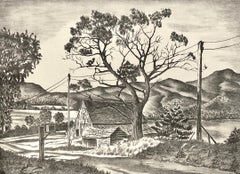
John Muench, The Road to Stow

John Muench, The Road to Stow

Located in New York, NY

John Muench was a master at drawing on a lithographic stone. He was a New Englander and this is a classic subject both for him and for the area. The...

Category

Mid-20th Century American Modern Ernest Adolphe Hyacinthe Constantin Prints and Multiples

Materials

Lithograph
Adolf Dehn, Gay Head Cliffs, 1935, mid-century lithograph, Martha's Vineyard, MA

Adolf Dehn, Gay Head Cliffs, 1935, mid-century lithograph, Martha's Vineyard, MA

By Adolf Dehn

Located in New York, NY

Gay Head Cliffs, a 1935 lithograph by Adolf Dehn (1895-1968), depicts a National Landmark in Aquinnah, Martha's Vineyard, MA. Somehow Dehn has managed to capture the very texture of ...

Category

1930s American Modern Ernest Adolphe Hyacinthe Constantin Prints and Multiples

Materials

Lithograph
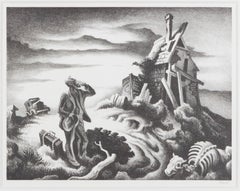
Ernest Adolphe Hyacinthe Constantin prints and multiples for sale on 1stDibs.

Find a wide variety of authentic Ernest Adolphe Hyacinthe Constantin prints and multiples available for sale on 1stDibs. You can also browse by medium to find art by Ernest Adolphe Hyacinthe Constantin in engraving, intaglio, photogravure and more. Not every interior allows for large Ernest Adolphe Hyacinthe Constantin prints and multiples, so small editions measuring 6 inches across are available. Customers who are interested in this artist might also find the work of Franz von Bayros (Choisi Le Conin), Odilon Redon, and Edvard Munch. Ernest Adolphe Hyacinthe Constantin prints and multiples prices can differ depending upon medium, time period and other attributes. On 1stDibs, the price for these items starts at $77 and tops out at $401, while the average work can sell for $145.