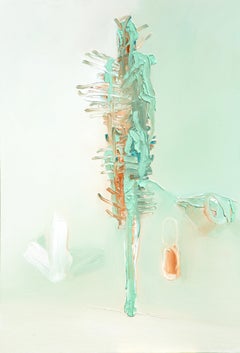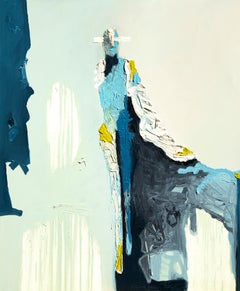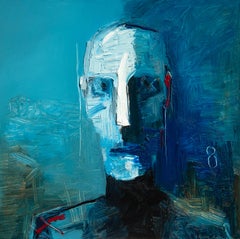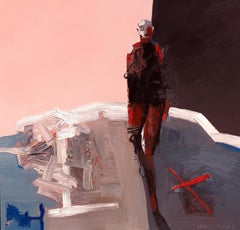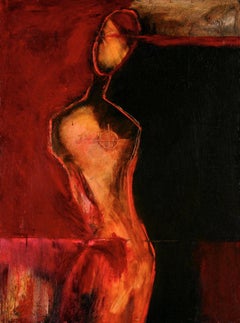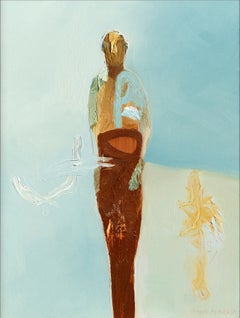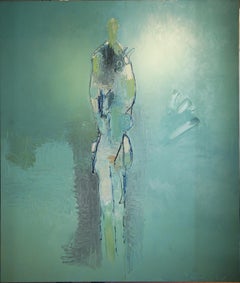
David Smith Figurative Paintings

American, 1906-1965
British landscape artist David Smith was born in Essex in 1949. David has been a professional artist since 1976 and has since established himself as one of the UK’s leading landscape artists. David’s passion for the countryside is more than evident, his traditional approach along with eye catching detail gives a truly naturalistic feel to his paintings. It’s easy to immerse yourself in one of David’s works and feel the landscape as if you were strolling along the river bank on a beautiful summer’s day. Over the years, David’s paintings have sold to private and corporate clients around the world, especially in the America where he’s held many successful exhibitions. David Smith is the father of successful landscape artist Michael James Smith.
to
2
Overall Width
to
Overall Height
to
2
2
2
2
2
2
2
2
7
509
317
263
225
2
2
Artist: David Smith
Untitled
By David Smith
Located in Palm Desert, CA
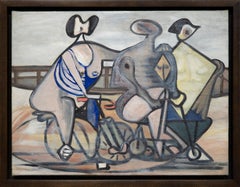
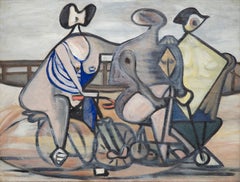
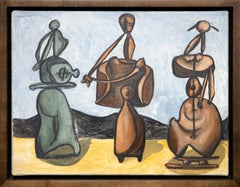
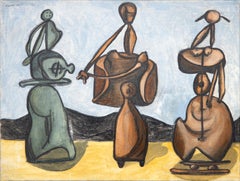
"Untitled" is a painting by artist David Smith. The work is signed and dated in the upper left "David Smith (symbol) 1936". When David Smith set up a workshop on the Brooklyn Navy Pier in 1933 to learn direct-metal techniques, he shared the space not with artists, but with professional welders. Yet as he stated in 1964, ‘…all my early friends were painters…I never conceived of myself as anything other than a painter because my work came straight through the raised surface.’ Picasso and Cubism would be dominant influences in Smith’s work. He understood that Picasso imagined the world as a sculptor might, and not necessarily limited to the unavoidable impact of Cubism. In addition to pursuing a kind of rethinking of the world in three-dimensionality on his own terms, by the late 1920s, Picasso had shown interest in surrealism. That meant drawing not as a depiction of reality, but rather as a reconfiguration of the body in an assemblage of often precariously balanced, interconnected forms — some expressed in a three-dimensional form, others as drawings or paintings. Those processes are reflected in this work by David Smith; three fanciful totemic assemblages set within a landscape perspective of ground, mountains, and sky and whose presence is surreal enough to cast shadows under a presumed solar presence. Untitled, 1936 embraces surrealism, yet also serves to demonstrate the extent to which his thought processes are inextricably linked to sculpture and related to scale, spatial orientation, and three-dimensionality. With that in mind, it is not surprising to know that Smith saw no demarcation between sculpture and painting, or that a painting such as Untitled (1936) can exist outside of planning or design for future three-dimensional work. Provenance: Estate of David Smith, New York Hauser & Wirth Private Collection Exhibition: Kunstsammlung Nordrhein-Westfalen, ‘David Smith: Skulptureen, Zeichnungen [David Smith: Sculpture and Drawings]’ Dusseldorf/DE, March 14 – April 27, 1986 (travelled to: Städtische Galerie im Stäelschen Kunstinstitut, Frankfurt/DE, June 19 – September 28, 1986: Whitechapel Art Gallery...
Category

1930s Abstract David Smith Figurative Paintings

Materials

Canvas, Oil

Untitled
By David Smith
Located in Palm Desert, CA
"Untitled" is a painting by American artist David Smith. David Smith’s paintings from the 1930s rarely come to market, and when Untitled (Billiard Players) surfaced at a Christie’s auction in 2018, it created quite a stir, realizing an impressive price of $1.15 million. Painted around the same time, Untitled shares many similarities with Untitled (Billiard Players). Both paintings affirm Smith’s place among the American artists when ideas and style began to intermingle and coalesce around Picasso’s innovations. Uniquely positioned in temperament and ability, Smith was a man of considerable ambition whose direct-metal configurations would have much to do with achieving new ideas about abstraction. Yet all along, he insisted he was a painter, not a sculptor who painted. Paintings by Smith...
Category

1930s Abstract David Smith Figurative Paintings

Materials

Canvas, Oil

Related Items
"Green Hat"
By Gershon Benjamin
Located in Lambertville, NJ
Ashley John is proud to offer this artwork by: Gershon Benjamin (1899 - 1985) Gershon Benjamin is a painter of portraits, landscapes, still lives, and the urban scene. He had a pro...
Category

20th Century Abstract David Smith Figurative Paintings

Materials

Canvas, Oil

"Green Hat"
"Green Hat"
$48,125
H 33 in W 29 in D 2 in
"Manhattan Night Life"
By Vaclav Vytlacil
Located in Lambertville, NJ
Jim’s of Lambertville is proud to offer this artwork by: Vaclav Vytlacil (1892-1984) He was born to Czechoslovakian parents in 1892 in New York City. Living in Chicago as a youth, he took classes at the School of the Art Institute of Chicago, returning to New York when he was 20. From 1913 to 1916, he enjoyed a scholarship from the Art Students League, and worked with John C. Johansen (a portraitist whose expressive style resembled that of John Singer Sargent), and Anders Zorn. He accepted a teaching position at the Minneapolis School of Art in 1916, remaining there until 1921. This enabled him to travel to Europe to study Cézanne’s paintings and works of the Old Masters. He traveled to Paris, Prague, Dresden, Berlin, and Munich seeking the works of Titian, Cranach, Rembrandt, Veronese, and Holbein, which gave him new perspective. Vytlacil studied at the Royal Academy of Art in Munich, settling there in 1921. Fellow students were Ernest Thurn and Worth Ryder, who introduced him to famous abstractionist Hans Hofmann. He worked with Hofmann from about 1922 to 1926, as a student and teaching assistant. During the summer of 1928, after returning to the United States, Vytlacil gave lectures at the University of California, Berkeley, on modern European art. Soon thereafter, he became a member of the Art Students League faculty. After one year, he returned to Europe and successfully persuaded Hofmann to teach at the League as well. He spent about six years in Europe, studying the works of Matisse, Picasso, and Dufy. In 1935, he returned to New York and became a co-founder of the American Abstract Artists group in 1936. He later had teaching posts at Queens College in New York; the College of Arts and Crafts in Oakland, California; Black Mountain College in North Carolina; and the Art Students League. His paintings exhibit a clear inclination toward modernism. His still lives and interiors from the 1920s indicate an understanding of the art of Cézanne. In the 1930s, his works displayed two very different kinds of art at the same time. His cityscapes and landscapes combine Cubist-inspired spatial concerns with an expressionistic approach to line and color. Vytlacil also used old wood, metal, cork, and string in constructions, influenced by his friend and former student, Rupert Turnbull. He eventually ceased creating constructions as he considered them too limiting. The spatial challenges of painting were still his preference. During the 1940s and 1950s, his works indicated a sense of spontaneity not felt in his earlier work. He married Elizabeth Foster in Florence, Italy, in 1927 and they lived and worked in Positano, Italy for extended periods of time. Later on, they divided their time between homes in Sparkill, New York and Chilmark, Massachusetts, where Vyt, as he was affectionately called, taught at the Martha's Vineyard Art...
Category

1930s Abstract Expressionist David Smith Figurative Paintings

Materials

Canvas, Oil

Fisherman at Dusk
By Oskar D'Amico
Located in Wilton Manors, FL
Oskar D'Amico (1923-2003). Fisherman at Dusk, c.1960. Oil on linen canvas, 16 x 30 inches; 18 x 32 inches (frame). Signed lower right. Excellent condition with no damage or conservation. Biography: Oskar Maria D'Amico (February 22, 1923 – May 3, 2003) was an active Italian artist in Rome, Naples, Lanciano, Cisterna, Milan, Gallarate, Torino, Zagabria, Paris, Toulouse, Melun, Carenac, Maubeuge, Madrid, Barcelona, Zaragoza, Budapest, Győr, Mexico City, Cuernavaca, Morelia, Toronto, New York City, Philadelphia, Los Angeles, San Francisco, Miami, Denver, Santa Fe, Albuquerque and Socorro, between 1943 and 2003. He is considered a Nomad artist because of his ability to work in various styles. He had three major periods in his artistic life: Figurative, Materic and Geometric. [1]He also was an outstanding art director for more than 75 epic movies. D'Amico had a very outgoing personality. He was a non-conformist, which was reflected in his work throughout his life. D'Amico was born in CastelFrentano, Italy, a small village in Abruzzo. At a young age, he felt he had to leave and dive into the big world. After being a seminarist with the Salesiani during World War II, he left Naples, where he studied architecture, and began a great adventure in Rome. He specialized at the time in decorating nightclubs and bars, and invented a special type of double ceiling to hide the lights. D'Amico, who was self-taught as a teenager in drawing and painting, burst onto the filmmaking scene in Rome when an art director asked him to do a perspective of a set design. Soon other moviemakers were calling him.[2] D'Amico was an art director on 75 films including two by Orson Welles. D’Amico was able to create a real marble floor in the set of the palace of the King Saul, in "David and Goliath" directed by Orson Welles. Art directors previously painted a simulated marble on top of concrete due to the cost of the real thing. D'Amico became an associate of Jadran Films in ex-Yugoslavia, which specialized in Roman and Egyptian constructions. While an art director, he never stopped painting. His faceless clowns, reflecting the people who had no identity after World War II, were a big success. In the early 1960s, D'Amico moved with his family to Toronto, Canada, another place he felt was too small. He left for Philadelphia and New York City, which affected his work. He turned his focus to abstract, and for more than a decade created abstract Expressionist paintings "on the plane of all matter" that he called "Materic". The Materic style, which he invented, was done in several media and could not be changed once on the canvas. The paintings were very well received. D’Amico sold more than 400 in Philadelphia and New York City. Unfortunately he had to stop doing the Materics because the colors he used were harmful to his liver. In the mid 1970s, he returned to his architectural roots and developed a new vision for Abstract Constructivism using just acrylic colors. Presented in Paris by his French Art dealer, Francoise Tournier, at the Grand Palais de Paris, and in Mexico City, D'Amico's interpretation of the "New Geometry" was widely admired. In 1983, when he presented the work at the Bodley Gallery, people whispered that he had the potential to be the new Picasso because of his eclecticism and the Nomad nature of his styles. In 1987, D'Amico abandoned the gypsy life and settled in New Mexico. Albuquerque was the perfect place to dedicate himself 100 percent to his work.[3] There were no distractions and a good climate that reminded him of his beloved Cuernavaca in Mexico. Staying in close contact with his French art dealer Tournier, D’Amico had several shows in Denver at the Helen Karsh Gallery and in Albuquerque at the Black Swan and Café Galleries. At least once a year, D’Amico went to Europe to immerse himself in the antique world and visit museums and galleries. In 1992, visiting Tournier at the Castle of Saint Cirq Lapopie, he met the man who founded the MADI movement in 1940, Carmelo Arden Quin...
Category

1960s Abstract David Smith Figurative Paintings

Materials

Canvas, Oil

Fisherman at Dusk
Fisherman at Dusk
$1,000 Sale Price
50% Off
H 16 in W 30 in D 1 in
"Toucan" Edward Zutrau, 1949 Abstracted Bird by Abstract Expressionist Artist
Located in New York, NY
Edward Zutrau Toucan, 7/29/1949 Dated on verso Oil on linen 30 x 23 inches Edward Zutrau (1922–1993) was an American painter whose career spanned from the 1940s through the early 1...
Category

1940s Abstract Expressionist David Smith Figurative Paintings

Materials

Canvas, Oil

"Untitled" Albert Heckman, Still Life, Floral Abstracted Modernist Composition
By Albert Heckman
Located in New York, NY
Albert Heckman Untitled, circa 1950 Signed lower right Oil on canvas 25 1/4 x 32 1/4 inches Albert Heckman was born in Meadville, Western Pennsylvania, 1893. He went to New York City to try his hand at the art world in 1915 after graduating from high school and landing a job at the Meadville Post Office. In 1917, at the age of 24, Heckman enrolled part-time in Teachers' College, Columbia University's Fine Arts Department to begin his formal art education. He worked as a freelance ceramic and textile designer and occasionally as a lecturer at the Metropolitan Museum of Art. In the early 1920s, at the age of almost 30, he graduated with a Bachelor of Arts degree from Columbia Teachers College. He was especially impacted by his instructor at Columbia, Arthur Wesley Dow. After graduating, he was hired by the Teachers' College as a Fine Arts instructor. He stayed with Columbia Teachers' College until 1929, when he left to attend the Leipzig Institute of Graphic Arts in Leipzig, Germany. Isami Doi (1903-1965), who was born in Hawaii, was arguably his most impressive student at Columbia. Doi is now regarded as one of the most prominent artists hailing from Hawaii. Heckman became an active member and officer of the Keramic Society and Design Guild of New York in the 1920s as part of his early commercial art career. The Society's mission was to share knowledge and showcase textile and ceramic design exhibits. In 1922, Heckman married Florence Hardman, a concert violinist. Mrs. Heckman's concert schedule during the 1920s kept Albert and Florence Heckman apart for a significant portion of the time, but they spent what little time they had together designing and building their Woodstock, New York, summer house and grounds. A small house and an acre of surrounding land on Overlook Mountain, just behind the village of Woodstock, were purchased by Albert and Florence Heckman at the time of their marriage. Their Woodstock home, with its connections, friendships, and memories, became a central part of their lives over the years, even though they had an apartment in New York City. Heckman's main artistic focus shifted to the house on Overlook Mountain and the nearby towns and villages, Kingston, Eddyville, and Glasco. After returning from the Leipzig Institute of Graphic Arts in 1930, Mr. Heckman joined Hunter College as an assistant professor of art. He worked there for almost thirty years, retiring in 1956. Throughout his tenure at Hunter, Mr. Heckman and his spouse spent the summers at their Woodstock residence and the winters in New York City. They were regular and well-known guests at the opera and art galleries in New York. Following his retirement in 1956, the Heckmans settled in Woodstock permanently, with occasional trips to Florida or Europe during the fall and winter. Mr. Heckman's close friends and artistic career were always connected to Woodstock or New York City. He joined the Woodstock art group early on and was greatly influenced by artists like Paul and Caroline Rohland, Emil Ganso, Yasuo Kuniyoshi, Andre Ruellan, and her husband, Jack Taylor. Heckman operated a summer art school in Woodstock for several years in the 1930s with support from Columbia University, where these and other Woodstock artists gave guest lectures. The Potter's Shop in New York City hosted Mr. Heckman's first art show in December 1928. The exhibit received some positive reviews from critics. The American Institute of Graphic Arts chose the plate of "Wehlen, Saxony" as one of the "Fifty Prints of the Year in 1929." There were sixteen etchings displayed. The remaining plates depicted scenes in Saxony, Germany, while five of the plates were based on scenes in Rondout, New York. Heckman started switching from etching to black and white lithography by the early 1930s. A lifelong admirer of Heckman's artwork, Mr. Gustave von Groschwitz organized a significant exhibition of Heckman etchings and lithographs at the Ferargil Gallery in New York City in 1933. The exhibition traveled to the Stendahl Galleries in Los Angeles (May 1933), the Charles Lessler Gallery in Philadelphia (May 1933), J.L. Hudson in Detroit (June 1933), and Gumps in San Francisco (July 1933). Together with his early etchings, the exhibition featured brand-new black and white lithographs depicting scenes in and around Woodstock as well as "A View from Tudor City...
Category

1950s Abstract David Smith Figurative Paintings

Materials

Canvas, Oil

American Abstract Expressionist Artist Melissa Meyer Oil Painting Flaming Heart
By Melissa Meyer
Located in Surfside, FL
MELISSA MEYER (American, b. 1946), ''Bleeding Heart'', 1982, Oil and wax (encaustic) on canvas, Signed to canvas verso. Canvas 39-1/4''h, 31-3/4''w. Melissa Meyer (born May 4,...
Category

1980s Abstract Expressionist David Smith Figurative Paintings

Materials

Canvas, Wax, Oil

Mid-Century Cyclists-The Field Sprint Pierre Bosco #26 (Italy/France, 1909-1993)
By Pierre Bosco
Located in SANTA FE, NM
Mid-Century Cyclists - The Field Sprint Pierre Bosco (Italy/France, 1909-1993) Oil on canvas 15 x 12 inches, frame size “The savage art of Bosco bears its rudeness and its mystery....
Category

1960s Abstract Expressionist David Smith Figurative Paintings

Materials

Canvas, Oil

"The Evening Crowd, Manhattan"
By Vaclav Vytlacil
Located in Lambertville, NJ
Jim’s of Lambertville is proud to offer this artwork by: Vaclav Vytlacil (1892-1984) He was born to Czechoslovakian parents in 1892 in New York City. Living in Chicago as a youth, he took classes at the School of the Art Institute of Chicago, returning to New York when he was 20. From 1913 to 1916, he enjoyed a scholarship from the Art Students League, and worked with John C. Johansen (a portraitist whose expressive style resembled that of John Singer Sargent), and Anders Zorn. He accepted a teaching position at the Minneapolis School of Art in 1916, remaining there until 1921. This enabled him to travel to Europe to study Cézanne’s paintings and works of the Old Masters. He traveled to Paris, Prague, Dresden, Berlin, and Munich seeking the works of Titian, Cranach, Rembrandt, Veronese, and Holbein, which gave him new perspective. Vytlacil studied at the Royal Academy of Art in Munich, settling there in 1921. Fellow students were Ernest Thurn and Worth Ryder, who introduced him to famous abstractionist Hans Hofmann. He worked with Hofmann from about 1922 to 1926, as a student and teaching assistant. During the summer of 1928, after returning to the United States, Vytlacil gave lectures at the University of California, Berkeley, on modern European art. Soon thereafter, he became a member of the Art Students League faculty. After one year, he returned to Europe and successfully persuaded Hofmann to teach at the League as well. He spent about six years in Europe, studying the works of Matisse, Picasso, and Dufy. In 1935, he returned to New York and became a co-founder of the American Abstract Artists group in 1936. He later had teaching posts at Queens College in New York; the College of Arts and Crafts in Oakland, California; Black Mountain College in North Carolina; and the Art Students League. His paintings exhibit a clear inclination toward modernism. His still lives and interiors from the 1920s indicate an understanding of the art of Cézanne. In the 1930s, his works displayed two very different kinds of art at the same time. His cityscapes and landscapes combine Cubist-inspired spatial concerns with an expressionistic approach to line and color. Vytlacil also used old wood, metal, cork, and string in constructions, influenced by his friend and former student, Rupert Turnbull. He eventually ceased creating constructions as he considered them too limiting. The spatial challenges of painting were still his preference. During the 1940s and 1950s, his works indicated a sense of spontaneity not felt in his earlier work. He married Elizabeth Foster in Florence, Italy, in 1927 and they lived and worked in Positano, Italy for extended periods of time. Later on, they divided their time between homes in Sparkill, New York and Chilmark, Massachusetts, where Vyt, as he was affectionately called, taught at the Martha's Vineyard Art...
Category

1930s Abstract David Smith Figurative Paintings

Materials

Canvas, Oil

"Attention" Heavily Textured Abstract Expressionist Composition in Oil on Canvas
Located in Soquel, CA
"Attention" Heavily Textured Abstract Expressionist Composition in Oil on Canvas Bold, textured, impasto composition of a nude female by California artist Harald "Harry" Dry Schmidt...
Category

1970s Abstract David Smith Figurative Paintings

Materials

Canvas, Oil, Stretcher Bars

Norman Carton, abstract cityscape, unique oil painting hand signed twice, Framed
By Norman Carton
Located in New York, NY
Norman Carton Mid Century Modern Cityscape, ca. 1951 Oil on canvas painting (signed twice) Signed twice: hand signed on the front and also signed on the back Unique Frame included: T...
Category

1950s Abstract Expressionist David Smith Figurative Paintings

Materials

Oil, Canvas

"Untitled" Theresa Bernstein, Expressionist Work by American Ashcan Artist
By Theresa Bernstein
Located in New York, NY
Theresa Bernstein Untitled, circa 1990 Signed lower right Oil on canvas 16 x 20 inches Theresa F. Bernstein was born in Philadelphia in 1895 to cultured, middle-class immigrant par...
Category

1990s Abstract David Smith Figurative Paintings

Materials

Canvas, Oil

Light 2001. Canvas, oil, 92x65 cm
By Ivars Muizulis
Located in Riga, LV
Light 2001. Canvas, oil, 92x65 cm The artwork portrays a colorful and abstract woman figure against a backdrop of pink and blue hues. The central focus of the painting is the woman...
Category

Early 2000s Abstract Expressionist David Smith Figurative Paintings

Materials

Canvas, Oil

Light  2001. Canvas, oil, 92x65 cm
$2,739 Sale Price
20% Off
H 36.23 in W 25.6 in D 1.19 in
Previously Available Items
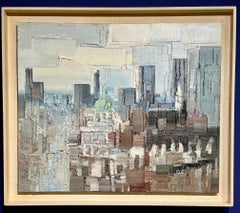
Modern British Impressionist View of London, St. Pauls from the Monument
By David Smith
Located in Woodbury, CT
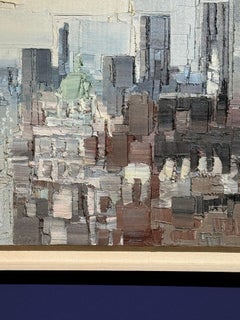
This stunning 1971 thick impasto view of London and St. Paul's Cathedral from the Monument by the English artist David Smith is a masterful example of abstract urban landscape painti...
Category

1970s Modern David Smith Figurative Paintings

Materials

Oil, Panel

David Smith figurative paintings for sale on 1stDibs.

Find a wide variety of authentic David Smith figurative paintings available for sale on 1stDibs. You can also browse by medium to find art by David Smith in canvas, fabric, oil paint and more. Much of the original work by this artist or collective was created during the 1930s and is mostly associated with the abstract style. Not every interior allows for large David Smith figurative paintings, so small editions measuring 16 inches across are available. Customers who are interested in this artist might also find the work of Vaclav Vytlacil, Robert McIntosh, and Leslie Luverne Anderson. David Smith figurative paintings prices can differ depending upon medium, time period and other attributes. On 1stDibs, the price for these items starts at $300,000 and tops out at $300,000, while the average work can sell for $300,000.