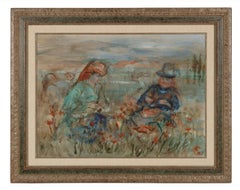
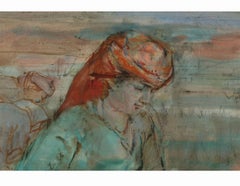
Edna Hibel“Figural”
$5,000
“Figural”
By Edna Hibel
Located in Warren, NJ
Edna Hibel Original Figural Painting On Board. In good condition measures 38x30
Category
20th Century Edna Hibel Art
Materials
Oil
$5,000
“Figural”
By Edna Hibel
Located in Warren, NJ
Edna Hibel Original Figural Painting On Board. In good condition measures 38x30
Oil
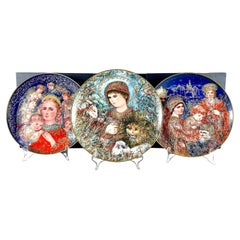
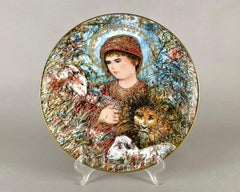
Plates Edwin Knowles Edna Hibel Christmas Collection Peaceful Kingdom 1989
By Edna Hibel
Located in Bastogne, BE
This lot includes three different plates, from 1985-89, the first plate collection created by Edna Hibel, produced by Knowles. All plates have hand a...
Porcelain
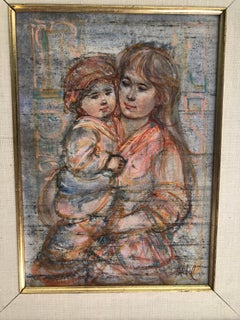
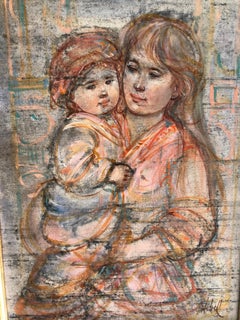
Edna Hibel Mother and Child Original Oil Painting on Silk
By Edna Hibel
Located in San Francisco, CA
Edna Hibel: 1917-2015. Well listed important American artist. Mostly associated with Florida and Massachusetts. There is a Hibel Museum in Florida. Some called her the latter 20th ce...
Oil
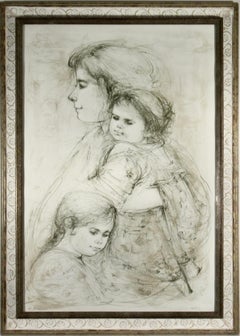
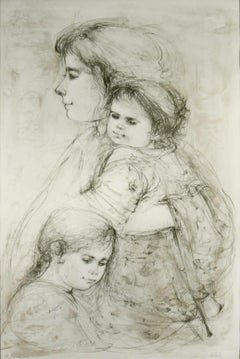
Mother and Children
By Edna Hibel
Located in San Francisco, CA
This artwork "Mother and Children" c.1970, is a colors lithograph on paper by American artist Edna Hibel, 1917-2014. It is signed and numbered II 3/10 Ed. 200 in pencil by the artist. The The artwork (sheet ) size is 34 x 23 inches, framed size is 40 x 29 inches. Custom framed in original wooden decorated grey/silver frame. It is in excellent condition. About the artist: Edna Hibel, a painter of sentimental pictures of children, has had a more than 60-year career as painter and lithographer and promoter of peace through exhibitions of her artwork. She was born in 1917 in Boston, Massachusetts. Her parents were Abraham and Lena Hibel, and she was raised in the Boston area and educated at Brookline High School where she met her future husband, Theodore Plotkin. She began to paint when she was nine years old and learned watercolor during summers at the shore where her family vacationed in Maine and Hull, Massachusetts. Hibel studied at the Boston Museum School of Fine Arts, from 1935-39, receiving a Sturtevant Traveling Fellowship to Mexico. In Boston, in 1966, she began lithography, continuing in 1970 in Zurich, where she still works every year. She has created lithographic works with up to 32 stones (or colors) on paper, silk, wood veneer and porcelain. The latter pieces are called lithographs on porcelain and result from a complicated process, that she keeps a secret, whereby she transfers stone lithographic color separations onto Bavarian hard paste porcelain. Hibel has created the "Arte Ovale" series and various plaques with this technique. She organized the Edna Hibel Museum of Art, in Jupiter, Florida, to display and promote her work and also created a United Nations stamp, "Mother Earth." In 1995, she was commissioned by the Foundation of the U.S. National Archives to commemorate the 75th anniversary of women receiving the universal right to vote. At the ceremony, Ms. Lucy Baines Johnson referred to Hibel as the "Heart and Conscience of America." In November, 2001, the World Cultural Council based in Mexico City gave her the Leonardo da Vinci World Award of Arts. Hibel's work has been exhibited in museums and galleries in more than 20 countries including Russia, Brazil, China, Costa Rica, and the United States, and under the royal patronage of Count and Countess Bernadotte of Germany, Count Thor Bonde of Sweden, Prince and the late Princess Rainier of Monaco and Her Majesty Queen Elizabeth II of England. Pope John Paul II gave her a medal of honor as did the late Belgian King Baudouin. She also received honorary Doctoral degrees including from Eureka College, and Northwood University of Florida, Michigan and Texas. She also has received many humanitarian honors for her charitable efforts for children's and medical charities. Her exhibitions "Golden Bridge" and " Peace Through Wisdom" were efforts to promote peace and cultural understanding between China, the United States, Yugoslavia and Russia, and a television documentary titled "Hibel's Russian Palette" was based on her trips and art shows in Leningrad, now St. Petersburg. In 2001, Edna received a Lifetime Achievement Award from "Women in the Visual Arts," an organization of artists in the South Florida area. Works in Permanent Collections: Harvard University Boston University Museum of Fine Arts, Boston Springfield Museum of Arts, Massachusetts University of New Hampshire Fleischmann Collection, Cincinnati Detroit Art Institute Milwaukee Art Museum Phoenix Art Museum La Jolla Museum, California Lowe Gallery, University of Miami, Florida Columbus Museum of Arts and Crafts, Georgia WarrenHall Coutts, Ill, Memorial Museum of Art, El Dorado, Kansas Palais des Nations,Geneva, Switzerland United Nations Headquarters, New York City Norton Gallery, West Palm Beach, Florida de Saisset Museum, Santa Clara, California Russian Academy of Art, St. Petersburg, Russia Hibel Museum of Art, Lake Worth, Florida One Artist Exhibitions: Shacknow Museum of Fine Arts, Plantation, Florida, 2000 Cornell Museum of Art and History, Delray Beach, Florida, 1999 (and 1993) Klutznick National Jewish Museum, Washington, D.C., 1999 The Museum of Printing History, Houston, Texas, 1999 (and 1998) Mitsukoshi Fine Art Gallery, Tokyo, Japan, 1995 (and 1994) Lyme Academy of Fine Art, Old Lyme, Connecticut, 1994 Grenchen Art Museum, and Galerie BrechbUhl, Grenchen, Switzerland, 1992 Soviet Union Academy of Art, and Exhibition Hall of the Russian Union of Artists, Leningrad (St. Petersburg), Russia, U.S.S.R., 1990 Northern Indiana Arts Association Gallery, Munste~ Indiana, 1990 Galerie Vindobona, Bad Kissingen,West Germany, 1988 The National Museum of Women in the Arts, Washington, D.C., 1989 St. Peter An...
Lithograph
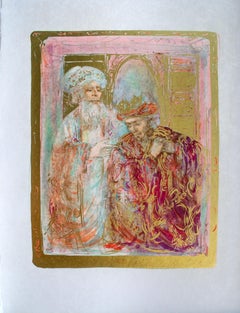
Two Fine Prints from the David Suite by Edna Hibel, 1978
By Edna Hibel
Located in New York, NY
Edna Hibel (American, 1917-2015) Two Lithographs from the David Suite, 1978 Hand pulled original lithograph on Japanese rice paper Sheet: 26 x 20 in. Signed lower right: Hibel Number...
Rice Paper, Lithograph
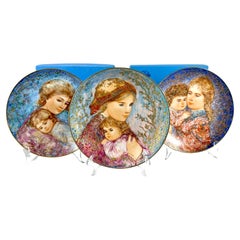
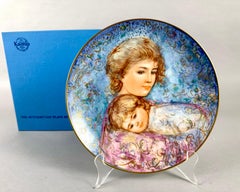
Plates Edwin M.Knowles - Edna Hibel Mother's Day Limited Edition Collectibles
By Edna Hibel
Located in Bastogne, BE
Vintage 1984 Edwin M. Knowles Mother's Day Limited Edition Collectible Plates created exclusively by Edna Hibel. These fine china plates are nice and titled “Abby and Lisa" “Emily a...
Porcelain
$1,980Sale Price|28% Off
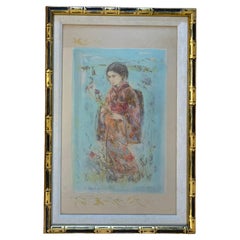
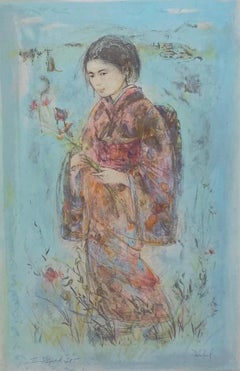
Edna Hibel Color Lithograph Japanese Girl in a Traditional Kimono, Hand Signed
By Edna Hibel
Located in Miami, FL
A stunning piece of decorative art by Edna Hibel featuring a young girl dressed in a traditional Japanese kimono. Edna Hibel: 1917-2015. Well listed important American artist. Most...
Silk, Wood

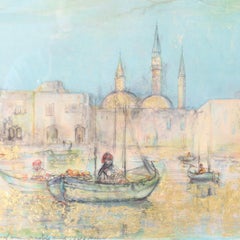
Edna Hibel Enhanced Lithograph of Venice
By Edna Hibel
Located in Palm Beach, FL
Serene moment in time on a Venetian canal as realized by artist Edna Hibel executed with a stone lithograph technique as the artists proof and enhanced with pastel and gold leaf. Pre...
Gold Leaf
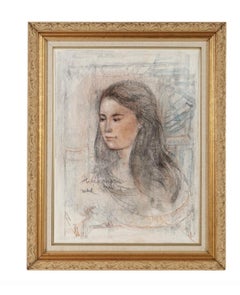
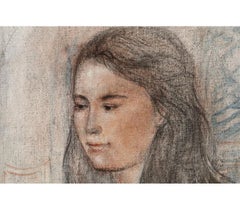
“Himalayan Girl”
By Edna Hibel
Located in Warren, NJ
Edna Hibel Himalayan Girl Oil Painting On Board. In good condition comes with Coa from Hibel gallery. Measures 30x24
Oil
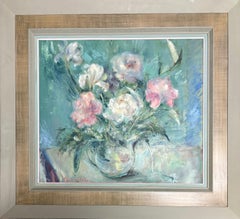
$5,000
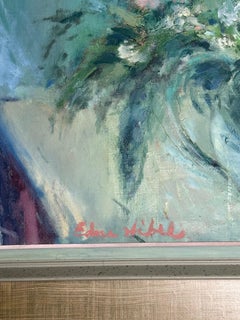
“Flowers”
By Edna Hibel
Located in Warren, NJ
Edna Hibel original painting on board “flowers”. In good condition measures 38x34
Oil
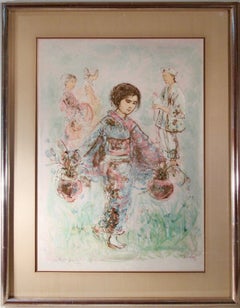
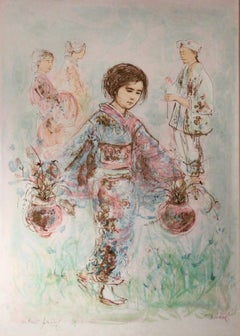
Chinese Girl
By Edna Hibel
Located in San Francisco, CA
This artwork "Chinese Girl" c.1970, is a colors lithograph on Japan nacre paper by American artist Edna Hibel, 1917-2014. It is signed and inscribed Artist Proof in pencil by the art...
Lithograph
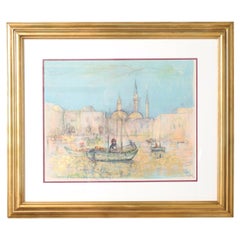
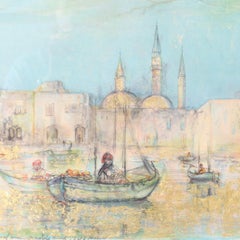
Edna Hibel Enhanced Lithograph of Venice
By Edna Hibel
Located in Palm Beach, FL
Serene moment in time on a Venetian canal as realized by artist Edna Hibel executed with a stone lithograph technique as the artists proof and enhanced with pastel and gold leaf. Pre...
Gold Leaf
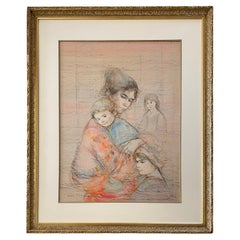
$1,980Sale Price|26% Off
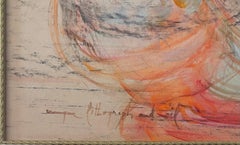
Edna Hibel Color Lithograph and Oil Embellished Mother and Children
By Edna Hibel
Located in Miami, FL
Color Lithograph by Edna Hibel, Mother and Children This stunning color lithograph is marked as a lithograph but appears to be embellished with oil on silk...
Wood, Paper
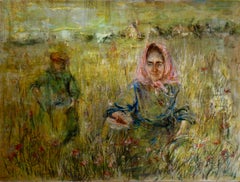
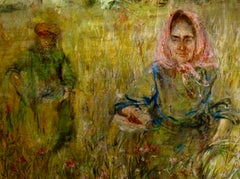
Untitled, Two people in the field
By Edna Hibel
Located in San Francisco, CA
This artwork "Untitled, Two People in the Field" c.1970, is an oil painting on canvas by American artist Edna Hibel, 1917-2014. It is signed at the lower left corner by the artist. The canvas size is 30 x 40 inches. It is in good condition, It has been recently revarnished. About the artist:Edna Hibel, a painter of sentimental pictures of children, has had a more than 60-year career as painter and lithographer and promoter of peace through exhibitions of her artwork. She was born in 1917 in Boston, Massachusetts. Her parents were Abraham and Lena Hibel, and she was raised in the Boston area and educated at Brookline High School where she met her future husband, Theodore Plotkin. She began to paint when she was nine years old and learned watercolor during summers at the shore where her family vacationed in Maine and Hull, Massachusetts. Hibel studied at the Boston Museum School of Fine Arts, from 1935-39, receiving a Sturtevant Traveling Fellowship to Mexico. In Boston, in 1966, she began lithography, continuing in 1970 in Zurich, where she still works every year. She has created lithographic works with up to 32 stones (or colors) on paper, silk, wood veneer and porcelain. The latter pieces are called lithographs on porcelain and result from a complicated process, that she keeps a secret, whereby she transfers stone lithographic color separations onto Bavarian hard paste porcelain. Hibel has created the "Arte Ovale" series and various plaques with this technique. She organized the Edna Hibel Museum of Art, in Jupiter, Florida, to display and promote her work and also created a United Nations stamp, "Mother Earth." In 1995, she was commissioned by the Foundation of the U.S. National Archives to commemorate the 75th anniversary of women receiving the universal right to vote. At the ceremony, Ms. Lucy Baines Johnson referred to Hibel as the "Heart and Conscience of America." In November, 2001, the World Cultural Council based in Mexico City gave her the Leonardo da Vinci World Award of Arts. Hibel's work has been exhibited in museums and galleries in more than 20 countries including Russia, Brazil, China, Costa Rica, and the United States, and under the royal patronage of Count and Countess Bernadotte of Germany, Count Thor Bonde of Sweden, Prince and the late Princess Rainier of Monaco and Her Majesty Queen Elizabeth II of England. Pope John Paul II gave her a medal of honor as did the late Belgian King Baudouin. She also received honorary Doctoral degrees including from Eureka College, and Northwood University of Florida, Michigan and Texas. She also has received many humanitarian honors for her charitable efforts for children's and medical charities. Her exhibitions "Golden Bridge" and " Peace Through Wisdom" were efforts to promote peace and cultural understanding between China, the United States, Yugoslavia and Russia, and a television documentary titled "Hibel's Russian Palette" was based on her trips and art shows in Leningrad, now St. Peter...
Oil
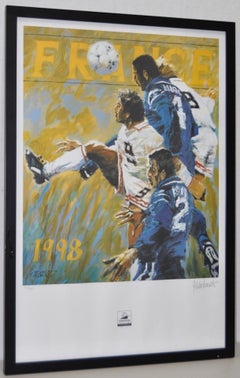
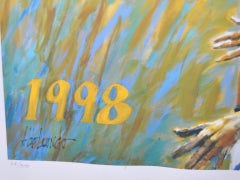
France World Cup Lithograph by Aldo Luongo c.1998
By Aldo Luongo
Located in San Francisco, CA
FRANCE World Cup Lithograph by Aldo Luongo c.1998 Limited edition France 98' World Cup - Official License From a very limited edition of 300. Pencil signed lower right. Edition 24/300 lower left. This is a rare, very small edition lithograph for the 1998 Soccer World Cup...
Lithograph
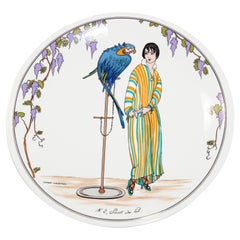
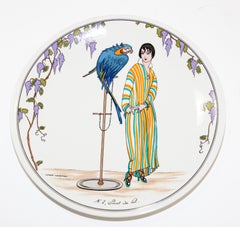
Art Deco Design Porcelain Plate Collectible Villeroy and Boch
By Villeroy & Boch
Located in Moreno Valley, CA
Vintage Villeroy and Boch 1900 Art Deco design, woman with parrot. Villeroy & Boch Design 1900 Porcelain collectible plate. The subjects coll...
Porcelain
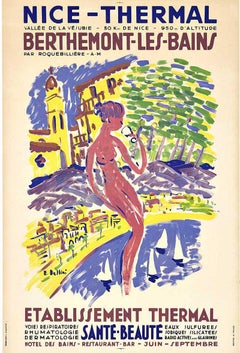
$796Sale Price|20% Off
H 47 in W 32 in D 0.07 in
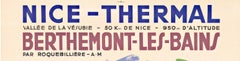
Original Nice-Themal spa Berthemont - Les -Bains antique French vintage poster
By Emmanuel Bellini
Located in Spokane, WA
Original French travel poster: Nice - Thermal health spa original vintage poster created by artist Emmanuel Bellini. Original linen backed, large French travel size: Nice - Therm...
Lithograph
Japanese Diarist Doll in Glass Case - Silkscreen
Located in Soquel, CA
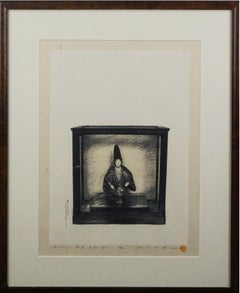
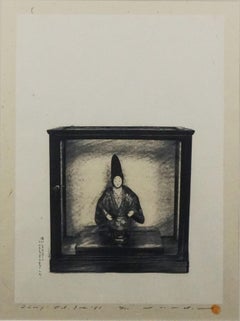
Wonderful silkscreen of Japanese diarist doll in glass case. Illegibly signed left corner, dated (October 8, 1983) and numbered (2/30). Presented in wood frame. Image size: 20"H x 14...
Ink, Rice Paper
$475
H 20 in W 16 in D 0.25 in
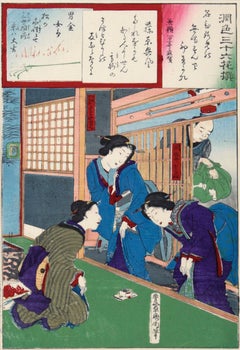
"Enshoku Sanju-roku Kasen" (Thirty-six Enchanting Flowers) Woodblock on paper
By Toyohara Kunichika
Located in Soquel, CA
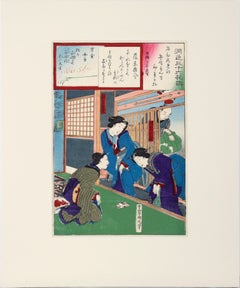
"Enshoku Sanju-roku Kasen" (Thirty-six Enchanting Flowers) Woodblock on paper Elegant woodblock print by Toyohara Kunuchika (Japanese, 1835-1900). Three women are in talking with each other inside, while a man waits outside holding a bag of some kind. The colors in this piece are rich and saturated, primarily blues, greens, and purple. Mat size: 16"H x 20"W Paper size: 14.75"H x 9.88"W Born in 1835, Toyohara Kunichika grew up in the Kyobashi district of Edo in the midst of merchants and artisans. In 1848, at age 13, he was accepted as an apprentice into the studio of Utagawa Kunisada I...
Ink, Rice Paper, Woodcut
$1,700
H 24 in W 36 in D 0.25 in
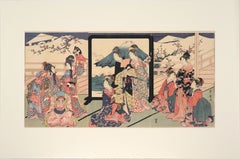
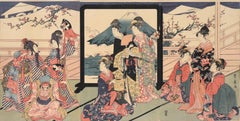
"Toy Horse Dance" Japanese Woodblock Triptych with Beauties and Mt Fuji
Located in Soquel, CA
"Toy Horse Dance" Japanese Woodblock Triptych with Beauties and Mt Fuji Vibrant three-panel woodblock print by Utagawa Toyohiro (Japanese,...
Ink, Rice Paper, Woodcut
$1,758
H 15.16 in W 18.31 in D 1.97 in
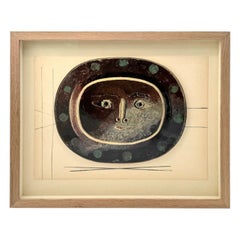
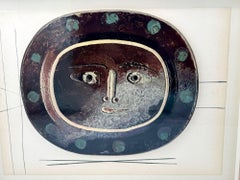
1948 framed lithographic plate from the limited edition “Ceramiques de Picasso”
By Albert Skira
Located in London, GB
A framed lithographic plate from the 1948 Swedish, limited edition portfolio of only 200 “Ceramiques de Picasso” by Albert Skira, framed, with the die-cut, gloss coloured lithograph...
Paper
$37,997
H 31.34 in W 26.38 in D 1.97 in
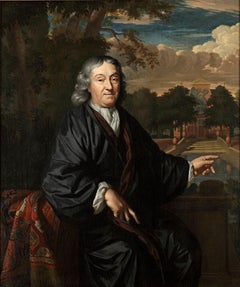
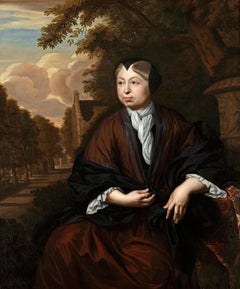
Male and female portrait, both in silk kimono, possibly textile dealers
By Christoffel Lubieniecki
Located in Amsterdam, NL
CHRISTOFFEL LUBIENIECKI (1659-1729) Pair of portraits of a gentleman and a lady, both in silk kimono, before a country house (circa 1680) Indistinctly signed “C.......” on a box under the man’s left hand Oil on canvas, 79.5 x 67 cm each Both sitters are portrayed wearing a silk “Japanese” coat. During the second half of the seventeenth the Japanese silk coat, an adapted Japanese kimono, became a real vogue in the Dutch elite. The exclusive Dutch trade contacts with Japan can explain the popularity of the kimono-style silk coats in the Netherlands. Everybody who could afford one, dressed in such a fashionable and comfortable coat and, like the present sitters, some proud owners had themselves portrayed in a “Japanese” coat often together with an oriental carpet to underline their standing and international connections. These portraits are the work of the Polish-born portraitist Christoffel Lubieniecki (also known as Lubienitski, Lubinitski or Lubiniecki) Lubieniecki was first trained in Hamburg under Julian Stuhr and after 1675 in Amsterdam under Adriaen Backer and Gerard de Lairesse. He specialized in landscapes, generally of an Italianate character, and in portraits. The loving execution of these contented burghers, enjoying the garden vistas of their country house, places him alongside Amsterdam portraitists such as Constantijn Netscher and Michiel van Musscher...
Canvas, Oil
$1,550
H 15.5 in W 19.25 in D 1.25 in
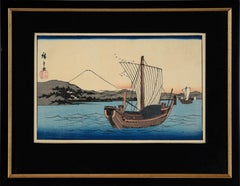
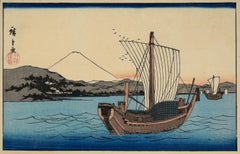
Kiyomi Barrier & Seiken Temple Near Okitsu- Japanese Woodcut Print on Rice Paper
By Utagawa Hiroshige
Located in Soquel, CA
Kiyomi Barrier & Seiken Temple Near Okitsu - Japanese Woodcut Print on Rice Paper Woodblock print of boats in a harbor by Utagawa Hiroshige (Japanese, 1797-1858). Originally publish...
Rice Paper, Woodcut
$218Sale Price / set|25% Off
H 0.6 in Dm 7.88 in
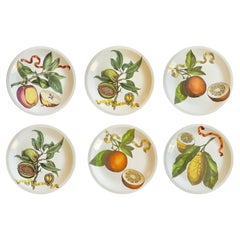
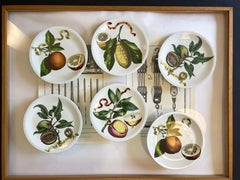
6 Fruit Plates Collection by Villeroy & Boch Septfontaines, Luxembourg, 1970s
By Villeroy & Boch
Located in Andernach, DE
Lovely set of 6 fruit or breakfast plates by Villeroy & Boch, Septfontaines, Luxembourg around 1978. Off-white porcelain with antique style decoration of traditional fruit, here a le...
Porcelain
$284
H 0.6 in W 11.42 in D 11.42 in
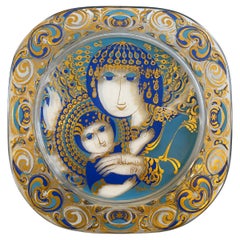
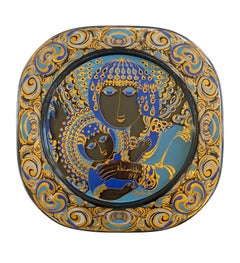
Christmas Glass Wall Plate by Bjørn Wiinblad 1976, Limited Edition for Rosenthal
By Bjørn Wiinblad, Rosenthal
Located in Andernach, DE
Bjorn Wiinblad, Danish artist, has created this beautiful series for German art glass & porcelain makers Rosenthal for their Studio-Line art edition. The Christmas decoration has bee...
Crystal
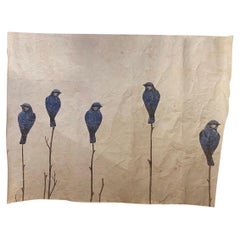
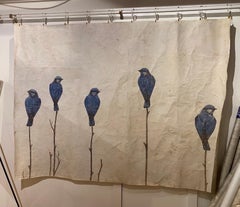
Decorative Limited Edition French Wallpaper Panels of Birds
Located in Richmond, VA
Great quality and colorful French artists made limited edition wallpaper panels. These panels are printed on recycled French paper then hand glazed and crumpled to give a dramatic antiqued appearance.
Paper
Sold
H 34 in W 30 in D 3 in
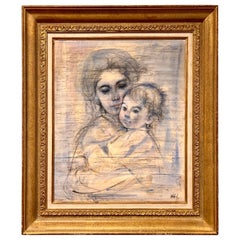
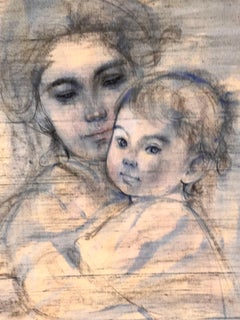
Rare Original Signed Edna Hibel Watercolor Painting on Silk in Gilt Gold Frame
By Edna Hibel
Located in West Hartford, CT
Signed original Hibel watercolor on masonite depicting a mother and child. Iconic in every way. Artist signed on lower right. Displayed in a beautiful carved giltwood frame. Original...
Silk, Giltwood
Sold
H 28.5 in W 35.5 in D 1.38 in
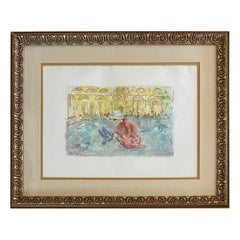
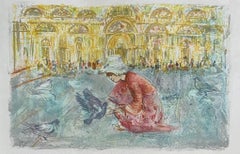
Edna Hibel Color Lithograph Piazza San Marco Venice Italy, Signed and Numbered
By Edna Hibel
Located in Miami, FL
Edna Hibel color lithograph depicting Piazza San Marco or St. Mark's Square in Venice, Italy. Signed and Numbered. A very decorative piece of art by listed Post-Impressionist artis...
Wood, Paper

Sold
H 23 in W 1.25 in D 19 in
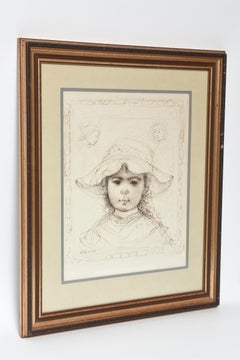
Young Girl in Hat Limited Edition Signed Numbered Lithograph by Edna Hibel
By Edna Hibel
Located in Miami Beach, FL
Lithograph print of a young girl wearing a floppy hat by Edna Hibel (American 1917-2014). Signed bottom right "Hibel" in pencil and numbered bottom left "IV 17/18 ed. 343." Matted di...
Glass, Wood, Paper
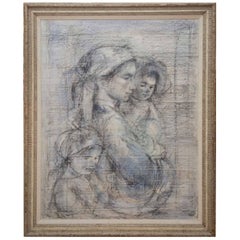

Mother and Two Children Painting by Edna Hibel
By Edna Hibel
Located in Sag Harbor, NY
"Mother and two Children" a large painting by Edna Hibel, created in her Brookline Massachusetts studio in 1970 with an oil wash and charcoal o...
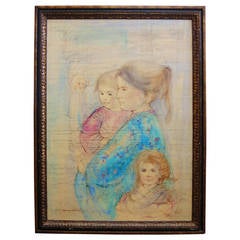
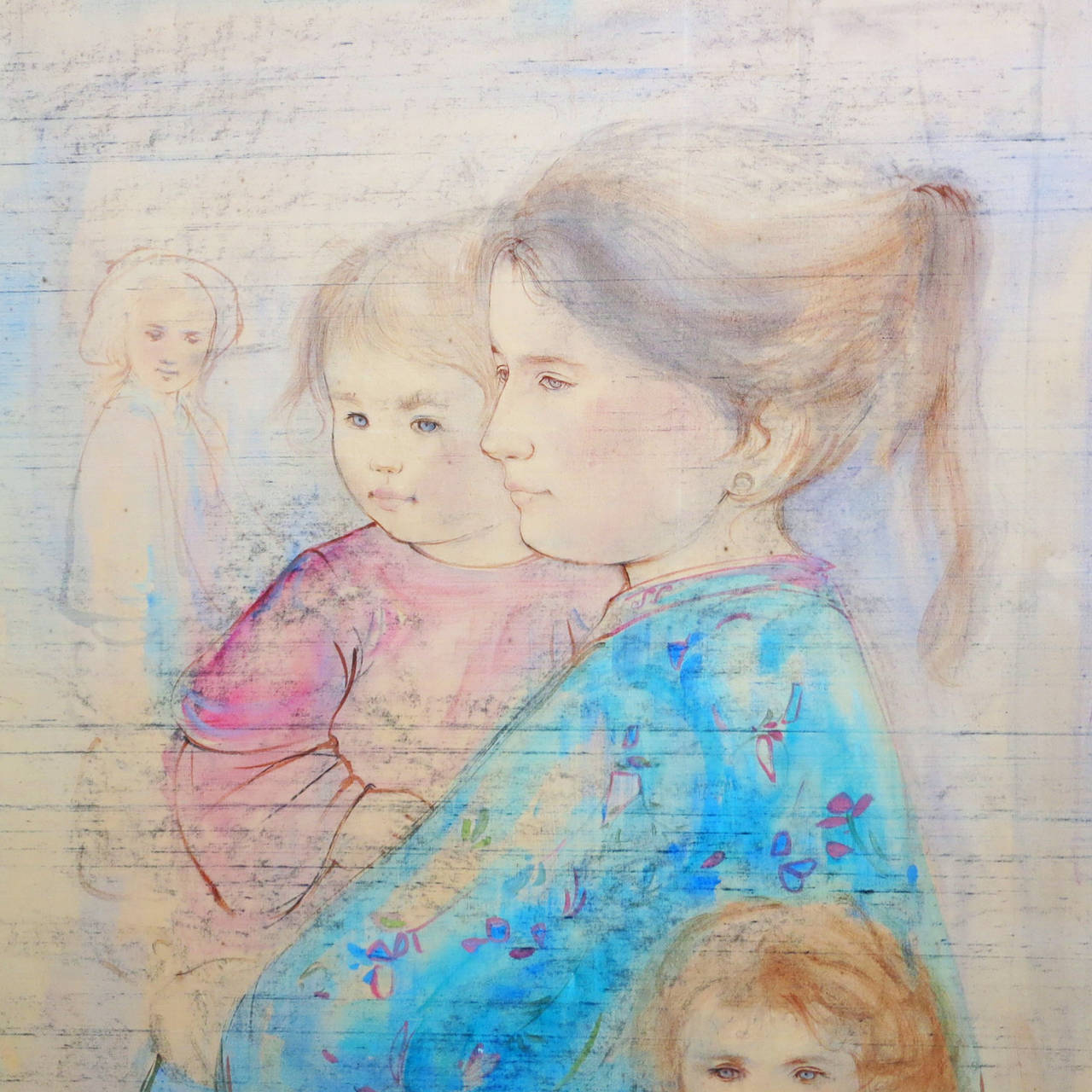
Hibel Mother and Daughter Lithograph and Oil
By Edna Hibel
Located in Van Nuys, CA
Mother and child, on board and noted lower left 'unique and oil', signed "Hibel" lower right, board measures 23.5 x 17.5 inches, frame measures 28.5 x 22.75 inches. Born in 1917, ...
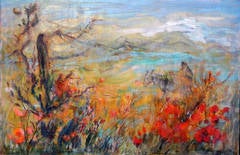
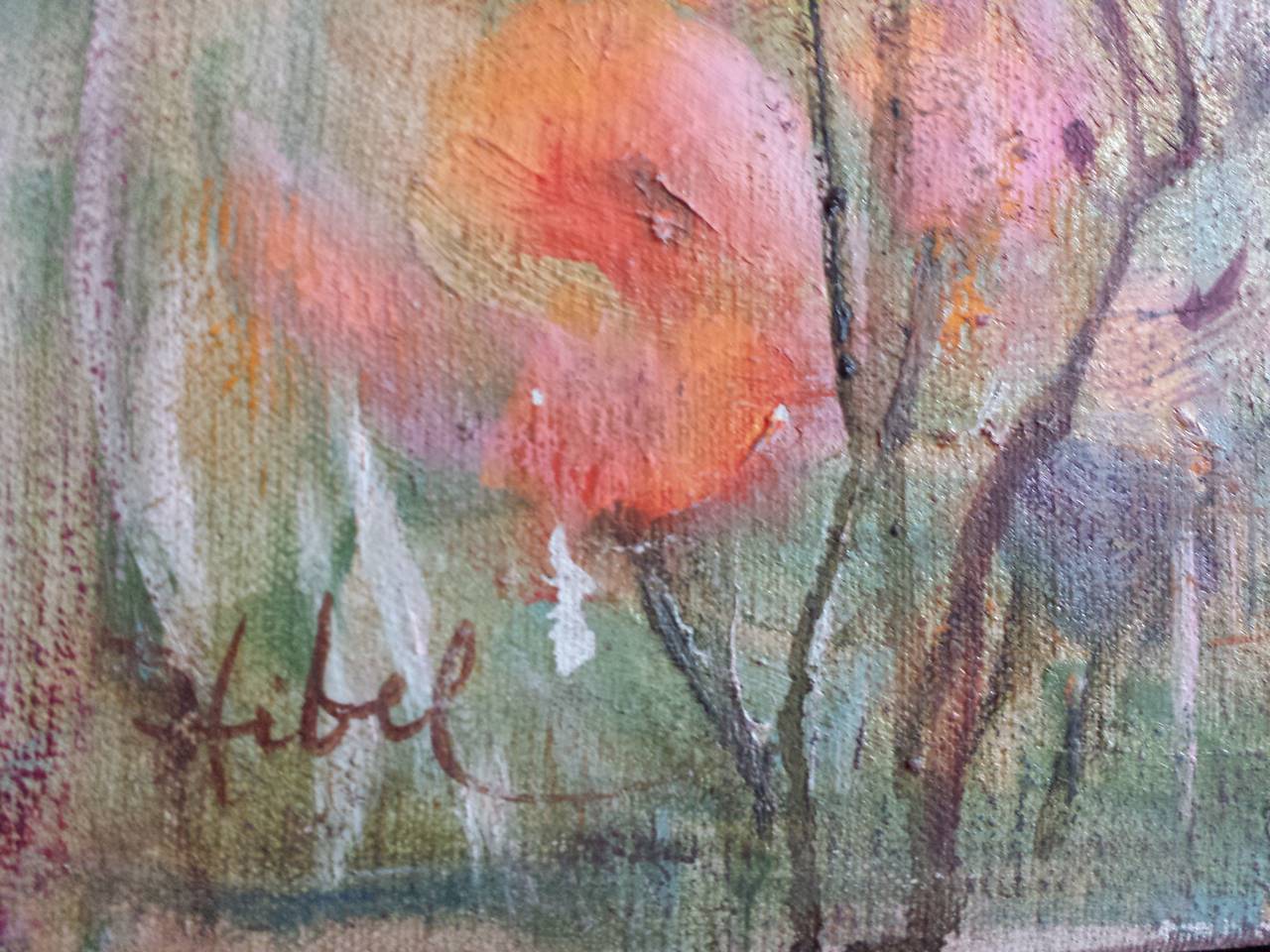
Arizona Desert
By Edna Hibel
Located in West Palm Beach, FL
Original Painting on Canvas by Renown Artist Edna Hibel
Oil