By Elsie Driggs
Located in Wilton Manors, FL
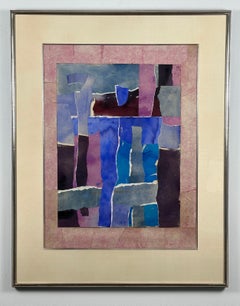
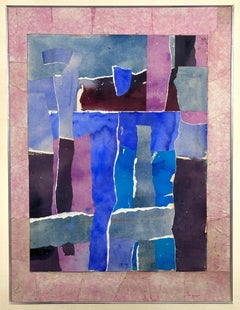
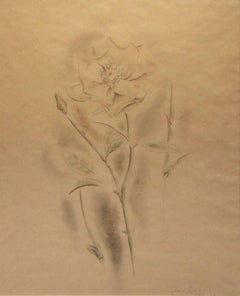
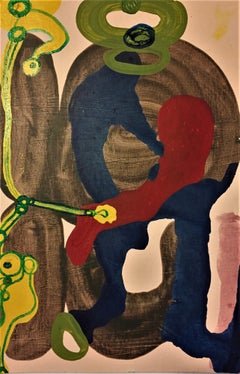
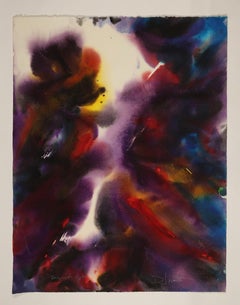
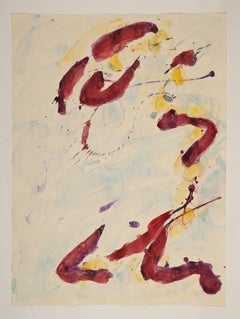
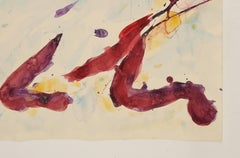
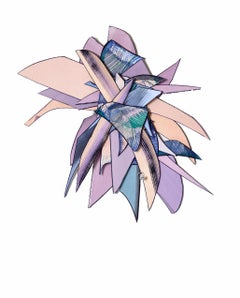
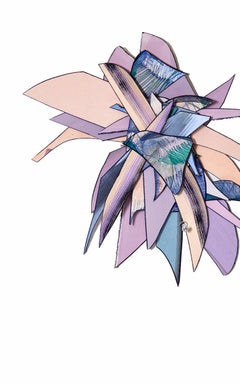
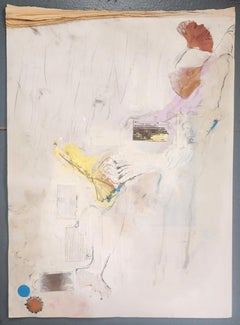
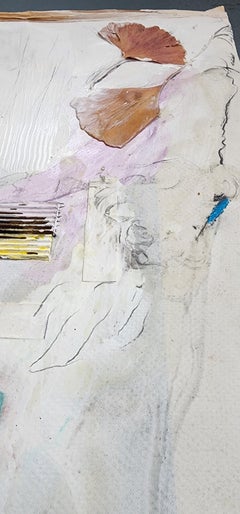
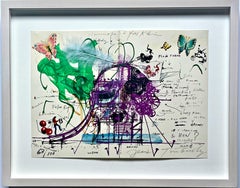
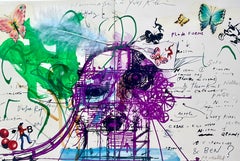
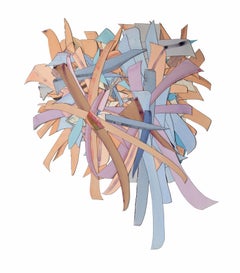
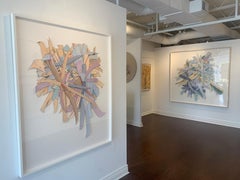
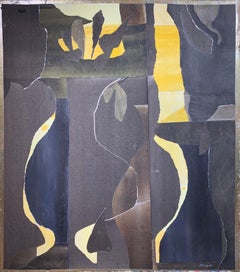
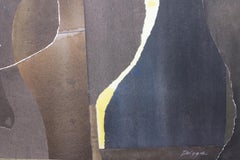
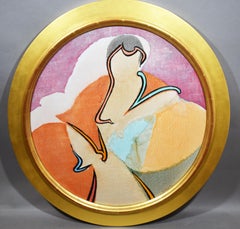
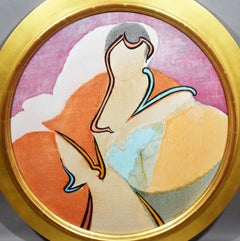
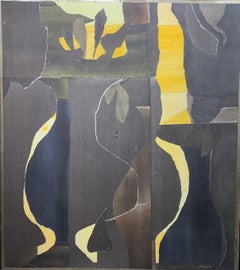
Elsie B. (Gatch) Driggs (1898-1992) – Untitled, c.1950. Mixed media collage, SLR. Painted and torn paper affixed to illustration board. 34.5″h x 31″w and 38.5h x 35″w framed. Excellent condition with no damage or fading. Signed lower right. Vintage solid chestnut wood frame repainted black. Archival materials, UV filter glass.
Biography:
Birth place: Hartford, CT
Death place: NYC
Addresses: Lambertville, NJ, c.1935-68; NYC, 1968-92
Profession: Painter
Studied: ASL, 1918-21 with John Sloan and G. Luks; also with Maurice Sterne, Rome, 1922
Exhibited: Soc. Indep. Artists, 1922, 1931; WMAA, 1926-36; “35 Under 35,” MoMA, 1930 (opening show); Provincetown AA, 1930s; “A Mile of Art,” Munic. Art Exhib., R.C.A. Bldg, 1934; Rehn Gal., NYC; Daniel Gal., NYC; Am. Soc. PS&G; AIC, 1939; Baltimore Mus. Art, 1953; MMA, 1954; “The Precisionists,” WMAA, 1963; Martin Diamond Gal., NYC, 1980 (retrospective), 1982; NJ State Mus., 1980 (retrospective; traveled to the Phillips Collection)
Member: Am. Soc. PS&G.
Work: WMAA; Baltimore Mus. Art; Yale Univ. Art Gal.; Phillips Mem Gal; Montclair AM; Sheldon Mem. Gallery, Lincoln, NE. Commissions: animal cartoons and W. African gold weights for WPA, Harlem House, NYC, 1934; Post Offices in La Salle, Huntsville & Rayville, LA, 1935; Indian Village, private commission, New York, 1938.
Comments: A Precisionist painter, she was one of the early women modernists. She married the painter Lee Gatch in 1935. Positions: WPA artist; asst., MMA, 1923. Teaching: instructor, 1945-48.
Born in Hartford, Connecticut, Driggs grew up in New Rochelle, a suburb of New York City, in a family that was supportive of her artistic interests. After a summer spent painting with her sister in New Mexico in her late teens, she felt she had found her life’s calling. At twenty, she enrolled in classes at the Art Students League of New York, where she studied under George Luks and Maurice Sterne, both of whom were charismatic, inspirational figures in her early life. She also attended the evening criticism classes held at the home of painter John Sloan. Driggs spent fourteen months in Europe from late 1922 to early 1924, drawing and studying Italian art. There she met Leo Stein, first in Paris and later in Florence, who became an important intellectual influence, and who urged her to study Cézanne. He also introduced her to the works of Piero della Francesca, the Renaissance artist for whom she felt throughout her life the greatest admiration.[1]
Driggs eventually settled in New York City, where she found representation with the progressive Charles Daniel Gallery.[2] (Advised that the old-fashioned and misogynistic Daniel would be unlikely to take on a woman artist, she signed the works she left for his consideration simply “Driggs” and waited to meet him in person until he had expressed his eagerness to include her in his gallery.)[3] In sympathy with those artists Daniel represented who were part of the burgeoning Precisionist movement, such as Charles Demuth, Charles Sheeler, George Ault, Niles Spencer, and Preston Dickinson, she too painted “the modern landscape of factories, bridges, and skyscrapers with geometric precision and almost abstract spareness.”[4] Impressionism and academic or Ashcan realism represented the past, in Driggs’ view, and she intended to be resolutely modern. She was an attractive and engaging woman, but her demeanor belied a strong ambition and a clear sense of what it would take to make her mark in the New York art world. However, Driggs was part of the pre-eminent first group of Precisionist painters, including Demuth and Sheeler, who exhibited at the Daniel Gallery in the 1920s. A later group of Precisionist painters, including Louis Lozowick, Ralston Crawford and others, came on the American Art scene during the 1930s. Driggs, herself, felt that the style came to an end with the 1929 stock market crash.[5]
In 1926 she painted her most famous work, Pittsburgh, a dark and brooding picture now in the permanent collection of the Whitney Museum of American Art, which depicts the gargantuan smokestacks of the Jones & Laughlin steel mills in Pittsburgh. Its focus is an overpowering mass of black and gray smokestacks, thick piping, and crisscrossing wires with only clouds of smoke to relieve the severity of the image, yet it was an image in which she found an ironic beauty. She called the picture “my El Greco” and expressed surprise that viewers in later years interpreted the painting as a work of social criticism.[6] Like the other Precisionists (e.g., Demuth, Charles Sheeler, Louis Lozowick, Stefan Hirsch), she was concerned with applying modernist techniques to renderings of the new industrial and urban landscape, not in commenting on potential dangers the overly mechanized modern world of 1920s America might present. If anything, Precisionism, like Futurism, was a celebration of man-made energy and technology. One year later, she painted Blast Furnaces, in a similar vein. As noted above, Piero della Francesca’s mural depicting “The Story of the True Cross” in Arezzo, with its tubular, static and frozen forms was the major influence on Driggs’ “Pittsburg” (it may have been the major influence for “Blast Furnaces” as well).[7]
After Pittsburgh, Driggs’ most acclaimed work was probably Queensborough Bridge (1927), now in the collection of the Montclair Art Museum, depicting shafts of light as rigid Futurist-style “lines of force” sweeping through the massive verticals of the East River bridge, a structure she had studied from her apartment window on Second Avenue. With this painting, art critic Forbes Watson wrote, ‘Miss Driggs waves goodbye to her old master Maurice Sterne and embraces for the moment the age of machinery.”[8] However, Driggs’ use of “ray lines” (slender black lines that criss-cross the canvas, recall Precisionist works by Charles Demuth, and particularly his “My Egypt” (also from 1927).[9] Although Driggs and Demuth exhibited at the Daniel Gallery, they never met.
In 1929 Charles Daniel gave Driggs a one-woman show, which included one of her sleekest and most compelling paintings, Aeroplane, now in the collection of the Houston Museum of the Fine Arts. The inspiration for the painting came from Driggs’ first experience flying in 1928, when she traveled from Cleveland to Detroit by air.[10] (“Elsie Driggs, following the spirit of the age, has gone up in the air,” commented an Art News reviewer.[11] Actually, Driggs went to Detroit to make studies from the Ford Motor Company’s River Rouge...
Category
Mid-20th Century Abstract Expressionist Elsie Driggs Art
MaterialsPaper, Ink, Watercolor