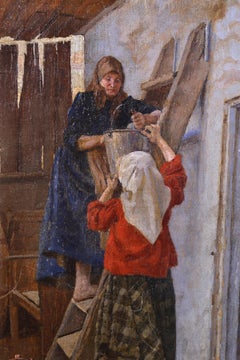
By Rogelio de Egusquiza y Barrena
Located in Madrid, ES
ROGELIO DE EGUSQUIZA Y BARRENA
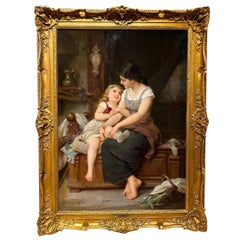
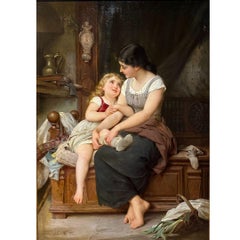
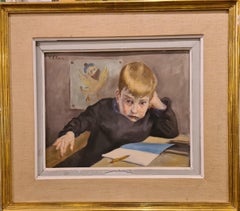
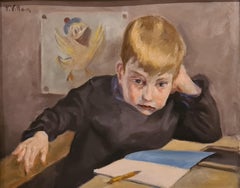
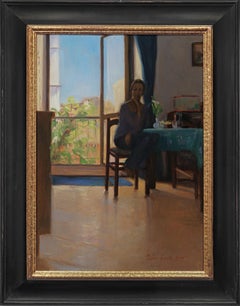
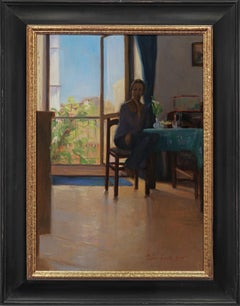
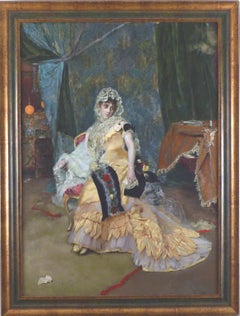
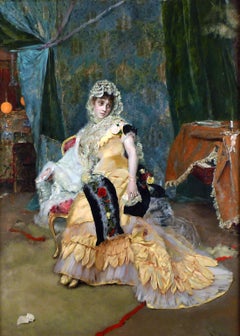
LADY IN YELLOW
signed "R. Egusquiza" (lower right)
oil on panel
28-5/8 X 20-3/4 inches (72.5 X 52.7 cm.)
framed: 32-5/8 X 24-3/4 inches (82.5 X 62.5 cm.)
Rogelio de Egusquiza y Barrena (1845 – 10 February 1915) was a Spanish painter, known for his friendship with the German composer Richard Wagner, whose works he helped make familiar in Spain
He was born in El Astillero, into a well-to-do family. He studied in Madrid and with Léon Bonnat at the École des Beaux-Arts in Paris. In 1868, after travelling and participating several times in the National Exhibition of Fine Arts, he returned to Paris and settled there. At first, he painted historical scenes, but later turned to genre scenes and portraits in the Academic style.
Following the death of Marià Fortuny, he moved to Rome at the invitation of the Madrazos, Raimundo and Ricardo, taking Fortuny's place at their studio through 1875 and attending classes at the Spanish Academy in Rome.
He heard Wagner's music for the first time in 1876, after returning to Paris. Three years later, he travelled to Munich to hear a performance of The Ring of the Nibelungen. His enthusiasm for what he heard led him to go to Bayreuth, where he introduced himself to Wagner and became his friend. In the following years, he and Wagner got together again several times; in Venice (1880), Berlín (1881) and Bayreuth (1882); where he was a guest at the premiere of Parsifal.
After his first meeting with Wagner, he decided to devote his career to doing works on Wagnerian themes; mostly portraits of the characters rather than specific scenes. During his visits to Germany, he also created portraits of Arthur Schopenhauer (posthumous) and King Ludwig II...
Category
1880s Realist Emile Munier Figurative Paintings