Eugene Vail Paintings

American, 1857-1934
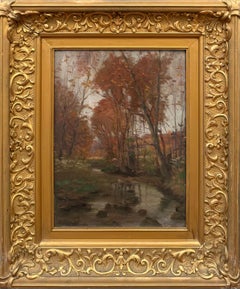
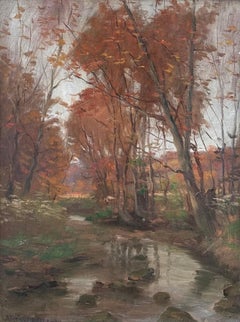
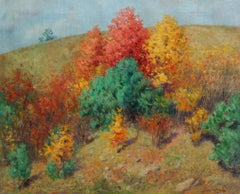
Eugene Vail was a cosmopolitan artist of American-French background. He was one of a close-knit circle of young painters in the ateliers in Paris and at the artists' colonies of Grez-sur-Loing, Concarneau and Etaples during the 1880s. He was a close friend of Irish artists Frank O'Meara and John Lavery. His pictures enjoyed great success at the Paris Salon and he was awarded the Legion d'Honneur. Eugene Laurent Vail was born of an American father and French mother in St. Servan, near St. Malo, Brittany, in 1857. He gained an engineering degree at the Stevens Institute of Technology, Hoboken, New Jersey. He worked as a cartographer on a scientific expedition in the West of America. Vail was also a keen sportsman and had an interest in theatre and art. He began to study at the Art Students' League, New York, in the studios of William Chase and Carol Beckwith. He travelled to Paris c.1882 and became a pupil at the Academie Julian. He became a close friend of John Lavery's there. In March 1882, he entered the Ecole des Beaux Arts, studying in the atelier of Cabanel. He was also a pupil of Collin and Dagnan-Bouveret. Vail first exhibited in the Paris Salon in 1883. In common with many of his contemporaries, Vail was impatient to paint from nature. In 1883, Vail first exhibited at the Paris Salon. In the same year he visited Brittany: Pont-Aven, and Concarneau, in the company of American students Harrison and Simmons. Vail favoured marine and harbour subjects. His best-known Breton painting, Le Port de la Peche, Concarneau (Musée des Beaux Arts, Brest), is a large, low-key study of the harbour and fishing boats. Although sombre in tone, there is a glowing twilight atmosphere, that was, perhaps, to influence Charles Cottet's paintings of Brittany. The picture was exhibited at the Salon in 1884. It was purchased by the French State for the Musée Luxembourg. In 1887, Vail moved to Etaples, Pas-de-Calais. He spent the winter there, lodging with his friends from Grez, O'Meara and Scottish artist Middleton Jameson. Although less well known than the great art colonies, and less picturesque than Concarneau, Etaples was convenient to reach, being close to Boulogne, and living was cheaper there than at Grez. Vail exhibited at the Salon again in 1886 and in 1888, when he was awarded a 3rd class medal. His work was praised by Albert Wolff, art critic of Le Figaro.' Vail served on the international jury of the Exposition Universelle in Paris in 1889. Four of his pictures were also exhibited there and he received a gold medal. Some of Veil's paintings were known for their dark tonality. Like Welden Hawkins, some of his subsequent work became more decorative and Symbolist, showing the influences of Whistler, Japonisme and the Nabis.
to
1
Overall Width
to
Overall Height
to
1
1
1
1
1
1
1
1
1
1
1
780
728
722
683
1
1
Artist: Eugene Vail
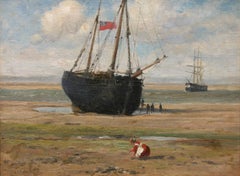
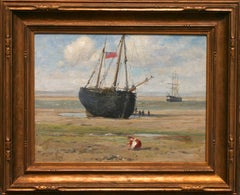
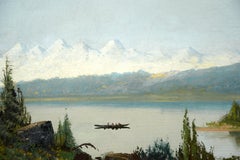
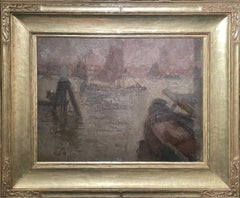
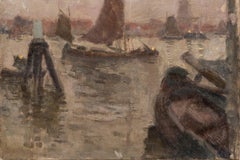
"Soir de Novembre, Dordrecht, " Eugene Vail, Dutch Landscape with Boats, Cloudy
By Eugène Lawrence Vail
Located in New York, NY
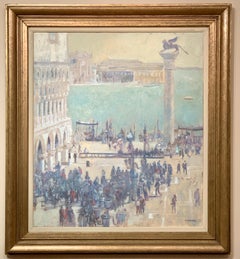
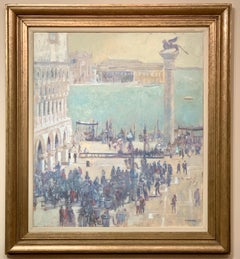
Eugène Laurent Vail (1857 - 1934) Soir de Novembre, Dordrecht Oil on canvas 19 1/4 x 25 3/4 inches Signed lower left; titled in two places on the stretcher with various other inscriptions, stamped "MADAME G:VAIL A" and inscribed "177" in ink and "#43" in pencil on a partial label from Garde-Meuble Maple affixed to the stretcher Eugene Vail (Saint-Servan, France September 29, 1857 - Paris, December 28, 1934), the son of a French mother and an American father, Lawrence Eugene Vail, studied at the Stevens Institute of Technology in Hoboken, New Jersey (where Alfred Stieglitz was born in 1864) and graduated with a degree in mechanical engineering in 1877. Then he became a student of William Merritt Chase and J. Carroll Beckwith at the Art Students League before returning to France. He entered the Ecole des Beaux-Arts in 1882 where he was instructed by Alexandre Cabanel, Raphaël Collin, and Dagnan-Bouveret (1852-1929), known as an extreme naturalist. When Bastien-Lepage died in 1884, Dagnan-Bouveret became the leader of the Naturalist School. He definitely made an indelible impression on Vail. According to Louise Cann, Vail soon became an independent painter working at Pont-Aven and Concarneau. It is difficult to determine when he separated from his teachers since he is listed as a student whenever he exhibited at the Paris Salon — that is, until 1899 when he dropped the mention of élève. A picture of a peasant girl, Seulette was his Salon debut painting in 1883, the same year that he sent two scenes of Brittany to the Pennsylvania Academy of the Fine Arts' exhibition, which documents his stay in that region. The next year he exhibited in the Salon: Fishing Port, Concarneau, which went to the Luxembourg Museum (it is now in the Musée Municipal of Brest). It has the Naturalist brown and gray palette and tonalist atmosphere but already shows that Vail had direct experience with scenes of life in coastal villages: "So convincing was his familiarity with the French coast that the critic Thiébault-Sisson claimed him as a Frenchman and declared that no American marine painter could touch his skill." (Maureen C. O'Brien, in Blaugrund, 1989, p. 218). In 1885, Vail exhibited Inner Port at Dieppe and in the following year On the Thames (Private collection), which later won him the Grand Diploma of Honor from an international jury in Berlin in 1891. Widow, the title of Vail's entry in the Salon of 1887 (unlocated), is a striking image of a woman standing on a beach, looking out to the expanse of the ocean where her husband obviously met his end. The innocent child who looks at us may have the same fate in store for him. Then in 1888, Vail completed his masterpiece, Ready, About! a "wall-size" 94 x 125½ inch canvas. The painting won a first-class gold medal in the Salon of 1888, then at the Paris Universal Exposition of 1889, Vail won another gold medal. The first precedent that comes to mind is Théodore Géricault's colossal Raft of the Medusa of 1819 (Louvre), the celebrated romantic image of castaways about to be rescued after being lost at sea. But while Géricault presents a massive, sculpturesque group of figures struggling on a raft just beyond our designated viewing space, Vail pulls the viewer into the picture, or more exactly, extends the diagonally rocking boat into the spectator's area, vividly anticipating the effects of cinematography. There is no more effective way to engage the spectator's attention and sympathies, and the illusionism is especially effective in this life-size picture. Vail's vigorous brushwork — a uniform use of rectangular strokes — adds to the motion-filled, dynamic actuality of this image, and the overall green-gray tonalities evoke the constantly menacing, cold and wet travails in the life of the fishermen in the Atlantic's rough waters. Theodore Child (1889, p. 518) wrote about this painting: "very beautiful in color, and amongst the very strongest and best pictures of this kind in the Exhibition." Dordrecht (unlocated) was Vail's painting exhibited at the Pennsylvania Academy in 1892, and in the following year he showed Fisherman — The North Sea at the Paris Salon, the same year in which he re-exhibited Dordrecht and On the Thames at the World's Columbian Exposition in Chicago. Vail won the coveted Légion d'Honneur in 1894. Some of his paintings found their way to European museums, for example, Soir de novembre (Odessa Museum) and Soir de Bretagne (Museo d'Arte Moderna, Venice). The latter was exhibited at the Exposition Universelle of 1900 in Paris. Also there was Voix de la mer (Voices of the Sea), which we identify as the painting that appears in an interior view of the American section, just to the right of a doorway (fig. 20 in Fischer, 1999), a simple marine painting. Some time after 1900, Vail turned to both impressionism and post-impressionism but no one seems to have charted this course. His Autumn near Beauvais, illustrated in International Studio (1902, p. 211), The Flags, St. Mark's Venice (1903; National Gallery of Art), and Grand Canal, Venice, ca. 1904 (Museum of Art, Rhode Island School of Design) demonstrate an impressionist technique with broken color. Mandel (1977, p. 202) wrote on the latter: "applied in short strokes juxtaposing brilliant hues of orange, blue, white, black and red, with a strong interplay between the warm pink tones of the walls and the green shadows of the black boats which are silhouetted against them." Cann (1937) believed that in Venice, Vail "found his true self." The Flags forecasts the Armistice Day pictures by Hassam and others, painted fifteen years later. Vail became involved in the Society of American Artists in Paris and the Société Internationale de Peinture et de Sculpture, whose membership included Frank Brangwyn, Charles Cottet (1863-1924), the famous Naturalist sculptor Constantin Meunier (1831-1905), Frits Thaulow...
Category

Early 20th Century American Impressionist Eugene Vail Paintings

Materials

Canvas, Oil

Related Items
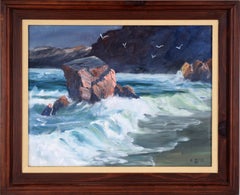
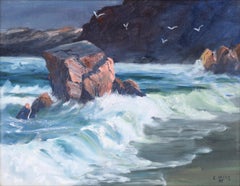
Emile Albert Gruppe “Winter - Gloucester MA”
By Emile Albert Gruppe
Located in Dallas, TX
Emile Albert Gruppe (American, 1896-1978) "Winter - Gloucester, Mass" Oil on canvas Signed "Emile A. Gruppe" (lower right) Canvas: 20 x 24 Inchesinches Framed: 27 x 31 inches Prove...
Category

1950s American Impressionist Eugene Vail Paintings

Materials

Canvas, Oil

Harborfront, American Impressionist, 20th Century, Wooden Sailing Ships at Dock
Located in Wiscasset, ME
In "Harborfront" the artist uses colorful, impressionist brushstrokes to bring a working waterfront to life.
Category

20th Century American Impressionist Eugene Vail Paintings

Materials

Canvas, Oil, Board

Sunny Day in the Park
Located in Buffalo, NY
19th century Impressionist oil painting of two women in a park. Oil on canvas, circa 1900. Signed illegibly lower left. Displayed in giltwood...
Category

1890s American Impressionist Eugene Vail Paintings

Materials

Canvas, Oil

Sunny Day in the Park
$3,975
H 29 in W 31 in D 2 in
The Empty Barn - California Country Scene Oil on Canvas
Located in Soquel, CA
The Empty Barn - California Country Scene Oil on Canvas American Impressionist oil painting of a vacant wooden barn along the hillside. A wooden barn acts as the focal point, with ...
Category

1960s American Impressionist Eugene Vail Paintings

Materials

Canvas, Oil

The Empty Barn - California Country Scene Oil on Canvas
$348 Sale Price
20% Off
H 14 in W 18 in D 1 in
A Peaceful Country Lane
Located in San Francisco, CA
There’s a gentle hand in Emanuel Matthews’ landscapes, exhibiting here and in other pieces a fondness for a more bucolic, genteel and barely industrialized America. Although painted ...
Category

20th Century American Impressionist Eugene Vail Paintings

Materials

Canvas, Oil

A Peaceful Country Lane
$1,650
H 32 in W 44 in D 2 in
Giverny
By John Leslie Breck
Located in Bryn Mawr, PA
Giverny, 1888 Oil on canvas, 11 x 14 inches (27.9 x 35.6 cm) Framed dimensions: 18 5/8 x 22 1/4 inches Signed and dated lower right: John Leslie Breck 88 Provenance Private collect...
Category

1880s American Impressionist Eugene Vail Paintings

Materials

Canvas, Oil

Giverny
Giverny
$80,000
H 11 in W 14 in
American Impressionist Oil on Canvas Painting "California Highlands" Los Angeles
By Charles Smith
Located in Portland, OR
A very attractive California Impressionist oil on canvas painting by Charles L. A. Smith, "California Highlands", dated 1930. This very attractive large painting by one of the foremo...
Category

1930s American Impressionist Eugene Vail Paintings

Materials

Canvas, Oil

A Quiet River - Oil on Canvas by A. Whipple
Located in Soquel, CA
A Quiet River - Oil on Canvas Oil painting depicting a river flowing through a grove of trees. Vibrant green trees surround the river, hues of deep greens make up the trees to the l...
Category

1940s American Impressionist Eugene Vail Paintings

Materials

Canvas, Oil

Pocono Mountains Pennsylvania in Winter Original Oil on Canvas by Bobby Topping
Located in Soquel, CA
Pocono Mountains Pennsylvania in Winter Original Oil on Canvas by Bobby Topping Pocono Pennsylvania Mountains in winter by Belchertown and Amherst Massachusetts artist Barbara Ann "B...
Category

1960s American Impressionist Eugene Vail Paintings

Materials

Canvas, Oil

Roadside Eucalyptus Trees, Mid Century Vertical Landscape by Jon Blanchette
By Jon Blanchette
Located in Soquel, CA
Roadside Eucalyptus Trees, Mid Century Vertical Landscape by Jon Blanchette Gorgeous mid-century plein air landscape painting of a tall Eucalyptus tree along a California road side...
Category

1960s American Impressionist Eugene Vail Paintings

Materials

Canvas, Masonite, Oil

Southern Marshes in Summer Florida Highwaymen Style
Located in Soquel, CA
Marshes and trees in Summer colors by an American (signature illegible) artist. Circa 1970s. Reminiscent of the Florida Highwaymen style. Ruby Velve...
Category

1970s American Impressionist Eugene Vail Paintings

Materials

Canvas, Oil

Horse Stables in the Valley - Farm Landscape
Located in Soquel, CA
Idyllic farm landscape by unknown artist F. Wright (20th Century). A large animal barn is nestled among lush trees, in a large valley. In the distance, a tree-covered hillside wraps ...
Category

Mid-20th Century American Impressionist Eugene Vail Paintings

Materials

Canvas, Oil

Previously Available Items
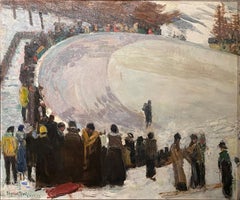
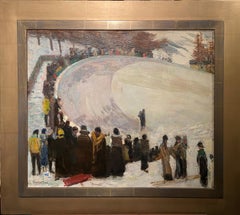
"St. Moritz, A Sunny Corner" Eugene Vail, Winter Bobsled Figures in Snow, Ashcan
By Eugène Lawrence Vail
Located in New York, NY
Eugene Lawrence Vail (1857 - 1934) St. Moritz, A Sunny Corner, circa 1925 Oil on canvas 21 1/4 x 25 1/2 inches Signed lower left Provenance: Berry-Hill Galleries, New York Eugene Vail (Saint-Servan, France September 29, 1857 - Paris, December 28, 1934), the son of a French mother and an American father, Lawrence Eugene Vail, studied at the Stevens Institute of Technology in Hoboken, New Jersey (where Alfred Stieglitz was born in 1864) and graduated with a degree in mechanical engineering in 1877. Then he became a student of William Merritt Chase and J. Carroll Beckwith at the Art Students League before returning to France. He entered the Ecole des Beaux-Arts in 1882 where he was instructed by Alexandre Cabanel, Raphaël Collin, and Dagnan-Bouveret (1852-1929), known as an extreme naturalist. When Bastien-Lepage died in 1884, Dagnan-Bouveret became the leader of the Naturalist School. He definitely made an indelible impression on Vail. According to Louise Cann, Vail soon became an independent painter working at Pont-Aven and Concarneau. It is difficult to determine when he separated from his teachers since he is listed as a student whenever he exhibited at the Paris Salon — that is, until 1899 when he dropped the mention of élève. A picture of a peasant girl, Seulette was his Salon debut painting in 1883, the same year that he sent two scenes of Brittany to the Pennsylvania Academy of the Fine Arts' exhibition, which documents his stay in that region. The next year he exhibited in the Salon: Fishing Port, Concarneau, which went to the Luxembourg Museum (it is now in the Musée Municipal of Brest). It has the Naturalist brown and gray palette and tonalist atmosphere but already shows that Vail had direct experience with scenes of life in coastal villages: "So convincing was his familiarity with the French coast that the critic Thiébault-Sisson claimed him as a Frenchman and declared that no American marine painter could touch his skill." (Maureen C. O'Brien, in Blaugrund, 1989, p. 218). In 1885, Vail exhibited Inner Port at Dieppe and in the following year On the Thames (Private collection), which later won him the Grand Diploma of Honor from an international jury in Berlin in 1891. Widow, the title of Vail's entry in the Salon of 1887 (unlocated), is a striking image of a woman standing on a beach, looking out to the expanse of the ocean where her husband obviously met his end. The innocent child who looks at us may have the same fate in store for him. Then in 1888, Vail completed his masterpiece, Ready, About! a "wall-size" 94 x 125½ inch canvas. The painting won a first-class gold medal in the Salon of 1888, then at the Paris Universal Exposition of 1889, Vail won another gold medal. The first precedent that comes to mind is Théodore Géricault's colossal Raft of the Medusa of 1819 (Louvre), the celebrated romantic image of castaways about to be rescued after being lost at sea. But while Géricault presents a massive, sculpturesque group of figures struggling on a raft just beyond our designated viewing space, Vail pulls the viewer into the picture, or more exactly, extends the diagonally rocking boat into the spectator's area, vividly anticipating the effects of cinematography. There is no more effective way to engage the spectator's attention and sympathies, and the illusionism is especially effective in this life-size picture. Vail's vigorous brushwork — a uniform use of rectangular strokes — adds to the motion-filled, dynamic actuality of this image, and the overall green-gray tonalities evoke the constantly menacing, cold and wet travails in the life of the fishermen in the Atlantic's rough waters. Theodore Child (1889, p. 518) wrote about this painting: "very beautiful in color, and amongst the very strongest and best pictures of this kind in the Exhibition." Dordrecht (unlocated) was Vail's painting exhibited at the Pennsylvania Academy in 1892, and in the following year he showed Fisherman — The North Sea at the Paris Salon, the same year in which he re-exhibited Dordrecht and On the Thames at the World's Columbian Exposition in Chicago. Vail won the coveted Légion d'Honneur in 1894. Some of his paintings found their way to European museums, for example, Soir de novembre (Odessa Museum) and Soir de Bretagne (Museo d'Arte Moderna, Venice). The latter was exhibited at the Exposition Universelle of 1900 in Paris. Also there was Voix de la mer (Voices of the Sea), which we identify as the painting that appears in an interior view of the American section, just to the right of a doorway (fig. 20 in Fischer, 1999), a simple marine painting. Some time after 1900, Vail turned to both impressionism and post-impressionism but no one seems to have charted this course. His Autumn near Beauvais, illustrated in International Studio (1902, p. 211), The Flags, St. Mark's Venice (1903; National Gallery of Art), and Grand Canal, Venice, ca. 1904 (Museum of Art, Rhode Island School of Design) demonstrate an impressionist technique with broken color. Mandel (1977, p. 202) wrote on the latter: "applied in short strokes juxtaposing brilliant hues of orange, blue, white, black and red, with a strong interplay between the warm pink tones of the walls and the green shadows of the black boats which are silhouetted against them." Cann (1937) believed that in Venice, Vail "found his true self." The Flags forecasts the Armistice Day pictures by Hassam and others, painted fifteen years later. Vail became involved in the Society of American Artists in Paris and the Société Internationale de Peinture et de Sculpture, whose membership included Frank Brangwyn, Charles Cottet (1863-1924), the famous Naturalist sculptor Constantin Meunier (1831-1905), Frits Thaulow (1847-1906), the painter of northern snowscapes, Walter Gay, and the post-impressionists Henri Martin (1860-1943) and Henri Le Sidanier (1862-1939). The group was represented by the Galerie Georges Petit. Naturally, such an association encouraged the seeking out of more modernist directions. In his Swiss mountain landscapes...
Category

1920s Ashcan School Eugene Vail Paintings

Materials

Canvas, Oil

Eugene Vail paintings for sale on 1stDibs.

Find a wide variety of authentic Eugene Vail paintings available for sale on 1stDibs. You can also browse by medium to find art by Eugene Vail in canvas, fabric, oil paint and more. Much of the original work by this artist or collective was created during the 20th century and is mostly associated with the Impressionist style. Not every interior allows for large Eugene Vail paintings, so small editions measuring 19 inches across are available. Customers who are interested in this artist might also find the work of Frank Vincent Dumond, Albert Van Nesse Greene, and Victor Coleman Anderson. Eugene Vail paintings prices can differ depending upon medium, time period and other attributes. On 1stDibs, the price for these items starts at $11,000 and tops out at $11,000, while the average work can sell for $11,000.