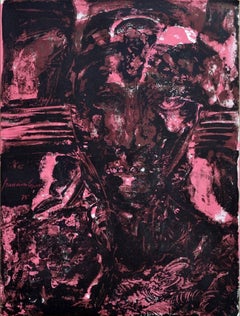
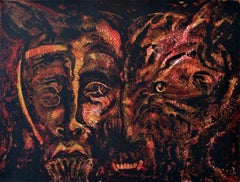
Francisco Corzas Art

to
5
Overall Width
to
Overall Height
to
5
4
4
1
4
1
5
3
3
2
2
1
1
1
1
5
5
10,734
2,826
2,495
1,414
5
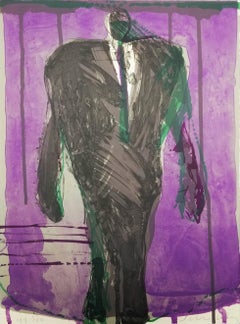
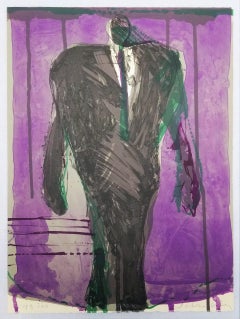
Artist: Francisco Corzas
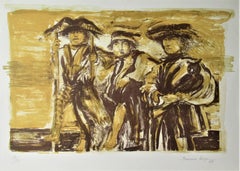
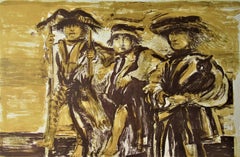
Three Men
Three Men

Three Men

By Francisco Corzas

Located in San Francisco, CA

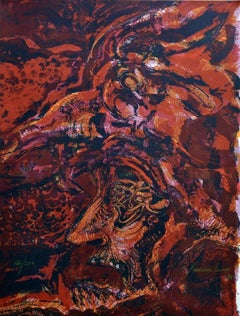
Artist: Francisco Corzas (Mexican, 1936-1983) Title: Three Men Year: 1968 Medium: Color lithograph Edition: Numbered 17/30 in pencil Paper: Wove Image ...

Category

Mid-20th Century Expressionist Francisco Corzas Art

Materials

Lithograph

Related Items
ASU Portrait II /// Fritz Scholder Native American Indian Expressionist Surreal

ASU Portrait II /// Fritz Scholder Native American Indian Expressionist Surreal

By Fritz Scholder

Located in Saint Augustine, FL

Artist: Fritz Scholder (Native American, 1937-2005) Title: "ASU Portrait II" Portfolio: Arizona State University Centennial Portfolio *Signed by Scholder in pencil lower right Year: 1984 Medium: Original Lithograph on Arches Cover buff paper Limited edition: 49/100 Printer: Joseph M. Segura of the Print Research Facility, School of Art, Arizona State University, Tempe, AZ Publisher: the Print Research Facility, School of Art, Arizona State University, Tempe, AZ Sheet size: 20.25" x 15" Reference: "Collaborative Works: Recent Work and Catalogue Raisonné of the Visual Arts Research Institute" - ASU/VARI No. 121, page 98 Condition: Never framed, has been professionally stored away within its original portfolio case for decades. In mint condition Not a single example of this work has ever appeared at auction in over 40 years. Extremely rare Notes: Provenance: one owner ever - private collection - Scottsville, AZ; acquired directly from the publisher the Print Research Facility, School of Art, Arizona State University, Tempe, AZ upon its release in 1984. Numbered by Scholder in pencil lower left. Comes from the 1984 "Arizona State University Centennial Portfolio" of eighteen prints in various mediums by Daniel R Britton, R. E. (Ron) Gasowski, Arthur W. Hahn, James Hajicek, Jules Heller...

Category

1980s Expressionist Francisco Corzas Art

Materials

Lithograph

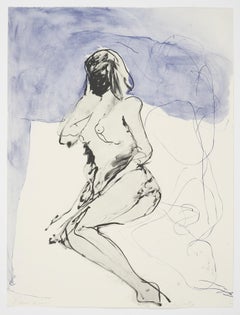
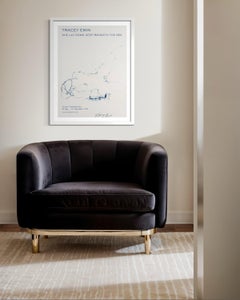
I Think of You

Tracey EminI Think of You, 2014

$20,432

H 90 in W 68 in

I Think of You

By Tracey Emin

Located in London, GB

Edition of 100 Lithographic print in 2 colours on Somerset 300 gsm paper 90 x 68 cm (35.4 x 26.7 in) Signed, numbered and dated by the artist.

Category

2010s Contemporary Francisco Corzas Art

Materials

Lithograph

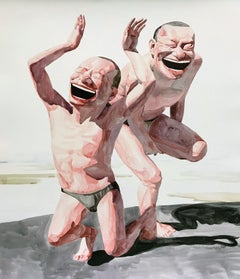
Untitled (Smile-ism No. 20)

Untitled (Smile-ism No. 20)

By Yue Minjun

Located in Calabasas, CA

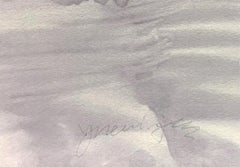
Artist: Yue Minjun Title: Untitled (Smile-ism No. 20) Year: 2006 Medium: Lithograph on Rives BFK paper Edition: 45; signed and numbered in pencil Sheet: 43.50 x 35.25 in. (110.5 x 8...

Category

Early 2000s Contemporary Francisco Corzas Art

Materials

Lithograph

Marc Chagall, The Lion of Judah and the Tablets of the Law, 1962

Marc Chagall, The Lion of Judah and the Tablets of the Law, 1962

By Marc Chagall

Located in Southampton, NY

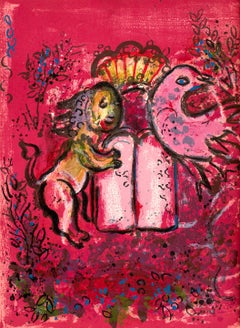
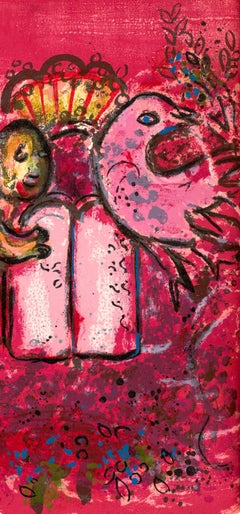
This exquisite lithograph by Marc Chagall (1887–1985), titled Le lion de Juda et les Tables de la Loi (The Lion of Judah and the Tablets of the Law), from the album Marc Chagall, The...

Category

1960s Expressionist Francisco Corzas Art

Materials

Lithograph

Rodeo Queen by Luis Jimenez

Rodeo Queen by Luis Jimenez

Located in Phoenix, AZ

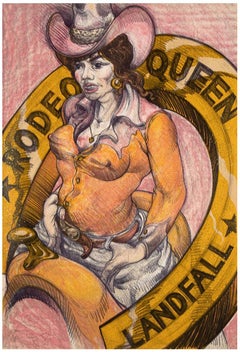
Rodeo Queen, 1981 Edition 36/50 Signed lower left, Inscribed: for the "Rose" 82. Provenance: Print was a gift to Rozanne Charington, companion and model for "Rodeo Queen", "Rose Tattoo" and "Jimenez at Adeliza's Candy Store". Lithograph on paper 42 ½ × 29 in. (107.3 × 73.7 cm) Luis Alfonso Jimenez Born, 1940, El Paso, Texas, died 2006, Hondo, New Mexico. Statement: Luis Jimenez, in his work, celebrates the vitality of life. . . . Jimenez es un hijo de la frontera; he knows its people and the landscape. It is the transformation of these people into art that is his most important contribution to the art of this vast region which stretches between Mexico and the United States. His subject matter utilizes the popular images of the cultura del norte, and a large part of it is depicted and transformed in the rough and tumble world of la frontera. He is also a son of el norte, and so he uses its materials and explores its emerging, popular myths. The tension and attraction of Jimnez’s work is that he always creates within the space of his two worlds, the Mexicano and the Americano. He constantly shows us the irony of the two forces which repel, while showing us glimpses of the synthesis he seeks. What a gift it has been to us for this talented artist to reflect on the soul of our region. He gives meaning to our existence and history. Rudolfo Anaya (passage chosen by the artist), A View from La Frontera, Man on Fire: Luis Jimenez, pp. 1, 3, 6Biography: Luis Jimenez was born in Texas to parents who had emigrated from Mexico to the United States; he would later dedicate his 1989 sculpture Border Crossing to his father, who had entered the country illegally. The elder Jimenez was a neon sign designer in El Paso, and Luis worked with him as a youth. His experience working in the neon shop and his fascination with U.S. car culture would both become major influences on his art career. Jimenez studied architecture at the University of Texas, Austin (UTA), and also took art courses in which he first created sculptures with wood, steel, and fiberglass, choosing the latter because of its association with U.S. popular culture. He subsequently became one of the artists who made fiberglass an acceptable medium in the 1960s. In 1964 Jimenez received his B.S. in art from UTA, and he continued his studies at the Universidad Nacional Autonoma de Mexico in Mexico City. In 1966 he moved to New York City and worked as an assistant to sculptor Seymour Lipton. Jimenez began to exhibit his art while in New York and in 1972 moved to New Mexico to focus on creating public sculptures, even as he maintained his diverse output of drawings, prints, and lithographs. Drawing on his early experiences, Jimenez creates works that come from a border perspective, one that draws upon the hybridity bred by culture clashes. Often socially and politically informed, his works speak not only in regional terms, those germane to the southwestern United States, but to broader, more global issues as well. They exhibit a profoundly Chicano aesthetic and sensibility, one that is informed by Mexican and Mexican American traditions, North American popular culture, Chicano cultural icons, and images and themes unique to the Southwest. Death, sexuality, and the struggle of the common people are frequent themes. Inspired by authors who write in an autobiographical style, Jimenez creates works that function as personal narrative yet are also able to make statements about culture in more global terms. His use of bold colors and lines, a legacy from his fathers work as a neon sign maker, lends a dynamic sensuality to his work, one that is particularly evident in his monumental fiberglass and acrylic urethane sculptural works Many of Jimenez's works correspond to scholar Toms Ybarra-Fraustos definition of the Chicano aesthetic of rasquachismo, a lowbrow sensibility that appeals to the working class in that it applies to objects that subvert expressions of the mainstream or dominant culture. Creating art that speaks to the people, Jimenez is able to transform regional and culturally specific myths and symbols into globally recognized and relevant icons. Exhibitions: In addition to his personal work, Jimenez has been commissioned for numerous public art projects. In 1999 his sculpture Southwest Piet was designated a National Treasure by First Lady Hillary Clinton. The many exhibitions featuring his work have included Human Concern/Personal Torment (Whitney Museum of American Art, New York, 1969). The First International Motorcycle Art Show (Phoenix Art Museum, Phoenix, AZ, 1973). Three Texas Artists (Centre Cultural Americaine, USIS, Paris, 1977), Recent Trends in Collecting (Smithsonian Institution, Washington, DC, 1982). Committed to Print (Museum of Modern Art, New York, 1989) Printmaking in Texas: The 1980s (Modern Art Museum, Fort Worth, TX. Laguna Gloria Art Museum, Austin, 1990. The Whitney Biennial (Whitney Museum of American Art, New York, 1991) Man On Fire: Luis Jimnez (Albuquerque Museum of Art, NM, 1994-95). 47th Annual Purchase Exhibition (American Academy of Arts and Letters, New York, 1995). Traveling solo exhibition, Working Class Heroes: Images from the Popular Culture (1997-2000). Jiménez Collier Gallery has been in continuous operation for over 40 years. Originally located just off Main Street in downtown Scottsdale, Arizona, we have moved to Phoenix to accommodate and showcase our large inventory including: • Original works by Maynard Dixon, Lon Megargee, Ed Mell, Fritz Scholder, Bill Schenck, Bill Lesch, Luis Jimenez, Greg Singley, Dan Budnik, and other 20th century Western, WPA and Contemporary Southwestern artists. • The Fine Art Estate of Lon Megargee • Vintage rodeo...

Category

1980s Contemporary Francisco Corzas Art

Materials

Lithograph

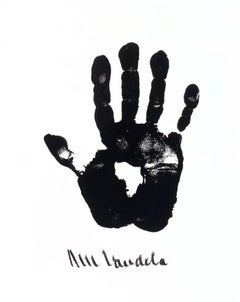
Hand of Africa - Mandela, Former South African President, Signed Artwork, Hand

Hand of Africa - Mandela, Former South African President, Signed Artwork, Hand

By Nelson Mandela

Located in Knowle Lane, Cranleigh

Nelson Mandela, Hand of Africa, Signed Limited Edition Lithograph Many people are unaware that Nelson Mandela turned his hand to art in his 80's as a way of leaving a legacy for his ...

Category

Early 2000s Contemporary Francisco Corzas Art

Materials

Lithograph

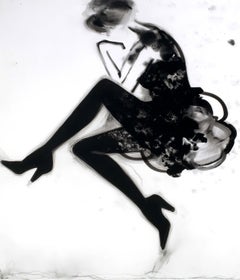
"Pensive (Thoughtful)" Print 40 x 30 inch Ed. of 50 by Gerard Marti

"Pensive (Thoughtful)" Print 40 x 30 inch Ed. of 50 by Gerard Marti

By Gerard Marti

Located in Culver City, CA

"Pensive (Thoughtful)" Print 40 x 30 inch Ed. of 50 by Gerard Marti Lithograph Not framed. Ships rolled in tube Signed and numbered by the artist. “Pensive” is an elegant evening ...

Category

21st Century and Contemporary Contemporary Francisco Corzas Art

Materials

Lithograph

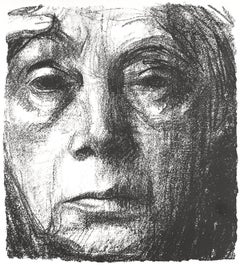
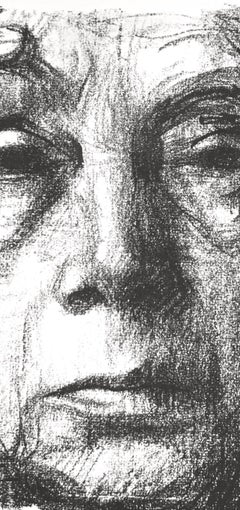
Kathe Kollwitz, Self-Portrait, from Ten Lithographs, 1941 (after)

Kathe Kollwitz, Self-Portrait, from Ten Lithographs, 1941 (after)

By Käthe Kollwitz

Located in Southampton, NY

This exquisite lithograph after Kathe Kollwitz (1867–1945), titled Selbstbildnis (Self-Portrait), from the folio Kathe Kollwitz, Ten Lithographs, originates from the 1941 edition published by Henry C. Kleemann, New York, and Curt Valentin, New York; printed by Duenewald Printing Corporation, New York. The composition reflects Kollwitz’s profound engagement with themes of identity, introspection, and human vulnerability, rendered with stark emotional intensity and a powerful graphic economy that underscores her enduring social message. Executed as a lithograph on velin paper, this work measures 19 x 16 inches (48.26 x 40.64 cm), overall; 10.5 x 9 inches (26.67 x 22.86 cm), image. Unsigned and unnumbered as issued. Artwork Details: Artist: After Kathe Kollwitz (1867–1945) Title: Selbstbildnis (Self-Portrait), from Kathe Kollwitz, Ten Lithographs Medium: Lithograph on velin paper Dimensions: 19 x 16 inches (48.26 x 40.64 cm), overall; 10.5 x 9 inches (26.67 x 22.86 cm), image Inscription: Unsigned and unnumbered as issued Date: 1941 Publisher: Henry C. Kleemann, New York, and Curt Valentin, New York Printer: Duenewald Printing Corporation, New York Condition: Well preserved, consistent with age and medium Provenance: From the folio Kathe Kollwitz, Ten Lithographs, 1941 About the Publication: Kathe Kollwitz, Ten Lithographs, published in New York in 1941 by Henry C. Kleemann in collaboration with Curt Valentin, represents an important early American presentation of Kollwitz’s graphic work at a time when her reputation was expanding internationally. Issued during the turbulence of the Second World War and following the suppression of her work in Germany under the Nazi regime, the folio played a crucial role in introducing her imagery to a broader audience outside Europe. The publication gathers a selection of her most powerful lithographic compositions, emphasizing her mastery of tonal contrast, expressive line, and psychological depth. Produced with careful attention to print quality by Duenewald Printing Corporation, the edition reflects the continued transmission of European modernist printmaking traditions into the American context, serving both as a document of artistic excellence and as a vehicle for the preservation and dissemination of Kollwitz’s humanistic vision. About the Artist: Kathe Kollwitz (1867–1945) was a German draughtsman, printmaker, and sculptor whose profoundly moving imagery, exceptional technical mastery, and unwavering social conscience established her as one of the most important and influential artists of the twentieth century, widely recognized as a master of modern printmaking and one of the most powerful visual chroniclers of human suffering, war, and social injustice. Born in Konigsberg, East Prussia, into a progressive and intellectually engaged family, Kollwitz was encouraged from an early age to pursue art and developed a deep awareness of social inequality that would shape her entire career, studying in Berlin and Munich at a time when women were largely excluded from formal academies while mastering drawing and graphic techniques with extraordinary discipline. Her breakthrough came with the monumental graphic cycle A Weavers’ Revolt (1893–1897), followed by The Peasants’ War (1901–1908), works that combined complex narrative structure with extraordinary technical command in etching, aquatint, and lithography, establishing her reputation as one of Europe’s leading graphic artists. Throughout her career, Kollwitz remained committed to portraying the lives of workers, mothers, and victims of poverty and conflict with unflinching honesty, creating compositions defined by bold, sculptural line, dense shadow, and unparalleled psychological depth that conveyed grief, resilience, and dignity. Working during a period transformed by the radical innovations of Pablo Picasso, Alexander Calder, Alberto Giacometti, Salvador Dali, Joan Miro, Wassily Kandinsky, Marcel Duchamp, and Man Ray, Kollwitz maintained a resolutely figurative and human-centered approach, aligning more closely with German Expressionism and artists such as Ernst Barlach, Max Liebermann, and Edvard Munch, whose emotional intensity and symbolic treatment of the human figure profoundly shaped her artistic language. Her later work, particularly the woodcut cycle War (1922–1923), stands among the most powerful anti-war statements in the history of art, reflecting both personal tragedy, including the death of her son in World War I, and a universal condemnation of violence and loss. In addition to her prints, Kollwitz created deeply moving sculptures that extended her exploration of grief and maternal protection into three dimensions, reinforcing her status as a multidisciplinary artist of exceptional range. She achieved significant recognition during her lifetime, becoming the first woman elected to the Prussian Academy of Arts, though her work was later condemned by the Nazi regime as degenerate, leading to her forced resignation and the removal of her works from public collections, yet her reputation expanded internationally after World War II and she is now regarded as a central figure in modern art. Her influence has been profound and far-reaching, shaping later artists including Francis Bacon, Anselm Kiefer, Leon Golub, Kiki Smith, and numerous contemporary figurative and socially engaged artists who continue to explore themes of trauma, memory, and human vulnerability. Today her works are held in major museum collections worldwide, including the Kathe Kollwitz Museum in Berlin, the Museum of Modern Art in New York, the British Museum in London, and the Art Institute of Chicago, and remain highly sought after by collectors for their emotional intensity and historical significance. The highest auction record for a work by Kathe Kollwitz is held by her sculpture Mutter mit totem Sohn (Mother with Dead Son), which achieved approximately 1.2 million EUR at auction, confirming her enduring importance. Kathe Kollwitz Selbstbildnis 1941 lithograph German Expressionism social realism print.

Category

1940s Expressionist Francisco Corzas Art
Materials

Lithograph

Composition Red and Blue

Composition Red and Blue

By David Hockney

Located in London, GB

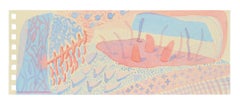
2005 Offset lithograph in colours on wove paper with the accompanying blue paper folio 10.7 x 28 cm An unsigned, unnumbered work from the edition of unknown size Published by Momart ...

Category

Early 2000s Contemporary Francisco Corzas Art

Materials

Lithograph

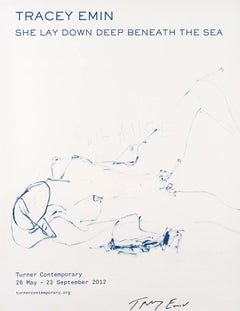
She Lay Down Deep Beneath the Sea

She Lay Down Deep Beneath the Sea

By Tracey Emin

Located in London, GB

2012 Offset lithograph in colours on wove paper 80 x 60 cm Signed in black in by Tracey Emin Published by Turner Contemporary Accompanied by a gallery Certificate of Authenticity Tr...

Category

2010s Contemporary Francisco Corzas Art

Materials

Paper, Lithograph, Offset

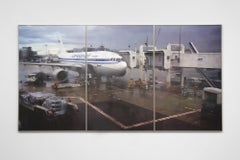
Untitled (Airport Paris)

Untitled (Airport Paris)

By Peter Fischli & David Weiss

Located in New York, NY

Peter Fischli / David Weiss Untitled (Airport Paris) 2008 Offset lithograph on three sheets Each sheet: 51 1/4 x 32 5/8 inches; 130 x 83 cm Edition of 100 Signed and numbered in ink ...

Category

Early 2000s Contemporary Francisco Corzas Art

Materials

Lithograph

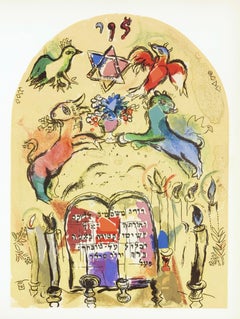
Marc Chagall, Tribe of Levi, from The Jerusalem Windows, 1962 (after)

Marc Chagall, Tribe of Levi, from The Jerusalem Windows, 1962 (after)

By Marc Chagall

Located in Southampton, NY

This exquisite lithograph after Marc Chagall (1887–1985), titled Tribe of Levi, from the album Marc Chagall, The Jerusalem Windows, originates from the 1962 edition published by Andr...

Category

1960s Expressionist Francisco Corzas Art
Materials

Lithograph

Francisco Corzas art for sale on 1stDibs.

Find a wide variety of authentic Francisco Corzas art available for sale on 1stDibs. You can also browse by medium to find art by Francisco Corzas in lithograph, engraving, paper and more. Much of the original work by this artist or collective was created during the 20th century and is mostly associated with the contemporary style. Not every interior allows for large Francisco Corzas art, so small editions measuring 20 inches across are available. Customers who are interested in this artist might also find the work of Juan Soriano, Antonio Díaz Cortés, and Orazio Toschi. Francisco Corzas art prices can differ depending upon medium, time period and other attributes. On 1stDibs, the price for these items starts at $1,000 and tops out at $1,200, while the average work can sell for $1,000.

Artists Similar to Francisco Corzas