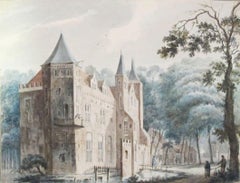
Landscape with Cattle
By Hendrick V. Tavernier
Located in Chicago, IL
verso: signed and dated "H. Tavernier, 1779"
Category
18th Century Hendrick V. Tavernier Art
Materials
Watercolor
Landscape with Cattle
By Hendrick V. Tavernier
Located in Chicago, IL
verso: signed and dated "H. Tavernier, 1779"
Watercolor
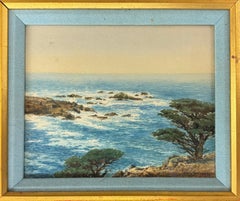
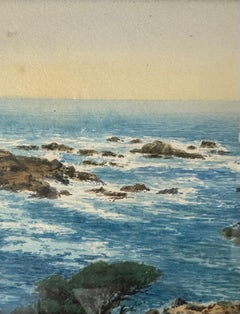
Coastal Landscape
Located in Cliffside Park, NJ
A painter who has lived amid and loved the subject matter of his art, Jorgensen’s pictures of the Yosemite Valley and the Missions of California are monuments of early art in this co...
Watercolor
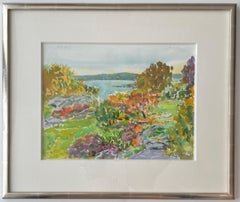
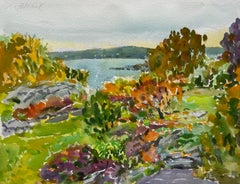
Touch of Fall watercolor and pastel painting by Nell Blaine
By Nell Blaine
Located in Hudson, NY
Signed "Nell Blaine" upper left in pencil. Signed, titled, dated verso on sheet. Signed, titled, dated verso on backing panel. The artist. Exhibited at Fischbach Gallery, NYC, in 1994 (Gallery label verso, and wall label affixed verso). Purchased by private collectors c.1994. By descent. Tibor de Nagy Gallery, NYC (the artist's estate representative), exhibited 2020 (label verso). Exhibited at Fischbach Gallery, NYC, in 1994 (Gallery label verso, and wall label affixed verso). Tibor de Nagy Gallery, NYC (the artist's estate representative), exhibited 2020 (label verso). From her November 15, 1996 NYT obituary: Nell Blaine, a widely respected New York landscape painter and watercolorist, died yesterday at Mount Sinai Hospital. She was 74 and had homes in Manhattan and Gloucester, Mass. Ms. Blaine, who had been hospitalized since July, had been confined to a wheelchair since 1959, when she contracted polio. Ms. Blaine was born in Richmond, Va., in 1922, and first studied at the Richmond School of Art, now part of Virginia Commonwealth University. She moved to New York in 1942 to study painting with Hans Hofmann and later studied etching and engraving at Atelier 17 with Stanley William Hayter. During her first years in New York, her work, which had previously been tightly realist, turned abstract, inspired by Mondrian, Leger and Jean Helion. At one time she was the youngest member of the American Abstract Artists. She was also a founding member of the Jane Street Gallery, one of Manhattan's earliest artists' cooperatives, and had her first solo show there in 1945. Just as Ms. Blaine was becoming known as a promising abstract painter, and gaining the admiration of such critics as Clement Greenberg, she started to shift back to representation. Inspired in part by a trip with Larry Rivers in 1950 to Paris, where she was especially impressed by the work of Vuillard and Bonnard, she immersed herself in the tradition of 19th-century European painting. From the mid-1950's, she cultivated an increasingly painterly and colorful style, usually working directly from nature, or still life, with particular emphasis on the forms and hues of flowers. Her work retained a sense of all-over structure and pulsating energy that she nonetheless credited to abstract art. ''It all goes back to Mondrian,'' she would say. In the 1950's, Ms. Blaine was prominent among a circle of New York artists and poets that included John Ashbery, Frank O'Hara, Kenneth Koch, Mr. Rivers, Jane Freilicher, Leland Bell, Louisa Matthiasdottir, Robert De Niro Sr. and Rudy Burckhardt. She had her first solo show of representational work at the Tibor de Nagy Gallery in 1953 and was represented by the Poindexter Gallery until it closed in 1978, and, in recent years, by the Fischbach Gallery. During the 1950's she supported herself as a commercial artist, designing brochures for art galleries. In 1955, she designed the original logo, column heads and layout for The Village Voice. In 1957, Ms. Blaine was featured in Life magazine as one of five leading young female artists in America. In 1959, after several months of traveling and painting in Greece, she contracted severe bulbar polio on the island of Mykonos. ''To Nell Blaine,'' an exhibition organized at Poindexter to raise money for her hospital bills, included the work of 79 artists, including Saul Steinberg, Robert Motherwell, Elaine and Willem de Kooning, Philip Guston, Mr. Rivers, Ms. Freilicher and Robert Rauschenberg. After eight months in a New York hospital, including five months in an iron lung...
Paper, Pastel, Watercolor
$18,500
H 8.25 in W 11 in
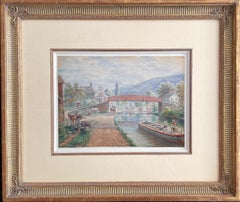
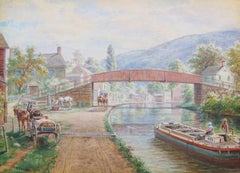
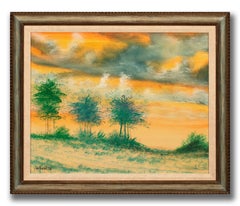
Delaware & Hudson Canal, Ellenville NY watercolor by Edward Lamson Henry
By Edward Lamson Henry
Located in Hudson, NY
Original watercolor by Edward Lamson Henry looking back at barge travel through small New York state towns. Delaware & Hudson Canal, Ellenville N...
Paper, Watercolor
$4,200
H 27.625 in W 33.125 in D 1 in
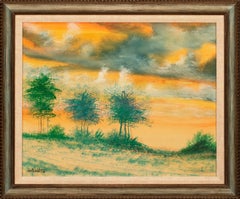
"Meadow" Original Watercolor on Paper Landscape by William Verdult, Framed
By William Verdult
Located in Encino, CA
"Meadow," an original watercolor on paper by William Verdult, is a piece for the true collector. The artist's genius reflects a fiery artistic approach that inspires unexplored feeli...
Watercolor
$125,000
H 20 in W 14 in D 2 in
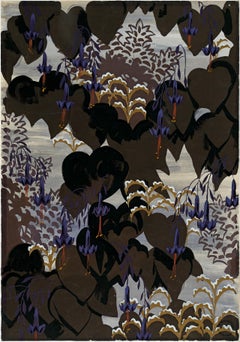
Watercolor and Gouache on Paper, by Charles Burchfield, circa 1925
Located in New York, NY
Charles Burchfield, 1893-1967 Wallpaper Design No.2, 1922-28 Watercolor and gouache on paper
Paper, Watercolor, Gouache
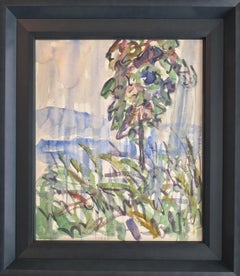
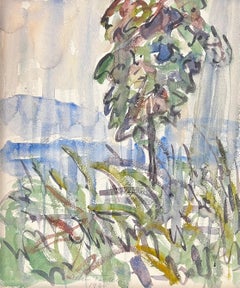
The Rainstorm a watercolor by Allen Tucker
By Allen Tucker
Located in Hudson, NY
Signed and dated "Allen Tucker 1930" lower left. Artwork measures 14" x 11 ¾" and framed 19" x 16 ½" x 2 ¼". Provenance: Gift from the artist to his friend Una Brage, USA/Switzerland, in the 1930s Estate of Ms. Brage to her friend Jean Corbett Peck, daughter of architect Harvey Wiley Corbett By descent About this artist: Allen Tucker, was an architect and painter so influenced by Vincent Van Gogh that he was called "Vincent in America". (Gerdts 291) Robert Henri and Maurice Prendergast were also credited as having an influence on Tucker's brushwork and compositions, the latter decisively. However, as his painting evolved, he did not fit into any tidy slot for description and was known as an individualist not easily categorized in American art history. Tucker was born in Brooklyn in 1866 and graduated from the School of Mines of Columbia University with a degree in architecture and took a job as an architectural draftsman in the architectural firm of McIvaine and Tucker, his fathers business. During that time, he studied painting at the Art Students League with Impressionist John H. Twachtman, but it was not until around 1904, when he was 38, that Tucker became a full-time painter, leaving architecture behind. Many of his early canvases were classically Impressionistic with poplar trees resembling those of Van Gogh and haystacks and corn shocks...
Paper, Watercolor
$665Sale Price|19% Off
H 12 in W 12 in
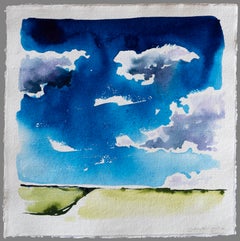
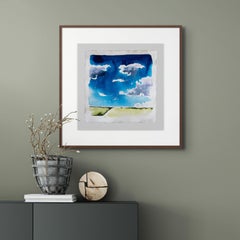
'Ebren Ha Dor, Shifting Sky'. Contemporary Landscape, Rural, Countryside, Clouds
By Sophia Milligan
Located in Penzance, GB
'Ebren Ha Dor, Shifting Sky'. Contemporary landscape painting, Cornwall Original Artwork, Unframed _________________ The dancing light and rapidly changing skies, hung high above the the landscape of West Cornwall: a harshly beautiful peninsula, jutting out into the wild tireless ocean, shaped and moulded by powerful salt laden Atlantic winds. Criss-crossed by ancient, tangled hedgerows marking the stories of the leathered, labour-roughened hands worn like the granite, coloured as the bronze bracken covered land they toiled endlessly to tame, carving spaces of sanctuary against the raw elements. A plein air painting from the series 'Ebren ha Dor' (Meaning 'Sky and Earth in Cornish). In this series, Sophia's fluid expressive style captures the immediacy of the changing light in the seasonal landscapes, whilst exploring flux and balance in the nature of all things: The freedom of the air and solidity of the soil; Of human narratives written in the wild landscapes; in the sensual interplay of light and shadow. They capture an essence of the equilibrium between wild raw energy and serene stillness; chaos and harmony; and the enduring and the effervescent. Acrylic ink on handmade rough edge watercolour paper Signed in pencil to the lower right corner 30 x 30cm / 12 x 12 inches __________________________ About The Artist Sophia Milligan is a contemporary multidisciplinary artist, exploring discourses on permanence & evanescence; the eternal, cyclical absolutes of birth & death; motherhood & childhood; and ancient immutable connections. With resonating ripples of intuition and instinct Sophia illuminates the presence of the ordinary, creating moments of sublime present. 'Born among the wild cliffs and tempestuous seas of west Cornwall, I grew with the intimate details in the twisting lanes and the intense changing light throughout the turbulent seasons. I formed a primordial connection with a deep instinctual sense of being part of the natural narrative, and wherever in the world I may be, this connectivity underpins my practice. Like the wind sculpted hawthorns and sensual coves of weather worn granite, I have been shaped by the powerful energy entwined in this ancient raw environment.’ ‘We are the stories of the journeys that came before. I weave into my work the tales of transitory circumstance; of struggle and survival; of forms and textures holding records of evolutionary millennia. I paint, I draw: with marks, mixtures, photography, words; the raw earth; the restless oceans; the whispered breeze. I work with time, and the immeasurable spaces of experience within, giving subtleties of existence a pause for contemplation. There is beauty in such poignant breaths. All moments are significant, every pebble of now forms the vast mountain of yesterday, and the great realm of tomorrow's possibilities'. Sophia has a 1st class honours Bachelor of Arts Degree in Visual Arts and World History, and a Masters Degree in Contemporary Visual Arts. Her work is held in prestigious international private collections, and exhibitions of her interactive, immersive installation, photography and mixed media works include 'Tabula Rasa', London; 'Superlative', Plymouth; 'Transition', Newlyn; The Eden Project, Cornwall; The European Parliament, Brussels; Kew Gardens, London; and 'The Cameraless Film Festival', Chicago. _________________________________ Modern . Landscape . Contemporary . landscape . Stone . Cornwall . Sky . Yellow . Blue . Green . Brown . Rural...
Ink, Watercolor, Handmade Paper
$2,273
H 6.89 in W 8.94 in
Southern Landscape, Ships, Old Master Drawing, 19th Century, by Von Stengel
Located in Greven, DE
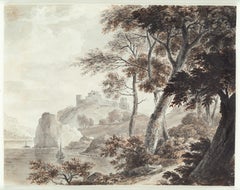
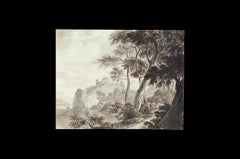
Southern Landscape with View of a Castle and Ships passing by Pen and brush in brown and black over pencil, brown and grey wash, 17,5 x 22,7cm Plain black moulding with golden pearl ...
Paper, Gouache
Watercolor of the Oak Tree by Allen Tucker
By Allen Tucker
Located in Hudson, NY
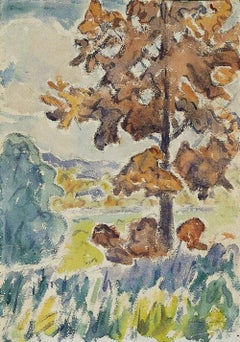
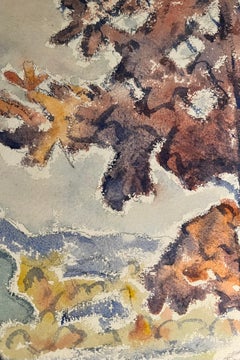
Landscape watercolor by Allen Tucker of an oak tree. This piece, along with several others, was gifted to Una Brage, a friend of the artist in the 1930s. More about this artist: Allen Tucker, was an architect and painter so influenced by Vincent Van Gogh that he was called "Vincent in America". (Gerdts 291) Robert Henri and Maurice Prendergast were also credited as having an influence on Tucker's brushwork and compositions, the latter decisively. However, as his painting evolved, he did not fit into any tidy slot for description and was known as an individualist not easily categorized in American art history. Tucker was born in Brooklyn in 1866 and graduated from the School of Mines of Columbia University with a degree in architecture and took a job as an architectural draftsman in the architectural firm of McIvaine and Tucker, his fathers business. During that time, he studied painting at the Art Students League with Impressionist John H. Twachtman, but it was not until around 1904, when he was 38, that Tucker became a full-time painter, leaving architecture behind. Many of his early canvases were classically Impressionistic with poplar trees resembling those of Van Gogh and haystacks and corn shocks...
Paper, Watercolor
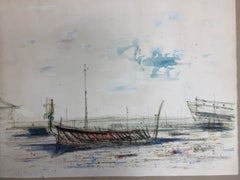
Havana
By Jean Carzou
Located in New York, NY
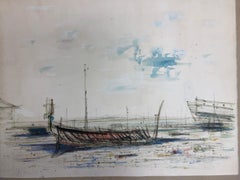
Jean Carzou traveled to Havana as an artist to explore the world and he captured a ship from a earlier era.
Watercolor
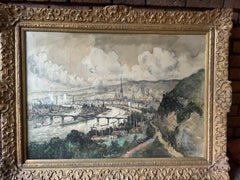
Rouen
By Frank Will
Located in New York, NY
"Rouen" is a watercolor by Frank- Will , it is extremely large in size and from an important place in the history of France. This is where the tower of Joan of Arc is located and wh...
Watercolor
$36,000
H 8.25 in W 6 in D 2 in
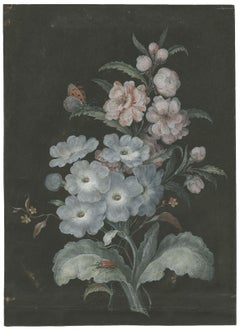
Barbara Regina Dietzsch Watercolor Painting of White Primrose, ca. 1730
Located in New York, NY
Barbara Regina Dietzsch, 1706-1783 White Primrose, Japanese Quince, a Beetle, and a Butterfly, ca. 1730 Opaque watercolor painting inscribed on...
Watercolor
Sold
H 10.63 in W 13.78 in
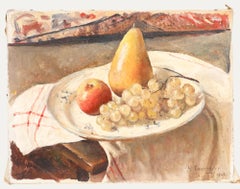
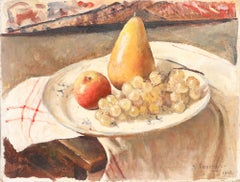
H. Tavernier - 1945 Oil, Still Life of Grapes and Pears
By Hendrick V. Tavernier
Located in Corsham, GB
A charming study of grapes and pears on a ceramic plate and white tablecloth. The artist uses a muted, tonal palette reminiscent of the Bloomsbury Group style. Signed and dated to th...
Oil