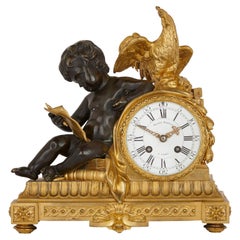
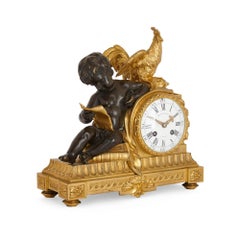
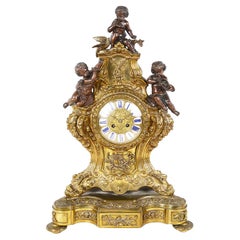
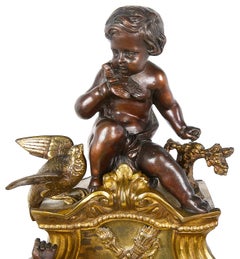
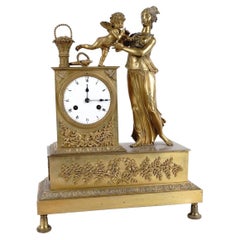
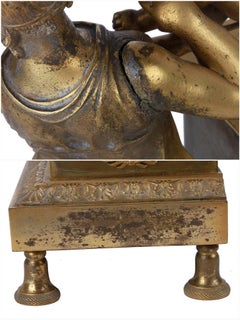
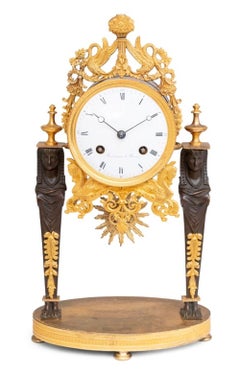
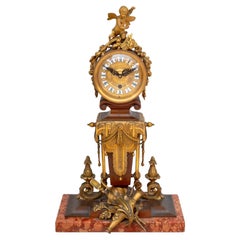
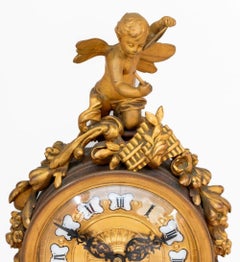
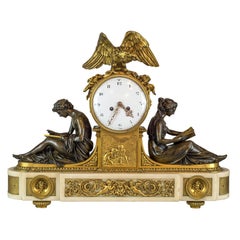
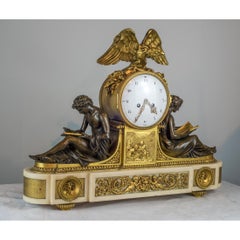
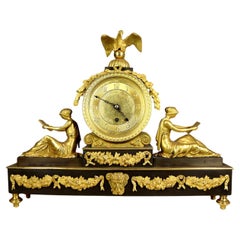
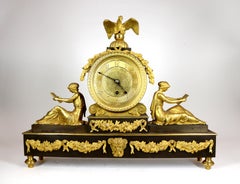
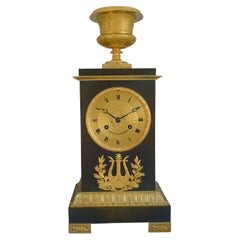
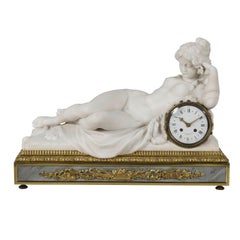
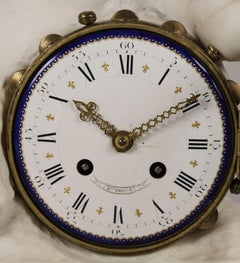
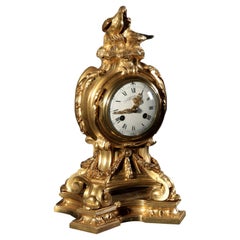
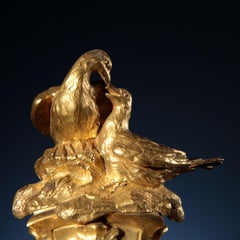
This impressive mantel clock with an eight day single fusee movement evokes the concept of time well spent in learning. It is crowned by Jupiter's eagle who bears sacred oak garlands above the dial, whose Ionic capital cradle is framed by addorsed studying nymphs. They are seated on a bronze plinth which is centred by an Arcadian Pan mask amongst golden flowered ormolu garlands, the whole resting on turned baluster feet. The dial is cast in ormolu and unusually has Arabic numerals, surround by a anthemion frieze bezel.
With the eagle a symbol of Jupiter and hence the divinity of learning, and the mask of Pan a reference to the natural world. This clock is, therefore, a celebration Natural Philosophy, the study of science and the natural world, and a display of classical learning and understanding.
The two seated figures derive from the model of L'Etude, which together with La Philosophie, was created for the Sèvres factory by Louis-Simon Boizot in 1780. Under the instructions of the marchand-mercier Dominique Daguerre, these figures were incorporated into a clock design, from which the present clock derives, by the cisleur-doreur François Rémond. In 1788 Daguerre delivered two clocks after his new design to Louis XVI for the Château de St. Cloud. The model obviously appealed to the Prince of Wales, later George IV, as he purchased two clocks of this model from Daguerre, one of which was in his bedroom, the other in his dressing-room one is now in Windsor Castle the other in Buckingham Palace.
This clock was probably made by Baetens & Co who specialised in bronze and ormolu decorative objects in the Regency period. No doubt identifying the fashionable subject matter and style after the Prince Regent popularised it at Carlton House. They made models in bronze ormolu and marble for many clock makers of the period. A near identical version of this clock was in the collection of the Marquess of Bath at Longleat House until its sale at Christies in 2002, made by Santiago James Moore French of the Royal Exchange. Other examples of this clock have been recorded by Barraud and Lund...
Category
1810s Regency Antique Henry Dasson Mantel Clocks
MaterialsBronze, Steel, Ormolu