Henry Moore Figurative Paintings

British, 1898-1986

Henry Spencer Moore OM CH FBA was an English artist. He is best known for his semi-abstract monumental bronze sculptures, which are located around the world as public works of art. As well as sculpture, Moore produced many drawings, including a series depicting Londoners sheltering from the Blitz during the Second World War, along with other prints and graphic works on paper.

His forms are usually abstractions of the human figure, typically depicting mother-and-child or reclining figures. Moore's works are usually suggestive of the female body, apart from a phase in the 1950s when he sculpted family groups. His forms are generally pierced or contain hollow spaces. Many interpreters liken the undulating form of his reclining figures to the landscape and hills of his Yorkshire birthplace.

Moore became well known through his carved marble and larger-scale abstract cast bronze sculptures, and was instrumental in introducing a particular form of modernism to the United Kingdom. His ability in later life to fulfil large-scale commissions made him exceptionally wealthy. Despite this, he lived frugally; most of the money he earned went toward endowing the Henry Moore Foundation, which continues to support education and promotion of the arts.

Find original Henry Moore art on 1stDibs.

to
1
1
Overall Width
to
Overall Height
to
2
1
1
1
1
1
1
1
1
1
1
1
1
1
1
1
1
133
517
315
276
230
1
Artist: Henry Moore
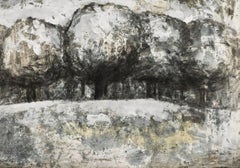
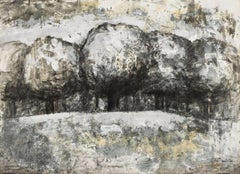
Trees Mixed Media Painting

Trees Mixed Media Painting

By Henry Moore

Located in London, GB

This mixed media painting by Henry Moore is a unique artwork created in 1980 using layers of watercolour, charcoal and gouache on paper. Moore has adopted his usual style to create t...

Category

1980s Contemporary Henry Moore Figurative Paintings

Materials

Paper, Charcoal, Mixed Media, Gouache

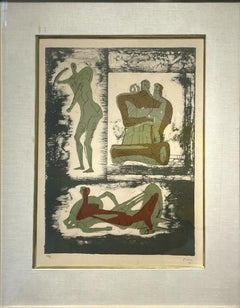
Untitled

Untitled

By Henry Moore

Located in PARIS, FR

Henry Spencer Moore OM CH FBA (30 July 1898 – 31 August 1986) was an English artist. He is best known for his semi-abstract monumental bronze sculptures which are located around the ...

Category

1970s Abstract Henry Moore Figurative Paintings

Materials

Lithograph

Related Items
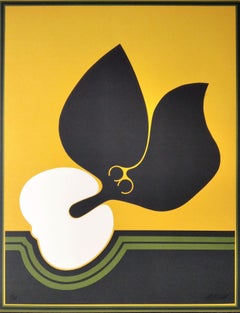
Untitled
Untitled

Alberto Arboleda Untitled, 1980

$1,145

H 27.37 in W 21.46 in

Untitled

Located in Barcelona, CT

The painting is being offered with a work and authenticity certificate

Category

1980s Abstract Henry Moore Figurative Paintings

Materials

Lithograph

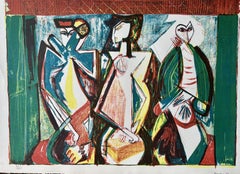
Three Figures

Walter BeckerThree Figures, mid 20th Century 1953

$580Sale Price|51% Off

H 14 in W 19 in

Three Figures

Located in Belgrade, MT

This lithograph is part of my private collection. It is limited in edition ,artist signed lower right and is in very good condition. Walter Becker was a German artist. Another impres...

Category

Mid-20th Century Abstract Expressionist Henry Moore Figurative Paintings

Materials

Lithograph

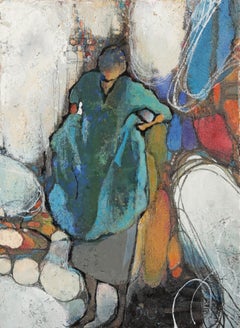
Japanese Contemporary Art by Miyuki Takanashi - Skirt-Like

Japanese Contemporary Art by Miyuki Takanashi - Skirt-Like

By Miyuki Takanashi

Located in Paris, IDF

Mixed media (acrylic, gouache,oil) on canvas Put a canvas cloth on a wooden panel Miyuki Takanashi is a Japanese artist born in 1961 who lives & works in Sapporo in Japan. She is gr...

Category

2010s Contemporary Henry Moore Figurative Paintings

Materials

Canvas, Mixed Media, Oil, Acrylic, Gouache

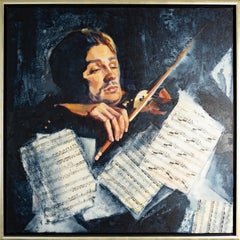
Violinist. Square, portrait, figurative, notes, semi-abstract

Violinist. Square, portrait, figurative, notes, semi-abstract

Located in Oslo, NO

Acrylic painting, portrait, violinist, music, black, square, notes The painting "Violinist" is an image of an inner refuge where a person retreats after a battle with the elements. ...

Category

Early 2000s Abstract Expressionist Henry Moore Figurative Paintings

Materials

Acrylic

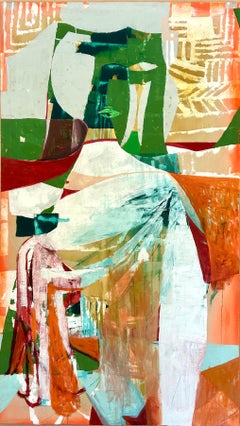
The Brooch
The Brooch

Galen CheneyThe Brooch, 2025

$6,900

H 60 in W 34 in

The Brooch

Located in Dallas, TX

oil & flashe on canvas

Category

2010s Abstract Henry Moore Figurative Paintings

Materials

Canvas, Oil

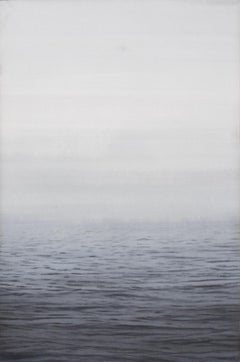
Abstract Sea Painting, Contemporary Minimalist Ocean Horizon, 2025 Ricky Lee

Abstract Sea Painting, Contemporary Minimalist Ocean Horizon, 2025 Ricky Lee

Located in Barcelona, Barcelona

At Escat Gallery we are committed to maintaining the highest standards of trust and professionalism for our collectors. Every artwork in our collection comes with a Certificate of Au...

Category

2010s Abstract Henry Moore Figurative Paintings

Materials

Oil, Carbon Pencil, Pigment

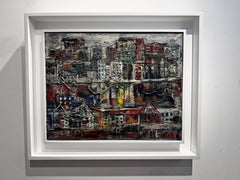
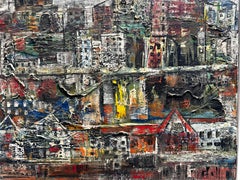
Norman Carton, abstract cityscape, unique oil painting hand signed twice, Framed

Norman Carton, abstract cityscape, unique oil painting hand signed twice, Framed

By Norman Carton

Located in New York, NY

Norman Carton Mid Century Modern Cityscape, ca. 1951 Oil on canvas painting (signed twice) Signed twice: hand signed on the front and also signed on the back Unique Frame included: T...

Category

1950s Abstract Expressionist Henry Moore Figurative Paintings

Materials

Oil, Canvas

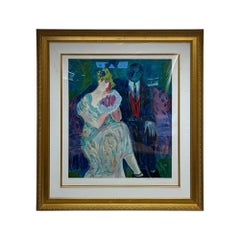
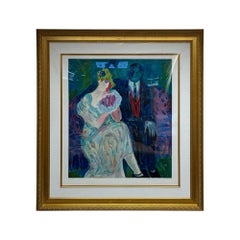
Barbara Wood, Art Deco, Monumental Lithograph, USA, 20th c.

Barbara Wood, Art Deco, Monumental Lithograph, USA, 20th c.

Located in Stamford, CT

Monumental Oil Painting by Barbara Wood of a Couple, Art Deco, Framed and Matted A finely detailed lithograph by renowned artist Barbara Wood of a man courting his lady. "Romance" A...

Category

20th Century Abstract Expressionist Henry Moore Figurative Paintings

Materials

Lithograph

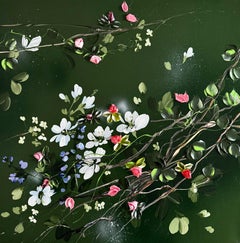
Quiet Branches III - dark green impasto painting on linen canvas with 3d flowers

Quiet Branches III - dark green impasto painting on linen canvas with 3d flowers

By Anastassia Skopp

Located in Zofingen, AG

"Look at the flowers. It is simply unbelievable how happy flowers are." — Osho 60 × 60 × 2 cm 23.6 × 23.6 × 0.8 in Acrylic & mixed media on 100% linen canvas Quiet Branches III in...

Category

2010s Abstract Impressionist Henry Moore Figurative Paintings

Materials

Canvas, Linen, Acrylic

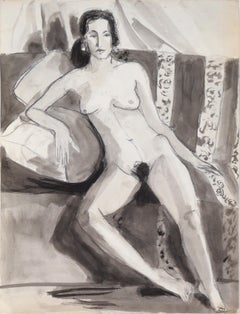
Nude Woman on Striped Chair #2 in Charcoal and Gouache on Paper

Nude Woman on Striped Chair #2 in Charcoal and Gouache on Paper

Located in Soquel, CA

Nude Woman on Striped Chair #2 in Charcoal and Gouache on Paper Black and white painting of a woman by acclaimed bluegrass musician Katherine "Kathy" Kallick (American, b. 1952). Th...

Category

1970s Contemporary Henry Moore Figurative Paintings

Materials

Paper, Charcoal, Gouache

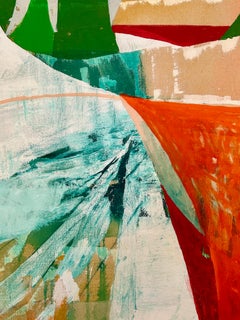
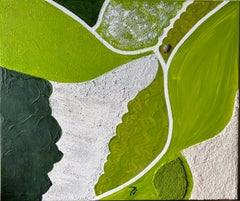
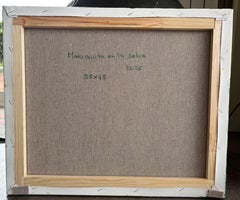
Ladybug in the jungle

paola vignolaLadybug in the jungle, 2025

$843

H 17.72 in W 21.66 in D 1.97 in

Ladybug in the jungle

Located in Barcelona, CT

This artwork presents a vibrant aerial impression of abstract landscapes, cleverly using shades of green and textured white. The composition is defined by fluid, sinuous lines that d...

Category

2010s Abstract Henry Moore Figurative Paintings

Materials

Mixed Media, Acrylic

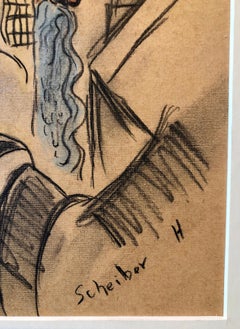
Rare Modernist Hungarian Rabbi Pastel Drawing Gouache Painting Judaica Art Deco

Rare Modernist Hungarian Rabbi Pastel Drawing Gouache Painting Judaica Art Deco

By Hugó Scheiber

Located in Surfside, FL

Rabbi in the synagogue at prayer wearing tallit and tefillin. Hugó Scheiber (born 29 September 1873 in Budapest – died there 7 March 1950) was a Hungarian modernist painter. Hugo Scheiber was brought from Budapest to Vienna at the age of eight where his father worked as a sign painter for the Prater Theater. At fifteen, he returned with his family to Budapest and began working during the day to help support them and attending painting classes at the School of Design in the evening, where Henrik Papp was one of his teachers. He completed his studies in 1900. His work was at first in a post-Impressionistic style but from 1910 onward showed his increasing interest in German Expressionism and Futurism. This made it of little interest to the conservative Hungarian art establishment. However, in 1915 he met the great Italian avant-gardist Filippo Tommaso Marinetti and the two painters became close friends. Marinetti invited him to join the Futurist Movement. The uniquely modernist style that he developed was, however, closer to German Expressionism than to Futurism and eventually drifted toward an international art deco manner similar to Erté's. In 1919, he and his friend Béla Kádar held an exhibition at the Hevesy Salon in Vienna. It was a great success and at last caused the Budapest Art Museum to acquire some of Scheiber's drawings. Encouraged, Scheiber came back to live in Vienna in 1920. A turning point in Scheiber's career came a year later, when Herwarth Walden, founder of Germany's leading avant-garde periodical, Der Sturm, and of the Sturm Gallery in Berlin, became interested in Scheiber's work. Scheiber moved to Berlin in 1922, and his paintings soon appeared regularly in Walden's magazine and elsewhere. Exhibitions of his work followed in London, Rome, La Paz, and New York. Scheiber's move to Germany coincided with a significant exodus of Hungarian artists to Berlin, including Laszlo Moholy-Nagy and Sandor Bortnyik. There had been a major split in ideology among the Hungarian avant-garde. The Constructivist and leader of the Hungarian avantgarde, Lajos Kassák (painted by Hugó Scheiber in 1930) believed that art should relate to all the needs of contemporary humankind. Thus he refused to compromise the purity of his style to reflect the demands of either the ruling class or socialists and communists. The other camp believed that an artist should be a figurehead for social and political change. The fall out and factions that resulted from this politicisation resulted in most of the Hungarian avant gardists leaving Vienna for Berlin. Hungarian émigrés made up one of the largest minority groups in the German capital and the influx of their painters had a significant effect on Hungarian and international art. Another turning point of Scheiber's career came in 1926, with the New York exhibition of the Société Anonyme, organized by Katherine Dreier. Scheiber and other important avant garde artists from more than twenty-three countries were represented. In 1933, Scheiber was invited by Marinetti to participate in the great meeting of the Futurists held in Rome in late April 1933, Mostra Nazionale d’Arte Futurista where he was received with great enthusiasm. Gradually, the Hungarian artists began to return home, particularly with the rise of Nazism in Germany. Kádar went back from Berlin in about 1932 and Scheiber followed in 1934. He was then at the peak of his powers and had a special flair in depicting café and cabaret life in vivid colors, sturdily abstracted forms and spontaneous brush strokes. Scheiber depicted cosmopolitan modern life using stylized shapes and expressive colors. His preferred subjects were cabaret and street scenes, jazz musicians, flappers, and a series of self-portraits (usually with a cigar). his principal media being gouache and oil. He was a member of the prestigious New Society of Artists (KUT—Képzőművészek Új Társasága)and seems to have weathered Hungary's post–World War II transition to state-communism without difficulty. He continued to be well regarded, eventually even receiving the posthumous honor of having one of his images used for a Russian Soviet postage stamp (see image above). Hugó Scheiber died in Budapest in 1950. Paintings by Hugó Scheiber form part of permanent museum collections in Budapest (Hungarian National Museum), Pecs (Jannus Pannonius Museum), Vienna, New York, Bern and elsewhere. His work has also been shown in many important exhibitions, including: "The Nell Walden Collection," Kunsthaus Zürich (1945) "Collection of the Société Anonyme," Yale University Art Gallery, New Haven, Connecticut (1950) "Hugó Scheiber: A Commemorative Exhibition," Hungarian National Museum, Budapest (1964) "Ungarische Avantgarde," Galleria del Levante, Munich (1971) "Paris-Berlin 1900-1930," Centre Georges Pompidou, Paris (1978) "L’Art en Hongrie, 1905-1920," Musée d’Art et l’Industrie, Saint-Etienne (1980) "Ungarische Avantgarde in der Weimarer Republik," Marburg (1986) "Modernizmus," Eresz & Maklary Gallery, Budapest (2006) "Hugó Scheiber & Béla Kádár," Galerie le Minotaure, Paris and Tel Aviv (2007) Hugó Scheiber's paintings continue to be regularly sold at Sotheby's, Christie's, Gillen's Arts (London), Papillon Gallery (Los Angeles) and other auction houses. He was included in the exhibition The Art Of Modern Hungary 1931 and other exhibitions along with Vilmos Novak Aba, Count Julius Batthyany, Pal Bor, Bela Buky, Denes Csanky, Istvan Csok, Bela Czobel, Peter Di Gabor, Bela Ivanyi Grunwald, Baron Ferenc Hatvany, Lipot Herman, Odon Marffy, C. Pal Molnar...

Category

Early 20th Century Modern Henry Moore Figurative Paintings

Materials

Paper, Charcoal, Pastel, Watercolor, Gouache
Henry Moore figurative paintings for sale on 1stDibs.

Find a wide variety of authentic Henry Moore figurative paintings available for sale on 1stDibs. You can also browse by medium to find art by Henry Moore in ink, lithograph, paint and more. Much of the original work by this artist or collective was created during the 20th century and is mostly associated with the modern style. Not every interior allows for large Henry Moore figurative paintings, so small editions measuring 7 inches across are available. Customers who are interested in this artist might also find the work of Stefano Georges, Christopher Barrow, and Charles Ragland Bunnell. Henry Moore figurative paintings prices can differ depending upon medium, time period and other attributes. On 1stDibs, the price for these items starts at $3,340 and tops out at $3,340, while the average work can sell for $3,340.
Questions About Henry Moore Figurative Paintings
  • 1stDibs ExpertJune 6, 2024
    Henry Moore's style of art was modern. He is best known for his monumental bronze sculptures, which are installed around the world, often as public art. He used abstract forms of the human body, typically depicting mother-and-child or reclining figures. His more abstract forms are generally pierced or contain hollow spaces. Many critics have likened the undulating shapes of his reclining figures to the landscape and hills of his Yorkshire birthplace. On 1stDibs, find an assortment of Henry Moore art.
  • 1stDibs ExpertApril 5, 2022
    Henry Moore’s sculptures often represented the connection between the human body and landscapes. The underlying meaning is that humanity is shared with the natural world, and many of his large-scale sculptures were created to compliment the outdoor landscape where they were placed. You’ll find a selection of Henry Moore sculptures and sketches on 1stDibs.
  • 1stDibs ExpertMay 30, 2024
    Henry Moore drew hands to symbolize the passage of time. His series of drawings depicting his own hands in old age and other elderly people's hands were meant to represent the effects of work and living on the human body. Much of Moore's work reflected on the human form, including his large bronze sculptures. Explore a diverse assortment of Henry Moore art on 1stDibs.
  • 1stDibs ExpertMay 3, 2024
    Opinions vary as to what Henry Moore's most famous piece is. Since the British artist's semi-abstract monumental bronze sculptures are often public works of art, many have become well known. Among them are Reclining Figure: Festival (1951), Harlow Family Group (1954-5), Helmet Head No. 4: Interior/Exterior (1963), The Arch (1963-69) and Mother and Child (1983). On 1stDibs, find a variety of Henry Moore art.
  • 1stDibs ExpertApril 5, 2022
    Henry Moore frequently used the wax resist process in his drawings, which involved sketching the forms in wax crayon and coating the drawing with a wash of gray watercolor. He then went in with black ink, gray and black crayons and white watercolor. Find a selection of Henry Moore artwork from top art dealers around the world on 1stDibs.
  • 1stDibs ExpertApril 26, 2024
    Henry Moore created sculptures for a few reasons. Born in Castleford, Yorkshire, in 1898, he had an early interest in being a sculptor, and in 1921, he was awarded a scholarship to study at the Royal Academy of Art in London. As he would explain, this is where he was particularly inspired to pursue his sculpting practice: “Even when I was a student I was totally preoccupied by sculpture in its full spatial richness, and if I spent a lot of time at the British Museum in those days, it was because so much of the primitive sculpture there was distinguished by complete cylindrical realization.” He also had an interest in exploring how the human body connected to landscapes. He often produced works with specific locations in mind, considering how his figures would relate to the space around them. His forms are usually abstractions of the human body, typically depicting mother-and-child or reclining figures, and are often pierced or contain hollow spaces. Many interpreters liken the undulating form of his reclining figures to the landscape and hills of his Yorkshire birthplace. On 1stDibs, shop a variety of Henry Moore art.
  • 1stDibs ExpertMarch 13, 2024
    Henry Moore drew sheep for a few reasons. The British artist thought sheep were peaceful and found watching them graze to be relaxing. He also liked how they stood out against the landscape due to their coloring, likening it to the way a statue draws the eye away from the rest of its surroundings. On 1stDibs, find a diverse assortment of Henry Moore art.
  • 1stDibs ExpertAugust 20, 2024
    How much a Henry Moore statue is worth depends on its history, condition and other factors. In 2022, his Reclining Figure: Festival, created for the 1951 Festival of Britain, set an auction record for the artist when it sold for $31 million. The piece is a good example of the artist's forms, which are usually abstractions of the human figure, typically depicting a mother and child or reclining figure. Moore's works are often suggestive of the female body, apart from a period in the 1950s when he sculpted family groups. If you own a Henry Moore statue, a certified appraiser or experienced art dealer can help you determine its estimated value. Shop an assortment of Henry Moore art on 1stDibs.
  • 1stDibs ExpertApril 5, 2022
    Henry Moore moved to London to study art and often visited the British Museum where he was inspired by ancient sculptures from Egypt, Africa and Mexico. His sculptures have a semi-abstract nature, but he often dabbled in other styles of art. Moore even created his own form of modernism with an eye toward the abstract. On 1stDibs, find a variety of original artwork from top artists.
  • 1stDibs ExpertApril 5, 2022
    Henry Moore used holes in his sculptures to create the illusion that his work was growing from an empty center. His sculptures Oval with Points and Double Oval are two examples of the technique. You'll find a selection of Henry Moore art on 1stDibs.
  • 1stDibs ExpertOctober 30, 2024
    Yes, Barbara Hepworth knew Henry Moore. They met while she was attending the Leeds School of Art in the 1920s. Moore and Hepworth maintained a friendly rivalry throughout their careers. Along with Paul Nash and Ben Nicholson, the two founded the Unit One art movement in 1933. The movement's purpose was to promote avant-garde art in the UK. Explore a wide variety of Barbara Hepworth art.
  • 1stDibs ExpertNovember 20, 2024
    Yes, Henry Moore and Barbara Hepworth were friends. The two met at the Leeds School of Art in the UK and maintained a friendly rivalry throughout their careers. Both Hepworth and Moore were members of Unit One, a group of British artists who sought to educate the public about avant-garde art during the 1930s. Shop a selection of Henry Moore and Barbara Hepworth art on 1stDibs.
  • 1stDibs ExpertApril 5, 2022
    Henry Moore was a prolific artist and it’s difficult to pinpoint exactly how many pieces of art he created. The Henry Moore Foundation lists that their online catalogue of his works currently features more than 11,000 sculptures, drawings, tapestries, textiles and graphics. That’s a significant number indeed and does not represent all of his contributions to the art world. On 1stDibs, find a variety of original artwork from top artists.