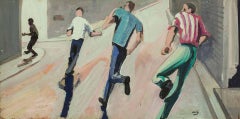
Herman Roderick Volz Art

American, Swiss, 1904-1990

Herman Roderick Volz was a Swiss-American painter, muralist, lithographer, set designer, and mosaic/ceramic artist. He was a politically active champion of the working man and often used his strikingly modernist graphic works as vehicles to address issues of inequality and social injustice. Initially trained by his grandfather, a master in decorative arts, he began his formal study at the Art und Gewerbeschule in Zürich and the Academy of Fine Art in Vienna. He traveled for four years in France, Spain, Italy, Africa, and Holland and then moved to the San Francisco Bay Area in 1933, becoming a US citizen in 1938. During the Great Depression, Volz was appointed a supervisor in the Northern California Art Project and for the Federal Building mural project at the Golden Gate International Exposition (GGIE) Art in Action exhibit from 1939-40. Directing a group of about ten artists he produced two monumental murals (the world’s largest at the time) on the facade of San Francisco’s Federal Building titled The Conquest of the West. In 1940-42 with another team of workers he created two large, low-relief polished marble mosaic panels for the Golden Gate International Exhibition “Art in Action” World's Fair which were later installed at San Francisco City College. The murals titled Organic and Inorganic Science represent the fields of physics, chemistry, biology, and mathematics. The slogan of the mural reads ‘Give me a base and I move the world. From 1944-48, Volz worked in Hollywood, as a scenic artist and technical director at Actors' Laboratory Theatre, and he also designed sets for MGM and Paramount Studios. Volz was a member of the California Watercolor Society and the San Francisco Art Association. He exhibited at Berlin National Exhibition (1927), Paris Salon (1937), San Francisco Art Association (1938–41), Golden Gate International Exposition (1939), and San Francisco Museum of the Legion of Honor (1937–41), and won the San Francisco Art Association prize in 1937.

to
2
1
2
Overall Width
to
Overall Height
to
5
1
4
1
5
4
3
2
2
2
1
1
1
1
1
4
1
10
10,159
2,807
2,503
1,398
5
Artist: Herman Roderick Volz
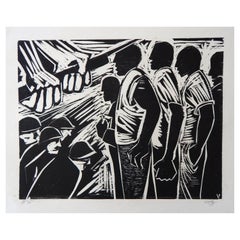
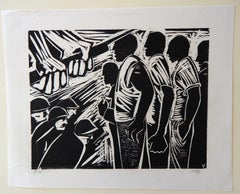
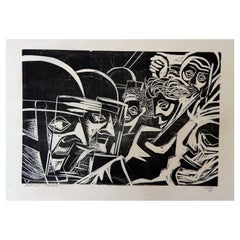
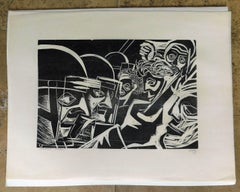
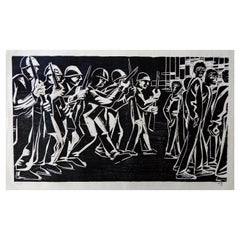
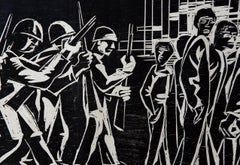
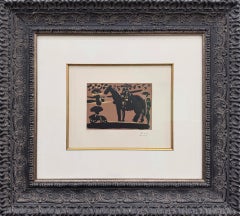
Herman Volz Original Woodcut, Social Unrest of the 1960's, Disbursing the Riot

Herman Volz Original Woodcut, Social Unrest of the 1960's, Disbursing the Riot

By Herman Roderick Volz 1

Located in Phoenix, AZ

An original woodcut print depicting the social unrest of the 1960s by Herman Roderick Volz. Pencil signed by the artist lower right. Image measures 14" x 24," sheet measures 18 1/2"...

Category

Mid-20th Century Herman Roderick Volz Art

Materials

Paper

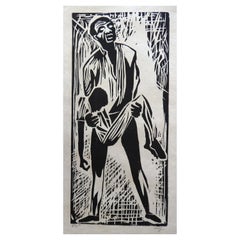
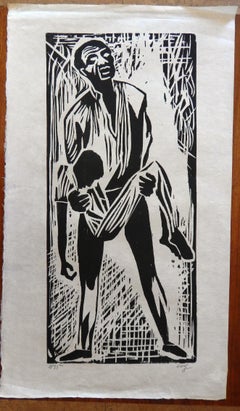
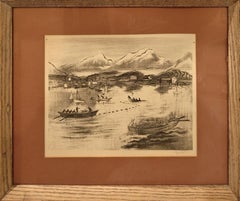
THE PARTISAN (SF Dock strike)

THE PARTISAN (SF Dock strike)

By Herman Roderick Volz 1

Located in Santa Monica, CA

HERMAN VOLZ (Swiss/American 1904 - 1990) THE PARTISAN, 1937 Lithograph, signed and no. in pencil. Edition 30. 10 1/2 x 14. Sheet 11 1/4 x 17 1/2" Generally good condition aside fro...

Category

1930s American Realist Herman Roderick Volz Art

Materials

Lithograph

Related Items
Asphalt Jungle, black and white, interior, crime scene, narrative

Asphalt Jungle, black and white, interior, crime scene, narrative

By Tom Bennett

Located in Brooklyn, NY

Dramatic imagery from FILM NOIR series of black and white monotypes, blending surreal mindscapes with stark realism About Tom Bennett: With quick brushstrokes, Tom Bennett creates r...

Category

2010s Abstract Impressionist Herman Roderick Volz Art

Materials

Monotype, Archival Paper

Blackfeet Indians, Great Northern Railway 14 prints

Winold ReissBlackfeet Indians, Great Northern Railway 14 prints, 1940

$576Sale Price|20% Off

H 12 in W 9 in D 0.05 in

Blackfeet Indians, Great Northern Railway 14 prints

By Winold Reiss

Located in Spokane, WA

A group of 14 Blackfeet Indians prints created by the artist Winold Reiss. The Great Northern Railway printed and released these prints in c. 1940. This is for the entire group...

Category

1940s American Realist Herman Roderick Volz Art

Materials

Lithograph

"The Slope Near the Bridge" Paul Sample, Mid-Century, American Snowy Landscape

"The Slope Near the Bridge" Paul Sample, Mid-Century, American Snowy Landscape

By Paul Sample

Located in New York, NY

Paul Sample The Slope Near the Bridge, 1950 Signed in pencil lower left Lithograph on wove paper Image 8 15/16 x 12 15/16 inches Sheet 11 5/16 x 15 1/16 inches From the edition of 25...

Category

1950s American Realist Herman Roderick Volz Art

Materials

Paper, Lithograph
Ann Nooney, (Demolition with Windows, NYC)

Ann Nooney, (Demolition with Windows, NYC)

By Ann Nooney

Located in New York, NY

The dimensions are for the image; there are large margins. This lithograph is signed in pencil. A native New Yorker, Ann Nooney (1900-1970) recorded the urban scene while on the Wo...

Category

1930s American Realist Herman Roderick Volz Art

Materials

Lithograph

"Fishing Village" Joe Jones, Mid-Century, American Life, Small Town Scene

"Fishing Village" Joe Jones, Mid-Century, American Life, Small Town Scene

By Joe Jones

Located in New York, NY

Joe Jones Fishing Village, 1949 Signed in pencil lower right margin Lithograph on wove paper Image 9 5/16 x 12 9/16 inches Sheet 12 x 15 15/16 inches From the edition of 250 The initial details of Jones' career are sparse, and this is intentional. The young artist was engaged in a process of self-reinvention, crafting a persona. When he submitted a work to the Sixteen Cities Exhibition at New York City's Museum of Modern Art in 1933, he briefly characterized himself: "Born St. Louis, 1909, self-taught. " Jones intentionally portrayed himself to the art community as an authentic working-class figure, backed by a compelling history. He was the youngest of five children in a family led by a one-armed house painter from St. Louis, a Welsh immigrant, and his German American spouse. At the age of ten, Jones found himself in a Missouri reformatory due to authorities' concerns over his graffiti activities. After completing elementary school, he traveled by freight car to California and back, even being arrested for vagrancy in Pueblo, Colorado. Returning to St. Louis, he attempted to settle down by working alongside his father. Yet, Jones felt a profound restlessness and was drawn toward a more elevated artistic pursuit in his late teenage years. He discovered a local collective of budding artists that formed St. Louis’s "Little Bohemia," sharing a studio and providing mutual support until he managed to secure his own modest workspace in a vacant garage. Jones’s initial creations comprised still lifes, landscapes, and poignant portraits of those close to him. These subjects were not only accessible but also budget-friendly, as hiring models was beyond his means. He depicted himself, his father, mother, and eventually, his wife. In December 1930, at the age of 21, Jones wed Freda Sies, a modern dancer and political activist who was four years older than him. By 1933, Jones had started gaining noteworthy local recognition through a solo exhibition at the Artists’ Guild of Saint Louis. Of the twenty-five paintings on display, one, titled River Front (private collection, previously with Hirschl and Adler Galleries), was selected to illustrate a feature article about his show in The Art Digest (February 15, 1933, p. 9). Shortly before this exhibition, a young surgeon named Dr. Robert Elman took an interest in Jones’s art, purchasing several pieces and forming a group of potential patrons committed to providing the emerging artist with a monthly stipend in exchange for art. This group was officially known as the "Co-operative Art Society," but it was informally dubbed the "Joe Jones Club. " Jones became an active participant in the St. Louis artistic scene, particularly within its bohemian segments. He embraced modernism and was a founding member of the "New Hat" movement in 1931, a playful rebellion against the conservative and traditional mainstream art establishment. The summer of 1933 marked a significant shift in Jones’s journey. Sponsored by a dedicated ally, Mrs. Elizabeth Green, Jones, along with Freda and Green, embarked on an eastward road trip. In Washington, D. C., they explored the Corcoran Gallery of Art, the Freer Gallery (part of the Smithsonian Institution), the Library of Congress, and Mount Vernon. Following this whirlwind of art and American culture, they made their way to New York, where they visited various museums and galleries, including a stop at The New School for Social Research, which featured notable contemporary murals by fellow Missourian Thomas Hart Benton and the politically active Mexican artist, José Clemente Orozco. From June through August, Jones and Freda resided in the artist colony of Provincetown, Massachusetts, later returning home via Detroit to see Diego Rivera’s Detroit Industry mural housed at the Detroit Institute of Fine Arts. While Elizabeth Green allegedly hoped that Jones would refine his artistic skills under the guidance of Charles Hawthorne or Richard Miller in Provincetown, Jones followed a different path. Rather than pursuing conservative mentors, he connected with an engaging network of leftist intellectuals, writers, and artists who dedicated their time to reading Marx and applying his theories to the American landscape. Jones's reaction to the traditional culture of New England was captured in his statement to a reporter from the St. Louis Post Dispatch: “Class consciousness . . . that’s what I got of my trip to New England. Those people [New Englanders] are like the Chinese—ancestor worshipers. They made me realize where I belong” (September 21, 1933). The stark social divisions he witnessed there prompted him to embrace his working-class identity even more fervently. Upon returning to St. Louis, he prominently identified himself as a Communist. This newfound political stance created friction with some of his local supporters. Many of his middle-class advocates withdrew their backing, likely influenced not only by Jones’s politics but also by his flamboyant and confrontational demeanor. In December 1933, Jones initiated a complimentary art class for unemployed individuals in the Old Courthouse of St. Louis, the same location where the Dred Scott case was deliberated and where slave auctions formerly took place. Concurrently, the St. Louis Art League was offering paid courses. Emphasizing the theme of social activism, with a studio adorned with Soviet artwork, Jones’s institution operated for just over a year before being removed from the courthouse by local officials. The school’s political focus and unconventional teaching practices, along with its inclusion of a significant number of African American students during a period marked by rigid racial segregation, certainly contributed to its challenges. Under Jones’s guidance, the class created a large chalk pastel mural on board, measuring 16 by 37 feet, titled Social Unrest in St. Louis. Mural painting posed no challenge for the former housepainter, who was adept at handling large wall surfaces. His first significant commission in St. Louis in late 1931 was a mural that celebrated the city’s industrial and commercial fortitude for the local radio station, KMOX. This mural, aimed at conveying optimism amid severe economic hardship, showcased St. Louis's strengths in a modernist approach. When Jones resumed mural work in late 1933, his worldview had evolved considerably. The mural produced for the school in the courthouse, conceived by Jones, featured scenes of modern St. Louis selected to highlight political messages. Jones had observed the technique of utilizing self-contained scenes to craft visual narratives in the murals he encountered in the East. More locally, this compositional strategy was commonly employed by the renowned Missouri artist...

Category

1940s American Realist Herman Roderick Volz Art

Materials

Paper, Lithograph
Nude - XXI century, Figurative print, Black and white

Nude - XXI century, Figurative print, Black and white

By Anna Mikke

Located in Warsaw, PL

Limited edition, 8/20. ANNA MIKKE (born in 1950) She graduated from the Academy of Fine Arts in Łódź in 1975. After graduation, she was engaged in graphic design, including designing...

Category

2010s Other Art Style Herman Roderick Volz Art

Materials

Paper, Photogravure

Pin Up Girl with Red Hat, untitled, original pinup vintage poster

Pin Up Girl with Red Hat, untitled, original pinup vintage poster

By Billy Devorss

Located in Spokane, WA

Original Pin-Up Girl with Red Hat vintage pin-up poster. Artist: Billy Devorss. Size: 15.25" x 20". Archival linen backed in mint condition; ready to frame. This striking original poster displays a graceful model wearing a vibrant red sun hat against a light blue background. This is truly a lovely piece! Billy DeVorss (1908 – 1985) was a self-taught illustration artist who started his commercial career in 1933. He was well known throughout his career for the voluptuous figures and attractive faces of his images. This poster is one of those great pin-up style images created by DeVorss. Alone among the pin-up artists in being entirely self-taught, Billy De Vorss sold his first three published pin-ups to the Louis F. Dow Calendar Company in St. Paul in about 1933. Until that time, he had been working as a teller in a bank in St. Joseph, Missouri. There, he met the stunning woman Glenna, who became his wife and first official model. Encouraged to develop his talent by Gene Sayles, the manager of Brown and Bigelow...

Category

Mid-20th Century American Realist Herman Roderick Volz Art

Materials

Lithograph

Birds - XXI century, Figurative print, Black and white, Animals

Birds - XXI century, Figurative print, Black and white, Animals

By Anna Mikke

Located in Warsaw, PL

Limited edition, 8/10. ANNA MIKKE (born in 1950) She graduated from the Academy of Fine Arts in Łódź in 1975. After graduation, she was engaged in graphic design, including designing...

Category

2010s Other Art Style Herman Roderick Volz Art

Materials

Paper, Etching

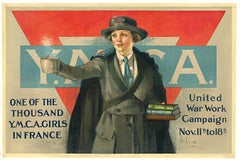
Original Patriotic League vintage poster  Christy Girl

Original Patriotic League vintage poster Christy Girl

By Howard Chandler Christy

Located in Spokane, WA

Original vintage poster: Patriotic League . Original Howard Chandler Christy's 1918 "Patriotic League" authentic World War 1 lithographic poster. Linen-backed and in excellent condition. This Christy girl...

Category

1910s American Realist Herman Roderick Volz Art

Materials

Lithograph

"Windy Hill" Lawrence Beall Smith, Mid-Century Realist Scene, American Life

"Windy Hill" Lawrence Beall Smith, Mid-Century Realist Scene, American Life

By Lawrence Beall Smith

Located in New York, NY

Lawrence Beall Smith Windy Hill, 1948 Signed in pencil lower right margin Lithograph on wove paper Image 10 3/8 x 13 1/16 inches Sheet 11 15/16 x 16 inches From the edition of 250 ...

Category

1940s American Realist Herman Roderick Volz Art

Materials

Paper, Lithograph
Birds - XXI century, Figurative print, Black and white, Animals

Birds - XXI century, Figurative print, Black and white, Animals

By Anna Mikke

Located in Warsaw, PL

Limited edition, 6/10. ANNA MIKKE (born in 1950) She graduated from the Academy of Fine Arts in Łódź in 1975. After graduation, she was engaged in graphic design, including designing...

Category

2010s Other Art Style Herman Roderick Volz Art

Materials

Paper, Etching

Previously Available Items
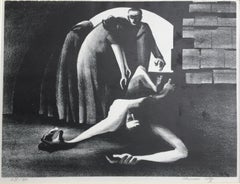
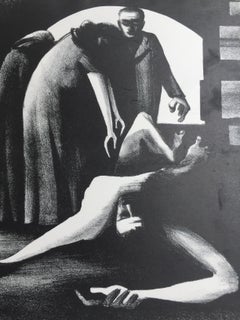
Industrial Accident
Industrial Accident

Herman Roderick Volz 1Industrial Accident, 1940

Sold

H 17.19 in W 12.32 in D 0.01 in

Industrial Accident

By Herman Roderick Volz 1

Located in Myrtle Beach, SC

Herman Roderick Volz, 'Industrial Accident', lithograph, 1942, edition 20. Signed, titled and numbered '6/20' in pencil. Signed in the stone, lower left. A fine, rich impression, on cream, wove paper, with full margins (1 1/8 to 1 3/4 inches), in excellent condition. Matted to museum standards, unframed. Reproduced and exhibited: 'L’Amérique de la Dépression: Artistes Engagés des Années 30', Musée-Gallerie de la Seita, Paris, 1996. Impressions of "Industrial Accident' are in the collections of the Crystal Bridges Museum of American Art and the Fine Arts Museums of San Francisco. Volz’s other graphic works are held in the collections of Detroit Institute of Arts, Museum of Wisconsin Art, Metropolitan Museum of Art, Museum of Wisconsin Art. ABOUT THE ARTIST Herman Roderick Volz (1904–1990) was a Swiss-American painter, muralist, lithographer, set designer, and mosaic/ceramic artist. He was a politically active champion of the working man and often used his strikingly modernist graphic works as vehicles to address issues of inequality and social injustice. Initially trained by his grandfather, a master in decorative arts, he began his formal study at the Art und Gewerbeschule in Zürich and the Academy of Fine Art in Vienna. He traveled for four years in France, Spain, Italy, Africa, and Holland and then moved to the San Francisco Bay Area in 1933, becoming a US citizen in 1938. During the Great Depression, Volz was appointed a supervisor in the Northern California Art Project and for the Federal Building mural project at the Golden Gate International Exposition (GGIE) Art in Action exhibit from 1939-40. Directing a group of about ten artists he produced two monumental murals (the world’s largest at the time) on the facade of San Francisco’s Federal Building titled ‘The Conquest of the West’. In 1940-42 with another team of workers he created two large, low-relief polished marble mosaic panels...

Category

1940s American Modern Herman Roderick Volz Art

Materials

Lithograph
'Giving Chase' California Modernist Oil Painting

'Giving Chase' California Modernist Oil Painting

By Herman Roderick Volz 1

Located in Surfside, FL

Three male figures are depicted in action. The figures seemed to be captured in movement while running together in the same direction. The figures are stylized, and elongated instead of realistically rendered. Herman Roderick Volz (1904–1990) Swiss-American painter, muralist, lithographer, set designer, decorative artist and ceramist. He was politically active, vocal and often made social statements through his imagery and he was especially taken by the industrial horizon of his adopted home of San Francisco Bay Area. Many of his art pieces done for the Federal Art Project (FAP, WPA), for example, were of men at work and of docks, piers, and railroad yards. Herman Roderick Volz was born December 25, 1904 in Zürich, Switzerland. His first training was under the tutelage of his grandfather, a master in decorative arts. He then started his formal training at the Art und Gewerbeschule in Zürich, the Academy of Fine Art in Vienna, and travelled for four years in France, Spain, Italy, Africa and Holland, eventually moving to the San Francisco Bay Area in 1933. By 1938 he became a US citizen. During the Great Depression, Volz was appointed to the position of supervisor in the Northern California Art Project and supervisor for the Federal Building mural project at the Golden Gate International Exposition (GGIE) Art in Action exhibit from 1939-1940.[4] He painted the two large mural on two sides of a large federal building called, The Conquest of the West, and on one side of the building it was By Land and the other was By Sea. This particular mural was the world's largest at the time and had around ten artist helping including Jose Ramis, John Saccaro...

Category

Mid-20th Century American Modern Herman Roderick Volz Art

Materials

Oil

Herman Roderick Volz art for sale on 1stDibs.

Find a wide variety of authentic Herman Roderick Volz art available for sale on 1stDibs. You can also browse by medium to find art by Herman Roderick Volz in lithograph and more. Not every interior allows for large Herman Roderick Volz art, so small editions measuring 14 inches across are available. Customers who are interested in this artist might also find the work of Popo and Ruby Lee, Paul H. Winchell, and Franz Oswald Schiffers. Herman Roderick Volz art prices can differ depending upon medium, time period and other attributes. On 1stDibs, the price for these items starts at $775 and tops out at $775, while the average work can sell for $775.
Artists Similar to Herman Roderick Volz