By Hermann Haase-Ilsenburg
Located in Newark, England
Foundry Mark H Gladenbeck and Sohn, Freidrichshagen
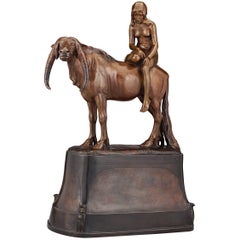
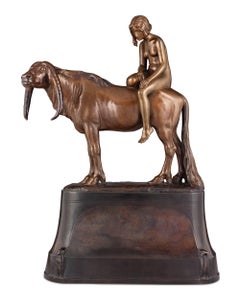
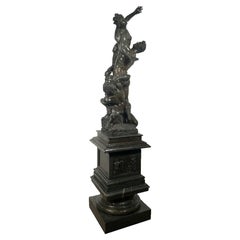
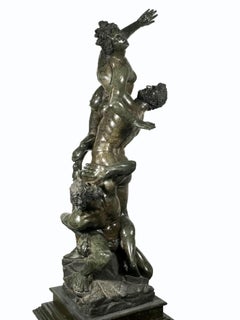
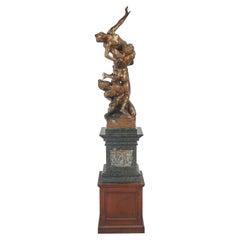
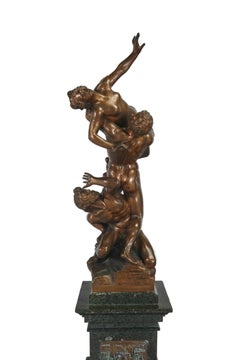
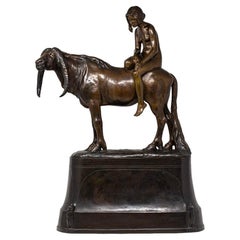
The bronze stood upon a large oval plinth with stylish Eagles and Owls to each corner tapering to the figure mounted above. The main subject relays the story of Europa being kidnapped by Zeus upon a long horned bull. Europa sits upon the bulls back nude leaning forward as the long horned bull peers across to the left. The bronze signed HHaase for prolific German sculptor Hermann Otto Haase-Ilsenburg alongside a circular foundry mark for H Gladenbeck and Sohn, Freidrichshagen. The bronze dates to the late Art Nouveau period circa 1910.
Hermann Otto Haase-Ilsenburg (German, 1879-1960) was a German sculptor known for his exceptional talent and contributions to the field of sculpture. Born in Germany, Haase displayed artistic abilities from a young age and pursued formal training in sculpture at various renowned art academies. Haase’s artistic style was primarily influenced by the neoclassical and naturalistic movements of the late 19th and early 20th centuries. He demonstrated a remarkable ability to capture human forms with great precision and detail, infusing his sculptures with a sense of grace and vitality.
Throughout his career, Haase created a diverse range of sculptures, including portrait busts, figurative works, and monumental pieces. He often drew inspiration from historical figures, mythological themes, and everyday life, translating them into three-dimensional sculptures that conveyed a sense of emotion and narrative. Haase’s sculptures were characterised by their technical mastery and attention to anatomical accuracy. He was skilled in capturing the subtleties of facial expressions, gestures, and drapery, bringing his subjects to life in a realistic and captivating manner.
H Gladenbeck and Sohn was arguably the most important German foundry of the time. Opened in Berlin in 1851, it cast many of the very best sculptures in bronze, but eventually closed in 1926.
The Abduction of Europa...
Category
Early 20th Century German Art Nouveau Hermann Haase-Ilsenburg Sculptures