Hand Painted Decorative Plate After an Original Iznik 16th C. Ottoman Design
By Iznik Pottery
Located in Moreno Valley, CA
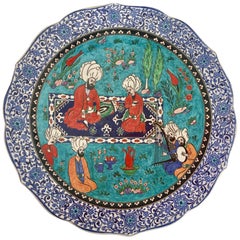
Handmade decorative wall plate, hand painted by artist Saim Kolhan.
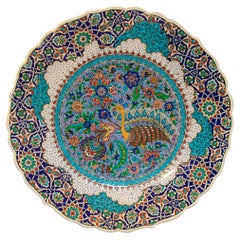
Hand Painted large Decorative wall plate after an original Iznik 16th C. Ottoman design.
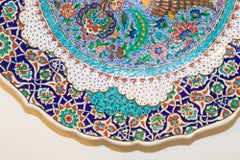
This plate is hand painted with an intricate design with a peacock in the center and foliages in teal, cobalt blue, green and burgundy.
Large Turkish Ottoman design polychrome hand painted ceramic platter from Kutahya with a piecrust shape rim.
Large Kütahya polychrome hand painted and handcrafted ceramic fruit bowl or wall decorative plate with polychrome ottoman design.
This is an intricately, hand painted plate that was made in Kutahya, Turkey: Kütahya is famous for its kiln products, such as tiles and pottery, which are glazed and multicolored. It has a beautifully hand painted scene with a peacock enjoying the outdoors surrounded by flowers in burgundy, turquoise, light and dark blue and green foliage.
The back of the plate is signed, handmade by "Saim Kohlan after an original Iznik 16th c Ottoman Design. / Kutahya /Turkey.
Great ceramic decorative Turkish ceramic Folk Art. There is a hole and string for hanging this piece on the wall.
Dimensions: 19" diameter x 2.5".
About the artist: Saim Kolhan
Saim (Usta*) Kolhan was born in Kütahya in 1962. He has graduated from a private vocational school as an electrician. He first worked as an electrician master in different factories. However he realized that it was not the profession he wanted to be in while he was in Cyprus for his military service.
Later Saim Usta decided to work as an apprentice in Atilla Kipergil’s tile workshop in 1984. That was when he realized that tile making, which is called "çinicilik" could turn out to his life's passion enabling him to express himself. Meanwhile he opened a retail shop named "Elif Çini" in 1984. At Elif Çini, unique tiles have been displayed with different techniques that already had existed in Kutahya, the center of Turkish tiles for five hundred years. The aim of protecting the perfection of the tradition and enforcing the standards of the town pushed him to be in co-operation with other artists such as Atilla Kipergil, Mehmet Gürsoy, Abdülkadir Uçaroglu and Habib Balalan. Saim Usta’s objective from the very beginning was not to increase the number of the already existent objects by imitating them, but rather to use them as elements and enablers of progression.
Together with his colleagues, Saim Usta established his own workshop trying to create new objects, which were better than the old masters'. From then on, pieces made in his workshop have been exceptional in terms of clay and glazing, creative forms and even functions together with hand decoration. This attempt also signifies a new école in the Iznik and Kütahya ceramics...
Category
Late 20th Century Turkish Moorish Iznik Pottery