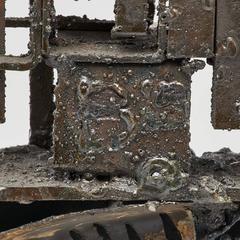
James Bearden Art
to
1
1
1
1
Overall Width
to
Overall Height
to
4
4
3
2
2
2
26
10,138
2,779
1,375
1,369
4
Artist: James Bearden
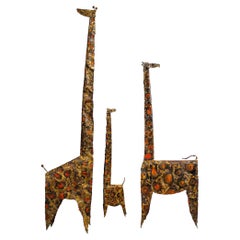
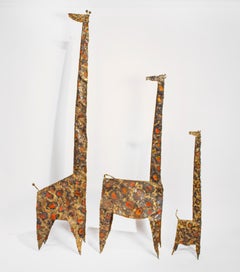
James Bearden Trio of Brutalist Giraffe Sculptures "Animal Series"
By James Bearden
Located in Dallas, TX
Amazing family of three large scale Giraffe sculptures by renowned Iowa abstract artist James Anthony Bearden. From his Animal Series, The large Giraffe measures 72"H x 16D x 9"W, th...
Category
21st Century and Contemporary James Bearden Art
Materials
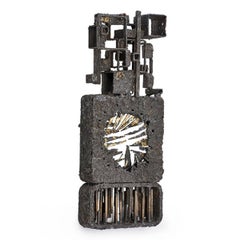
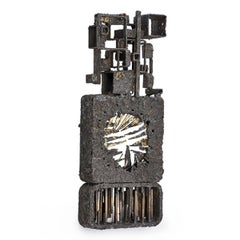
Brass, Copper, Enamel
Brutalist Abstract Sculpture, Gilded Steel and Bronze James Bearden American Mod
By James Bearden
Located in Surfside, FL
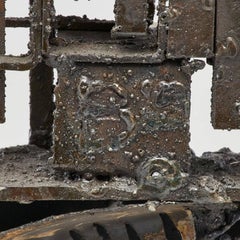
Wall-hanging sculpture: blackened steel, fused bronze, solvent dyes, abstract form, USA; Signed; 20 x 8 x 3 1/4
Suggesting archaeological artifacts from the future, these sculptures...
Category
21st Century and Contemporary James Bearden Art
Materials
Bronze, Steel
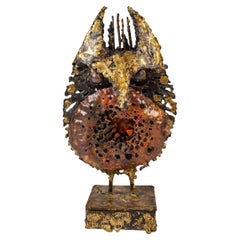
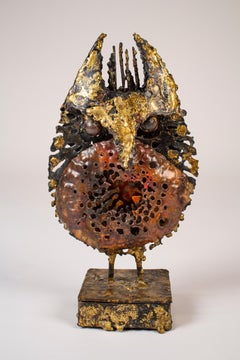
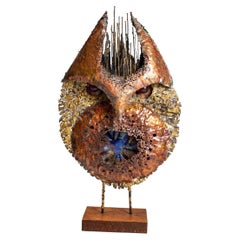
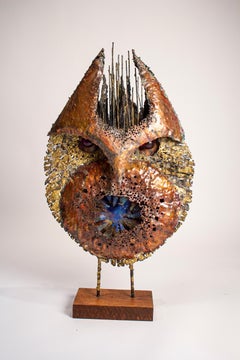
James Bearden Large Scale Brutalist Owl Sculpture from His "Animal Series"
By James Bearden
Located in Dallas, TX
Amazing large scale brutalist owl sculpture with glass eyes and beautiful enamel coloration by renowned Iowa abstract artist James Anthony Bearden from his Animal Series. We also hav...
Category
21st Century and Contemporary James Bearden Art
Materials
Brass, Bronze, Copper, Steel
James Bearden Brutalist Owl Sculpture with Stash Box in Base "Animals Series"
By James Bearden
Located in Dallas, TX
Amazing brutalist owl sculpture with felt lined stash box hidden in the base by renowned Iowa abstract artist James Anthony Bearden from his Animal Series.
Category
21st Century and Contemporary James Bearden Art
Materials
Brass
Related Items
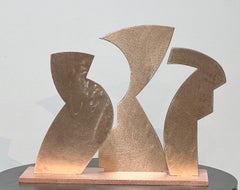
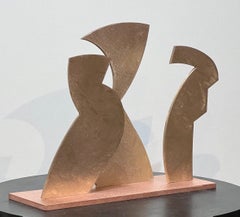
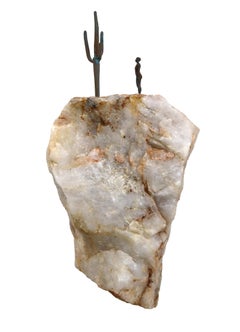
Henge, sculpture by Kerry Green, copper, bronze, abstract, figures, metal sculpt
By Kerry Green
Located in Santa Fe, NM
Henge, sculpture by Kerry Green, copper, bronze, abstract, figures, metal sculpture
Since childhood, Kerry Green has always been creative; painting, drawing, sculpting, and sewing. Her family provided her with materials and encouraged her efforts. She literally grew up in her parents’ art galleries, and with them toured the U.S.,
Europe, Mexico, Japan, and New Zealand, seeing museums and visiting artists’ studios. Growing up in Arizona and New Mexico gave her the opportunity to explore the Native reservations there where she has made life-long friendships. Several of her very early influences were Dr. Harry Wood...
Category
2010s Contemporary James Bearden Art
Materials
Bronze, Copper
$1,900
H 7.75 in W 9.5 in D 3.25 in
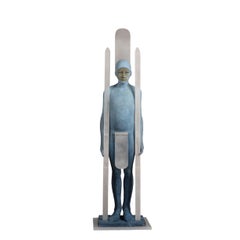
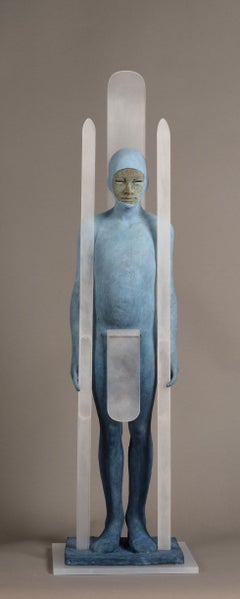
Snow - Hooded Bronze Figure with Skis, Light Blue Patina
By Jesus Curia Perez
Located in Chicago, IL
Jesús Curiá Perez
Snow
bronze and methacrylate
29.50h x 8.75w x 7d in
74.93h x 22.23w x 17.78d cm
ed. 1/8
JCP057
Jesús Curiá's sculptures arouse something more than purely aesthetic...
Category
21st Century and Contemporary Contemporary James Bearden Art
Materials
Bronze, Steel
$6,850
H 29.5 in W 8.75 in D 7 in
Ceramic #14 2017 original handmade signed unique large Talavera plate 18x18x2in
By Luis Miguel Valdes
Located in Miami, FL
Luis Miguel Valdes (Cuba, 1949)
"Ceramic #14", 2017
Ceramic plate in Uriarte's Talavera
45 x 45 x 4.5 cm. (17.75 x 17.75 x 1.75 in.)
Hand-signed by author
___________________________...
Category
2010s Contemporary James Bearden Art
Materials
Enamel
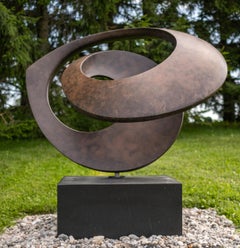
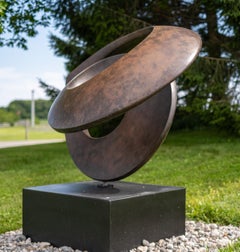
A Cappella - large, contemporary, abstract, bronze and steel outdoor sculpture
By David Chamberlain
Located in Bloomfield, ON
This lyrical and elegant contemporary sculpture is by David Chamberlain whose work is collected and admired around the world. Hand forged in patinated bronze and steel, the flowing c...
Category
2010s Abstract James Bearden Art
Materials
Bronze, Steel
$115,000
H 61 in W 61 in D 42 in
Arabesque, Female Ballet Dancer in Motion, Bronze Gray Bas Relief Sculpture Art
By Eric Bransby
Located in Denver, CO
This stunning figurative bas relief sculpture captures a female ballet dancer gracefully poised in the arabesque position, created by the acclaimed Colorado/Missouri artist Eric Bransby (1916-2020). Crafted from bronze and polymer Forton casting, the piece beautifully exemplifies Bransby’s mastery of motion and form.
Provenance:
Collection of the artist, Eric Bransby
About Eric Bransby:
Eric James Bransby was a highly respected muralist, painter, illustrator, and educator. His education at the Colorado Springs Fine Art Center included studies with renowned artists like Thomas Hart Benton, Jean Charlot, Boardman Robinson, and Josef Albers. He also studied at the prestigious Yale School of Fine Art.
Bransby’s career is defined by his exceptional work as a muralist, with notable commissions including the Rockhurst Library Triptych Mural at the University of Missouri, murals at Brigham Young University, the U.S. Air Force Academy...
Category
20th Century American Modern James Bearden Art
Materials
Bronze
$6,400 Sale Price
20% Off
H 40 in W 30 in D 3 in
"Viewer" Bronze Sculpture 41.5" x 32 "x 20" inch Ed. 1/1 by Sergii Shaulis
By Sergii Shaulis
Located in Culver City, CA
"Viewer" Bronze Sculpture 41.5" x 32 "x 20" inch Ed. 1/1 by Sergii Shaulis
2020
From the Fateful Flowers series
Approximate weight 75 lbs
ABOUT ARTIST
Born on 27 May 1985 in Kharkiv, Ukraine. From 2005 to 2011 studied at the Kharkiv State Academy of Design and Arts, at the Faculty of "Fine Arts" specialty "Easel and monumental sculpture." Now studying postgraduate at Kharkiv State Academy of Design and Arts. Works are in private collections in Ukraine, Israel, Germany, USA, Australia, Finland, Holland, Spain, Belgium, England.
Education
2002‑2005 Faculty of Engineering and Physics (NTU KhPI)
2005‑2011 Easel and monumental sculpture (KSADA)
2012-2016 postgraduate education (KSADA)
Exhibitions
2007-15 City exhibition HONSKHU. Kharkiv.
2007-14 Ukrainian Exhibition KONSKHU. Kyiv.
2008-11 "The maestro and his students", KSADA. Kharkiv (Audience Award 2009)
2008 11 International Triennial of sculpture. Kyiv .
2009 “Male portrait”, gallery KSADA. Kharkiv .
2009 "You get SMS ", Kharkiv ( Grand Prix "The best sculpture...
Category
21st Century and Contemporary Abstract James Bearden Art
Materials
Bronze, Steel
$11,500
H 45.5 in W 32 in D 20 in
Israeli Mod Arts & Crafts Copper Sculpture Bookends Bezalel Schatz Yaad Studio
By Bezalel Schatz
Located in Surfside, FL
Bezalel Schatz, (1912-1978), Yaad Studio Workshop
Mid century modern
The standing part is 6 X 5 inches. The copper sheet is 10 X 5 inches each. This is for a pair. they are copper w...
Category
Mid-20th Century Modern James Bearden Art
Materials
Copper
The Precious
Located in Brooklyn, NY
Stephen Lee is a Korean-American sculptor based in Dallas, Texas. Born in South Korea and immigrating to the United States as a teenager, Lee draws from a dual set of cultural influe...
Category
2010s Abstract James Bearden Art
Materials
Bronze, Steel
Florentine singer / - The Renaissance of the Renaissance -
By Paul Dubois
Located in Berlin, DE
Paul Dubois (1829 Nogent-sur-Seine - 1905 Paris), Florentine singer, 1865. Light brown patinated bronze with cast round plinth mounted on a square marble base (3.5 cm high). Total height 53 cm. Bronze dimensions: 49.5 cm (height) x 20 cm (length) x 10 cm (width), weight 5.6 kg. Inscribed on the plinth "P.[aul] DUBOIS", dated "1865", with the foundry's mark "F. BARBEDIENNE FONDEUR" and the signet "REDUCTION MECANIQUE A. COLLAS".
- Patina very occasionally darkened, lute with loss of one tuning peg, otherwise in excellent condition.
- The renaissance of the Renaissance -
The bronze is a precisely executed and masterfully cast contemporary reduction of Paul Dubois 155 cm tall masterpiece "Florentine Singer", which is exhibited in the Musée d'Orsay and for which the artist was awarded the Medal of Honor at the Paris Salon in 1865. The work acted as a beacon, and was followed by a plethora of depictions of juveniles.
Inspired by Donatello and Luca della Robbia, but also by painters such as Piero della Francesca, Benozzo Gozzoli, and Pinturicchio, the "Florentine Singer" is not an epigonal work that pays homage to a vanished era, but a successful attempt to draw vitality from the art of the past and thus give it new life.
The effect of vitality is the core of Italian Renaissance art theory. In order to fulfill itself as art, art had to appear like nature. This naturalism also characterizes the "Florentine Singer". The young man appears to have been taken from life, which is reinforced by the momentary nature of his action. He has just struck a now fading chord. In addition, the natural appearance is enhanced by the detailed shaping of the figurative details, such as the laces with the slightly curved leather of the shoes, the belt buckle, or the ornamentation on the body of the lute. Even the fingernails are clearly defined. Unlike the Renaissance, however, the effect of liveliness here is not based on the "discovery" of nature and the human body, but primarily on the rediscovery of the art of the Quattrocento. The liveliness of the artwork is therefore at the same time a revitalization of this art, so that we can speak of a Renaissance of the Renaissance, just as the Pre-Raphaelites in England at the same time transferred the Quattrocento to contemporary art.
Dubois takes on the most difficult of all subjects, the depiction of singing through silent sculpture. He was preceded in this by Luca della Robbia and Donatello with their pulpits of singers created in the 1430s in the Museo dell'Opera del Duomo in Florence. Compared to these works, the physiognomy of Dubois singer is far less animated, yet he also depicts singing in a convincing manner. He uses the whole body. He takes the ancient contrapposto, which was essential to Renaissance sculpture, and transforms the standing leg-playing posture into a late medieval S-swing, giving the body an elegant beauty and at the same time setting it in melodic motion. In the equally elegant finger position, the music is expressed in a much more literal way with the beating of the lute. Finally, the musicality of the sculpture culminates in the face with the mouth open to sing.
Through the act of singing, which is a great challenge to the artistic will to depict perfect beauty, the gracefulness of the classical face is not diminished, but enhanced. Starting from the face with the singing mouth and the gaze absorbed by the sounds, the inner vitality spreads, giving the bronze sculpture an intense aura, enhanced by the music. Dubois transfers the beauty of the Renaissance to the musical, sublimating the visible sculpture to the invisible of music.
He took up the challenge of transcending the Renaissance with the Renaissance, thus responding to the Querelle des Anciens et des Modernes, which arose at the end of the 17th century around the French Academy and remained virulent into the 19th century, in which antiquity was regarded either as an unattainable ideal or as a standard to be surpassed. With his work, Dubois proved that the Renaissance, which had championed the art of the ancients, could lead to a new renaissance of art.
About the artist
Paul Dubois' great-uncle was the famous French Baroque sculptor Jean-Baptiste Pigalle, in whose footsteps the talented great-nephew followed. When he debuted at the Paris Salon in 1858, he signed his work "Dubois-Pigalle". At his father's request, however, he first studied law before devoting himself to sculpture under the tutelage of François Christophe Armand Toussaint in 1856 and entering the École des Beaux-Arts in 1858. From 1859 to 1863, he lived in Rome and traveled to Naples and Florence. Inspired by Florentine art of the quattrocento, Dubois initiated a school-forming neo-Florentine style that combined the elegantly simple forms of youthful grace with a precise wealth of detail.Two purchases by the French state (“envois de Rome”) were made during his stay in Rome, which brought him recognition in Paris. After his return there, he quickly became an internationally sought-after artist.
Dubois was also active as a creator of monuments. His most famous work is the equestrian statue of Joan of Arc (1896) on the forecourt of Reims Cathedral. He was also a sought-after portraitist who produced around 50 busts and - Dubois was also a passionate painter - around 100 portraits in oil.
From 1873 to 1878 he was curator of the Museum du Luxembourg, in 1876 he became a member of the Institut de France and from 1878 to 1905 he was director of the École des Beaux-Arts.
In 1865, Dubois was awarded the Paris Salon Medal of Honor for his “Florentine Singer”. In 1867 he became Chevalier, in 1874 Officier, in 1886 Commandeur of the Légion d'honneur, which awarded Dubois the Grande Croix in 1896.
Selected Bibliography
Stole, Elmar: Paul Dubois. In: Saur. Allgemeines Künstlerlexikon, vol. 30, Munich - Leipzig 2001, pp. 677-678.
GERMAN VERSION
Paul Dubois (1829 Nogent-sur-Seine - 1905 Paris), Florentinischer Sänger, 1865. Hellbraun patinierte Bronze mit gegossener runder Plinthe auf quadratischem Marmorsockel montiert (3,5 cm Höhe). Gesamthöhe 53 cm. Maße der Bronze: 49,5 cm (Höhe) x 20 cm (Länge) x 10 cm (Breite), Gewicht 5,6 kg. Auf der Plinthe mit „P.[aul] DUBOIS“ bezeichnet, auf „1865“ datiert, mit dem Gießereistempel „F. BARBEDIENNE FONDEUR“ und dem Signet „REDUCTION MECANIQUE A. COLLAS“ versehen.
- Patina sehr vereinzelt nachgedunkelt, Laute mit Verlust eines Stimmwirbels, ansonsten ausgezeichnet erhalten.
- Die Renaissance...
Category
1860s Realist James Bearden Art
Materials
Bronze
$5,404
H 20.87 in W 7.88 in D 3.94 in
Bronze Table I
Located in Dallas, TX
Bronze & Steel Table
Category
2010s Abstract James Bearden Art
Materials
Bronze, Steel
Variation on a Theme II: Avoidance by Peter Brooke-Ball - Abstract sculpture
By Peter Brooke-Ball
Located in Paris, FR
Variation on a Theme II: Avoidance is a unique bronze, steel and oak wood sculpture by contemporary artist Peter Brooke-Ball, dimensions are 23 cm × 24 cm × 24 cm (9.1 × 9.4 × 9.4 in...
Category
2010s Contemporary James Bearden Art
Materials
Bronze, Steel
$3,182
H 9.06 in W 9.45 in D 9.45 in
Pecheur / - Full of anticipation -
Located in Berlin, DE
Adolphe Jean Lavergne (1863-1928), Pecheur, c. 1900. Brown patinated bronze with rectangular cast plinth on a green marble base (3 cm high), total height with hinge 37 cm, width 9 cm, depth 8 cm, weight 2.9 kg, signed “Lavergne” on the plinth.
- Base with old drilling and a few oxidized areas, patina occasionally rubbed, somewhat stained in the folds.
- Full of anticipation -
This bronze is the larger, highly detailed version of the fisherman that made Parisian artist Adolphe Jean Lavergne famous. In preparation for fishing, the boy prepares his rod before heading out to sea. The attachment of the iron ring and the rope behind him suggest a quay wall and a boat moored there. However, the depiction is entirely focused on the actual action of the young fisherman: With equal skill and concentration, he bends a hook to connect it to the fishing line. The contrast with his casual clothing, the loose-fitting trousers, the open shirt with its "wild" folds, and, last but not least, the sun hat boldly perched on his neck, reinforces the impression of the attentive care with which he goes about his work. His gaze makes him appear absorbed, as if he has forgotten the world around him and yet he is visibly filled with anticipation of fishing.
GERMAN VERSION
Adolphe Jean Lavergne (1863-1928), Pecheur, um 1890. Braun patinierte Bronze mit rechteckiger gegossener Plinthe auf grünem Marmorsockel (3 cm Höhe), Gesamthöhe mit Angel 37 cm, Breite 9 cm, Tiefe 8 cm, Gewicht 2,9 kg, auf der Plinthe mit „Lavergne“ signiert.
- Sockel mit alter Bohrung und wenigen oxidierten Stellen, Patina mitunter berieben, in den Falten vereinzelt etwas fleckig.
- Voller Vorfreude -
Die Bronzefigur ist die größere äußerst detaillierte Ausführung des Fischers, mit dem der Pariser Künstler Adolphe Jean Lavergne bekannt geworden ist. In Vorbereitung auf das Fischen präpariert der Junge die Angel...
Category
1890s Realist James Bearden Art
Materials
Bronze
Previously Available Items
Brutalist Abstract Sculpture, Gilded Steel and Bronze James Bearden American Mod
By James Bearden
Located in Surfside, FL
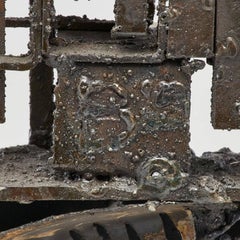
Wall-hanging sculpture: blackened steel, fused bronze, solvent dyes, abstract form, USA; Signed; 20 x 8 x 3 1/4
Suggesting archaeological artifacts from the future, these sculptures and functional pieces have been described as post-apocalyptic and brutalist in style, and they’re capturing the attention of collectors and galleries across the country.
Bearden was born in Alabama but grew up in Des Moines and received bachelor’s degrees in fine art and visual communications from Grand View University. He worked in graphic design for 20 years, most of that time as an award-winning art director at Flynn Wright advertising agency. In 2007, at the age of 43, he decided to leave that job and focus on fine art.
A longtime painter, Bearden found himself drawn to sculpture.
The work of Pablo Picasso, Harry Bertoia, Alexander Calder and Louise Nevelson particularly inspired him.
His early pieces were smooth, abstract shapes made from wire and sheets of steel painted with bright colors, evoking pop art. That felt like a dead end, he says, so he went in the opposite direction, building both organic and architectonic forms encrusted with craggy texture and charred, corroded or patinated finishes.
In 2012 Bearden entered his first public art competition. His sculpture, Paths Unite, was accepted for Clive’s Art Along the Trail and then purchased for the city’s permanent collection. He also has outdoor sculptures at Blank Park Zoo and Lowe Art Center in Marion, as well as in Ames, Coralville and Plymouth, Minnesota.
Rago auction brought Bearden’s sculptures to the attention of Larry Weinberg, owner of Weinberg Modern in New York. Weinberg began collecting Bearden’s work for himself and his gallery. This past winter, he curated a solo show of Bearden’s sculptures and functional pieces at 1stdibs Gallery in the New York Design Center. Weinberg compares Bearden’s style to the brutalist furniture of Paul Evans (1931-1987), a midcentury modern craftsman described as “the father of the modern art-furniture movement.”
Brutalism as an architectural style emerged after World War II and was characterized by the use of rough concrete as the primary building material. The term has been revived in the past few years to apply to a raw, un-prettified approach to web design as well as to the 1960s-1970s interior design aesthetic that emphasized rugged textures, distressed metals, unfinished concrete and industrial materials.
He went on to create cabinet-like boxes that he categorized as Dwelling Boxes, Harry Boxes (a tribute to the late sculptor and modern furniture designer Harry Bertoia), Barnacle Boxes...
Category
21st Century and Contemporary James Bearden Art
Materials
Bronze, Steel
H 20 in W 8 in D 3.25 in
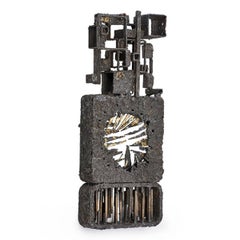
Brutalist Sculpture, Gilded Steel and Bronze
By James Bearden
Located in Surfside, FL
Wall-hanging sculpture: blackened steel, fused bronze, solvent dyes, abstract form, USA; Signed; 20 x 8 x 3 1/4
Suggesting archaeological artifacts from the future, these sculptures and functional pieces have been described as post-apocalyptic and brutalist in style, and they’re capturing the attention of collectors and galleries across the country.
Bearden was born in Alabama but grew up in Des Moines and received bachelor’s degrees in fine art and visual communications from Grand View University. He worked in graphic design for 20 years, most of that time as an award-winning art director at Flynn Wright advertising agency. In 2007, at the age of 43, he decided to leave that job and focus on fine art.
A longtime painter, Bearden found himself drawn to sculpture.
The work of Pablo Picasso, Harry Bertoia, Alexander Calder and Louise Nevelson particularly inspired him.
His early pieces were smooth, abstract shapes made from wire and sheets of steel painted with bright colors, evoking pop art. That felt like a dead end, he says, so he went in the opposite direction, building both organic and architectonic forms encrusted with craggy texture and charred, corroded or patinated finishes.
In 2012 Bearden entered his first public art competition. His sculpture, Paths Unite, was accepted for Clive’s Art Along the Trail and then purchased for the city’s permanent collection. He also has outdoor sculptures at Blank Park Zoo and Lowe Art Center in Marion, as well as in Ames, Coralville and Plymouth, Minnesota.
Rago auction brought Bearden’s sculptures to the attention of Larry Weinberg, owner of Weinberg Modern in New York. Weinberg began collecting Bearden’s work for himself and his gallery. This past winter, he curated a solo show of Bearden’s sculptures and functional pieces at 1stdibs Gallery in the New York Design Center. Weinberg compares Bearden’s style to the brutalist furniture of Paul Evans (1931-1987), a midcentury modern craftsman described as “the father of the modern art-furniture movement.”
Brutalism as an architectural style emerged after World War II and was characterized by the use of rough concrete as the primary building material. The term has been revived in the past few years to apply to a raw, un-prettified approach to web design as well as to the 1960s-1970s interior design aesthetic that emphasized rugged textures, distressed metals, unfinished concrete and industrial materials.
He went on to create cabinet-like boxes that he categorized as Dwelling Boxes, Harry Boxes (a tribute to the late sculptor and modern furniture designer Harry Bertoia), Barnacle Boxes...
Category
21st Century and Contemporary James Bearden Art
Materials
Bronze, Steel
James Bearden art for sale on 1stDibs.
Find a wide variety of authentic James Bearden art available for sale on 1stDibs. You can also browse by medium to find art by James Bearden in bronze, metal, steel and more. Not every interior allows for large James Bearden art, so small editions measuring 8 inches across are available. Customers who are interested in this artist might also find the work of Craig Campbell, Atticus Adams, and Denise Yaghmourian. James Bearden art prices can differ depending upon medium, time period and other attributes. On 1stDibs, the price for these items starts at $4,000 and tops out at $4,000, while the average work can sell for $4,000.