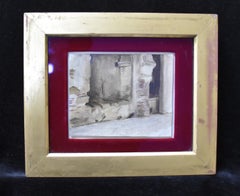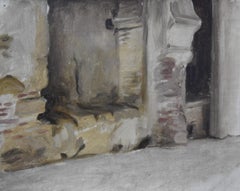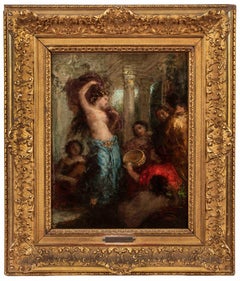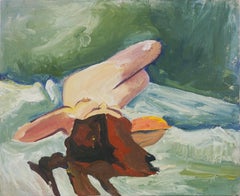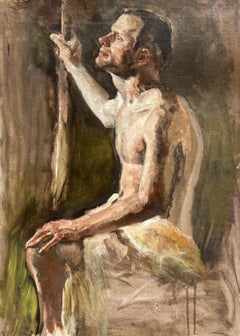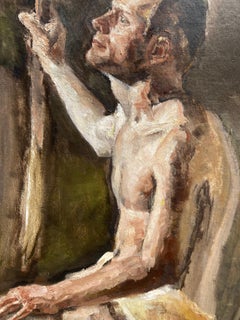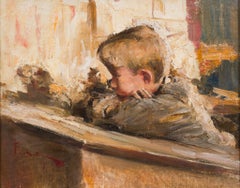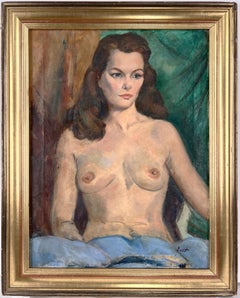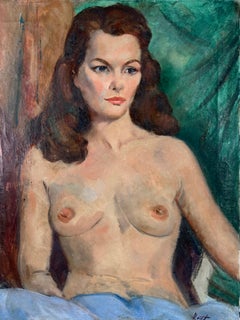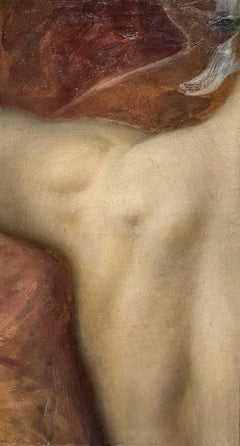
J J A Lecomte du Nouÿ (1842-1923) A shoulder and back study, oil painting
By Jean-Jules-Antoine Lecomte du Nouÿ
Located in Paris, FR
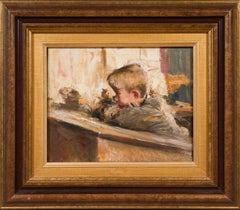
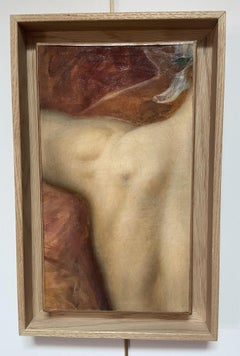
Jean-Jules-Antoine Lecomte du Nouÿ (1842-1923) A shoulder and back study, oil study oil on canvas 34 x 19.5 cm In good condition, a few small inpaintings visible under UV lights Stamp of the Estate sale in Toulouse on the stretcher In a modern frame : 40 x 25 cm Provenance : Estate of the artist and family of the artist by descent Estate sale in Toulouse 22 June 1999 This very interesting oil study was part of a set kept by the artist. He had studied fragments of anatomy both to use them as models in large compositions but probably also because he represented so many fragments. It is clear that this fragment of anatomy has a power of suggestion and serves as a relay to the imagination of the viewer, who is led to imagine the rest of the body taken as a model. We can speak of metonymy in painting and it is clear that the artist had this in mind when he kept such studies with him. Jean-Jules-Antoine Lecomte du Nouÿ was born on 10 June 1842 in Paris. Originally of a Piedmontese origin, his family had been settled in France since the fourteenth century and by the time of his birth had reached the status of nobility He was an Orientalist French painter and sculptor. He was strongly influenced by the works and teachings of Charles Gleyre and Jean-Léon Gérôme. Lecomte du Nouÿ found inspiration for his art through extensive travels to Greece, Turkey, Egypt, Romania and Italy. The thematic content of Lecomte du Nouÿ's work was mainly figural, but also spanned over a vast range of imagery throughout his career, including classical, historical and religious. Lecomte du Nouÿ is known for remaining faithful to his detailed, realistic style throughout the extent of his career, despite the onset of the Impressionist, Fauvist and Constructivist artistic movements during his lifetime. His work is said to have contributed significantly to the establishment of an iconic repertoire representing the Orient in the nineteenth century.A Parisian street was named after him in 1932. Lecomte du Nouÿ showed a strong attachment to visual art from a young age and was reported to have painted portraits of his father and uncle by the age of 6. In 1861, at 19 years of age, the artistic talents of young Jean-Jules-Antoine Lecomte du Nouÿ prompted him to become a pupil at the atelier of Swiss artist, Charles Gleyre. Under Gleyre's guidance Jean-Jules-Antoine learned the significance of individualistic style and gained the foundations of creative visual presentation. Later, Lecomte du Nouy further perfected his knowledge of the artistic form under the mentorship of Jean-Léon Gérôme, who was a renowned painter of the Academicism movement. It was at this time that Jean-Jules-Antoine learned the precision required to depict "la belle nature" —a style of illustration that aims to create the most beautiful representations of the natural form. This later became one of the main techniques employed in Lecomte du Nouÿ's signature artwork. In 1865, Du Nouÿ accompanied fellow artist, Félix Auguste Clément...
1890s Romantic Jean-Jules-Antoine Lecomte du Nouÿ Art
Oil