By Jean-Louis Boussingault
Located in Saint Amans des cots, FR
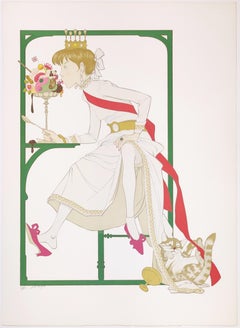
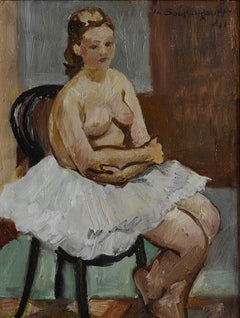
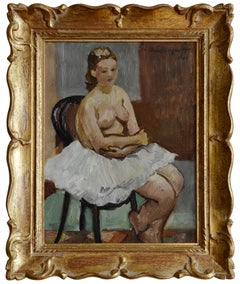
Oil on canvas by Jean-Louis Boussingault (1883-1943), France, 1941. The nostalgic ballerina. Provenance Charpentier Gallery, 76 rue du Faubourg St. Honore, Paris (now Sotheby's offices). Large label of the Charpentier Gallery on the back. Measurements : with frame: 43x35 cm - 16.9x13.8 inches, without frame: 32x24.5 cm - 12.6x9.6 inches. Signed "JL Boussingault" and dated "41" (see photo). In its period golden frame. Although realized at the end of his existence, a period when Boussingault uses bright and vivid colors to transcribe the happiness he has to cope with life, somewhat liberated from his demons, this work sees him return in part to his former way, that of the exit of the first war, produced by a desolate soul of the misfortunes which overwhelm him. It must be said that the period is dark. In 1940-1941, defeated France struggles to recover from defeat, discouragement fuels the feeling of inevitability. The crazy years are far, the youth of Boussingault also. Here, our ballerina no longer presents a physical conducive to the exercise of his art. Sitting, arms crossed, weary, without object, she is bored and seems to be thinking back to her past. To translate it, Boussingault returns to the sober, brown, gray and ocher colors attenuated by flat tints of pink and blue softened. The form, constructed and affirmed by simple masses, leaves no doubt about the reality of the situation. If the picture fits perfectly to the first degree, the allegory about the situation of France strikes the spirit. Some will see in the nudity of the torso of our dancer (the King is naked!) a contrast to the tutu, a vestige of the past, an allegory on the situation at the time of France divided into two zones, one said occupied in the North and the other free in the South. At the height of his art, Boussingault gratifies us here with an original work of a mastered and achieved neo-realism.
About Jean-Louis Boussingault :
Jean-Louis Boussingault was not a man to look for honors or rewards. Notoriety would have been appropriate for him if it had not been accompanied by considerations external to his profound art. It will have been deeply marked by the butchery of the First World War that will make it switch from dandy worldly enjoying the life to disillusioned mysanthropist whose painting will be the outlet for the pains of his deep soul. However, Jean-Louis Boussingault was born in 1883 under favorable auspices. A bourgeois family, a recognized chemist grandfather, friend of Louis Pasteur, a father, senior civil servant, liberal in the relations he will have with him. Boussingault's vocation will be precocious. He can take courses in the School of Decorative Arts in Paris and learn lithography. It is by fulfiling his military obligations that he will make a decisive meeting in the person of André Dunoyer de Segonzac. He follows with him the courses of Luc-Olivier Merson at the Ecole des Beaux-Arts, then Jean-Paul Laurens at the Julian Academy, and the Academy de la Palette. At that time, Boussingault is a pleasant person, his feature close to Bonnard and Toulouse-Lautrec (Souvenir of Maurice-Bar in Montmartre, 1905) makes him a skilful painter evolving in the worldly and semi-mundane world of the capital, universe that it captures with hindsight, relaxation, humor and accuracy. He frequents Montmartre and all the population of painters of the Butte. He shares tastes, hopes, parties, eejection of academicism, but not misery. On the contrary, his pace, his clothes, his easy elegance, his assumed dandyism contrast somewhat. He is the friend of many painters in Montmartre including Picasso, disguising himself as a femme fatale at the banquet that the latter will organize in honor of Douanier Rousseau. During the summer of 1906 he is with Segonzac and Luc-Albert Moreau in Saint-Tropez, and is part of the group of resistance to cubism that is formed around them. At the age of 24, he exhibits at the Salon des Indépendants. A master stroke for a first try, he wins the Bernheim Prize for a Nude with a Top Hat.
Recommended by Desvallières, close to the Black Band (see below), he continues to collaborate with Témoin by Iribe and Scheherazade by Cocteau and Benouard. He becomes one of the designers of the great fashion designer Paul Poiret, alongside Dufy and Fauconnet. His association with the patron culminates in an imposing, frescoed canvas...
Category
1940s Realist Jean-Louis Boussingault Art