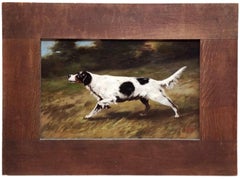
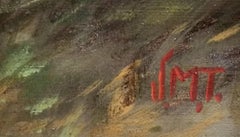
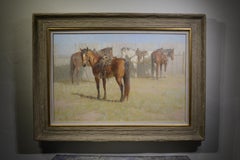
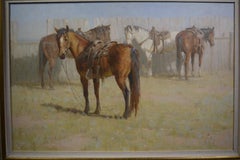
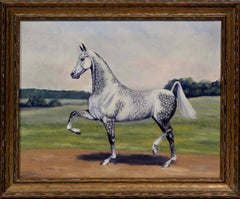
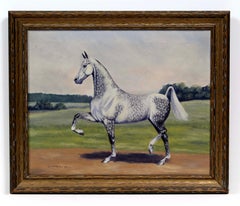
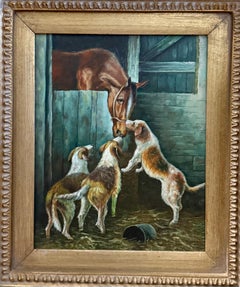
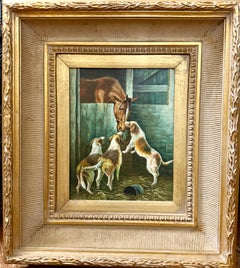
John Martin Tracy’s reputation as one of the nation's most admired sporting artists is unquestioned, despite his having come to the genre fairly late in his brief life. In 1895, a writer for the New York Times opined that "J. M. Tracy was a painter to delight the heart of all sporting men . . . He painted the hunter before the flock of birds, the dog with tail extended and paw uplifted, as he stood quivering over the scent and he did it all con amore, faithfully and with full understanding and knowledge of his subject." A Mayflower descendant, John Martin Tracy was born in Rochester, Ohio. His father, an abolitionist preacher, was killed in a mob uprising at an anti-slavery rally shortly before the boy's birth. His mother, Hannah Conant Tracy (later Cutler), was able to support the couple's three children by working as a highly respected journalist. Her professional duties in that capacity and pioneering role in the national suffrage movement required frequent travel; as a result, Tracy and his sisters spent a majority of their childhoods with their maternal grandmother in Rochester. A sensitive, gifted and imaginative child, Tracy excelled in the local schools before advancing to Oberlin College and then Northwestern University, where he began his art studies. Tracy was forced to abandon his education, however, at the onset of the Civil War; as a member of the 19th Illinois Infantry, Tracy quickly attained the rank of lieutenant and began to formulate his artistic ambitions. Upon his discharge from the military, Tracy worked various odd jobs in southern Illinois to save money for European travel. Tracy was enrolled at the École des Beaux-Arts from 1867–68 and studied in the progressive atelier of the French portrait master Carolus-Duran. Following his year abroad, Tracy struck out for California, where artists like Alfred Bierstadt were creating dynamic landscapes of the western terrain. From 1872–73, Tracy maintained a studio in Chicago, before returning to Paris. During his second stay in the city, Tracy underwent rigorous training under Horace Lecoq de Boisbaudran to learn precise drawing from memory, a skill that served him well in his notably accurate renditions of sporting scenes. Tracy also fraternized with fellow American artists John Singer Sargent and James Carroll Beckwith, who served as best man at Tracy's wedding to Mélanie Guillemin, sister of the sculptor Emile Guillemin. Tracy's full-length portrait of his wife was exhibited in the Paris Salon of 1874, marking a stylistic transition from romantic landscapes to portraiture. Upon his return to the United States in 1878, Tracy established a studio in St Louis. Despite his success as a portrait artist, he increasingly turned his attention to the elaborate field and sporting landscapes, themes with which painters Arthur Burdett Frost and Arthur Fitzwilliam Tait were already enjoying patronage. Tracy’s skill in capturing every element of the hunt—the glorious natural setting, the dynamic activity, the vitality of man and beast, the majesty of finely bred champion dogs and horses and the revered dignity of the sport—soon catapulted him to the forefront of that specialty. Though Tracy made a permanent home in Greenwich, Connecticut beginning in 1881, he traveled extensively—and especially throughout the South—executing the commission for hunt scenes. Tracy's life and career were cut short. Tracy was only 49 when he died in Ocean Springs, Mississippi, a warm retreat he had frequented during winter months. Shortly before his death, five paintings slated for inclusion in the 1893 Chicago World's Fair were lost in a fire, a devastating blow to the artist. In the aftermath of that loss, the final painting on his easel was one of his largest and most ambitious works, Candidates for the Horse Show, now in the collection of the Morris Museum of Art. Tracy's work rarely reaches the present-day art market, held closely by private collectors and sporting clubs. Examples of his work can be found at the Smithsonian American Art Museum and the American Kennel Club.