John Wentworth Russell Art

to
1
Overall Width
to
Overall Height
to
1
1
1
1
1
1
1
1
1
1
1
10,340
2,808
2,500
1,408
1
1
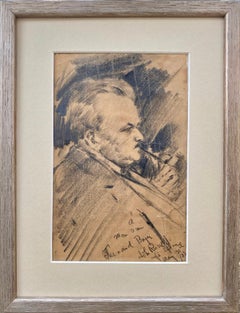
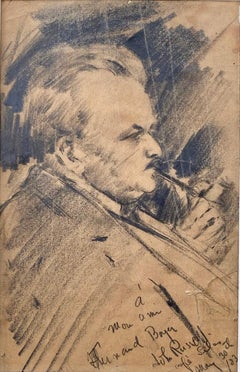
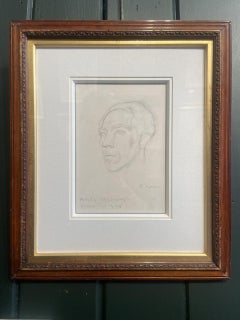
Artist: John Wentworth Russell
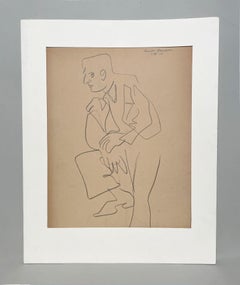
Cafe Society: The Smoker, male portait Closerie des Lilas, Lost Generation Paris

Cafe Society: The Smoker, male portait Closerie des Lilas, Lost Generation Paris

By John Wentworth Russell

Located in Norwich, GB

A strong portrait, and a piece of history. It was confidently sketched in 1923, during the heyday of the "Lost Generation" in Paris, at the Closerie des Lilas - Ernest Hemingway's favourite haunt and home-from-home in the City. This historical café is where Hemingway first read The Great Gatsby with his friend F. Scott Fitzgerald and where he wrote most of The Sun Also Rises...

Category

1920s American Modern John Wentworth Russell Art

Materials

Paper, Graphite

Related Items
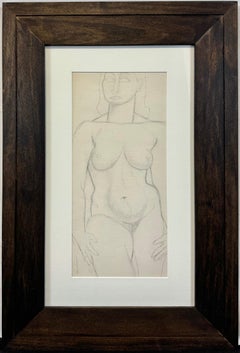
“Standing Nude, c. 1930” American Modernist Early Female Nude Drawing Signed

“Standing Nude, c. 1930” American Modernist Early Female Nude Drawing Signed

By Louise Nevelson

Located in Yardley, PA

“Standing Nude, c. 1930” by Louise Nevelson (1899-1988) This wonderful early pencil drawing by Nevelson represents a nude figure, rendered with simple and confident lines that empha...

Category

Early 20th Century American Modern John Wentworth Russell Art

Materials

Paper, Pencil, Graphite

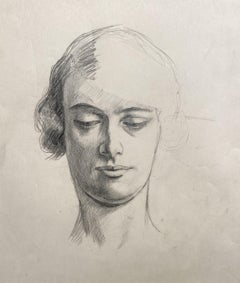
American Portrait Of A Woman

American Portrait Of A Woman

Located in Lake Worth Beach, FL

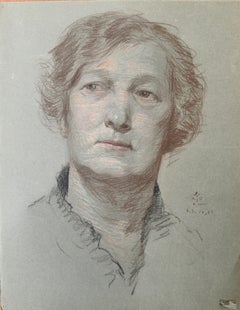
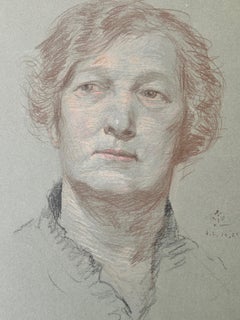
Portrait of a Woman Pencil signed and dated Feb 20. 20 unframed 14x11 George Kenneth Hartwell painter and illustrator was born in Fitchburg 1891-1949, Massachus...

Category

1920s American Modern John Wentworth Russell Art

Materials

Pastel, Paper, Pencil

Self Portrait with Arms Over Head, vignette on Paul Cadmus on left

Self Portrait with Arms Over Head, vignette on Paul Cadmus on left

Located in Fairlawn, OH

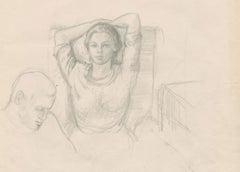
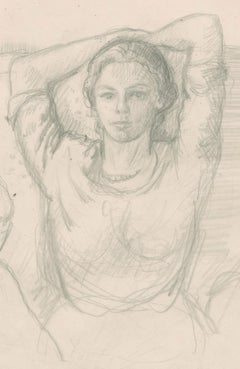
Self Portrait with Arms Over Head, vignette on Paul Cadmus on left Graphite drawing on thin wove paper, c. 1940's Unsigned Provenance: Paull Cadmus Jon F. Anderson (1937-2018) Condition: Sheet size: 15 x 10 1/4 inches Born in Hoboken, New Jersey, Margaret Hoening (1906–1998) was a painter and an etcher perhaps best known for her photographs as part of the PaJaMa photography collective. After attending Smith College, she settled in New York, where she pursued formal artistic training at the Art Students League. There, she met the artist couple Paul Cadmus and Jared French. In 1937, she married French, fifteen years her junior, who had spent the previous decade with Cadmus. The trio formed a tight bond, with Cadmus and French continuing their relationship. Born in Hoboken, New Jersey, Margaret Hoening (1906–1998) was a painter and an etcher perhaps best known for her photographs as part of the PaJaMa photography collective. After attending Smith College, she settled in New York, where she pursued formal artistic training at the Art Students League. There, she met the artist couple Paul Cadmus and Jared French. In 1937, she married French, fifteen years her junior, who had spent the previous decade with Cadmus. The trio formed a tight bond, with Cadmus and French continuing their relationship. Together, the three formed PaJaMa (a mashup of their first names, Paul, Jared, and Margaret). Using Hoening’s Leica, they captured themselves, their artist friends, and members of the gay community posing in artful tableaux on the beaches of Fire Island, Provincetown, and Nantucket over the following eight years. Those captured by their camera include the photographer George Platt Lynes; Cadmus’s sister and artist Fidelma; artist Bernard Perlin; and Monroe Wheeler, director of exhibitions at the Museum of Modern Art, among others. Though she produced few canvases, Hoening’s paintings demonstrate the influences of French and Cadmus, particularly with her adoption of the time-intensive, traditional medium of egg tempera that they championed. In the 1940s, the Frenches’ social circle continued to expand. They befriended the British author E.M. Forster, who stayed with them on his first trip to New York in 1947, spending a few days with them in Provincetown, and visiting them again in 1949. When Cadmus began a relationship with the young artist George Tooker in 1944, the trio became a foursome, with Tooker regularly vacationing with the group and appearing in PaJaMa’s photographs...

Category

1940s American Modern John Wentworth Russell Art

Materials

Graphite

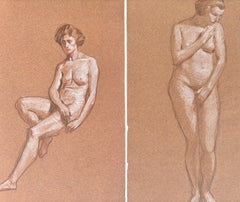
Pair of Nude Pencil Drawing

Pair of Nude Pencil Drawing

Located in Lake Worth Beach, FL

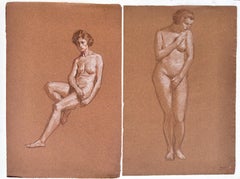
Nude Pencil Drawing pair of Portraits Pencil and pastel on paper, unsigned from the artist portfolio. George Kenneth Hartwell painter and illustrator was born in Fitchburg 1891-1949...

Category

1920s American Modern John Wentworth Russell Art

Materials

Paper, Pastel, Pencil

Love Hurts Mid Century Woman's Magazine Illustration Cosmopolitan Magazine

Love Hurts Mid Century Woman's Magazine Illustration Cosmopolitan Magazine

Located in Miami, FL

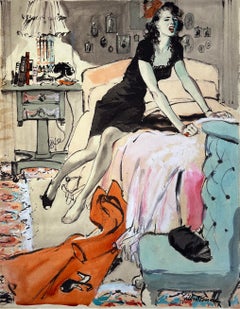
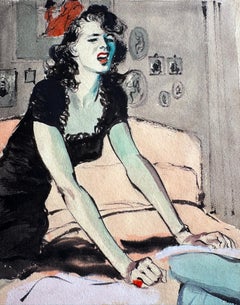
Love hurts. A young, attractive woman is captured in a moment of peak drama. She is leaning on her bed in her room, crying, her face grim with despair. A tear drop is seen below he...

Category

1940s American Modern John Wentworth Russell Art

Materials

Paper, Watercolor, Gouache, Pencil

Chef Basting Chicken with Madeline Watching

Chef Basting Chicken with Madeline Watching

By Ludwig Bemelmans, 1898-1962

Located in Miami, FL

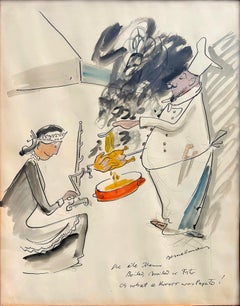
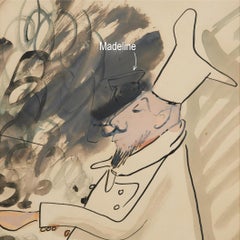
This large Bemelans features a small image of Madeline in the smoke behind the chef's face. It was most likely preliminary work for an illustration with Madeline and the Chef that a...

Category

1950s American Modern John Wentworth Russell Art

Materials

Paper, Watercolor, Gouache, Pencil

“Reclining Nude, c. 1930” American Modernist Female Drawing Lady African Mask

“Reclining Nude, c. 1930” American Modernist Female Drawing Lady African Mask

By Louise Nevelson

Located in Yardley, PA

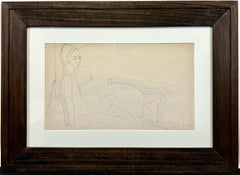
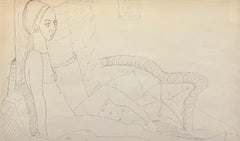
“Reclining Nude, c. 1930” by Louise Nevelson (1899-1988) This wonderful original ink drawing highlights Nevelson’s interest in the early 20th century avant-garde. Inspired by Picass...

Category

Early 20th Century American Modern John Wentworth Russell Art

Materials

Paper, Pencil, Graphite

A Handsome 1940s Portrait of a Seated Man by Chicago Artist, Harold Haydon

A Handsome 1940s Portrait of a Seated Man by Chicago Artist, Harold Haydon

By Harold Haydon

Located in Chicago, IL

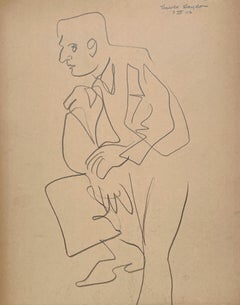
A Handsome 1940s Portrait of a Seated Man by Chicago Modern Artist, Harold Haydon (Am. 1909-1994). A wonderfully executed line drawing dating from 1946 with great character; looks ...

Category

Mid-20th Century American Modern John Wentworth Russell Art

Materials

Paper, Graphite

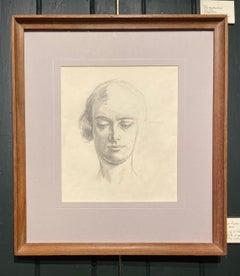
Study of a Woman, Graphite Sketch, 20th Century British Artist, Signed

Study of a Woman, Graphite Sketch, 20th Century British Artist, Signed

Located in London, GB

Graphite on paper, signed on reverse Image size: 11 x 9 1/2 inches (28 x 24 cm) Mounted and framed Ernest Proctor Born in Tynemouth, Northumberland, the son of a scientist, Ernest was educated at Bootham Friends' School in York and then came to Newlyn in 1907 to study with Stanhope Forbes. He quickly become recognized as the best student of the School. He acted as Assistant to Stanhope Forbes and Elizabeth Forbes...

Category

20th Century Modern John Wentworth Russell Art

Materials

Graphite, Paper

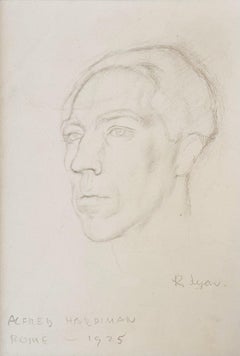
Portrait of Alfred Hardiman, Graphite Sketch, Signed and Dated 1925

Portrait of Alfred Hardiman, Graphite Sketch, Signed and Dated 1925

Located in London, GB

Graphite on paper, signed and dated Image size: 18 x 12 1/2 inches (46 x 32 cm) Mounted and framed The sitter for this portrait, Alfred Hardiman, was an English sculptor. Hardiman and Lyon were friends and met when they both attended the British School at Rome in the early 1920s. Hardiman won a London County Council Scholarship to the Royal College of Art in 1912, and three years later joined the Royal Academy School. After a period as an engineer's draughtsman in the Royal Flying Corps during the First World War, Hardiman resumed his studies and in 1920 was awarded the British Prix de Rome scholarship, spending two years at the British School at Rome. There he developed his style, a blend of naturalism and classicism influenced by Roman and Etruscan art and early fifth century Greek sculpture. Hardiman's best-known (but also most controversial) work is the Earl Haig Memorial on Whitehall in London. More universally admired are the heraldic lions flanking the main entrance to the City Hall, Norwich, a work which fully epitomises his style. He was appointed consultant sculptor to the building, having worked with one of the architects, Stephen Rowland Pierce, on the Haig Memorial. Hardiman also carved three large stone figures for the outside of the council chamber, and worked with other sculptors on the project including James Woodford and Eric Aumonier. Hardiman was elected Associate of the Royal Academy in 1936 and a full Academician in 1944. He became a fellow of the Royal Society of British Sculptors in 1938 and the following year received their silver medal for his statue of Haig. In 1946 he won a gold medal for his bronze fountain figure for the New Council House, College Green, Bristol, which however was never erected. In 1918 he married Violet, daughter of Herbert Clifton White, of London, and had two daughters. He died at Stoke Poges on 17th April 1949. Robert Lyon...

Category

1920s Modern John Wentworth Russell Art

Materials

Paper, Graphite

Black Panther Trials - Civil Rights Movement  Police Violence African American

Black Panther Trials - Civil Rights Movement Police Violence African American

Located in Miami, FL

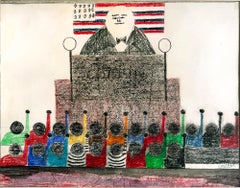
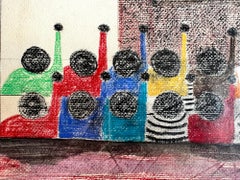
The Black Panther Trials - In this historically significant work, African American Artist Vicent D. Smith functions as an Art Journalist/ Court Reporter as much as a Artist. Here, he depicts, in complete unity, 21 Black Panther Protestors raising their fist of defiance at the White Judge. Smith's composition is about utter simplicity, where the Black Panther Protestors are symmetrically lined up in a confrontation with a Judge whose size is exaggerated in scale. Set against a stylized American Flag, the supercilious Judge gazes down as the protesters as their fists thrust up. Signed Vincent lower right. Titled Panter 21. Original metal frame. Tape on upper left edge of frame. 255 . Panther 21. Framed under plexi. _____________________________ From Wikipedia In 1969-1971 there was a series of criminal prosecutions in New Haven, Connecticut, against various members and associates of the Black Panther Party.[1] The charges ranged from criminal conspiracy to first-degree murder. All charges stemmed from the murder of 19-year-old Alex Rackley in the early hours of May 21, 1969. The trials became a rallying-point for the American Left, and marked a decline in public support, even among the black community, for the Black Panther Party On May 17, 1969, members of the Black Panther Party kidnapped fellow Panther Alex Rackley, who had fallen under suspicion of informing for the FBI. He was held captive at the New Haven Panther headquarters on Orchard Street, where he was tortured and interrogated until he confessed. His interrogation was tape recorded by the Panthers.[2] During that time, national party chairman Bobby Seale visited New Haven and spoke on the campus of Yale University for the Yale Black Ensemble Theater Company.[3] The prosecution alleged, but Seale denied, that after his speech, Seale briefly stopped by the headquarters where Rackley was being held captive and ordered that Rackley be executed. Early in the morning of May 21, three Panthers – Warren Kimbro, Lonnie McLucas, and George Sams, one of the Panthers who had come East from California to investigate the police infiltration of the New York Panther chapter, drove Rackley to the nearby town of Middlefield, Connecticut. Kimbro shot Rackley once in the head and McLucas shot him once in the chest. They dumped his corpse in a swamp, where it was discovered the next day. New Haven police immediately arrested eight New Haven area Black Panthers. Sams and two other Panthers from California were captured later. Sams and Kimbro confessed to the murder, and agreed to testify against McLucas in exchange for a reduction in sentence. Sams also implicated Seale in the killing, telling his interrogators that while visiting the Panther headquarters on the night of his speech, Seale had directly ordered him to murder Rackley. In all, nine defendants were indicted on charges related to the case. In the heated political rhetoric of the day, these defendants were referred to as the "New Haven Nine", a deliberate allusion to other cause-celebre defendants like the "Chicago Seven". The first trial was that of Lonnie McLucas, the only person who physically took part in the killing who refused to plead guilty. In fact, McLucas had confessed to shooting Rackley, but nonetheless chose to go to trial. Jury selection began in May 1970. The case and trial were already a national cause célèbre among critics of the Nixon administration, and especially among those hostile to the actions of the FBI. Under the Bureau's then-secret "Counter-Intelligence Program" (COINTELPRO), FBI director J. Edgar Hoover had ordered his agents to disrupt, discredit, or otherwise neutralize radical groups like the Panthers. Hostility between groups organizing political dissent and the Bureau was, by the time of the trials, at a fever pitch. Hostility from the left was also directed at the two Panthers cooperating with the prosecutors. Sams in particular was accused of being an informant, and lying to implicate Seale for personal benefit. In the days leading up to a rally on May Day 1970, thousands of supporters of the Panthers arrived in New Haven individually and in organized groups. They were housed and fed by community organizations and by sympathetic Yale students in their dormitory rooms. The Yale college dining halls provided basic meals for everyone. Protesters met daily en masse on the New Haven Green across the street from the Courthouse (and one hundred yards from Yale's main gate). On May Day there was a rally on the Green, featuring speakers including Jean Genet, Abbie Hoffman, Jerry Rubin, and John Froines (an assistant professor of chemistry at the University of Oregon). Teach-ins and other events were also held in the colleges themselves. Towards midnight on May 1, two bombs exploded in Yale's Ingalls Rink, where a concert was being held in conjunction with the protests.[4] Although the rink was damaged, no one was injured, and no culprit was identified.[4] Yale chaplain William Sloane Coffin stated, "All of us conspired to bring on this tragedy by law enforcement agencies by their illegal acts against the Panthers, and the rest of us by our immoral silence in front of these acts," while Yale President Kingman Brewster Jr. issued the statement, "I personally want to say that I'm appalled and ashamed that things should have come to such a pass that I am skeptical of the ability of a Black revolutionary to receive a fair trial anywhere in the U.S." Brewster's generally sympathetic tone enraged many of the university's older, more conservative alumni, heightening tensions within the school community. As tensions mounted, Yale officials sought to avoid deeper unrest and to deflect the real possibility of riots or violent student demonstrations. Sam Chauncey has been credited with winning tactical management on behalf of the administration to quell anxiety among law enforcement and New Haven's citizens, while Kurt Schmoke, a future Rhodes Scholar, mayor of Baltimore, MD and Dean of Howard University School of Law, has received kudos as undergraduate spokesman to the faculty during some of the protest's tensest moments. Ralph Dawson, a classmate of Schmoke's, figured prominently as moderator of the Black Student Alliance at Yale (BSAY). In the end, compromises between the administration and the students - and, primarily, urgent calls for nonviolence from Bobby Seale and the Black Panthers themselves - quashed the possibility of violence. While Yale (and many other colleges) went "on strike" from May Day until the end of the term, like most schools it was not actually "shut down". Classes were made "voluntarily optional" for the time and students were graded "Pass/Fail" for the work done up to then. Trial of McLucas Black Panther trial sketch...

Category

1970s American Modern John Wentworth Russell Art

Materials

Watercolor, Pen, Pencil, Paper
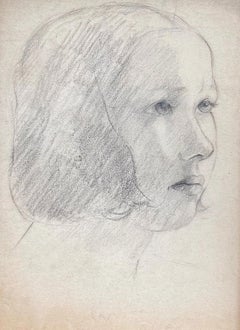
The New Haircut, 20th Century portrait of a Young Girl, drawing

The New Haircut, 20th Century portrait of a Young Girl, drawing

Located in London, GB

Graphite on paper Image size: 11 ¾ x 8 ½ inches (30 x 21.5 cm) Original frame This superbly-drawn portrait highlights the artist’s undeniable skill as a portrait artist, particularl...

Category

20th Century Modern John Wentworth Russell Art

Materials

Graphite, Paper

John Wentworth Russell art for sale on 1stDibs.

Find a wide variety of authentic John Wentworth Russell art available for sale on 1stDibs.

Artists Similar to John Wentworth Russell