Joseph Fleck Paintings

to
2
Overall Width
to
Overall Height
to
2
2
2
2
2
2
1
1
2
2
2
2
2
757
757
745
672
2
2
Artist: Joseph Fleck
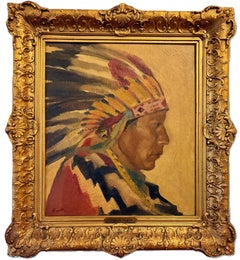
Chief Star Road
Chief Star Road

Chief Star Road

By Joseph Fleck

Located in Denver, CO

"Chief Star Road" stands out for how clearly it showcases Joseph Amadeus Fleck’s strengths as a Western modernist with classical training. Fleck’s confident draftsmanship gives the p...

Category

1950s Joseph Fleck Paintings

Materials

Canvas, Oil

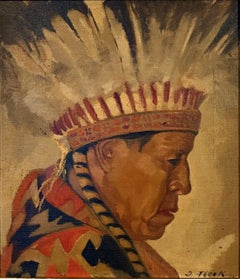
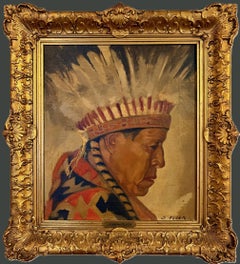
Chief Samaro
Chief Samaro

Chief Samaro

By Joseph Fleck

Located in Denver, CO

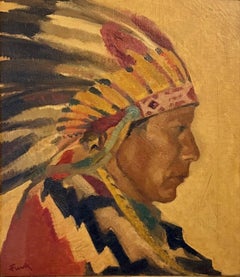
"Chief Samaro" by Joseph Amadaeus Fleck is a compelling portrait that reflects the artist’s deep connection to the culture and people of the American Southwest. Rendered in warm, ear...

Category

1950s Joseph Fleck Paintings

Materials

Canvas, Oil

Related Items
Italian 18th Century Oval Religious Oil on Canvas Painting with Saint Dominic

Italian 18th Century Oval Religious Oil on Canvas Painting with Saint Dominic

By Francesco de Mura

Located in Firenze, IT

This beautiful Italian 18th Century old masters oil painting on oval canvas with giltwood frame is attributed to Solimena and features a religious scene. In this splendid oval-shaped painting are depicted Saint Dominic...

Category

18th Century Old Masters Joseph Fleck Paintings

Materials

Canvas, Oil

"Dancer's Dream" Large Original Oil Painting by Robert White, Frameless Display

"Dancer's Dream" Large Original Oil Painting by Robert White, Frameless Display

Located in Encino, CA

“Dancer's Dream,” an original oil on canvas by Robert K. White, is a piece for the true collector. White’s careful attention to detail and vivid use of greens, browns, and whites project from the painting, immediately capturing the viewer's attention and highlighting the artist's keen ability to capture emotion and life - all in a brushstroke. White's talent for depicting light and shadow provides the foundation for him to deliver subjects and scenes to the viewer's eye. This masterful work would make a great addition to an art collection and enhance most any home, perfect for those who have an affinity for dancers, the ballet, portraits, and color-rich works of art. In the artist’s own words, “I don’t paint what is inside of me; I paint what I see outside of me. I’m an observer. If I see something and I feel an affinity for it, something just clicks in my head. I’ll make the decision right then and there to paint that particular subject during that particular moment. It’s a perfect moment. Once something has caught my eye and I’ve heard the “perfect” click, it’s like a photograph has been taken in my mind’s eye. I only have a few days of clarity with that image. I have to start the painting quickly or else it will be gone and I will lose that image forever.” Artist: ROBERT KENNETH WHITE...

Category

2010s Realist Joseph Fleck Paintings

Materials

Oil, Canvas

Paul Anton Kaulbach (1864 Hanover - 1930 Berlin) Male Nude

Paul Anton Kaulbach (1864 Hanover - 1930 Berlin) Male Nude

Located in Greding, DE

Depiction of a male nude in diffuse architectural scenery. Signed lower right (Paul) Anton Kaulbach (1864 Hannover - 1930 Berlin). Oil on canvas, in gold-patinated frame. Image size:...

Category

20th Century Abstract Impressionist Joseph Fleck Paintings

Materials

Oil, Canvas

Fenzoni, Painting AND preparatorial Drawing, John the Baptist, Italy Renaissance

Fenzoni, Painting AND preparatorial Drawing, John the Baptist, Italy Renaissance

By Ferrau Fenzoni

Located in Greven, DE

The painting and the preparatory drawing are offered together. Provenance Private collection, Germany, Trier, c. 1980- 2013 Saint John the Baptist Brown ink and wash over red chalk on oatmeal paper 31 x 20.5 cm Inscribed: „Ferrau Fenzonio da Faenza invt. esque … imp. da Fran. Villamena …“. bears the collector's mark of Henry Scipio Reitlinger (1882-1950; Lugt 2274a) on a tiny label glued to the verso On the reverse is a partial drawing of a Pieta, pricked for transfer. Provenance New York, Doyle, 14. October 2015, No. 6 The painting and the preparatory drawing resemble the composition of an engraving after Ferraù Fenzoni by Francesco Villamena. Drawing, engraving and painting are almost identical, except for minor differences. Even the measurements nearly correspond: painting (32 x 25,5 cm), drawing (30 x 20,5 cm), engraving (31,1 x 23,5 cm). Dr. Guiseppe Scavizzi confirmed the attribution of the present panting to Fenzoni and he dates it to c. 1590. The inscription on the drawing reads “Ferrau Fenzonio da Faenza invt. esque. . . imp. da Fran: Villamena . . .”. The engraving’s inscription also lists place and date “Ferra Fensionius inventor/F. Villamoena sculpsit Rome/Aspectu fruitur… antra puer/cum Privilegio… 1613”. Interestingly, the engraving is not mirrored as it is in most printing processes. Painting, drawing and engraving are not reversed but the same. It is remarkable to note that there are further paintings by Fenzoni which were engraved in the same order and not reverted. They also show strong parallels regarding the compositions and the measurements (see for example “Deposition of Christ” ). Ferraù Fenzoni was an Italian painter mainly active in Todi. He is also called Il Faenzone after his birthplace (Faenza). He apprenticed in Rome during the papacy of Gregory XIII and contributed to numerous fresco cycles under pope Sixtus V, such as the Loggia della Benedizioni in the Lateran Palace, the frescoes on the walls and vaults of the Scala Santa of the adjacent Basilica of San Giovanni in Laterano, and the decoration in the Sistine library. His expressive canvases straddle the styles of Mannerism and Baroque. In 1594, he moved to Todi. A “Last Judgement” by him is housed in the cathedral of Todi. He returned to Faenza in 1599, where he decorated chapels in the cathedral from 1612 to 1616. In 1622, he completed a “Deposition”, now in the local Pinacoteca. In 1640, Fenzoni was named “cavaliere dello speron d’oro” by Cardinal Colonna and, on 25th April 1634, he was nominated vicar and “castellano of Granarolo”. Fenzoni‘s style is characterized by a mixture of the Mannerism of the Northern Netherlands and the Italian Baroque. Saint John the Baptist, Old Master, 17th Century, By Fenzoni, Religious Scene, Rome Art...

Category

16th Century Mannerist Joseph Fleck Paintings

Materials

Canvas, Oil, Handmade Paper

Aeneas Fleeing the Burning of Troy, 17th Century Flemish Oil on Canvas Painting

Aeneas Fleeing the Burning of Troy, 17th Century Flemish Oil on Canvas Painting

Located in Firenze, IT

This oil painting on canvas, created by an artist from the 17th Century Flemish School, depicts one of the most significant scenes from Greco-Roman mythology: Aeneas saving his famil...

Category

17th Century Dutch School Joseph Fleck Paintings

Materials

Canvas, Oil

Untitled (Jai Lai)
Untitled (Jai Lai)

Guillermo CaivanoUntitled (Jai Lai), 2006

$2,250Sale Price|25% Off

H 16.25 in W 12.5 in D 1 in

Untitled (Jai Lai)

Located in Beverly Hills, CA

Provenance: Ibid Projects Private collection, Los Angeles

Category

Early 2000s Contemporary Joseph Fleck Paintings

Materials

Canvas, Oil

«Sh*t Happens» Figurative Oil Painting by Samantha Van Heest

«Sh*t Happens» Figurative Oil Painting by Samantha Van Heest

By Samantha Van Heest

Located in Oslo, NO

Shit happens sometimes. In this piece, the artist wanted to create an unsettling and claustrophobic space where people feel most private and vulnerable. Inspired by artist Tala Madani, she created a cartoon figure to act as the voyeur, a bright and unwelcome disturbance that cannot be ignored. Samantha Van Heest...

Category

2010s Contemporary Joseph Fleck Paintings

Materials

Canvas, Oil

Christ as Salvator Mundi, Circle Van Dyck, Flemish Old Master, Christ Child

Christ as Salvator Mundi, Circle Van Dyck, Flemish Old Master, Christ Child

By Anthony van Dyck

Located in Greven, DE

The Christ Child as Redeemer of the World Oil on Canvas, 69.3 x 49.7 cm Provenance Private Collection, Belgium The present painting is known in different versions. One of them is ...

Category

17th Century Baroque Joseph Fleck Paintings

Materials

Canvas, Oil

Previously Available Items
Pueblo
Pueblo

Joseph FleckPueblo, c.1940

Sold

H 30 in W 36 in D 2 in

Pueblo

By Joseph Fleck

Located in Wilton Manors, FL

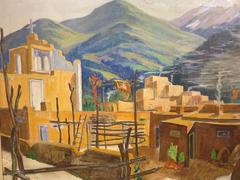
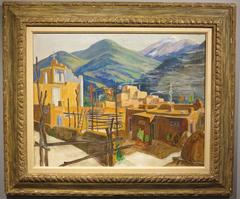
Joseph Amadeus Fleck ( 1892-1977). Pueblo, c.1940's. Oil on canvas measures 22 x 28 inches; 30 x 36 inches in a carved Hydenryk frame. A few very minor surface scratches. The piece has never been cleaned and has very minor surface dirt. Signed lower right. No damage or restoration. Born in the old Austro-Hungarian Empire, Joseph Flecks artistic talents were fired in Fin de siecle Vienna - the crucible of Expressionism - alongside Klimt and Kokoschka. After a stint in the army, where he served as regimental artist, Fleck emigrated to the United States in 1922. He found work in Missouri at the Tiffany Glass Studios, but settled eventually in Taos, where he became a fixture in the second wave after the Founders. The chromatic geometry of Pueblo creates a rhythm of horizontals, verticals and diagonals. What pulls the work together is the subtlety of the tight curls of smoke from the chimneys, contained in the picture plane by the river that runs between the peaks, obscuring the tree-covered slope at right as if with a layer of mist. Joseph Amadeus Fleck, born of German speaking parents in the village of Sziklos, Austria-Hungary on August 25, 1892, saw the American Southwest through Viennese eyes. He received his first education in the arts at the Kunstgewerbeschule or Institute of Applied Arts in Vienna, which he entered in 1908. There he studied lithography, etching, and ornamental engraving, receiving a diploma around 1911. Shortly thereafter he entered Vienna's Royal Academy of Fine Arts, where he studied under Hans Tichi, and Rudolf Bacher, two members of the Austrian Succession group. Other members of this movement, founded in 1897 to break away from more traditional styles of painting, were Gustav Klimt, Egon Schiele and Oscar Kokoschka. Pre-war Vienna, the hub of a vast multi-racial, multi-cultural Empire, was the original source of Fleck's artistic vision. But an epoch ended with the shots fired at Sarajevo. In 1915, Fleck was called into the army, as were many of his Academy classmates. Shortly thereafter he arrived on the Italian front. His artistic talents were soon discovered by officers of his regiment, and he became recognized as the unofficial regimental artist. In 1916 he returned to Vienna as a lieutenant to spend the remaining war years painting war heroes and important government figures. He completed his training at the Vienna Academy of Fine Arts in 1919. In 1922, he emigrated to the United States, arriving in Kansas City, Missouri. He began working at a stained-glass factory owned by Tiffany and Co, rising to the position of chief designer. His solid training in portraiture soon enabled him to receive many portrait commissions. Among the most notable of these were the portrait of Confederate General George Franklin Paxton, now hanging in the Museum of the Virginia Historical Society; and the portrait of Mayor Albert I. Beech of Kansas City. Both were painted in 1924. In early 1924, Fleck visited an exhibition of paintings by members of the Taos Society of Artists in a Kansas City Art Gallery. His curiosity aroused, he visited Taos in the summer of 1924. In 1925, he married Mable Davidson Mantz and returned to Taos to become a permanent resident. With the exception of extended painting trips to Europe in 1926 and 1930-1931 and three years as Dean of Fine Arts at the University of Missouri at Kansas City, he remained a resident of Taos until 1973. He died in Pleasanton, California in 1977. Among his prizes and honors were the bronze medal of the Kansas City Art Institute, 1923, the silver medal of the Kansas City Art Institute, 1929, the Morris Rosenwald prize of the Art Institute of Chicago, 1927. He was also a contributor to juried national and international exhibitions sponsored by the Pennsylvania Academy of Fine Arts, the Carnegie Foundation, the Corcoran Gallery, the National Academy of Design, the Toledo Museum, and the World's Fairs in New York and San Francisco in 1939. One-man shows included the Houston Museum, 1930; Galerie Bernheim Jeune, Paris, 1931; and the Nelson Atkins Museum, Kansas City, Missouri, 1944. Fleck was a member of the Artist's Equity Association and the Chicago Galleries Association. He served as president of the Taos Artist's Association from 1947 to 1949. Fleck's early Taos paintings...

Category

1940s American Impressionist Joseph Fleck Paintings
Materials

Canvas, Oil

Joseph Fleck paintings for sale on 1stDibs.

Find a wide variety of authentic Joseph Fleck paintings available for sale on 1stDibs.