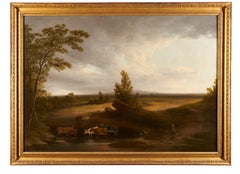
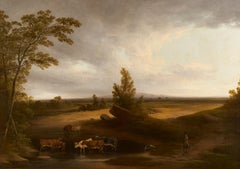
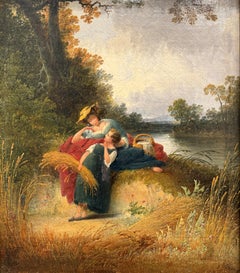
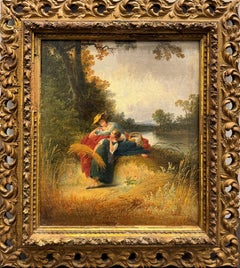
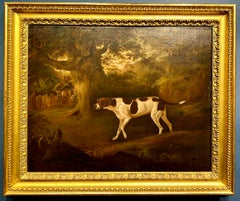
Joshua Shaw was a farmer’s son, born in Billingborough, Lincolnshire, and orphaned at the age of seven. After a boyhood of privation, he tried a number of occupations, until he finally apprenticed to a sign painter and found his métier. Shaw went to Manchester to study art, and by 1802 was in Bath, painting landscapes. In that year he began to exhibit his work at the Royal Academy in London. Essentially self-taught, Shaw achieved an impressive level of competence and versatility, producing portraits, floral compositions, still lifes, landscapes and cattle pieces. Shaw continued to send works for exhibition at the Royal Academy, the British Institution, and the Suffolk Street Gallery, all in London, until 1841. (Although Shaw is regularly mentioned and frequently illustrated in a host of general books on American art history, as well as included in numerous historical survey exhibitions, the only monographic study of this artist is Miriam Carroll Woods, “Joshua Shaw [1776–1860]: A Study of the Artist and his Paintings” [M.A. thesis, University of California at Los Angeles, 1971]. Apart from short biographical sketches in various dictionaries and museum collection catalogues, the two most interesting references — both contemporary — are John Sartain’s personal recollections in The Reminiscences of a Very Old Man, 1808–1897 [1899; reprint 1969] and an article in Scientific American from August 7, 1869, “Joshua Shaw, Artist and Inventor.” The article quotes extensively from an autobiographical document in the possession of Shaw’s grandson that Shaw prepared for William Dunlap when Dunlap was collecting data for his History of the Rise and Progress of the Arts of Design in the United States [1834].)
Shaw was determined to succeed, and London defined success. By 1813, Shaw had moved from Bath, where he enjoyed considerable local esteem to the capital city. In that year he showed his ambitious The Deluge, towards Its Close at the British Institution, where it attracted favorable critical attention (the painting is now at The Metropolitan Museum of Art, New York, see John Caldwell and Oswaldo Rodriguez Roque, American Paintings in The Metropolitan Museum of Art, Volume I: A Catalogue of Works by Artists Born by 1815 [1994], pp. 273–77, p. 277 illus.). At some point Shaw became acquainted with the famous American expatriate and President of the Royal Academy, Benjamin West. West made Shaw the guardian of his epic canvas, Christ Healing the Sick in the Temple, which he had painted for the Pennsylvania Hospital in Philadelphia. Shaw and the painting sailed on the Electra, arriving in Philadelphia in 1817, where Shaw supervised the unpacking and hanging of West’s munificent gift. Shaw, who was throughout his life both restless and prone to fits of irascibility, decided to leave England behind. He remained in Philadelphia, where his wife joined him in the following year.
Shaw’s first projects in his new country involved traveling and sketching scenic locales for an illustrated travelogue. Picturesque Views of American Scenery was published in Philadelphia in 1819 with engravings by his fellow English immigrant, John Hill (1770–1850). A second illustrated travel book, United States Directory for the Use of Travelers followed in 1822. Shaw was an activist and an organizer and a principal player in a series of art initiatives in Philadelphia. In 1835, he was among the founders of the Artist’s Fund Society, a breakaway group from the Pennsylvania Academy of Art. Two years later, after quarrelling with the Society’s President, John Neagle, he led a dissident group in establishing the Artists’ and Amateurs’ Association. He left that also after a brief time. Shaw’s differences with the Pennsylvania Academy did not keep him from being among its most active exhibitors. Beginning in 1818, Shaw showed over 75 pictures at the Academy, ending two years after his death in 1862.
Shaw was also an early exhibitor at James Herring’s Apollo Gallery in New York City, the forerunner to the American Art-Union. His correspondence with Herring (who had also been, at one time, a Philadelphia artist) offered Shaw an opportunity to complain about the vicissitudes of the artist’s life, including the injuries incurred from destructive critics and the harms inflicted by enemy colleagues. Indeed, a deal of Shaw’s energy was taken up in struggle, and not just in the art world. Like many artists before and since, Shaw was an inventor as well as a fine artist. In his case, he invented an important copper percussion cap for heavy artillery, as well as the glazier’s revolving diamond for cutting curves in glass. According to his own account (as published in the 1869 Scientific American), Shaw invented the percussion cap in 1814 in England, but did nothing with the invention until he came to America. When he attempted to patent his invention, his application was denied on the grounds that he had not met the criteria of having been a resident of the United States for the previous two years. Shaw struggled mightily with the patent system and is credited with later reforms to the law. He was able to patent his percussion cap in 1822, as well as additional firearm improvements in 1828. He was eventually awarded $25,000 by the United States Congress for his invention, of which he received $17,000. This money, although agreed upon, was also not easily extracted from the Federal government and Shaw made numerous trips to Washington, D.C., to advocate for himself. According to Sartain, Shaw received, for his inventions, “a present of a purse of money” from the Czar of Russia. In 1833, Shaw traveled back to England, in an attempt to claim disputed patent rights there. Around this time, he also exhibited paintings at the Royal Society of British Artists.
Despite all of this, Shaw was primarily an artist. He was an Honorary Member of the National Academy of Design, New York, from 1828 until his death in 1860 and exhibited there regularly from 1828 through 1852. (He was “Honorary” because he did not live in New York and therefore was not eligible for regular academician status.) His participation with the Art-Union lasted through 1848 (the Art-Union closed down in 1851). It is clear from the titles of works that Shaw exhibited at these venues that he continued throughout his career to paint English and European subjects as well as American. Shaw remained in Philadelphia until about 1843, when he moved to nearby Bordentown, New Jersey. Bordentown had become something of an artist’s colony due to the presence of Joseph Bonaparte, Napoleon’s brother, and former King of Spain and Sicily, who in 1817 bought the estate, Point Breeze, and built a mansion that included a gallery for his substantial art collection. Although Joseph returned to Europe in 1839 and died there in 1844, his family kept the estate until 1847. Shaw remained in Bordentown for the rest of his life, acquiring a house of his own in 1847. Shaw continued his activity as an artist until 1853, when a stroke put an end to his painting career.
Shaw was a mature artist when he arrived in the United States. His work, according to William H. Gerdts, echoes concerns and themes expressed in the Rococo style of the French artist, François Boucher (1703–1770), as well as the canvases of Philippe de Loutherbourg (1740–1812) who emigrated from the continent to England, the Dutch artist Nicholas Berchem (1620–1683), and English genre artists George Morland (1763–1804) and Julius Caesar Ibbetson (1759–1817), all of whose work Shaw knew from his time in England. Caldwell and Roque (American Paintings in The Metropolitan Museum) also find echoes in Shaw of two mainstays of 18th-century English art, Richard Wilson (1714–1782) and Thomas Gainsborough (1714–1782). All of this is consistent with the methodology of an autodidact whose chief means of education was to observe as closely as he could the techniques and subjects of the leading men of his day. The consequence for this with regard to Shaw’s oeuvre, is that in America, Shaw was very much sui generis, an artist whose style was, in origin, and remained throughout his career, essentially English.
(Biography provided by Hirschl & Adler)