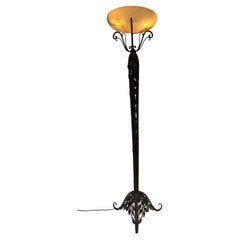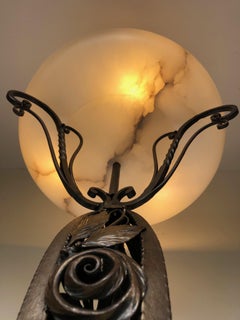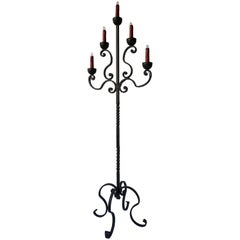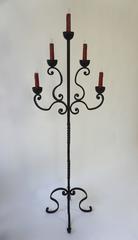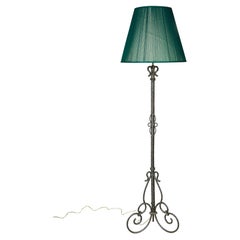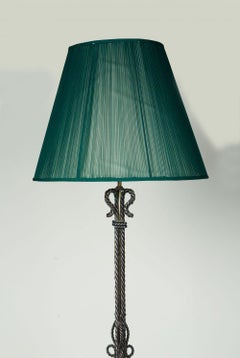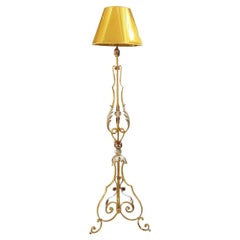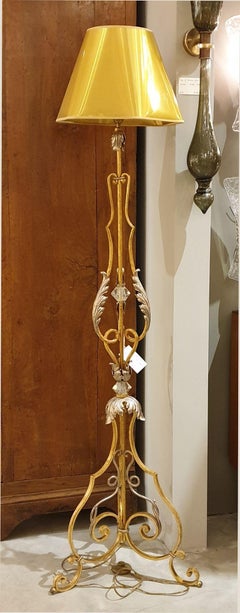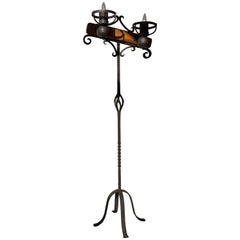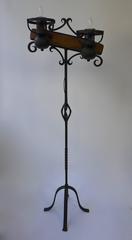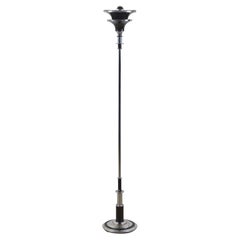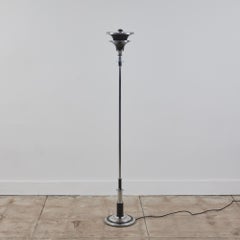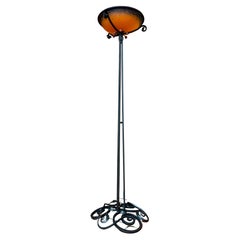
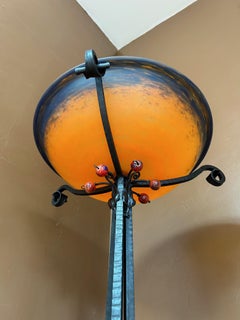
Art Deco floor lamp by Jules Cayette and Schneider
By Charles Schneider, Jules Cayette
Located in NANTES, FR
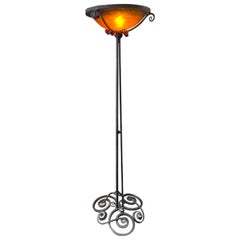
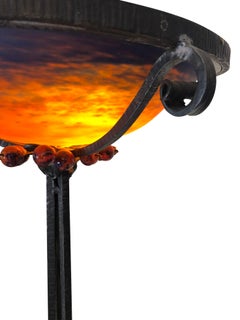
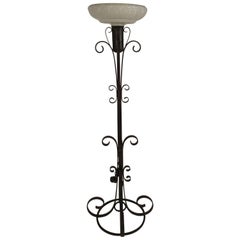
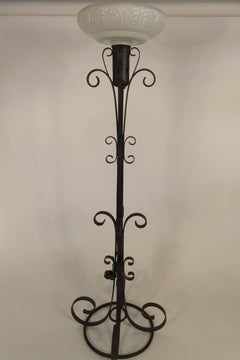
Art Deco floor lamp circa 1925. Wrought iron base by Jules Cayette. Glassware by Charles Schneider. 1 basin of 40 cm in diameter and 6 blown glass balls. In perfect condition, electrified, 3 lights. Height: 167.5 cm Base diameter: 49 cm Basin diameter: 40 cm Weight: 16 Kg Édouard Élie Jules Cayette, born on May 27, 1882 in Paris and died on January 2, 1953 in Nancy, was a French ironworker, bronze worker, cabinetmaker, sculptor and interior decorator, representative of the Art Nouveau movement, then of that of Art Deco. In 1896, he enrolled for the first time at the municipal and regional school of fine arts in Nancy. He left the school in 1899 and entered as an apprentice with Férez, a wood sculptor and carpenter from Nancy. In 1900, he re-enrolled at the Beaux-Arts in Nancy, while continuing his apprenticeship with Schwartz. He left the school for good in 1902. During this apprenticeship, he received instruction from Victor Prouvé and Eugène Vallin. His classmates were Auguste Vallin, Joseph Mougin and Pierre Mougin. In 1904, he joined Jacques Gruber as a collaborator, where he perfected his style. He modeled many compositions and made sculptures in place of the master as far as furniture was concerned. The workshop then adjoined that of Vallin, hence the latter's definite influence on Cayette's early works. In 1910, Jules Cayette set up his own business and officially began his activity on August 1st. From 1912, he exhibited regularly at the Société lorraine des amis des arts. It was at this time that he met his main patron, Saint-Just Péquart (1881-1944). He set up his first workshop on rue Collinet de La Salle in Nancy in 1913, the date of his first mention in the Meurthe-et-Moselle commercial directory. He married Marie Lucie Berche (1893-1933) on May 11, 1918. In 1919, he moved and set up his workshop at 63, rue des Jardiniers (which would be supplemented by the one on rue du Montet, currently avenue du Général Leclerc, bought from the widow Guth). The 1920s were the glory years of the workshops, which employed a dozen workers. The productions were very varied: from bronze ashtrays to light fixtures — always with Daum glassware...
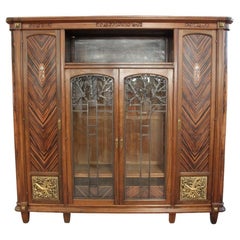
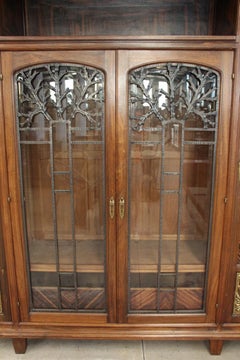
1920s French Art Deco Vintage Jules Cayette Furniture
Wrought Iron