Kan Tai-Keung Art

Chinese, b. 1942

Kan Tai-Keung was born in Panyu, Guangdong, in 1942. He was deeply influenced by his grandfather, Yao Sheung and became passionate about painting from childhood on. Tai-Keung moved to Hong Kong in 1957 and worked as an apprentice tailor there for 10 years. In 1964, he started to learn watercolor painting and sketching with his uncle Han May-Tin. Later, he took a Chinese ink painting course from Lui Shou-Kwan and an applied design course from Wucius Wong at the Department of Extramural Studies, Chinese University of Hong Kong. In 1967, Tai-Keung started his career as a designer and he founded his own company in 1976. He has exhibited his paintings in Hong Kong and abroad since the 1970s, and his works are in the permanent collections of numerous museums in the region.

to
1
Overall Width
to
Overall Height
to
1
1
1
1
1
1
1
1
1
1
10,340
2,808
2,500
1,408
1
1
Artist: Kan Tai-Keung
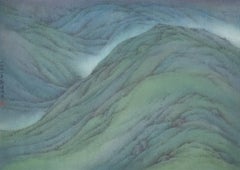
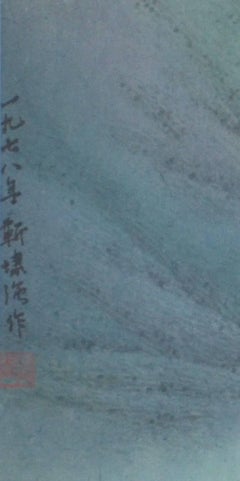
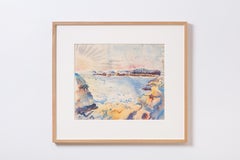
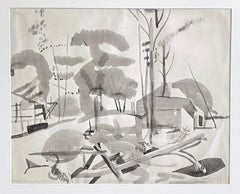
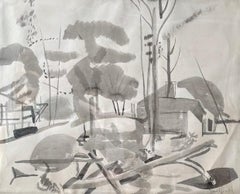
KAN TAI-KEUNG Spring Mountain 1978 Modern Chinese WC Sumi Painting blue green

KAN TAI-KEUNG Spring Mountain 1978 Modern Chinese WC Sumi Painting blue green

By Kan Tai-Keung

Located in Rancho Santa Fe, CA

This painting is illustrated in color in the the book, "PAINTINGS BY KAN TAI-KEUNG 1970-1979" page 51. Published by S S Design & Production, Hong Kong, 1980. A copy of this book will accompany the painting. Born in Panyu, Guangdong, in 1942, Kan Tai-Keung was deeply influenced by his grandfather, Yao Sheung, and became passionate about painting from childhood on. He moved to Hong Kong in 1957, and worked as an apprentice tailor there for ten years. In 1964, Kan started to learn watercolour painting and sketching with his uncle Han May-Tin. Later he took a Chinese ink painting course from Lui Shou-kwan and an applied design course from Wucius Wong...

Category

1970s Modern Kan Tai-Keung Art

Materials

Sumi Ink, Watercolor, Mulberry Paper

Related Items
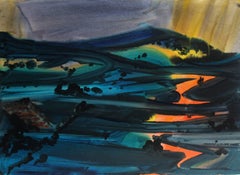
Rainstorm Sunset

Rainstorm Sunset

By Robert Noel Blair

Located in Buffalo, NY

You are viewing a modernist American watercolor painting by Robert Noel Blair. Robert Noel Blair (American, 1912-2003) was an American artist, painter, sculptor, printmaker and te...

Category

American Modern Kan Tai-Keung Art

Materials

Paper, Watercolor

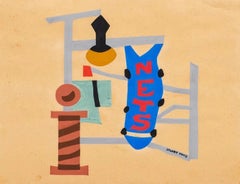
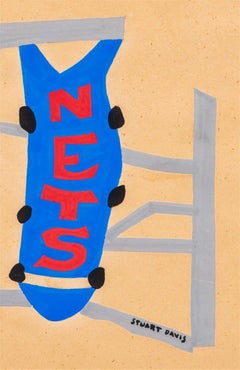
"NY Street Signs" Mid-20th Century WPA 1938 Modernist Abstract Realism Pop Art

"NY Street Signs" Mid-20th Century WPA 1938 Modernist Abstract Realism Pop Art

By Stuart Davis

Located in New York, NY

"NY Street Signs" Mid-20th Century WPA 1938 Modernist Abstract Realism Pop Art Stuart Davis (American, 1892-1964) "Street Signs" Modernist gouache and traces of pencil on paper in the proto-pop art style Davis is celebrated for, 1938, signed to lower right, framed. Image: 11 1/4 x 15 1/4 inches. Frame by Bark: 18 1/2 x 22 inches. LITERATURE: A, Boyajian, M. Rutkowski, Stuart Davis, A Catalogue Raisonne, Vol. 2, New Haven, Connecticut, 2007, vol. II, p. 632, no. 1232, illustrated. EXHIBITIONS: ACA Galleries, New York American Artists' Congress: Group Exhibition of Paintings and Sculpture, Dec. 3-16, 1939 (SDAB I, 12/3/39, p. 129). Outlines Gallery, Pittsburgh, Stuart Davis, Mar. 3-16, 1946. Coleman Art Gallery, Philadelphia, 5 Prodigal Sons: Former Philadelphia Artists: Ralston Crawford, Stuart Davis, Charles Demuth, Julian Levi, Charles Sheeler, Oct 4 - 30, 1947 (pamphlet), no. 12. PROVENANCE: The artist; Mr. and Mrs. Frank Bowles, New York, Apr. 3, 1956; thence by descent, Private Collection, New York. NOTES: According to the Catalogue Raissonne, "the title 'Street Signs' is recorded in the artist's account books...

Category

1930s American Modern Kan Tai-Keung Art

Materials

Paper, Gouache, Pencil

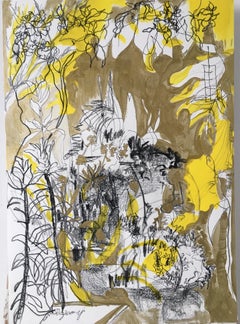
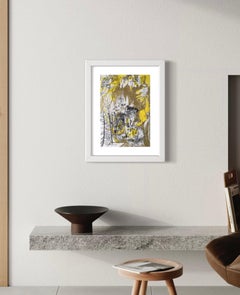
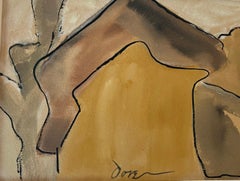
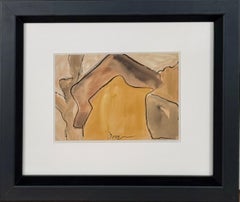
Original drawing-frame included-Golden Summer- British Awarded Artist-expression

Original drawing-frame included-Golden Summer- British Awarded Artist-expression

Located in London, GB

Shizico spent three days painting this plein air in her sunlit garden. She applied 550 Ture Gold paint and Van Gogh Yellow creating a stunning backdrop which served as the canvas for...

Category

2010s Abstract Expressionist Kan Tai-Keung Art

Materials

Gold

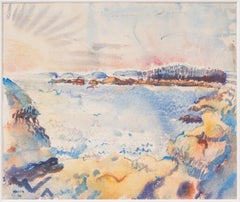
Sunset
Sunset

John MarinSunset, 1914

$37,687

H 25.4 in W 28.15 in D 0.79 in

Sunset

By John Marin

Located in London, GB

Maine became an important muse for Marin during his summer vacations, which is exampled in the present work ‘Sunset’. Marin first visited Maine in 1914, meaning ‘Sunset’ was one of h...

Category

Early 20th Century American Modern Kan Tai-Keung Art

Materials

Watercolor, Paper

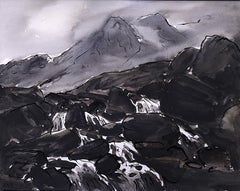
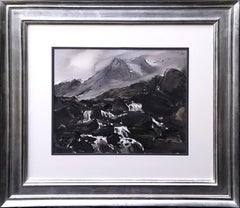
Waterfall Below Idwal

Sir Kyffin WilliamsWaterfall Below Idwal

$37,180

H 29.5 in W 33 in D 2 in

Waterfall Below Idwal

By Sir Kyffin Williams

Located in Belgravia, London, London

Watercolour on paper Paper size: 15.25 x 19.25 inches Framed size: 29.5 x 33 inches Signed lower left

Category

21st Century and Contemporary Modern Kan Tai-Keung Art

Materials

Paper, Watercolor

WOODED LANDSCAPE WITH HOUSES Signed Watercolor, Trees, African American Artist

WOODED LANDSCAPE WITH HOUSES Signed Watercolor, Trees, African American Artist

Located in Union City, NJ

WOODED LANDSCAPE WITH HOUSES Signed original brush and ink on wove paper, circa 1950. WOODED LANDSCAPE WITH HOUSES is an original watercolor brush and ink on paper, hand signed in ink pen by African-American artist, teacher, and printmaker Ronald Joseph (1910--1992) Artwork depicts an abstract landscape, is in good condition, paper tape remaining on reverse side edges, mounted in an archival acid-free mat, unframed. Artwork paper size - 18 x 21.5 in. Year created - c. 1950 About the artist - Ronald Joseph (1910 -1992) was born on the island of St. Kitts, West Indies In 1910. When he was very young, his mother decided to move to the United States but she could not afford to take him with her. Mr. and Mrs. Theophilus Joseph, a childless couple who were friends of Joseph’s mother, adopted him. Afterwards, the Joseph family moved to the Island of Dominica, where they stayed for ten years. In 1921, his foster parents also decided to come to the United States. In New York, Joseph met his mother but remained living with his foster parents. In 1926 Ronald Joseph received a scholarship for the Ethical Culture School, were he spent two and half years of his high school period. At this time he obtained an art scholarship through Dr. Henry Fritz, with whom he became acquainted through his art teacher in public school. Joseph was taken into the Saturday art class, where he was the only black participant. An artistic prodigy, Ronald Joseph had his student works shown at the Metropolitan Museum of Art. Ronald Joseph graduated from Ethical Culture Fieldston School in 1929. He was honored as “the most promising” young artist in New York City’s schools. He began his study at Pratt Institute in 1931 and graduated in 1934. During the 1930s and 1940s, Joseph participated in many exhibitions of African-American art, the Works Progress Administration mural project, and the Harlem Artists Guild. Ronald Joseph enlisted in the U.S. Army Air Corps at the declaration of World War II and was posted as a member of the ground crew in Tuskegee, Alabama, and in Michigan. At the end of the war in 1945, he received his G. I. Bill of Rights scholarship. In 1948, he was presented with the Rosenwald Fellowship. The funds allowed him to live and work abroad – first in Peru for two years, then in Paris. Joseph used the G.I. bill to study in Paris at the Grande Chaumière. He described this period of his life as being “independent of economy”. His work from these travels is largely undocumented; according to Rosenwald scholar, Daniel Schulman, many pieces of art are undated or simply dated “1948-1952”. After this period he came back to New York without money and work and indicated this as period of hardship. Ronald Joseph left the U.S. in 1956, disappointed in the unreceptiveness of the art world to his work with mixed feelings about this. On the one hand, he felt guilty for having left the U.S. during a period when blacks were struggling for their civil rights; on the other, he felt “lucky” to have been able to live and work in place where he did not feel discrimination as intensely. He emigrated to Belgium and later settled permanently in Brussels. Ronald Joseph was married to Claire Joseph and they had a son, Robin Joseph. In 1989 Joseph returned to the United States after an absence of thirty-three years to attend the Lehman College exhibition and symposium and to renew his old friendships. Afterward, he returned to Brussels where he continued to work as a painter, living there for the remainder of his life. Ronald Joseph started his artistic career in Harlem, New York City at the Harlem Community Arts Center, where he was one of the youngest pupils. Joseph studied lithography and other printmaking techniques with Riva Helfond, who taught him many aspects of the process based on simple techniques, including how to operate the press, and how to prepare the stones. Helfond played a significant role as a teacher of lithography at the Harlem Art Center. Joseph produced his first lithographs under her supervision, and this was at a time when she was just beginning to learn the medium herself. At the Harlem Community Arts Center Joseph met Robert Blackburn, who was his classmate. In 1937 Ronald Joseph depicted Blackburn, in one of his most famous works, that is now located at The Metropolitan Museum collection. Experimenting with lithography and etching, as well as woodblock and silkscreen printing, Joseph explored the techniques of printmaking alongside his friend Robert Blackburn. Joseph described the Harlem Art Center as a “healthy and lively” place, where he had made wonderful friends. In the late thirties, he also served as a teacher at the Harlem Community Arts Center. There Joseph met younger artist Jacob Lawrence and Gwendolyn Knight. They formed a friendship, where they enjoyed conversations and visiting museums together. Both Joseph and Knight would hire Lawrence to pose for them. Jacob Lawrence considered Ronald Joseph to be a very intellectual artist. In the 1930s, Joseph became chairman of the Harlem Artists Guild and represented it in Washington with Stuart Davis and Hugo Gellert. Ronald Joseph was also a participant in the mural section of WPA and a representative of the Harlem Artists’ Guild to the New York World’s Fair (1939-1940). Joseph’s early oil paintings were influenced by Picasso, Braque and other European artists while most of his contemporaries focused on social realism. By 1943, he was hailed by art historian James Porter as New York’s “foremost Negro abstractionist painter”. His pastels and gouaches from the late forties and early fifties showed a highly structured abstraction combined with a studied spontaneity. Ronald Joseph’s finely tuned abstractions often incorporated representational elements along with apparently “purer” forms. He described this aspect of his work in these terms: “It’s not abstract and abstract at the same time. It’s pure creation.” His works from the 1950s employed both still life and landscape as pretexts for masterly exercises in nearly abstract pictorial construction related to cubism and fauvism. During World War II, Joseph was drafted. After the war he formed “a kind of a group” with Robert Blackburn, Charles White, Larry Potter, and Reginald Gammon...

Category

1950s Contemporary Kan Tai-Keung Art

Materials

Mixed Media, Watercolor, Ink
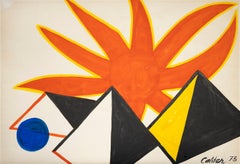
Three Pyramids + Blue Ball

Three Pyramids + Blue Ball

By Alexander Calder

Located in Palm Desert, CA

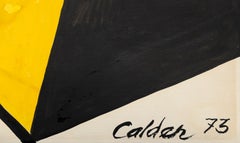
"Three Pyramids + Blue Ball" is a gouache on paper by Alexander Calder. The work is signed in the lower right, "Calder 73”. Although renowned for his innovative and groundbreaking sculptures, Alexander Calder started his artistic career as an abstract painter, preferring to use gouache. What is gouache? Gouache is a water-soluble paint – a type of opaque watercolor. As Calder returned to gouache painting towards the end of his life, he was now armed with a lifetime of experience as a sculptor. He explored the three-dimensional vocabulary of sculptural forms he had developed onto the two-dimensional surface of the paper. Certain shapes and colors recur throughout his gouaches and sculptures. Circles, ovals, and other geometric forms dominate the space. There is the same sense of energy and fluidity. The shapes do not sit on the surface but vibrate giving a feeling of movement in contrast to the static nature of painting. Like his sculpture, Calder’s gouache...

Category

1970s Abstract Kan Tai-Keung Art

Materials

Paper, Ink, Gouache

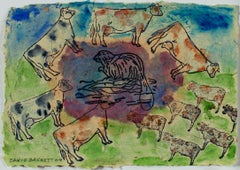
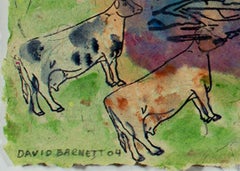
"Beaver Lake Beaver with Surround Sound Cows" signed by David and Sarah Barnett

"Beaver Lake Beaver with Surround Sound Cows" signed by David and Sarah Barnett

By David Barnett

Located in Milwaukee, WI

"Beaver Lake Beaver with Surround Sound Cows" is an original mixed media piece incorporating watercolor and ink on handmade paper by David Barnett and his daughter, Sarah. They both ...

Category

Early 2000s Contemporary Kan Tai-Keung Art

Materials

Ink, Watercolor, Handmade Paper

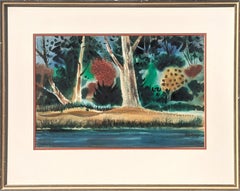
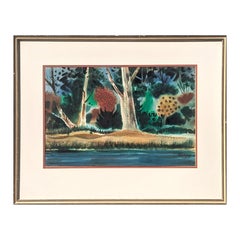
Modern Red, Yellow, Green, & Blue Abstract Forest Landscape Watercolor Painting

Modern Red, Yellow, Green, & Blue Abstract Forest Landscape Watercolor Painting

By Michael Frary

Located in Houston, TX

Modern abstract watercolor landscape painting by Texas based artist Michael Frary. The work features an abstract view of a tree line at the edge of a river or lake that is dotted by ...

Category

20th Century Modern Kan Tai-Keung Art

Materials

Paper, Watercolor

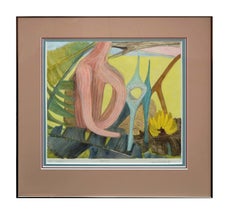
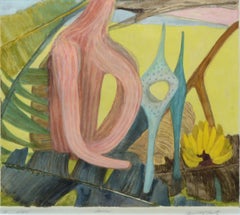
Modern Tropical Abstract -- "Spires II"

Claire Wolf Krantz Modern Tropical Abstract -- "Spires II", 1977

$476Sale Price|20% Off

H 22 in W 21 in D 1 in

Modern Tropical Abstract -- "Spires II"

Located in Soquel, CA

Colorful abstract watercolor of imaginative shapes in a tropical setting with botanical landscape elements by Claire Wolf Krantz (American, b. 1938). Signed "Claire Wolf Krantz" lower right. Titled "Spires" lower center. Dated "11/18/77" and numbered "II" in a series lower left. Peach colored mat and bronze tone metal frame. Image, 14"H x 14"L. Kranz is an artist and art critic living in Chicago, she uses fictional and real elements in her works. She is known for mixed media works layering photograph...

Category

1970s American Modern Kan Tai-Keung Art

Materials

Paper, Watercolor

Kan Tai-keung art for sale on 1stDibs.

Find a wide variety of authentic Kan Tai-Keung art available for sale on 1stDibs. You can also browse by medium to find art by Kan Tai-Keung in handmade paper, ink, mulberry paper and more. Much of the original work by this artist or collective was created during the 1970s and is mostly associated with the modern style. Not every interior allows for large Kan Tai-Keung art, so small editions measuring 34 inches across are available. Customers who are interested in this artist might also find the work of Avigdor Arikha, Robert Noel Blair, and Benjamin G. Benno. Kan Tai-Keung art prices can differ depending upon medium, time period and other attributes. On 1stDibs, the price for these items starts at $12,000 and tops out at $12,000, while the average work can sell for $12,000.