By Linn Lovejoy Phelan
Located in Clifton Springs, NY
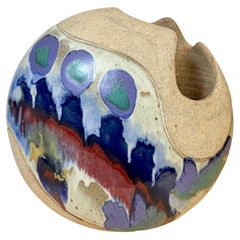
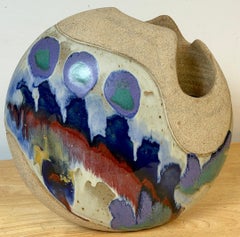
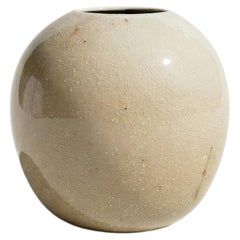
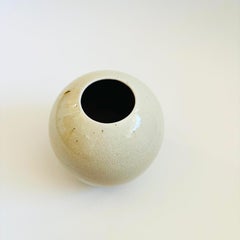
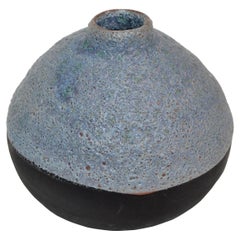
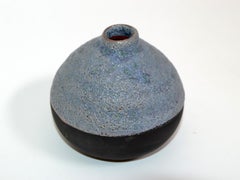
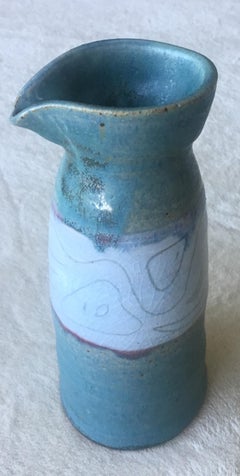
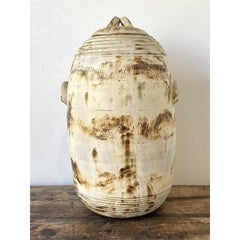
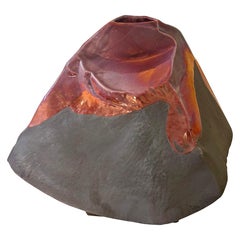
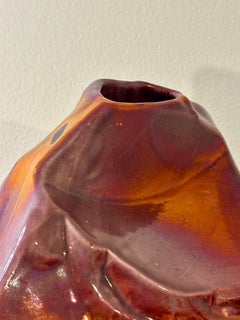
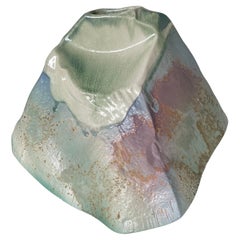
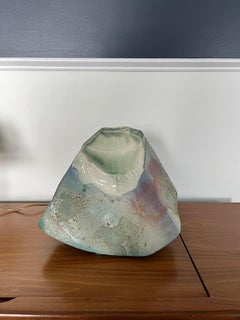
Sculptural vintage vase features a bulbous body with pronounced wide rim; it is decorated in complex drip glaze in blue, teal, and green palette with beige pink accents. Parts of the vase near the bottom are intentionally left unglazed to accentuate the unpredictable nature of the drip glazes. The inner surfaces are decorated with the glazes in the same palette, and the inner part of the rim is done with the same drip glaze pattern as the outer surfaces, creating a continuous composition and guiding the eyes of the viewers along the lines of the piece.
The vase is signed and dated by the artist on the bottom, "Linn L. Phelan 1932", circling the base, and marked with that appears to be either model or glaze numbers in the center. The date corresponds with Phelan's training under Arthur Baggs; the vase is an important example of Phelan's early work and of early American studio pottery movement. While the form of the vase shows Art Deco style influence, the striking glaze on the piece points towards the distinctive works Phelan created later in his career. We are offering a large ceramic decorative bowl, created by Phelan in 1950s-1960s, in a separate listing.
Linn Lovejoy Phelan (1906-1992) was a renowned American ceramic artist, who operated famous Rowantrees and Linwood Pottery in Maine. He studied art in Bevier School of Art of the Rochester Athenaeum and Mechanics Institute (now Rochester Institute of Technology) in Rochester, New York, in 1928, and received his BFA in Ceramic Art in Ohio State University, Columbus, Ohio, in 1932. While attending Ohio State University, Phelan took "Ceramic Art: Survey of the Field" class, taught by Arthur Baggs. After Phelan left the school, he corresponded with Baggs, and in late 1930s Phelan wrote to Baggs of his experiences in helping to start up what becomes Rowantrees Pottery of Blue Hill, Maine. Arthur E. Baggs (1886-1947) studied at Alfred University in 1903-1905 and 1910-1911 with Dr. Charles F. Binns, who was considered "the father of American ceramic art"; Baggs worked at Marblehead Pottery and Cowan Pottery Studio, and became the head of the Ceramic Art Division of the Fine Arts Department at Ohio State University in 1928. Examples of Baggs work are in the collections of The Metropolitan Museum of Art in New York; Museum of Fine Arts, Boston; Everson Museum of Art in Syracuse, NY; and Columbus Museum of Art in Ohio. Baggs was an extremely influential figure in early American ceramics; he was given the Binns medal for outstanding achievement, made a Fellow of the American Ceramic Society and a member of Keramos. Through Baggs Phelan was exposed to the foundations of technical creativity and advancements in ceramic art in Alfred University, as well as the early 1900s studio pottery movement in America, linking the Arts and Crafts phase of studio pottery to Modernist movement.
In 1940s Phelan started teaching ceramics at School of American Craftsman (SAC), founded by Aileen Osborn Webb at Darthmouth College in 1944; SAC moved to Alfred University in Alfred, New York, in 1946, and to Rochester Institute of Technology (RIT) in 1950s. In 1940s SAC faculty included Edwin Blanchard Brown, Ernest Frank Brace, Laurits Eichner, Philip Morton, Charles Reese, Ethel Mitchell, Robert Savage, Thomas Mclure, along with Linn Phelan and another renowned ceramist, Herbert...
Category
1930s American Art Deco Vintage Ken Pick Furniture
MaterialsCeramic, Pottery