By Kobayashi Kiyochika
Located in Fairlawn, OH
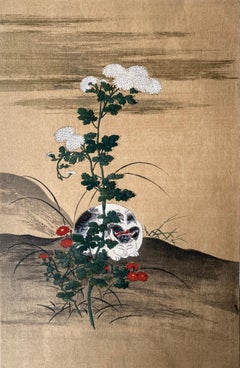
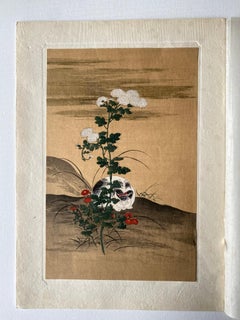
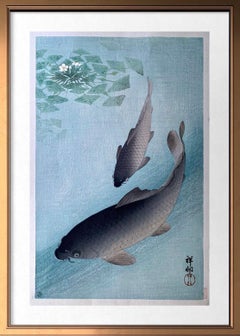
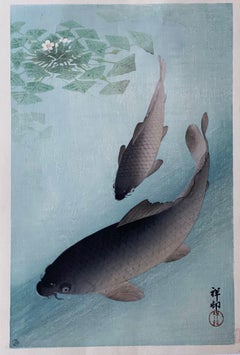
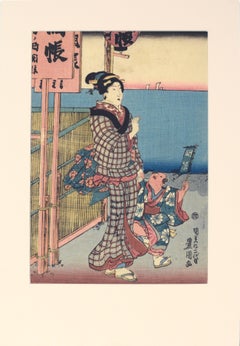
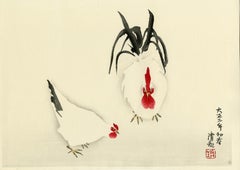
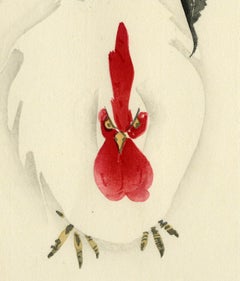
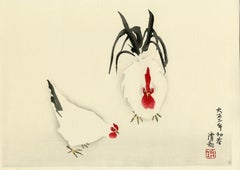
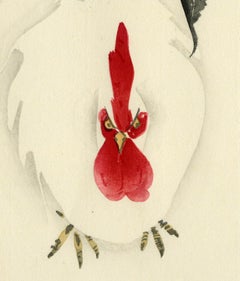
Chicken and Rooster
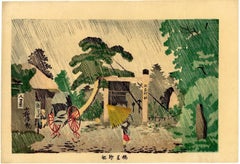
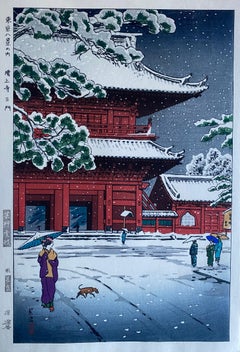
Color woodcut with embossing, 1914-1915
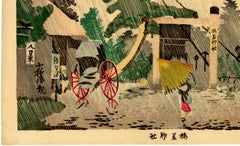
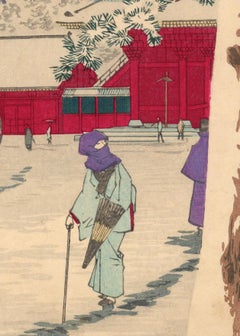
Signed: Kiyochika (see photo_
Seal: Artist's red signature seal (See photo)
Publisher: Watanabe (see photo)
Format: Oban
Condition: Excellent
Image size: 11 3/8 x 15 5/8 inches
Provenance: Robert O. Muller Collection (1911-2003), famous collector and dealer
From Wikipedia, the free encyclopedia
Kobayashi Kiyochika
小林清親
Born Kobayashi Katsunosuke
10 September 1847
Edo, Japan
Died 28 November 1915 (aged 68)
Tokyo, Japan
Nationality Japanese
Movement ukiyo-e
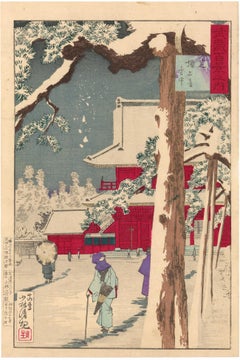
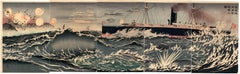
Kobayashi Kiyochika (小林 清親, 10 September 1847 – 28 November 1915) was a Japanese ukiyo-e artist, best known for his colour woodblock prints and newspaper illustrations. His work documents the rapid modernization and Westernization Japan underwent during the Meiji period (1868–1912) and employs a sense of light and shade called kōsen-ga [ja] inspired by Western art techniques. His work first found an audience in the 1870s with prints of red-brick buildings and trains that had proliferated after the Meiji Restoration; his prints of the First Sino-Japanese War of 1894–95 were also popular. Woodblock printing fell out of favour during this period, and many collectors[who?] consider Kobayashi's work the last significant example of ukiyo-e.
Life and career
Kiyochika was born Kobayashi Katsunosuke (小林 勝之助) on 10 September 1847 (the first day of the eighth month of the ninth year of Kōka on the Japanese calendar) in Kurayashiki [ja] neighbourhood of Honjo in Edo (modern Tokyo). His father was Kobayashi Mohē (茂兵衛), who worked as a minor official in charge of unloading rice collected as taxes. His mother Chikako (知加子) was the daughter of another such official, Matsui Yasunosuke (松井安之助). The 1855 Edo earthquake destroyed the family home but left the family unharmed.
Though the youngest of his parents' nine children, Kiyochika took over as head of the household upon his father's death in 1862 and changed his name from Katsunosuke. As a subordinate to a kanjō-bugyō official Kiyochika travelled to Kyoto in 1865 with Tokugawa Iemochi's retinue, the first shogunal visit to Kyoto in over two centuries. They continued to Osaka, where Kiyochika thereafter made his home. During the Boshin War in 1868 Kiyochika participated on the side of the shōgun in the Battle of Toba–Fushimi in Kyoto and returned to Osaka after defeat of the shōgun's forces. He returned by land to Edo and re-entered the employ of the shōgun. After the fall of Edo he relocated to Shizuoka, the heartland of the Tokugawa clan, where he stayed for the next several years.
Kiyochika returned to the renamed Tokyo in May 1873 with his mother, who died there that September. He began to concentrate on art and associated with such artists as Shibata Zeshin...
Category
1910s Showa Kobayashi Kiyochika Art