Léon Bakst Art

to
1
2
1
Overall Width
to
Overall Height
to
1
2
1
2
1
3
3
2
2
1
1
2
2
1
1
4
10,185
2,809
2,503
1,398
2
1
Artist: Léon Bakst
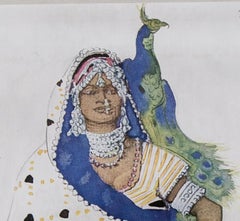
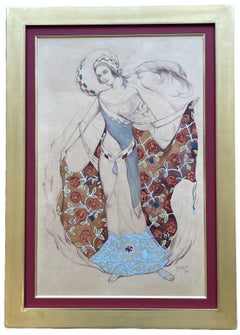
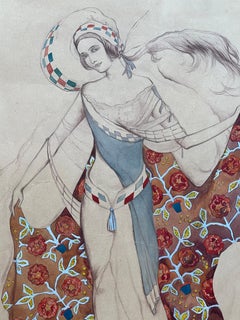
Leon Bakst Three Costume designs from Le Dieu Bleu Ballet 1911

Leon Bakst Three Costume designs from Le Dieu Bleu Ballet 1911

By Leon Bakst

Located in Paonia, CO

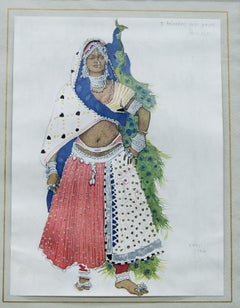
Three iconic Leon Bakst costume designs for Le Dieu Bleu ( The Blue God ) a ballet choreographed by Michel Fokine and written by Cocteau. The ballet premiered in Paris in 1912. It tells the story of a girl who tries to dissuade her fiancé from becoming a priest and is thereafter tormented by demons; but she is eventually saved by the Blue God, a part performed by Vaslaw Nijinsky, the greatest male dancer of his time. Fokine’s choreography and Bakst’s costumes drew upon Siamese dance and Hindu sculpture. These three prints are vintage reproductions quite unlike the reproductions of today. They each have the look of original watercolors and are backed on heavy grey rag paper with a hand painted gold border. Properly framed they will definitely look like the original drawing. The size of the actual prints varies slightly but the background paper size is consistently 10.5 x 15.5. Born in Russia in 1866, Léon Bakst belonged to a young generation of European artists who rebelled against 19th-century stage realism, sparking a revolution in theatre design. His fame lay in the sets and costumes he designed for Serge Diaghilev’s (1872 – 1929) legendary dance company the Ballets Russes, and his huge pageant spectaculars for the dancer and patron of the performing arts, Ida Rubinstein...

Category

20th Century Art Nouveau Léon Bakst Art

Materials

Color

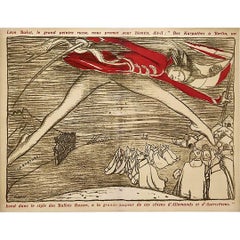
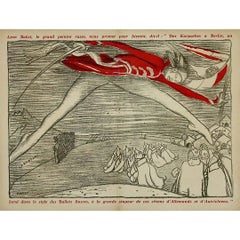
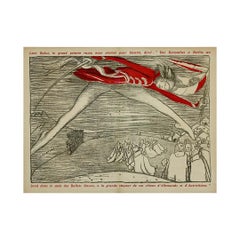
Work by Léon Bakst - early 20th-century wartime propaganda Avant-garde

Work by Léon Bakst - early 20th-century wartime propaganda Avant-garde

By Leon Bakst

Located in PARIS, FR

This striking work by Léon Bakst, titled “Le grand peintre russe nous promet pour bientôt…” (“The great Russian painter promises us soon…”), vividly captures the spirit of early 20th...

Category

1910s Léon Bakst Art

Materials

Linen, Paper, Lithograph

Related Items
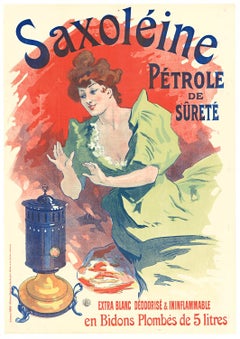
Original "Saxoleine Petrole Surete" vintage stone lithograph  1900

Original "Saxoleine Petrole Surete" vintage stone lithograph 1900

By Jules Chéret

Located in Spokane, WA

Original Saxoleine Petrole de Surete, artist Jules Cheret. Linen-backed turn-of-the-century original stone lithograph poster advertising Saxoleine, a lamp oil. The glow from this l...

Category

Early 1900s Art Nouveau Léon Bakst Art

Materials

Lithograph

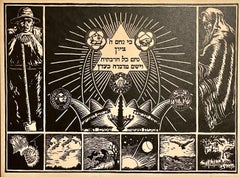
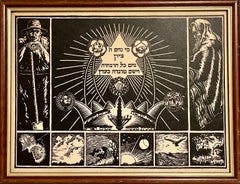
Rare 1922 German Jewish Judaica Zion Woodcut Woodblock Print Hermann Fechenbach

Rare 1922 German Jewish Judaica Zion Woodcut Woodblock Print Hermann Fechenbach

By Hermann Israel Fechenbach

Located in Surfside, FL

Title: Zion Subject: Various biblical images depicting Creation and prayer 1922 Medium: woodcut Frame: 14" x 18" Image: 12.5" x 16.75" Provenance: owned and signed verso by Peter Keil. Central panel shows the Jewish star over a crown, with inscription in Hebrew: "When God comforts Zion, He will comfort all its ruins and make its deserts look like Eden," and "You have sanctified the seventh day, the goal of creation of Heaven and Earth." This is flanked by a Palestinian farmer pioneer on the left and a Jew praying on the right. The lower tier shows six vignettes of the days of creation from Genesis. Hermann Fechenbach was born in 1897 in Württemberg, Germany. He grew up in Bad Mergentheim where his parents had an inn, which served as a meeting place for the local Jewish community. He left school early and through family connections with clothing retailers received training in window dressing. His skill with brush writing was quickly recognised by a big firm in Dortmund where he was responsible for the displays in 10 large windows. He received his conscription papers in 1916 and recalls “being as patriotic as any other fool”. In August 1917 he was involved in a grenade attack in which he was the sole survivor. With serious injuries to both legs he struggled to safety and was eventually transported to a front line “slaughterhouse” where the first of a series of amputations was performed which led to the loss of his left leg. As a result of his injuries his father dropped his opposition to him becoming an artist. His formal art education started in 1918 with training at a Stuttgart handcraft school for invalids. He attended the Academies in Stuttgart and Munich to learn painting and restoration for 3 years. He was influenced at this time by Max Liebermann. He has been compared to Kathe Kollwitz and was a contemporary of Jakob Steinhardt and hermann Struck. In 1923 he went to Florence for a year. While in Florence he started to produce a series of miniature wood engravings to illustrate the stories of Genesis. This was followed by periods in Pisa, Venice, Vienna and Amsterdam. In 1924 he returned to Stuttgart to paint in the contemporary style “Die Neue Sachlichkeit”. (The New Objectivity was a movement in German art that arose during the 1920s Weimar republic as a reaction against expressionism. The term was coined by Gustav Friedrich Hartlaub, the director of the Kunsthalle in Mannheim, who used it as the title of an art exhibition staged in 1925 to showcase artists who were working in a post-expressionist spirit. These artists—who included Max Beckmann, Otto Dix, George Grosz, Christian Schad, Rudolf Schlichter and Jeanne Mammen) Every spring and autumn he exhibited at the “Kunstgebit” which served as the showcase for all serious artists of the period. His professional status “Kunstmaler und Grafiker” was recognised by Berlin in 1926. Practically all his work from this period was sold following exhibition. In 1926 he collaborated with an architect friend to build a bungalow in Hohenheim, a non-Jewish area and a suburb of Stuttgart. Hermann alternately lived in his country bungalow and his town studio, producing portraits for sale or barter and wood engravings for his own pleasure. In 1930 he married a non-Jewish professional photographer – Greta Batze. They had a studio in Stuttgart, which was used to teach art to a group of 12 students. In 1933 the Nazi influence removed his name from the official state register together with the right to exhibit. By spending most of his time in his bungalow out of the Jewish quarter the Fechenbachs escaped being registered by the Nazis for some years. They were ostracised and abused by their non-Jewish neighbours. Hermann made weekly visits to friends in town to teach them the practical skills they would need assuming they were to escape from Germany. His energies were directed towards protection and survival. Ultimately the Nazi persecution forced the Fechenbachs to flee their homeland. They moved to Palestine for 3 months in 1938, but found the political and physical environment unsustainable. Greta arrived in England penniless in January 1939 to work as a domestic servant and to find a guarantor for her husband. Hermann arrived in May 1939. They moved to Blackheath a few months later. Hermann resumed his painting and engraving as a means of earning a living. He raised enough money to get his parents out of Germany to join his brothers in Argentina but was unable to save his twin sister Rosa who died in a Nazi concentration camp. In 1940 Hermann was interned in Bury as a suspect alien. He protested about his treatment by starting a hunger strike. Because of his persistence he was moved to a prison in Liverpool. From Liverpool he was moved to the Hutchinson Camp in the Isle of Man with fellow artist Kurt Schwitters. Arrangements were made for Greta to be accommodated near by. While interned he commenced work on “Refugee Impressions”, a series of linocut prints (no wood was available). In 1941 when released from internment the Fechenbachs came under the sponsorship of Dr. Bela Horovitz, the Austrian art publisher who in turn made an introduction to Professor Tancred Borenius. They were offered lodgings with a family in Oxford. Hermann had his first public exhibition for many years in a small gallery in Oxford in 1942. A second exhibition of oils, pencil drawings, coloured linocut and woodblock prints held later in the year was opened by the mayor of Oxford and critically acclaimed. In 1944 the first London exhibition took place at the Anglo-Palestinian club in Piccadilly. There were two exhibitions at the Ben Uri Art gallery during this period. In 1948 a second exhibition at the Anglo Palestinian club was inaugurated by a member of the Rothschild family and several members of Parliament. This was a great success. In 1944 the Fechenbachs moved to a top floor studio flat in Colet Gardens. Open exhibitions were held each Spring at the Embankment from 1946 to 1951. Movietone News produced a short feature on the artist, which was shown in cinemas in England and Germany. In 1969 he published the Genesis story in a hard back volume containing 137 prints. He started to research the fate of the entire Jewish community of Bad Mergentheim during the period of the second world war, liaising with historian Dr. Paul Sauer and Professor Max Miller, historian and theologian. In 1972 Kohlhammer published his partly autobiographical book “The last Jews of Mergentheim”. He exhibited at the Anglo-Palestinian Club & the Ben Uri Gallery in the 1940s. His works only came to prominence during the last year of his life when he exhibited at Blond Fine Art. Peter Keil part of the Junge Wilde. In 1978, the Junge Wilde painting style arose in the German-speaking world in opposition to established avant garde, minimal art and conceptual art. It was linked to the similar Transavanguardia movement in Italy, USA (neo-expressionism) and France (Figuration Libre). They were also known as the Neue Wilde. Artists included; Austria: Siegfried Anzinger, Erwin Bohatsch, Herbert Brandl, Gunter Damisch, Hubert Scheibl, Hubert Schmalix...

Category

1980s Impressionist Léon Bakst Art
Materials

Woodcut

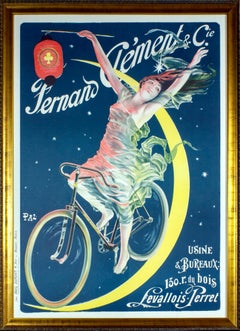
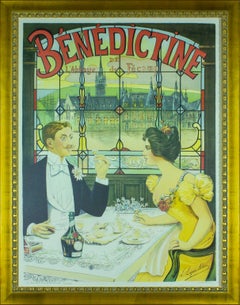
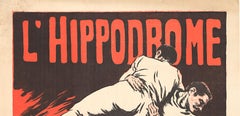
"Fernand Clement & Cie" lithograph print poster by Pal (Jean de Paléologue)

"Fernand Clement & Cie" lithograph print poster by Pal (Jean de Paléologue)

By Pal (Jean de Paléologue)

Located in Boca Raton, FL

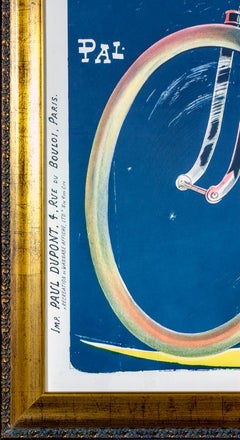
"Fernand Clément & Cie" framed lithograph poster by Pal (Jean de Paléologue.) Inscription on side reads Imp. Paul Dupont, 4 Rue du Bouloi, Paris. Recreation 84 Wannabe Affiche, Ltd. ...

Category

1890s Art Nouveau Léon Bakst Art

Materials

Lithograph

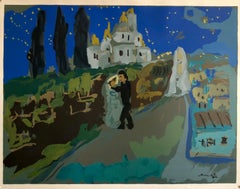
Colorful Russian French Judaica Jewish Shtetl Wedding Lithograph Mourlot Paris

Colorful Russian French Judaica Jewish Shtetl Wedding Lithograph Mourlot Paris

By Mane Katz

Located in Surfside, FL

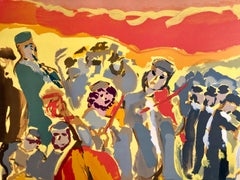
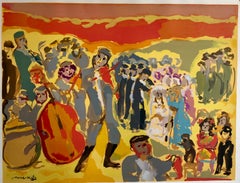
Mane-Katz (1894-1962) Original Lithograph published by Andre Sauret, Monte Carlo, 1966, printed in France, by Mourlot. The ouvrage sheet is not included. this is from a limited editi...

Category

1960s Modern Léon Bakst Art

Materials

Lithograph

Divan Japonais

Divan Japonais

By Henri de Toulouse-Lautrec

Located in New York, NY

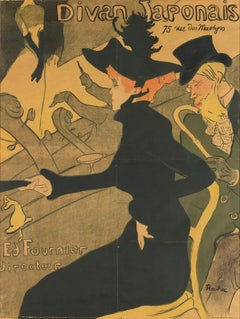
Color lithograph. Printed by Ancourt, Paris. The Divan Japonais was a small café-concert at 75 rue des Martyrs, Paris, where Yvette Guilbert began her career. This is Toulouse-Lautr...

Category

1890s Art Nouveau Léon Bakst Art

Materials

Color, Lithograph

Original Mozart en France vintage French poster, 200th Birthday of Mozart

Original Mozart en France vintage French poster, 200th Birthday of Mozart

Located in Spokane, WA

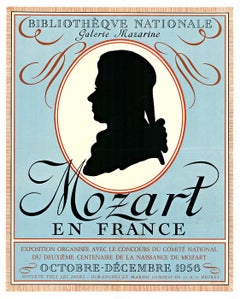
“Mozart en France” – Original French Exhibition 1956 Poster, Linen-Backed. Grade A- condition, ready to frame. Fold marks restored. A striking, authentic mid-century poster creat...

Category

1950s Art Nouveau Léon Bakst Art

Materials

Lithograph

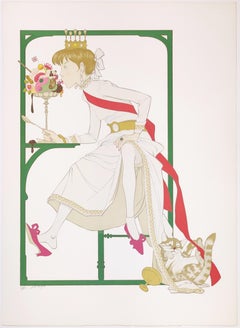
PRINCESS ELODIE AND THE ICE CREAM

PRINCESS ELODIE AND THE ICE CREAM

By Philippe Henri Noyer

Located in Aventura, FL

Hand signed & numbered by the artist. From the edition of 325. Artwork is in excellent condition. Certificate of Authenticity included. All reasonable offers will be considered. Pl...

Category

1980s Art Nouveau Léon Bakst Art

Materials

Paper, Lithograph

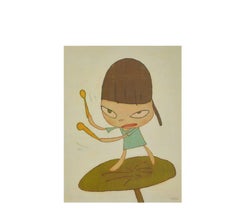
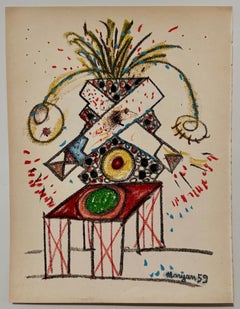
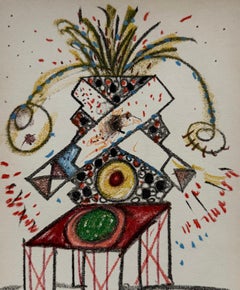
Polish French Figurative Abstract Art Brut Expressionist Lithograph Maryan

Polish French Figurative Abstract Art Brut Expressionist Lithograph Maryan

By Pinchas Maryan

Located in Surfside, FL

Pinchas Burstein, known as Maryan Lithograph (after the drawing). 1960 Dimensions: 12 3/8 x 9 3/8 inches (315 x 240mm). There is printed text on the back, as issued. Signed in the...

Category

1960s Expressionist Léon Bakst Art
Materials

Paper, Lithograph

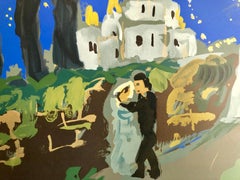
Colorful Russian French Judaica Jewish Shtetl Wedding Lithograph Mourlot Paris

Colorful Russian French Judaica Jewish Shtetl Wedding Lithograph Mourlot Paris

By Mane Katz

Located in Surfside, FL

Mane-Katz (1894-1962) Original Lithograph published by Andre Sauret, Monte Carlo, 1966, printed in France, by Mourlot. The ouvrage sheet is not included. this is from a limited editi...

Category

1960s Modern Léon Bakst Art
Materials

Lithograph

Previously Available Items
Work by Léon Bakst - early 20th-century wartime propaganda Avant-garde

Work by Léon Bakst - early 20th-century wartime propaganda Avant-garde

By Leon Bakst

Located in PARIS, FR

This striking work by Léon Bakst, titled “Le grand peintre russe nous promet pour bientôt…” (“The great Russian painter promises us soon…”), vividly captures the spirit of early 20th...

Category

1910s Léon Bakst Art
Materials

Paper, Lithograph, Linen

Léon BAKST (1866-1924), dancer with scarf

Léon BAKST (1866-1924), dancer with scarf

By Leon Bakst

Located in Paris, FR

Russian painter and decorator, Bakst revolutionized scenography in the early 20th century with his creations for Diaghilev's Ballets Russes, such as « Shéhérazade » and « L'Après-mid...

Category

1910s Art Nouveau Léon Bakst Art
Materials

Paper, Watercolor

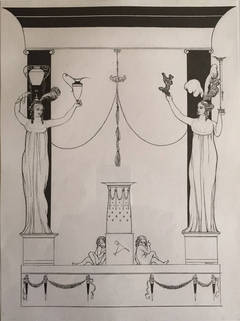
Design with Caryatids and Cherubs

Design with Caryatids and Cherubs

By Leon Bakst

Located in Los Angeles, CA

Leon Samoilovitch Bakst was a Russian painter and scene- and costume designer. He was a member of the Sergei Diaghilev circle and the Ballets Russes, for which he designed exotic, ri...

Category

Early 1900s Art Deco Léon Bakst Art
Materials

India Ink, Paper

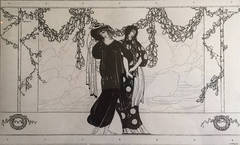
Two Nymphs

Leon BakstTwo Nymphs, c.1910

Sold

H 5.5 in W 10 in

Two Nymphs

By Leon Bakst

Located in Los Angeles, CA

Leon Samoilovitch Bakst was a Russian painter and scene- and costume designer. He was a member of the Sergei Diaghilev circle and the Ballets Russes, for which he designed exotic, ri...

Category

Early 1900s Art Deco Léon Bakst Art
Materials

India Ink, Paper

Léon Bakst art for sale on 1stDibs.

Find a wide variety of authentic Léon Bakst art available for sale on 1stDibs. You can also browse by medium to find art by Léon Bakst in paper, gouache, lithograph and more. Much of the original work by this artist or collective was created during the 20th century and is mostly associated with the modern style. Not every interior allows for large Léon Bakst art, so small editions measuring 10 inches across are available. Customers who are interested in this artist might also find the work of Charles Herbert Woodbury, Eugène Delâtre, and Louis Moe. Léon Bakst art prices can differ depending upon medium, time period and other attributes. On 1stDibs, the price for these items starts at $600 and tops out at $16,104, while the average work can sell for $4,993.

Artists Similar to Léon Bakst