By Lesieur
Located in Belper, Derbyshire
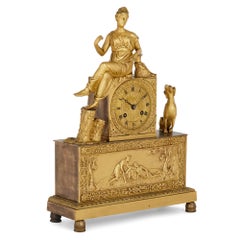
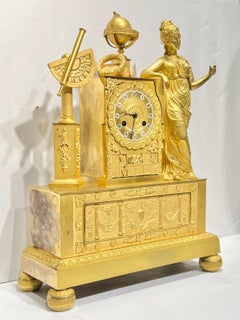
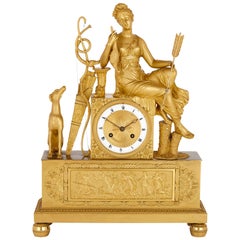
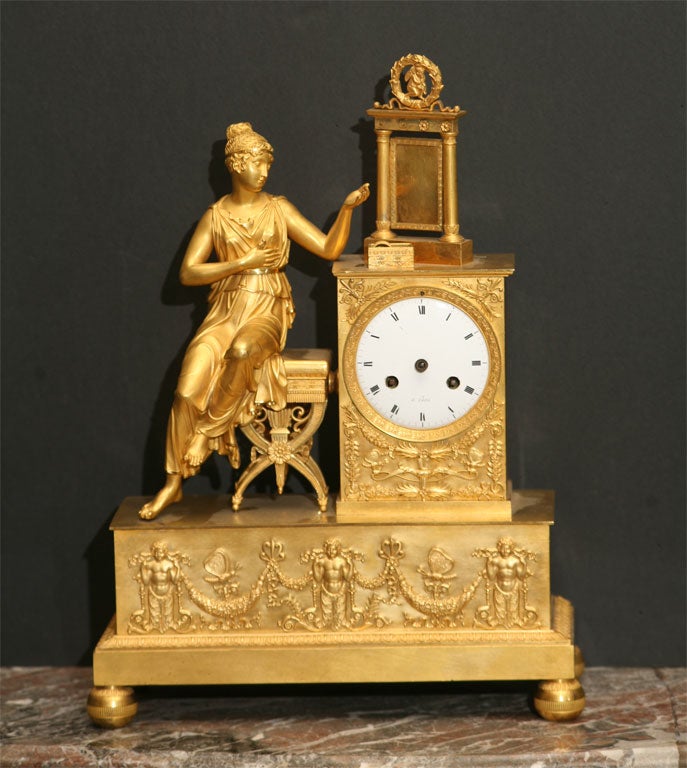
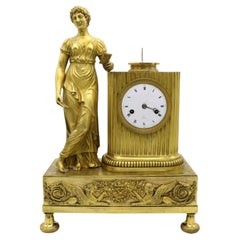
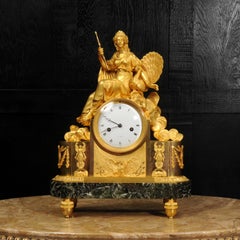
A rare and fine original antique French Empire clock featuring the goddess Juno. Beautifully made in sumptuous mercury fire gilded bronze, Juno is seated with a peacock amongst the clouds. The fine chasing and finishing of the bronze gives a beautiful life to her.
Below the dial is an ormolu panel showing an Eagle, representing Jupiter, with lighting bolts which as Jupiter's wife, Juno was able to hurl. The clock sits upon a green marble base with four feet. The fine porcelain dial is signed 'Paris' and is complete with blued steel Breguet hands and the original bayonet bezel. The rear door is also glazed to allow the pendulum to be seen.
The French movement is of high quality and is signed on the backplate by the clockmaker Lesieur. It is in excellent clean and running condition having been fully overhauled by our clockmaker. It has a silk suspension and the pendulum is a replacement. It runs for 8 days and strikes the hours and halves on a bell. We have a video of the clock running, please ask and we will send you a link.
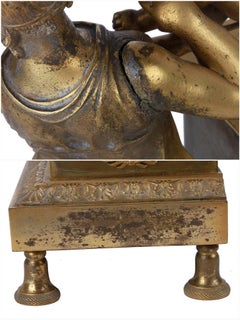
Condition of the case is excellent; the original gilding is in stunning condition, just some wear to mainly the rear and the right hand side of the base, where less gold was originally applied. Possibly there were originally two further feet to the marble base, however the clock sits well on four feet. There is also possibly some repair / alteration to the bottom of Juno's right foot at some time. The rear bezel is a later hinged type rather than the bayonet fit of the front bezel. The dial is also in excellent condition just some tiny nibbles to the winding holes.
Lesieur (fl. 1790-1850) was a highly respected but little documented clockmaker who worked in Paris during the last years of the eighteenth century and continued in business up until circa 1850. He was known to have regularly worked with Thomire and the greatest Parisian Bronziers.
Tardy (Tardy, Dictionnaire des Horlogers Francais) notes that by 1806 he was established at Vieille rue du Temple; during 1812-20 and 1830-50 he was at rue de la Verrerie and in 1840 at Boulevard St. Martin. Elsewhere in the Paris almanacs he is recorded at Bar-du-Bec in 1839 and in 1840 at rue des Alexiens.
Lesieur’s name also appears on a number of complex and important clocks, counting among them a mantle clock showing signs of the zodiac with marble columns of 1807-8, in the Hôtel de l’Intendance de la Généralité de Metz, Moselle (originally the Préfecture de la Moselle et de la Région Lorraine). The latter is probably a pair to another identical clock by Lesieur in the Château de Nymphenburg in Bavaria. Lesieur also made the movements for a variety of other clocks, from a late Louis XVI Sèvres porcelain...
Category
19th Century French Empire Antique Lesieur, Paris Mantel Clocks