Louis Bunce Paintings

to
1
Overall Width
to
Overall Height
to
1
1
1
1
1
1
1
757
752
733
671
1
1
Artist: Louis Bunce
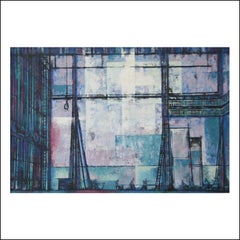
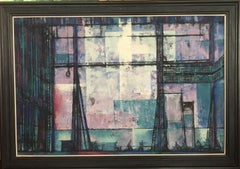
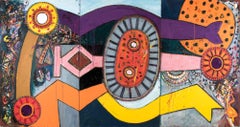
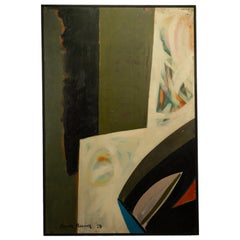
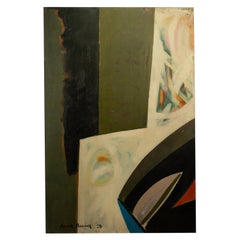
Monumental Abstract Modernist Oil Panel Oregon Centennial Exposition Mural 1959

Monumental Abstract Modernist Oil Panel Oregon Centennial Exposition Mural 1959

By Louis Bunce

Located in Portland, OR

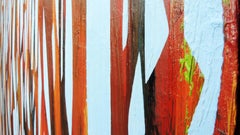
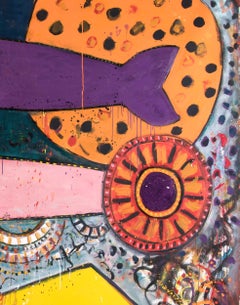
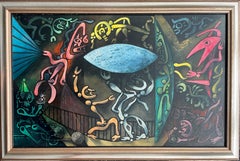
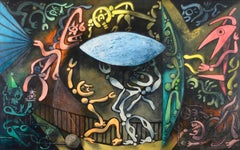
Monumental modernist oil on panel painting by Louis Demott Bunce (1907-1983), from an installation for the Oregon Centennial Exposition, 1959. A rare & important and monumental abstract painting by the celebrated Oregon artist Louis Bunce, the artist was commissioned to paint a mural for the 1959 Oregon Centennial & Trade Fair in Portland, the installation was titled " Gay Garden Way ", it was painted for the exterior of the Horticultural building. The mural having abstract plant abstractions, according to Bunce in his own words it was "the rounded shapes of flowers and the sun", the mural created a major furor from the conservative art public. The painting signed and dated by the artist lower left, the work was sold in the late 1980s through the celebrated Laura Russo Gallery, this painting is featured in Roger Hull's book; "Louis Bunce, Dialogue with Modernism". The painting is in good condition and ready to grace your wall. Louis Bunce attended high school and the Museum Art School before leaving for the Art Students League in New York. He established a New York connection that began when he first attended classes there in 1927 and continued over the years with frequent visits. He became friends with many promising artists, including Jackson Pollock and David Smith. In 1939 he worked for the WPA Easel Project in New York and by the time he returned to Portland he was an established artist on the East Coast. He worked at the WPA art center in Salem as an Instructor and Assistant Director. His work included murals, two of which are in the Post Offices in Grants Pass and St. Johns. Their subjects, mining and orchard farming, are activities of each region. "I have always been visually drawn to the landscape, at first the desert and mountain regions of Wyoming; then the lush and gentle color of the Pacific Northwest and the urban landscape of New York." From 1942-1945 he worked as an illustrator, a tool designer, and in assembly for the Oregon Shipbuilding Corporation. After WWII, Bunce joined the faculty of the Museum Art School in Portland, where he had been a student in 1925-1926. He taught there until his retirement in 1972. He excelled at producing screen-prints and introduced this technique to Oregon. While maintaining a national reputation throughout the 1950s and 1960s, some of New York's most prestigious galleries represented him. Theater buffs will remember his murals and portraits for Portland Civic Theater's 1938 production of Pride and Prejudice. In a career that made him one of the most recognized names in Oregon's art history, Bunce had many styles: cubism, expressionism, surrealism and abstractionism. His 1958 mural in the Portland International Airport presents this abstract style: "whirling propellers and shadows of the concourse as seen from above." It was controversial at the time as being too abstract for a public art project. Louis and wife Eda opened a full-time art gallery in Portland in 1949, called the Kharouba. Located first at 1016 SE Morrison, then at SW 11th and Alder, the gallery represented many of the leading artists of the day: Josephine Cameron, William Givler, Clifford Gleason, Jack Hammack, Charles Heaney, Frederick Heidel, George Johanson, Jack McLarty, Rick Norwood, C.S. Price, Arthur Runquist, Jolan Torok, Charles Voorhies...

Category

1950s Modern Louis Bunce Paintings

Materials

Oil

Related Items
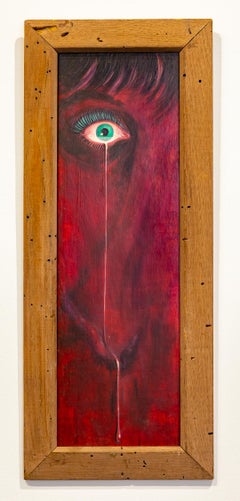
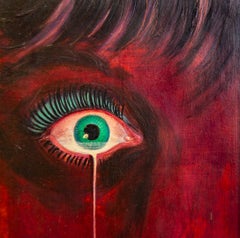
"Don't Cry Long" Abstracted and Distorted Self-Portrait, One Crying Eye

"Don't Cry Long" Abstracted and Distorted Self-Portrait, One Crying Eye

Located in Detroit, MI

"Don't Cry Long" is a self-portrait of the artist and an unusual one at that in which the artist portrays herself shedding tears. Perhaps it is an expression of some grief experienced by Ms. Woodlock, but it also admonishes her to not "Cry Long" while at the same time poking fun because of her elongated face and the one lone "long" tear tracing a pattern down her face. In addition to self-portraits, Ethelyn painted commissioned portraits. In this painting her head is cocked and her famous bangs hang down her forehead. Compare two self-portraits, “Up From Under”, and “M’Eyes" to "Don't Cry Long." The major differences are the close facial view and the brilliant blood red paint that fills the entire canvas. This painting is included in the book, "Dreams Have Wings: An Artist's Journey into Magic and Mystery" printed in the United States, 1985. She describes "Don't Cry Long" as showing how funny looking we are, if we cry too long. Ethelyn Woodlock...

Category

Mid-20th Century American Modern Louis Bunce Paintings

Materials

Oil, Masonite

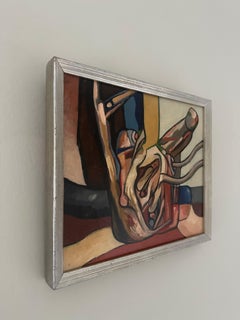
1968 Abstract Figurative Composition "Growth" By Ole Vincent Larsen

1968 Abstract Figurative Composition "Growth" By Ole Vincent Larsen

Located in Frederiksberg C, DK

This abstract painting presents a dynamic figurative composition in which organic forms and bold contours intertwine in a rhythmic and balanced arrangement. In this oil on canvas, t...

Category

1960s Modern Louis Bunce Paintings

Materials

Canvas, Oil

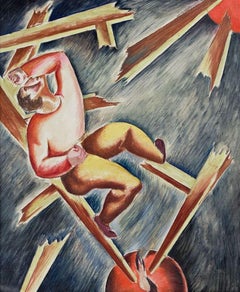
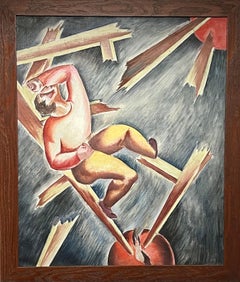
"Shattered" WPA Mid 20th Century Modernism American Scene Surrealism Figurative

"Shattered" WPA Mid 20th Century Modernism American Scene Surrealism Figurative

By Leon Bibel

Located in New York, NY

"Shattered" WPA Mid 20th Century Modernism American Scene Surrealism Figurative Estate stamp on the stretcher, verso. Provenance: Estate of the artist. 20 x 24 inches. Look at the last two photos in the listing. A new book about Leon Bibel was just published and there's a photo of the artist taken in front of the painting. Amazingness. BIO Leon Bibel continued painting through 1941 and resumed work in both painting and especially wood sculpture by 1960. He worked until his very last day in 1995. His last series of large wood sculptures were modeled on spice boxes, which were miniature buildings...

Category

1930s American Modern Louis Bunce Paintings

Materials

Canvas, Oil

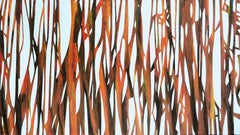
Reed 22 November 09:54 - Modern Nature Oil Painting, Abstract, Minimalism

Reed 22 November 09:54 - Modern Nature Oil Painting, Abstract, Minimalism

By Robert Motelski

Located in Salzburg, AT

Robert Motelski's paintings are exceptional visions of nature, visions of space which surrounds us. They tell about being, fate and passing. They depend on the season of year, the ti...

Category

2010s Modern Louis Bunce Paintings

Materials

Canvas, Oil

Le Boischaut - Maurice Esteve, modern, colorful, french, painting, abstract, art

Le Boischaut - Maurice Esteve, modern, colorful, french, painting, abstract, art

By Maurice Estève

Located in London, GB

Maurice Estève (1904-2001) Le Boischaut 1960 oil on canvas 65 x 100 cm signed and dated ‘Estève 60’ (lower left) Price: €276,000 EUR (inc. 20% UK VAT) Provenance: Galerie Villand-Galanis, Paris Sonja...

Category

1960s Modern Louis Bunce Paintings

Materials

Canvas, Oil

Interieur No. II
Interieur No. II

Benjamin G. BennoInterieur No. II, 1937

$8,500

H 13.75 in W 10.75 in

Interieur No. II

By Benjamin G. Benno

Located in Fairlawn, OH

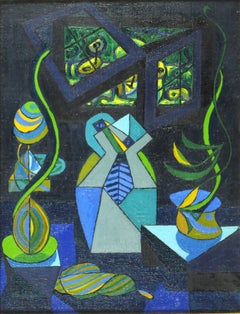
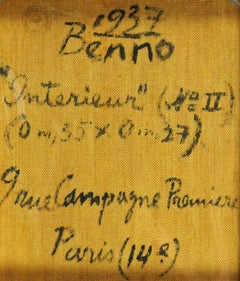
Interieur No. II Oil on canvas, 1937 Signed on verso (see photo) nscribed on reverse: Benno 1937 "Interieur" (No. II) 35 x 27 cm 9 rue Compagne Premiere Paris 14e Provenance: Estate of the artist Ruth O'Hara, Lang & O'Hara, New York...

Category

1930s American Modern Louis Bunce Paintings

Materials

Canvas, Oil

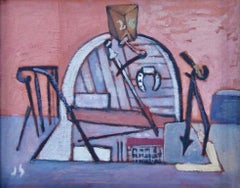
WPA American Scene Modernism 20th Century NYC Industrial "Cellar with Horseshoe"

WPA American Scene Modernism 20th Century NYC Industrial "Cellar with Horseshoe"

By Joseph Solman

Located in New York, NY

"Cellar with Horseshoe" WPA American Scene Modernism 20th Century NYC Industrial Joseph Solman (1909-2008) "Cellar with Horseshoe" 16 x 20 inches, c. 1938 Oil on canvas Initialed "...

Category

1930s American Modern Louis Bunce Paintings

Materials

Canvas, Oil

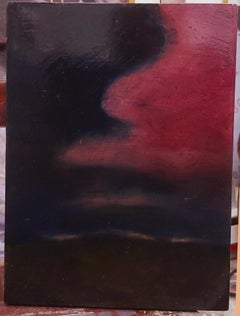
Brooklyn Dusk Panel Painting

Tom Irizarry StudioBrooklyn Dusk Panel Painting, 1990

$2,000Sale Price|20% Off

H 12 in W 9 in D 0.5 in

Brooklyn Dusk Panel Painting

By Tom Irizarry Studio

Located in Booklyn, NY

Brooklyn Dusk is painted on panel. The glass-like finish can be achieved on few other surfaces. I was attracted to this style of painting early on, seduced by the deep delicate tones...

Category

2010s Modern Louis Bunce Paintings

Materials

Canvas, Resin, Oil, Pigment

Inevitable Day – Birth of the Atom oil and tempera painting by Julio De Diego

Inevitable Day – Birth of the Atom oil and tempera painting by Julio De Diego

By Julio de Diego

Located in Hudson, NY

Julio De Diego’s Atomic Series paintings made an extraordinary statement regarding the shock and fear that accompanied the dawn of the nuclear age. In the artist’s own words, “Scientists were working secretly to develop formidable powers taken from the mysterious depths of the earth - with the power to make the earth useless! Then, the EXPLOSION! . . . we entered the Atomic Age, and from there the neo-Atomic war begins. Explosions fell everywhere and man kept on fighting, discovering he could fight without flesh.” To execute these works, De Diego developed a technique of using tempera underpainting before applying layer upon layer of pigmented oil glazes. The result is paintings with surfaces which were described as “bonelike” in quality. The forms seem to float freely, creating a three-dimensional visual effect. In the 1954 book The Modern Renaissance in American Art, author Ralph Pearson summarizes the series as “a fantastic interpretation of a weighty theme. Perhaps it is well to let fantasy and irony appear to lighten the devastating impact. By inverse action, they may in fact increase its weight.” Bibliography Art in America, April 1951, p.78 About this artists: Julio De Diego crafted a formidable persona within the artistic developments and political struggles of his time. The artist characterized his own work as “lyrical,” explaining, “through the years, the surrealists, the social-conscious painters and the others tried to adopt me, but I went my own way, good, bad or indifferent.” [1] His independence manifested early in life when de Diego left his parent’s home in Madrid, Spain, in adolescence following his father’s attempts to curtail his artistic aspirations. At the age of fifteen he held his first exhibition, set up within a gambling casino. He managed to acquire an apprenticeship in a studio producing scenery for Madrid’s operas, but moved from behind the curtains to the stage, trying his hand at acting and performing as an extra in the Ballet Russes’ Petrouchka with Nijinsky. He spent several years in the Spanish army, including a six-month stretch in the Rif War of 1920 in Northern Africa. His artistic career pushed ahead as he set off for Paris and became familiar with modernism’s forays into abstraction, surrealism, and cubism. The artist arrived in the U.S. in 1924 and settled in Chicago two years later. He established himself with a commission for the decoration of two chapels in St. Gregory’s Church. He also worked in fashion illustration, designed magazine covers and developed a popular laundry bag for the Hotel Sherman. De Diego began exhibiting through the Art Institute of Chicago in 1929, and participated in the annual Chicago Artists Exhibitions, Annual American Exhibitions, and International Water Color Exhibitions. He held a solo exhibition at the Art Institute of Chicago in the summer of 1935. Though the artist’s career was advancing, his family life had deteriorated. In 1932 his first marriage dissolved, and the couple’s young daughter Kiriki was sent to live with friend Paul Hoffman. De Diego continued to develop his artistic vocabulary with a growing interest in Mexican art. He traveled throughout the country acquainting himself with the works of muralists such as Carlos Merida, and also began a collection of small native artifacts...

Category

1940s American Modern Louis Bunce Paintings

Materials

Masonite, Oil, Tempera

Previously Available Items
Large Abstract Modernist Surrealist Painting Pacific Northwest Portland Oregon

Large Abstract Modernist Surrealist Painting Pacific Northwest Portland Oregon

By Louis Bunce

Located in Portland, OR

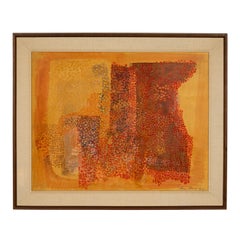
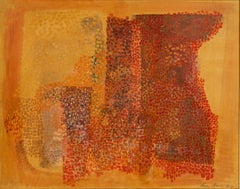
A good & large abstract oil painting by Louis Demott Bunce (1907-1983), the painting signed & dated 1957. One of the most famous celebrated artists of the Pacific Northwest and a member of the Modernist scene in New York from the 1920s to the 1950s. This painting on an orange ground with various tones of orange & gold punctuated with brown & ivory highlights. The painting is made up of large swathes of smaller geometric shapes, tipping a nod to Gustav Klimpt, the painting signed lower right. Housed in the original frame the painting is in excellent condition and ready to hang on your wall. Provenance; From a major private collection of PNW & WPA art Louis Bunce attended high school and the Museum Art School before leaving for the Art Students League in New York. He established a New York connection that began when he first attended classes there in 1927 and continued over the years with frequent visits. He became friends with many promising artists, including Jackson Pollock and David Smith. In 1946 Pollock wrote to his good friend Bunce stating, "Would like to hear from you Lou wish you hadn't left New York,". In 1939 he worked for the WPA Easel Project in New York and by the time he returned to Portland he was an established artist on the East Coast. He worked at the WPA art center in Salem as an Instructor and Assistant Director. His work included murals, two of which are in the Post Offices in Grants Pass and St. Johns. Their subjects, mining and orchard farming, are activities of each region. "I have always been visually drawn to the landscape, at first the desert and mountain regions of Wyoming; then the lush and gentle color of the Pacific Northwest and the urban landscape of New York." From 1942-1945 he worked as an illustrator, a tool designer, and in assembly for the Oregon Shipbuilding Corporation. After WWII, Bunce joined the faculty of the Museum Art School in Portland, where he had been a student in 1925-1926. He taught there until his retirement in 1972. He excelled at producing screen-prints and introduced this technique to Oregon. While maintaining a national reputation throughout the 1950s and 1960s, some of New York's most prestigious galleries represented him. Theater buffs will remember his murals and portraits for Portland Civic Theater's 1938 production of Pride and Prejudice. In a career that made him one of the most recognized names in Oregon's art history, Bunce had many styles: cubism, expressionism, surrealism and abstractionism. His 1958 mural in the Portland International Airport presents this abstract style: "whirling propellers and shadows of the concourse as seen from above." It was controversial at the time as being too abstract for a public art project. Louis and wife Eda opened a full-time art gallery in Portland in 1949, called the Kharouba. Located first at 1016 SE Morrison, then at SW 11th and Alder, the gallery represented many of the leading artists of the day: Josephine Cameron, William Givler, Clifford Gleason, Jack Hammack, Charles Heaney...

Category

1950s Abstract Louis Bunce Paintings

Materials

Oil

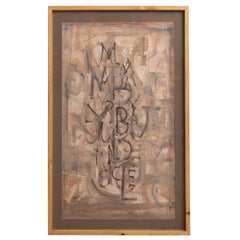
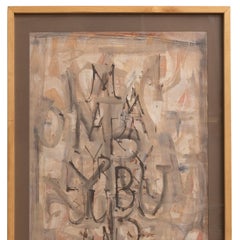
Abstract Surrealist Cubist Painting Oregon Artist Louis Bunce 1959 "Tablet"

Abstract Surrealist Cubist Painting Oregon Artist Louis Bunce 1959 "Tablet"

By Louis Bunce

Located in Portland, OR

An large abstract mixed media painting by Louis De Mot Bunce (1907-1983). The painting is signed and dated 1969 lower right, with the title "Tablet". Condition is very good indeed, a rare and compelling artwork by one of Oregon's most acclaimed artists. Louis Bunce, a major painter and printmaker beginning in the 1930s, is considered a legend in Oregon modernism. Known for variations of Surrealism and Cubism in the 1930s and 1940s, nature-based adaptations of Abstract Expressionism in the 1950s and 1960s, and geometric compositions related to Minimalism in the 1970s, he created a body of work that resonates with international modern art. He influenced many artists in the Pacific Northwest, including those who studied with him at the Museum Art School (now Pacific Northwest College of Art), where he taught from 1946 until 1972. Louis Demott Bunce was born in Lander, Wyoming, and moved with his family to Portland in 1920. He studied at the Museum Art School in 1925-1926, befriending fellow student William Givler. Both enrolled at the Art Students League in New York, Bunce studying there during 1927-1931. In Oregon, Bunce participated in the Public Works of Art Project in Portland in 1934, and in 1936 assisted John Ballator in painting murals for the St. Johns Post Office. These were funded by the U.S. Treasury Department, which also commissioned Bunce to paint the mural of Native American life for the Grants Pass Post Office. During the period 1937-1939, he was a teacher and then associate director for the WPA Federal Art Center in Salem, where he collaborated with his students, including Clifford Gleason, in painting murals for Bush Elementary School. He met and married Eda Hult in Salem. In 1940, Bunce returned to New York and worked as a WPA muralist and easel painter until 1942. Living in New York for two extended periods and visiting almost annually for many years thereafter helped him establish links between the art communities in Portland and New York, where he knew Jackson Pollock, Willem de Kooning, Robert Motherwell, Franz Kline, and other key figures in American modernism. During World War II, Bunce worked as illustrator and tool designer for the Oregon Shipbuilding Corporation, and in 1946 William Givler, by then dean of the Museum Art School, hired him as a faculty member. In 1949, Bunce and his wife established the Kharouba Gallery, the first in Portland devoted to showcasing experimental avant-garde art by artists working in Portland and further afield. Bunce’s abstract mural for Portland International Airport created controversy in 1958, when the debate between “modern” and “traditional” artists was at its height in Oregon. Bunce’s figurative Surrealism and Cubism of the 1930s and 1940s gave way to more complete abstraction in his paintings, drawings, serigraphs, and lithographs of the 1950s and on, but references to landscape, human figures, or still life are nearly always present in understated ways. The Oregon coast, Columbia Gorge...

Category

1950s Abstract Louis Bunce Paintings

Materials

Mixed Media

Louis Bunce paintings for sale on 1stDibs.

Find a wide variety of authentic Louis Bunce paintings available for sale on 1stDibs. You can also browse by medium to find art by Louis Bunce in oil paint, paint and more. Much of the original work by this artist or collective was created during the 1950s and is mostly associated with the modern style. Not every interior allows for large Louis Bunce paintings, so small editions measuring 50 inches across are available. Customers who are interested in this artist might also find the work of Robert McIntosh, Stanley Bate, and Clarence Holbrook Carter. Louis Bunce paintings prices can differ depending upon medium, time period and other attributes. On 1stDibs, the price for these items starts at $15,995 and tops out at $15,995, while the average work can sell for $15,995.