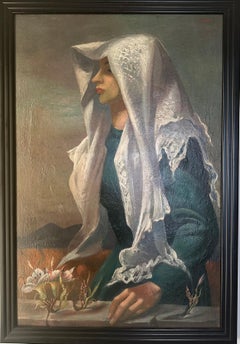
White Shawl
By Michael Lenson
Located in Los Angeles, CA
Michael Lenson 1903-1971 "WHITE SHAWL" OIL ON PANEL, SIGNED AMERICAN, C.1935 30 X 20 INCHES
Category
1930s Art Deco Michael Lenson Figurative Paintings
Materials
Oil, Panel
Michael Lenson was born in Russia in 1903. He is a Russian-American painter who won a prize at the National Academy of Design and exhibited at several New York galleries, before becoming the director of WPA mural projects in New Jersey in the 1930s. Lenson painted a set of murals on the history of Newark for City Hall, including scenes showing industries such as tanning and iron casting.
White Shawl
By Michael Lenson
Located in Los Angeles, CA
Michael Lenson 1903-1971 "WHITE SHAWL" OIL ON PANEL, SIGNED AMERICAN, C.1935 30 X 20 INCHES
Oil, Panel
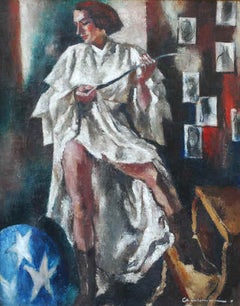
Femme du Cirque
By Paul Charlemagne
Located in West Hollywood, CA
Presenting an original oil by French artist Paul Charlemagne, “Femme du Cirque”, an original oil on canvas, signed, c.1930, with an image dimension of 30 x 24 inches.
Canvas, Oil
$489
H 21.26 in W 31.89 in
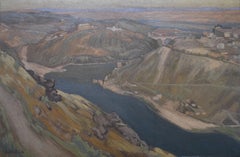
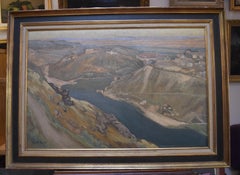
Emmanuel Aubain (1872-1965) A Landscape, signed oil painting
Located in Paris, FR
Emmanuel Aubain (1872-1965) A Landscape Signed lower left Oil on canvas transefered on cardboard panel In quite good condition, some abrasions in the r...
Oil
$766
H 15.36 in W 18.12 in
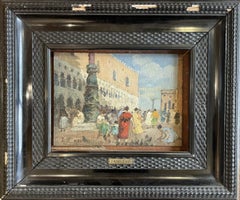
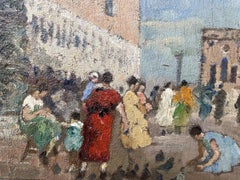
Ermo Zago (Bovolone, 1880 - Milan, 1942) View Of The Doge's Palace In Venice
Located in Firenze, IT
Ermo Zago (Bovolone, 1880 - Milan, 1942) View of the Doge's Palace in Venice, circa 1920 Oil on wooden panel, 27 × 19.5 cm (without frame) 46 × 39 cm (with frame) Original black-pa...
Oil, Board
$4,250Sale Price|29% Off
H 36.88 in W 30.88 in
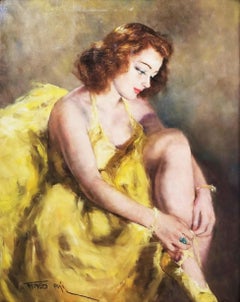
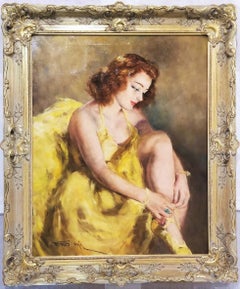
Hortense (Ballerina) /// Impressionism Degas French Ballet Renoir Figurative Art
By Pal Fried
Located in Saint Augustine, FL
Artist: Pál Fried (Hungarian, 1893-1976) Title: "Hortense (Ballerina)" *Signed by Fried lower left Circa: 1940 Medium: Original Oil Painting on Canvas Framing: Framed in a light gold...
Canvas, Paint, Oil
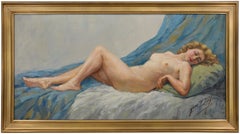
YVES DIEY The Nude, Oil on canvas, 1930s
By Yves Diey
Located in Saint Amans des cots, FR
Oil on canvas by Yves Dieÿ (1892-1984), France – The Nude. A striking oil on canvas by the renowned French artist Yves Dieÿ (1892-1984), depicting a sensual and elegant nude. This wo...
Canvas, Oil
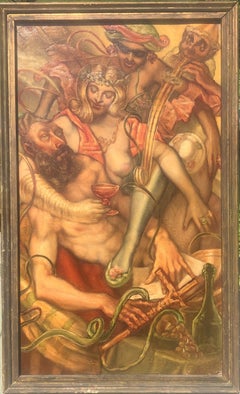
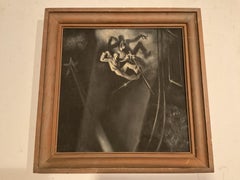
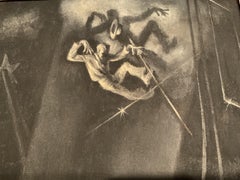
Early 20th Century British School Erotic Bacchanalian Scene
Located in Exton, PA
Stunning and alluring painting showing Sampson succumbing to the wiles of the sensual temptress Delilah. Done in a manner that is reminiscent of the murals of the WPA, the art deco p...
Oil
$795
H 16 in W 16 in D 2 in
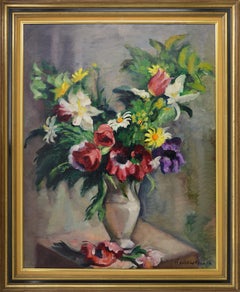
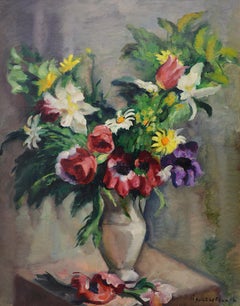
Vintage 1940’s Circus Acrobat Oil on Canvas Painting. Unique modern style.
Located in Baltimore, MD
This is a highly stylized circus acrobat scene. Done “en grissille” or shades of grey, it portrays an acrobat on a trapeze high above the crowd, abstractly shown lower right. The stark composition, enhanced by the theatrical lighting...
Oil
$2,500
H 37.01 in W 30.71 in D 1.97 in
Charles PICART LE DOUX, Bouquet of Wild Flowers, 1934
By Charles Picart le Doux
Located in Saint Amans des cots, FR
Oil on canvas by Charles PICART LE DOUX (1881-1959), France, 1934. Bouquet of Wild Flowers. Artwork typical of the manner of Charles Picart Le Doux. However, the robust and contrasti...
Canvas, Oil
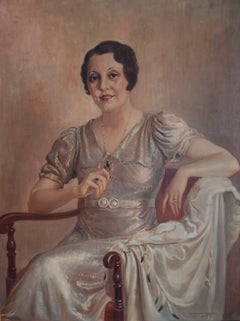
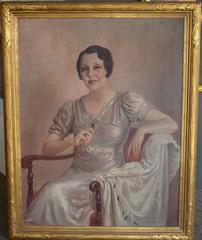
Elegance
By Alexander Rosenfeld
Located in West Hollywood, CA
We are proud to have recently discovered, “The Sophisticate”, by American artist Alexander Rosenfeld. Rosenfeld was classically trained in fine ...
Oil
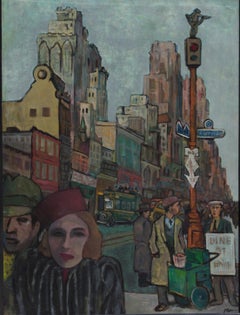
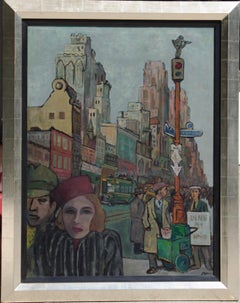
City Street: Fifth Avenue
By Ron Blumberg
Located in West Hollywood, CA
Presenting a just discovered oil painting from the earliest period, c.1932, of American artist Ron Blumberg. After completing his fine art studies art at La Grande Academie Chaumiere in Paris Ron Blumberg left for New York in 1932, where he worked for eight years as a National Academy artist and a member of the Art Students League. Virtually every painting from this early New York period has been sold, making this the rarest period of work in Ron Blumberg’s career. City Street: Fifth Avenue, is an original oil on canvas, signed, c.1932, with an image dimension of 39 x 39 inches, good original condition with two very small restorations, set in a beautiful custom white gold frame. Please contact the gallery for information, availability and pricing Ron Blumberg Born: 1908 Reading, Pennsylvania Education: National Academy of Design, New York, NY Art Students League, New York, NY, 1930 Academie de La Grande Chaumiere, Paris, France, 1930-1931 Museum Exhibitions Delgado Museum, New Orleans, LA 1933 Houston Museum of Art, Houston, TX 1936 Oakland Museum Oakland, CA Dallas Museum of Fine Arts, Dallas, TX 1936, 1936 Denver Museum of Fine Arts, Denver, CO 1957 Tucson Museum, Tucson, AZ 1955 San Diego Museum, San Diego, CA 1962 Los Angeles County Museum of Art, Los Angeles, CA 1958 H. d Young Memorial Museum, San Francisco, CA 1967 Erma Frye Museum, Seattle, WA 1969 Gallery Exhibitions ACA Gallery, New York, NY 1937 Arr USA, New York, NY 1939 MacBeth Gallery, New York, NY 1932 Landau Gallery, Los Angeles, CA 1951 Esther Robles Gallery, Los Angeles, CA 1958,1959 Cushing Gallery, Dallas, TX 1972 Jean Dichter Gallery, Denver, CO 1955 Feingarten Galleries, Los Angeles, CA 1987 Trigg Ison Fine Art...
Oil
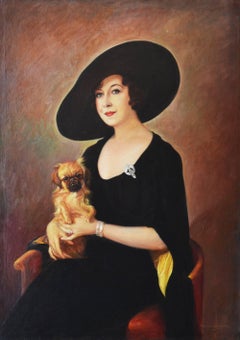
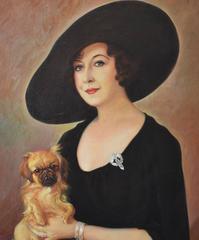
The Sophisticate
By Alexander Rosenfeld
Located in West Hollywood, CA
We are proud to have recently discovered, “The Sophisticate”, by American artist Alexander Rosenfeld. Rosenfeld was classically trained in fine ...
Oil
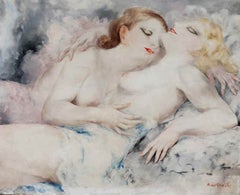
Les Amies
By Micao Kono
Located in West Hollywood, CA
Micao Kono was born in Japan, moving to work in Paris in the 1920's. His style, a mixture of Japanese watercolor and figurative Art Deco. He often mixed egg tempera into his oils to ...
Canvas, Oil
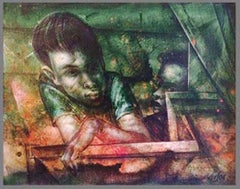
Under Stairs
By Michael Lenson
Located in Los Angeles, CA
MICHAEL LENSON "UNDER THE STAIRS" ACRYLIC ON CANVAS, SIGNED AMERICAN, C.1960 16 X 20 INCHES Michael Lenson 1903-1971 Michael Lenson was born in Galich, a Russian city of 25,000 situated on the eastern slopes of the Ural Mountains. “In winter, peasants from the north packed their horse-drawn sleighs with kindling and drove into the town across frozen Lake Galich,” Lenson later recalled. “Haggard monks paraded through the town carrying icons, then banged on our door to solicit alms. Wolves roamed through the streets in the dead of winter, and the Tsar and his family stopped their private railway car at the Galich station every summer to receive gifts of locally made leather boots from the local town officials.” Although Lenson and his family emigrated to New York when he was only seven years old, those vivid childhood memories stayed with him, and may have sparked the dream-infused imagery in his paintings and drawings. By 1928, Lenson was a struggling art student sharing a coldwater flat on East 116th Street in New York City flat with fellow artists Louis Guglielmi (1906-1956) and Gregorio Prestopino (1907-1984). He studied at the National Academy of Design and sketched at the Metropolitan Museum. To keep meat on his bones, Lenson was working in the Post Office at night, and airbrushing shoes for mail-order catalogs during the day. But that year, Lenson’s life changed dramatically when he was awarded the much-coveted $10,000 Chaloner Prize for Painting. “It was fantastic, absolutely fantastic,” Lenson later told an interviewer for the Smithsonian’s Oral History Project. “All of a sudden my worries fell away and I was aboard ship. All my relatives who considered me a no-good deficit to the family were on the dock waving farewell to me.” Thus the Russian born artist was able to return to Europe for four years of travel and study. At the University of London’s Slade School of Art, Lenson logged long months sitting at a drafting table, mastering the drawing skills that would remain a hallmark of his work. “You could say that the instruction there was academic,” he later recalled, “but boy, did they know their stuff.” While in London, Lenson also assisted the noted muralist Colin Gill. Moving on to Paris, Lenson occupied a Chaloner-funded apartment near the Jardin de Luxembourg. He enrolled in the Académie des Beaux-Arts, and began to paint large figurative canvases that were strongly influenced by the old master works that he studied at the Louvre. Beyond studying, Lenson made the most of his years in Paris. He and a circle of American expatriates congregated at Le Dôme Café in the evenings for camaraderie and drinks. He heard Chaliapin sing and saw Ravel conduct. He escorted glamorous women, including Henrietta Schumann, the phenomenal young Russian-American concert pianist who had just arrived in Paris to study with Alfred Cortot...
Canvas, Oil
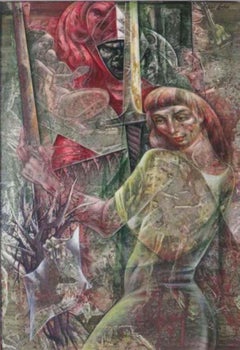
TERRIBLE WITH BANNERS"
By Michael Lenson
Located in Los Angeles, CA
MICHAEL LENSON "TERRIBLE WITH BANNERS" OIL ON MASONITE, SIGNED, TITLED AMERICAN, C.1959 42 X 28.5 INCHES Michael Lenson 1903-1971 Michael Lenson was born in Galich, a Russian city of 25,000 situated on the eastern slopes of the Ural Mountains. “In winter, peasants from the north packed their horse-drawn sleighs with kindling and drove into the town across frozen Lake Galich,” Lenson later recalled. “Haggard monks paraded through the town carrying icons, then banged on our door to solicit alms. Wolves roamed through the streets in the dead of winter, and the Tsar and his family stopped their private railway car at the Galich station every summer to receive gifts of locally made leather boots from the local town officials.” Although Lenson and his family emigrated to New York when he was only seven years old, those vivid childhood memories stayed with him, and may have sparked the dream-infused imagery in his paintings and drawings. By 1928, Lenson was a struggling art student sharing a coldwater flat on East 116th Street in New York City flat with fellow artists Louis Guglielmi (1906-1956) and Gregorio Prestopino (1907-1984). He studied at the National Academy of Design and sketched at the Metropolitan Museum. To keep meat on his bones, Lenson was working in the Post Office at night, and airbrushing shoes for mail-order catalogs during the day. But that year, Lenson’s life changed dramatically when he was awarded the much-coveted $10,000 Chaloner Prize for Painting. “It was fantastic, absolutely fantastic,” Lenson later told an interviewer for the Smithsonian’s Oral History Project. “All of a sudden my worries fell away and I was aboard ship. All my relatives who considered me a no-good deficit to the family were on the dock waving farewell to me.” Thus the Russian born artist was able to return to Europe for four years of travel and study. At the University of London’s Slade School of Art, Lenson logged long months sitting at a drafting table, mastering the drawing skills that would remain a hallmark of his work. “You could say that the instruction there was academic,” he later recalled, “but boy, did they know their stuff.” While in London, Lenson also assisted the noted muralist Colin Gill. Moving on to Paris, Lenson occupied a Chaloner-funded apartment near the Jardin de Luxembourg. He enrolled in the Académie des Beaux-Arts, and began to paint large figurative canvases that were strongly influenced by the old master works that he studied at the Louvre. Beyond studying, Lenson made the most of his years in Paris. He and a circle of American expatriates congregated at Le Dôme Café in the evenings for camaraderie and drinks. He heard Chaliapin sing and saw Ravel conduct. He escorted glamorous women, including Henrietta Schumann, the phenomenal young Russian-American concert pianist who had just arrived in Paris to study with Alfred Cortot. Lenson later said that when he returned to New York in 1932, “I was no longer the conquering hero. I came back to nothing . . . absolutely nothing.” Although the Great Depression was dawning, Lenson’s first one-man exhibition at the Caz-Delbo Gallery was a notable success. In a review in the April 30, 1933 New York Times, distinguished critic Howard Devree wrote: “He stands at the beginning of a very promising career, without close allegiance to any of the great names or schools. Yet in the best sense of the word he is traditional . . . The best of his things strike a good working balance between [color and form]. His figure studies . . . show him at his best . . . His still life is restrained both in color and form - refinement without academicism. The portraits show a sympathy with the old masters of the French school and yet are thoroughly modern. His landscapes are well worked out and lighted. His later things give evidence of growing freedom in the use of clear, rich color and of gathering powers of simplification.” Margaret Breuning, another noted critic, said of Lenson’s work in her review in the New York Evening Post on May 1, 1933: “He is a young artist who works in the tradition, particularly in his excellent portraits, but is finding a growing power to enrich tradition with personal expression . . . All the work has an integrity and soundness which warrant a belief in the artist’s future performance.” Such interviews did not feed artists in those bleak Depression days. Before long, Lenson found his way to New Jersey, where he joined the Federal Arts Project and quickly secured a mural commission for an immense wall in a tuberculosis hospital in Verona, New Jersey and soon painted murals for the New Jersey Pavilion of the 1939 World’s Fair. By then, Lenson had been appointed supervisor for all WPA mural projects in the State. Other mural commissions followed, including his eight-panel “History of Newark” in the City Council Chambers at Newark City Hall and his “Enlightenment of Man” panoramic mural in Weequahic High School in Newark. Another extant Lenson mural is “Mining,” completed for the U.S. Post Office in Mount Hope, West Virginia. Who Was Who In American Art? calls Lenson, “New Jersey’s most important muralist.” Recently, Lenson’s remarkable contributions to WPA art were covered extensively by Nick Taylor in his book, American Made: The Enduring Legacy of the WPA. After the demise of the WPA, Lenson bought a studio home in Nutley, a town seven miles north of Newark. He married June Rollar, an aspiring poet, and had two sons. Later, he taught painting at Rutgers University and the Montclair Art Museum. During the last sixteen years of his life, Lenson served as art critic for The Newark Sunday News. Michael Lenson’s paintings are in numerous private collections and in the permanent collections of many institutions, including the Johnson Museum at Cornell University, the Princeton University Art Museum, the Maier Museum of American Art, and the Quick Center for the Arts at Saint Bonaventure...
Masonite, Oil
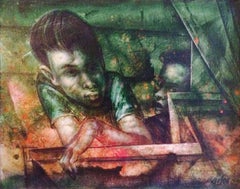
Under the Stairs
By Michael Lenson
Located in Los Angeles, CA
MICHAEL LENSON "UNDER THE STAIRS" ACRYLIC ON CANVAS, SIGNED AMERICAN, C.1960 16 X 20 INCHES Michael Lenson 1903-1971 Michael Lenson was born in Galich, a Russian city of 25,000 situated on the eastern slopes of the Ural Mountains. “In winter, peasants from the north packed their horse-drawn sleighs with kindling and drove into the town across frozen Lake Galich,” Lenson later recalled. “Haggard monks paraded through the town carrying icons, then banged on our door to solicit alms. Wolves roamed through the streets in the dead of winter, and the Tsar and his family stopped their private railway car at the Galich station every summer to receive gifts of locally made leather boots from the local town officials.” Although Lenson and his family emigrated to New York when he was only seven years old, those vivid childhood memories stayed with him, and may have sparked the dream-infused imagery in his paintings and drawings. By 1928, Lenson was a struggling art student sharing a coldwater flat on East 116th Street in New York City flat with fellow artists Louis Guglielmi (1906-1956) and Gregorio Prestopino (1907-1984). He studied at the National Academy of Design and sketched at the Metropolitan Museum. To keep meat on his bones, Lenson was working in the Post Office at night, and airbrushing shoes for mail-order catalogs during the day. But that year, Lenson’s life changed dramatically when he was awarded the much-coveted $10,000 Chaloner Prize for Painting. “It was fantastic, absolutely fantastic,” Lenson later told an interviewer for the Smithsonian’s Oral History Project. “All of a sudden my worries fell away and I was aboard ship. All my relatives who considered me a no-good deficit to the family were on the dock waving farewell to me.” Thus the Russian born artist was able to return to Europe for four years of travel and study. At the University of London’s Slade School of Art, Lenson logged long months sitting at a drafting table, mastering the drawing skills that would remain a hallmark of his work. “You could say that the instruction there was academic,” he later recalled, “but boy, did they know their stuff.” While in London, Lenson also assisted the noted muralist Colin Gill...
Canvas, Acrylic
Under the Stairs
By Michael Lenson
Located in Los Angeles, CA
MICHAEL LENSON "UNDER THE STAIRS" ACRYLIC ON CANVAS, SIGNED AMERICAN, C.1960 16 X 20 INCHES Michael Lenson 1903-1971 Michael Lenson was born in Galich, a Russian city of 25,000 situated on the eastern slopes of the Ural Mountains. “In winter, peasants from the north packed their horse-drawn sleighs with kindling and drove into the town across frozen Lake Galich,” Lenson later recalled. “Haggard monks paraded through the town carrying icons, then banged on our door to solicit alms. Wolves roamed through the streets in the dead of winter, and the Tsar and his family stopped their private railway car at the Galich station every summer to receive gifts of locally made leather boots from the local town officials.” Although Lenson and his family emigrated to New York when he was only seven years old, those vivid childhood memories stayed with him, and may have sparked the dream-infused imagery in his paintings and drawings. By 1928, Lenson was a struggling art student sharing a coldwater flat on East 116th Street in New York City flat with fellow artists Louis Guglielmi (1906-1956) and Gregorio Prestopino (1907-1984). He studied at the National Academy of Design and sketched at the Metropolitan Museum. To keep meat on his bones, Lenson was working in the Post Office at night, and airbrushing shoes for mail-order catalogs during the day. But that year, Lenson’s life changed dramatically when he was awarded the much-coveted $10,000 Chaloner Prize for Painting. “It was fantastic, absolutely fantastic,” Lenson later told an interviewer for the Smithsonian’s Oral History Project. “All of a sudden my worries fell away and I was aboard ship. All my relatives who considered me a no-good deficit to the family were on the dock waving farewell to me.” Thus the Russian born artist was able to return to Europe for four years of travel and study. At the University of London’s Slade School of Art, Lenson logged long months sitting at a drafting table, mastering the drawing skills that would remain a hallmark of his work. “You could say that the instruction there was academic,” he later recalled, “but boy, did they know their stuff.” While in London, Lenson also assisted the noted muralist Colin Gill...
Acrylic, Canvas
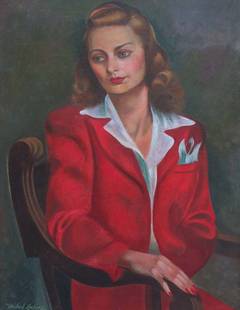
Portrait of a Woman
By Michael Lenson
Located in Los Angeles, CA
MICHAEL LENSON "PORTRAIT OF WOMAN" OIL ON CANVAS, SIGNED AMERICAN, DATED 1942 30 X 23 INCHES Michael Lenson Michael Lenson was born in 1903 in Galich, Russia. He em...
Girl with Guitar
By Michael Lenson
Located in Los Angeles, CA
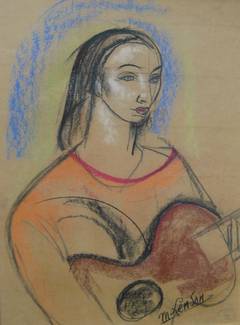
MICHAEL LENSON "GIRL WITH GUITAR" PASTEL, SIGNED AMERICAN, C.1935 22 X 18 INCHES Michael Lenson 1903-1971 Michael Lenson was born in Galich, a Russian city of 25,000 situated on the eastern slopes of the Ural Mountains. “In winter, peasants from the north packed their horse-drawn sleighs with kindling and drove into the town across frozen Lake Galich,” Lenson later recalled. “Haggard monks paraded through the town carrying icons, then banged on our door to solicit alms. Wolves roamed through the streets in the dead of winter, and the Tsar and his family stopped their private railway car at the Galich station every summer to receive gifts of locally made leather boots from the local town officials.” Although Lenson and his family emigrated to New York when he was only seven years old, those vivid childhood memories stayed with him, and may have sparked the dream-infused imagery in his paintings and drawings. By 1928, Lenson was a struggling art student sharing a coldwater flat on East 116th Street in New York City flat with fellow artists Louis Guglielmi (1906-1956) and Gregorio Prestopino (1907-1984). He studied at the National Academy of Design and sketched at the Metropolitan Museum. To keep meat on his bones, Lenson was working in the Post Office at night, and airbrushing shoes for mail-order catalogs during the day. But that year, Lenson’s life changed dramatically when he was awarded the much-coveted $10,000 Chaloner Prize for Painting. “It was fantastic, absolutely fantastic,” Lenson later told an interviewer for the Smithsonian’s Oral History Project. “All of a sudden my worries fell away and I was aboard ship. All my relatives who considered me a no-good deficit to the family were on the dock waving farewell to me.” Thus the Russian born artist was able to return to Europe for four years of travel and study. At the University of London’s Slade School of Art, Lenson logged long months sitting at a drafting table, mastering the drawing skills that would remain a hallmark of his work. “You could say that the instruction there was academic,” he later recalled, “but boy, did they know their stuff.” While in London, Lenson also assisted the noted muralist Colin Gill. Moving on to Paris, Lenson occupied a Chaloner-funded apartment near the Jardin de Luxembourg. He enrolled in the Académie des Beaux-Arts, and began to paint large figurative canvases that were strongly influenced by the old master works that he studied at the Louvre. Beyond studying, Lenson made the most of his years in Paris. He and a circle of American expatriates congregated at Le Dôme Café in the evenings for camaraderie and drinks. He heard Chaliapin sing and saw Ravel conduct. He escorted glamorous women, including Henrietta Schumann, the phenomenal young Russian-American concert pianist who had just arrived in Paris to study with Alfred Cortot. Lenson later said that when he returned to New York in 1932, “I was no longer the conquering hero. I came back to nothing . . . absolutely nothing.” Although the Great Depression was dawning, Lenson’s first one-man exhibition at the Caz-Delbo Gallery was a notable success. In a review in the April 30, 1933 New York Times, distinguished critic Howard Devree wrote: “He stands at the beginning of a very promising career, without close allegiance to any of the great names or schools. Yet in the best sense of the word he is traditional . . . The best of his things strike a good working balance between [color and form]. His figure studies . . . show him at his best . . . His still life is restrained both in color and form - refinement without academicism. The portraits show a sympathy with the old masters of the French school and yet are thoroughly modern. His landscapes are well worked out and lighted. His later things give evidence of growing freedom in the use of clear, rich color and of gathering powers of simplification.” Margaret Breuning, another noted critic, said of Lenson’s work in her review in the New York Evening Post on May 1, 1933: “He is a young artist who works in the tradition, particularly in his excellent portraits, but is finding a growing power to enrich tradition with personal expression . . . All the work has an integrity and soundness which warrant a belief in the artist’s future performance.” Such interviews did not feed artists in those bleak Depression days. Before long, Lenson found his way to New Jersey, where he joined the Federal Arts Project and quickly secured a mural commission for an immense wall in a tuberculosis hospital in Verona, New Jersey and soon painted murals for the New Jersey Pavilion of the 1939 World’s Fair. By then, Lenson had been appointed supervisor for all WPA mural projects in the State. Other mural commissions followed, including his eight-panel “History of Newark” in the City Council Chambers at Newark City Hall and his “Enlightenment of Man” panoramic mural in Weequahic High School in Newark. Another extant Lenson mural is “Mining,” completed for the U.S. Post Office in Mount Hope, West Virginia. Who Was Who In American Art? calls Lenson, “New Jersey’s most important muralist.” Recently, Lenson’s remarkable contributions to WPA art were covered extensively by Nick Taylor in his book, American Made: The Enduring Legacy of the WPA. After the demise of the WPA, Lenson bought a studio home in Nutley, a town seven miles north of Newark. He married June Rollar, an aspiring poet, and had two sons. Later, he taught painting at Rutgers University and the Montclair Art Museum. During the last sixteen years of his life, Lenson served as art critic for The Newark Sunday News. Michael Lenson’s paintings are in numerous private collections and in the permanent collections of many institutions, including the Johnson Museum at Cornell University, the Princeton University Art Museum, the Maier Museum of American Art, and the Quick Center for the Arts at Saint Bonaventure...
Pastel
PORTRAIT OF FRANCIS HEALY
By Michael Lenson
Located in Los Angeles, CA
Oil, Canvas
SAILOR'S STORY
By Michael Lenson
Located in Los Angeles, CA
Oil, Canvas
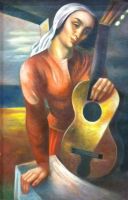
Woman with Guitar
By Michael Lenson
Located in Los Angeles, CA
Oil, Canvas