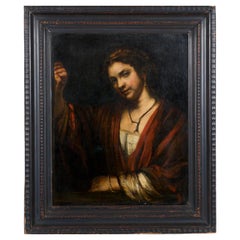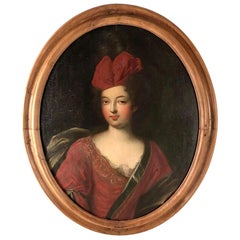
Roman school, late 16th-early 17th century Praying Madonna
Oil on canvas, 81 x 69 cm
Frame 83 x 95.5 cm
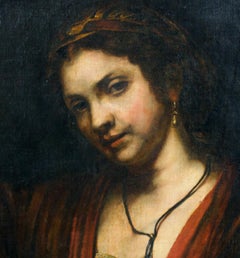
A divine whiteness reverberates with vibrant luster on the maphorion of the present Virgin. The palpable iridescence that structures the thin rosaceous garment, woven with the same fresh light, produces a slight rustle when she takes her hands off. The Madonna in fact takes a prayerful pose, opening her palms to underline her fervent ecstatic intention; the white neck is rendered with perishable fullness of pigments, like the hands, perfectly alive, and the very shiny eyes. With fine shrewdness the artist of the present styles the Virgin's hair with thin white ribbons, exacerbating the purity. An evocative light falls gently on the bust, a materialized sign of divine glory.
The present can be traced back to the late Mannerist climate that prevailed in the capital after the emanation of the Tridentine council (1545-1563). The late Mannerist licenses that can still be seen there, such as the intense lyricism in the stylistic code adopted by the artist, are innervated in the new basic catechetical intent, which at the end of the century produced a certain figurative rigorism. The present, however, still responds to that extraordinary Roman dynamism that raised the capital to a bulwark for the entire mannerist lesson, matched only by a second artistic center, the Florentine one. The engaging carriage of the Virgin reflects the contemporary examples of Giuseppe Valeriano (1542-1596), a Jesuit painter, returning in the Marriage of the Virgin of the Roman Church of Jesus, as well as in the Madonna of Sorrows in the Recanati Altarpiece, equal ardor. But it is in the Assumption of the Virgin painted in four hands with Scipione Pulzone...
Category
Early 17th Century Italian Antique Molla Decorative Art