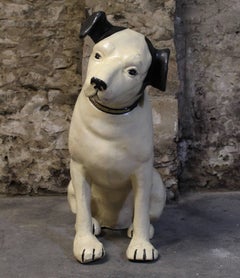
By Old King Cole
Located in Hamilton, Ontario
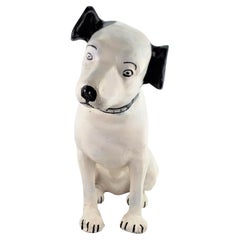
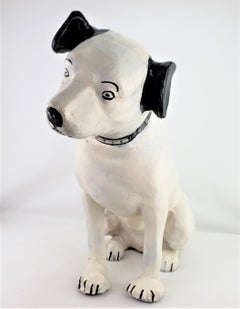
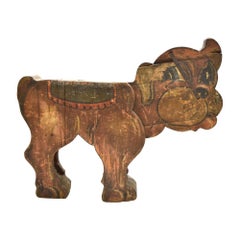
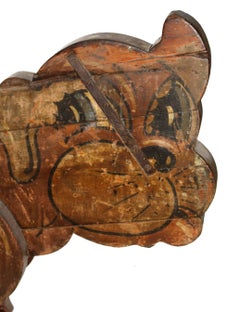
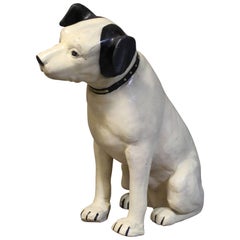
His Masters voice large store display 'Nipper' Dog by Old King Cole Papier-Mache Company of Canton, Ohio.
His Master's Voice (HMV) is a famous trademark in the music and recording industry and was the unofficial name of a major British record label. The name was coined in the 1890s as the title of a painting of a Jack Russell terrier dog named Nipper, listening to a wind-up gramophone. In the original painting, the dog was listening to a cylinder phonograph. In the 1970s, the statue of the dog and gramophone, His Master's Voice, were cloaked in bronze and was awarded by the record company (EMI) to artists or music producers or composers as a music award and often only after selling more than 100.000 sound carriers such as LPs.
The painting
The trademark image comes from a painting by English artist Francis Barraud and titled His Master's Voice. It was acquired from the artist in 1899 by the newly formed Gramophone Company and adopted by the Victor Talking Machine Company in the United States. According to contemporary Gramophone Company publicity material, the dog, a terrier named Nipper, had originally belonged to Barraud's brother, Mark. When Mark Barraud died, Francis inherited Nipper, with a cylinder phonograph and recordings of Mark's voice. Francis noted the peculiar interest that the dog took in the recorded voice of his late master emanating from the horn, and conceived the idea of committing the scene to canvas.
The Logo
In early 1899, Francis Barraud applied for copyright of the original painting using the descriptive working title Dog looking at and listening to a Phonograph. He was unable to sell the work to any cylinder phonograph company, but William Barry Owen, the American founder of the Gramophone Company in England, offered to purchase the painting under the condition that Barraud modify it to show one of their disc machines. Barraud complied and the image was first used on the company's catalogue from December 1899. As the trademark gained in popularity, several additional copies were subsequently commissioned from the artist for various corporate purposes. Emile Berliner, the inventor of the Gramophone, had seen the picture in London and took out a United States copyright on it in July, 1900. The painting was adopted as a trademark by Eldridge R. Johnson of the Consolidated Talking Machine Company, which was reorganized as the Victor Talking Machine Company in 1901. Victor used the image far more aggressively than its UK affiliate, and from 1902 most Victor records had a simplified drawing of Barraud's dog-and-gramophone image on their labels. Magazine advertisements urged record buyers to "look for the dog."
In British Commonwealth countries, the Gramophone Company did not use the dog on its record labels until 1909. The following year the Gramophone Company replaced the Recording Angel trademark in the upper half of the record labels with the Nipper logo.
The company was not formally called HMV or His Master's Voice, but rapidly became identified by that term due to the prominence of the phrase on the record labels. Records issued by the company before February 1908 were generally referred to by record collectors as G&Ts, while those after that date are usually called HMV records.
The image continued to be used as a trademark by Victor in the US, Canada, and Latin America. In 1929, the Radio Corporation of America (RCA) purchased the Victor Talking Machine Company. In British Commonwealth countries (except for Canada, where Victor held the rights) it was used by various subsidiaries of the Gramophone Company, which ultimately became part of EMI.
The trademark's ownership is divided among different companies in different countries, reducing its value in the globalised music market. The name HMV was used by a chain of music shops owned by HMV, mainly in the UK, Ireland, Canada, Singapore, Australia, Hong Kong, and Japan.
In 1921 the Gramophone Company opened the first HMV shop in London. In 1929 RCA absorbed Victor, and with it a major shareholding in the Gramophone Company, which Victor had owned since 1920. RCA was instrumental in the 1931 creation of EMI, which continued to own the His Master's Voice name and image in the UK. In 1935, RCA Victor sold its stake in EMI but continued to own the rights to His Master's Voice in the Americas. HMV continued to distribute RCA Victor recordings in the UK and elsewhere until 1957, when EMI purchased Capitol Records as their distributor in the western hemisphere. The hostilities between the US and Japan during World War II led to RCA Victor's Japanese subsidiary, the Victor Company of Japan (JVC), to become independent, and today the company is still allowed use of the "Victor" brand and Nipper trademark in Japan only. In 1968, RCA introduced a modern logo and restricted the use of Nipper to the album covers of Red Seal Records. The Nipper trademark was reinstated to most RCA record labels in the Western Hemisphere beginning in late 1976 and was once again widely used in RCA advertising throughout the late 1970s and 1980s. The dog reappeared for a time on RCA television sets and was also used on the RCA CED videodisc system. EMI owned the His Master's Voice label in the UK until the 1980s, and the HMV shops until 1998.
In 1967, EMI converted the HMV label into an exclusive classical music label and dropped its POP series of popular music. HMV's POP series artists' roster was moved to Columbia Graphophone and Parlophone and licensed American POP record deals to Stateside Records.
The globalised market for CDs pushed EMI into abandoning the HMV label in favour of "EMI Classics", a name they could use worldwide; however, it was revived between 1988 and 1992 for Morrissey's recordings. The HMV trademark is now owned by the retail chain in the UK. The formal trademark transfer from EMI took place in 2003. The old HMV classical music catalogue is now controlled by the Warner Classics unit of Warner Music Group. Reissues of HMV pop material that EMI previously controlled are now reissued on Warner's Parlophone label. In the UK, Warner Classics's online presence was launched as 'Dog and Trumpet' on Spotify, Facebook, Twitter and Instagram in January 2017.
The dog-and-gramophone image is now licensed by RCA Records and its parent company, Sony Music Entertainment, from Technicolor SA, which operates RCA's consumer electronics division (still promoted by Nipper the dog). Thomson SA acquired the division from General Electric after GE absorbed the RCA Corporation in 1986. The image of "His Master's Voice" exists in the U.S. as a trademark only on radios and radios combined with phonographs; the trademark is owned by RCA Trademark Management SA, a subsidiary of Technicolor.
With that exception, the "His Master's Voice" dog-and-gramophone image is in the public domain in the U.S., its trademark registrations having expired in 1989 (for sound recordings and phonograph cabinets), 1992 (television sets, television-radio combination sets), and 1994 (sound recording and reproducing machines, needles, and records).
Nipper Worldwide
Advertisement for "His Master's Voice gramophones in the Dutch East Indies, 1930s
The "His Master's Voice" logo was used around the world, and the motto became well known in different languages. In Europe these include "La voix de son maître," (France), "La voz de su amo" (Spain), "A voz do dono" (Portugal), "La voce del padrone" (Italy), "Die Stimme seines Herrn" (Germany), "Husbondens Röst" (Sweden), "GLos Swego Pana" (Poland), "Sin Herres Stemme" (Norway) and "Sahibinin Sesi" (Turkey).
On 1 April 2007, HMV announced that Gromit, the animated dog of Wallace and Gromit...
Category
20th Century American Old King Cole Decorative Objects