Oskar Schlemmer Art

to
1
1
Overall Width
to
Overall Height
to
1
1
1
2
1
1
1
1
2
10,340
2,808
2,500
1,408
2
Artist: Oskar Schlemmer
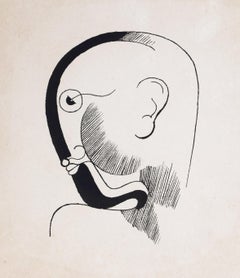
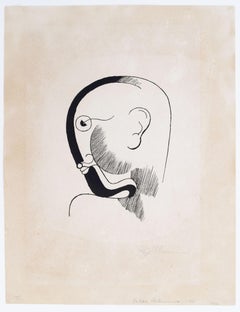
Head in profile with Black Contours - German Bauhaus

Head in profile with Black Contours - German Bauhaus

By Oskar Schlemmer

Located in London, GB

This original lithograph is hand signed in pencil by the artist “Schlemmer” at the lower right corner. It was printed in a total limited edition of 130 signed, but unnumbered impress...

Category

1920s Bauhaus Oskar Schlemmer Art

Materials

Lithograph

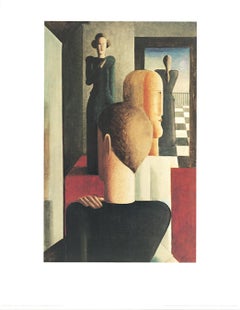
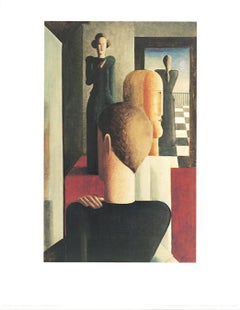
Roman - Oskar Schlemmer

Roman - Oskar Schlemmer

By Oskar Schlemmer

Located in Winterswijk, NL

Art print on heavy paper After the original from 1925 In great condition

Category

Early 19th Century Oskar Schlemmer Art

Materials

Color

Related Items
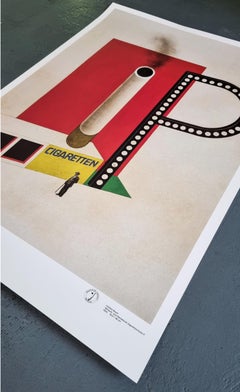
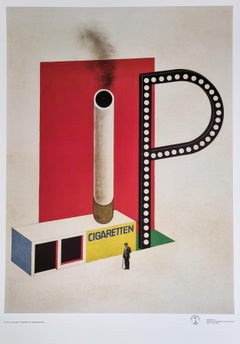
Sale and Marketing Kiosk for P Cigarettes (Bauhaus)  (20% OFF + Free Shipping)

Sale and Marketing Kiosk for P Cigarettes (Bauhaus) (20% OFF + Free Shipping)

By Herbert Bayer

Located in Kansas City, MO

Herbert Bayer Sale and Marketing Kiosk for P Cigarettes (Verkauf- und Werbekiosk, Zigarettenmarke P ), 1924 Offset Lithograph Year: 1994 Size: 33.2 × 23.2 inches Publisher: Bauhaus A...

Category

1920s Bauhaus Oskar Schlemmer Art

Materials

Lithograph

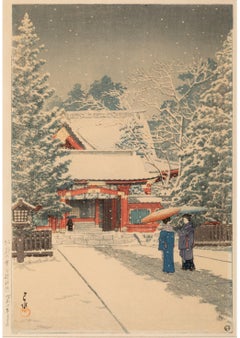
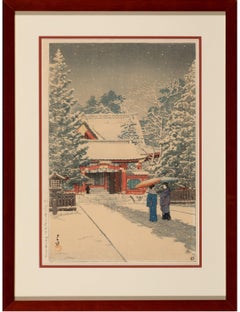
Kawase Hasui -- Snow at Hie Shrine, circa 1946 - 1957

Kawase Hasui -- Snow at Hie Shrine, circa 1946 - 1957

By Kawase Hasui

Located in BRUCE, ACT

Kawase Hasui (Japanese, 1883-1957) Snow at Hie Shrine, circa 1946 -1957 (dated in the publisher's seal) Woodblock Sheet size 37.5 x 26.0 cm (vertical oban) Frame size 51.3 x 38.5 x 2...

Category

1940s Oskar Schlemmer Art

Materials

Woodcut

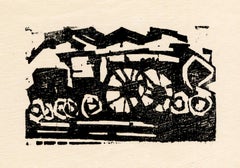
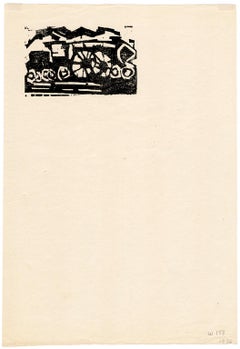
'Little Locomotive' – Artist's Personal Letterhead, Bauhaus Modernism

'Little Locomotive' – Artist's Personal Letterhead, Bauhaus Modernism

By Lyonel Feininger

Located in Myrtle Beach, SC

Lyonel Feininger, 'Little Locomotive (Kleine Lokomotive)', woodcut, 1936, one of a small but unknown number of letterhead proofs; Prasse W158. Annotated 'W 158' (Feininger catalogue number) and '1936' in pencil, in the bottom right sheet corner. A fine impression, on cream, laid letterhead stock; hinge remains on the left and right top sheet edges, verso, in excellent condition. Very scarce. Image size 2 1/4 x 3 5/16 inches; sheet size 10 x 7 inches. Archivally sleeved, unmatted. Exhibited: 'Lyonel Feininer, Woodcuts Used As Letterheads'; Associated American Artists; Feb 4 - March 2, 1974; New York, NY. Collections: Cleveland Museum of Art, Museum of Modern Art, Staatliche Museen zu Berlin (East Berlin KK). ABOUT THE ARTIST Lyonel Feininger (1871-1956) was born in New York City into a musical family—his father was a violinist and composer, his mother was a singer and pianist. He studied violin with his father, and by the age of 12, he was performing in public, but he also drew incessantly, most notably the steamboats and sailing ships on the Hudson and East Rivers, and the landscape around Sharon, Conn., where he spent time on a farm owned by a family friend. At the age of 16 he left New York to study music and art in Germany, from where his parents emigrated. Drawn more to the visual arts, he attended schools in Hamburg, Berlin, and Paris from 1887 to 1892. After completing his studies, Feininger began his artistic career as a cartoonist and illustrator, his originality leading him to great success. In 1906, after working for a dozen years in Germany, he was offered a job as a cartoonist at the Chicago Tribune, the largest circulation newspaper in the Midwest. He worked there for a year, inventing what became the standard design for the comic strip: in the words of John Carlin, “an overall pattern. . . that allowed the page to be read both as a series of elements one after the other, like language and as a group of juxtaposed images, like visual art.” His originality did not end there: he went on to become one of the great abstract painters. Like Kandinsky, music was his model, but Kandinsky only knew music from the outside—as a listener (inspired initially by Wagner, then by Schoenberg)—while Feininger knew it from the inside. He lived in Paris from 1906 to 1908, during which time he met and was influenced by the work of progressive painters Robert Delaunay and Jules Pascin, as well as that of Paul Cezanne and Vincent van Gogh. He began painting full-time, developing his distinctive Iyrical style based on Cubist and Expressionist idioms and a concern for the emotive qualities of light and color. He exhibited with the Der Blaue Reiter group in 1913, and in 1917, he had his first solo exhibition at Galerie Der Sturm in Berlin. One year after his solo exhibition, in 1918, Feininger began making woodcuts. He became enamored with the medium, producing an impressive 117 in his first year of exploring the printmaking medium. In 1919 at the invitation of the architect Walter Gropius, he was appointed the first master at the newly formed Staatliches Bauhaus in Weimar. His woodcut of a cathedral crowned...

Category

1930s Bauhaus Oskar Schlemmer Art
Materials

Woodcut

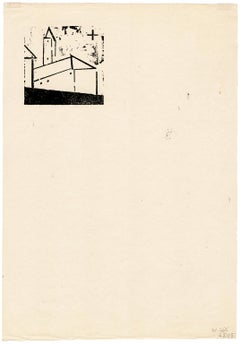
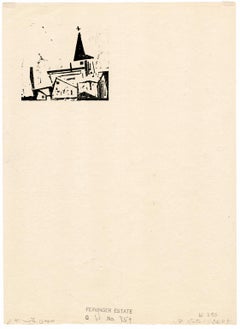
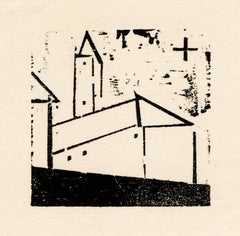
'Church with Star' – Artist's Personal Letterhead, Bauhaus Modernism

'Church with Star' – Artist's Personal Letterhead, Bauhaus Modernism

By Lyonel Feininger

Located in Myrtle Beach, SC

Lyonel Feininger, 'Church with Star (Kirche mit Stern)', woodcut, 1936, one of a small but unknown number of letterhead proofs; Prasse W265. Annotated 'W 265' (Feininger catalogue number) and inventory no. '2808' in pencil, in the bottom right sheet corner. A fine impression, on cream, laid letterhead stock; hinge remains on the left and right top sheet edges, verso, in excellent condition. Very scarce. Image size 2 3/8 x 2 3/8 inches; sheet size 10 1/16 x 7 1/16 inches. Archivally sleeved, unmatted. ABOUT THE ARTIST Lyonel Feininger (1871-1956) was born in New York City into a musical family—his father was a violinist and composer, his mother was a singer and pianist. He studied violin with his father, and by the age of 12, he was performing in public, but he also drew incessantly, most notably the steamboats and sailing ships on the Hudson and East Rivers, and the landscape around Sharon, Conn., where he spent time on a farm owned by a family friend. At the age of 16 he left New York to study music and art in Germany, from where his parents emigrated. Drawn more to the visual arts, he attended schools in Hamburg, Berlin, and Paris from 1887 to 1892. After completing his studies, Feininger began his artistic career as a cartoonist and illustrator, his originality leading him to great success. In 1906, after working for a dozen years in Germany, he was offered a job as a cartoonist at the Chicago Tribune, the largest circulation newspaper in the Midwest. He worked there for a year, inventing what became the standard design for the comic strip: in the words of John Carlin, “an overall pattern. . . that allowed the page to be read both as a series of elements one after the other, like language and as a group of juxtaposed images, like visual art.” His originality did not end there: he went on to become one of the great abstract painters. Like Kandinsky, music was his model, but Kandinsky only knew music from the outside—as a listener (inspired initially by Wagner, then by Schoenberg)—while Feininger knew it from the inside. He lived in Paris from 1906 to 1908, during which time he met and was influenced by the work of progressive painters Robert Delaunay and Jules Pascin, as well as that of Paul Cezanne and Vincent van Gogh. He began painting full-time, developing his distinctive Iyrical style based on Cubist and Expressionist idioms and a concern for the emotive qualities of light and color. He exhibited with the Der Blaue Reiter group in 1913, and in 1917, he had his first solo exhibition at Galerie Der Sturm in Berlin. One year after his solo exhibition, in 1918, Feininger began making woodcuts. He became enamored with the medium, producing an impressive 117 in his first year of exploring the printmaking medium. In 1919 at the invitation of the architect Walter Gropius, he was appointed the first master at the newly formed Staatliches Bauhaus in Weimar. His woodcut of a cathedral crowned...

Category

1930s Bauhaus Oskar Schlemmer Art
Materials

Woodcut

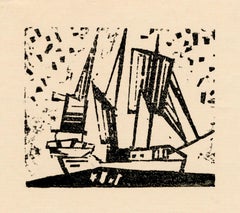
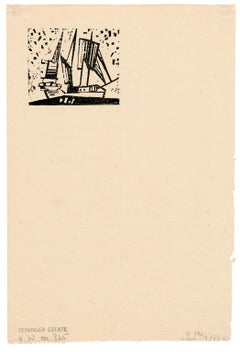
'Three Masted Ship, 2' – Artist's Personal Letterhead, Bauhaus Modernism

'Three Masted Ship, 2' – Artist's Personal Letterhead, Bauhaus Modernism

By Lyonel Feininger

Located in Myrtle Beach, SC

Lyonel Feininger, 'Three Masted Ship, 2 (Dreimastiges Schiff, 2)', woodcut, 1937, one of a small but unknown number of letterhead proofs; Prasse W296. Feininger estate stamp and inventory no. 'W 865' in pencil, bottom left sheet corner. Annotated 'W 296' and 'on block : 3702a' in pencil, bottom right sheet corner. A fine impression, on cream, laid, letterhead stock; hinge remains on the left and right top sheet edges, verso, in excellent condition. Very scarce. Image size 2 1/4 x 2 11/16 inches; sheet size 10 x 6 3/4 inches. Archivally sleeved, unmatted. Exhibited: 'Lyonel Feininer, Woodcuts Used As Letterheads'; Associated American Artists; Feb 4 - March 2, 1974; New York, NY. ABOUT THE ARTIST Lyonel Feininger (1871-1956) was born in New York City into a musical family—his father was a violinist and composer, his mother was a singer and pianist. He studied violin with his father, and by the age of 12, he was performing in public, but he also drew incessantly, most notably the steamboats and sailing ships on the Hudson and East Rivers, and the landscape around Sharon, Conn., where he spent time on a farm owned by a family friend. At the age of 16 he left New York to study music and art in Germany, from where his parents emigrated. Drawn more to the visual arts, he attended schools in Hamburg, Berlin, and Paris from 1887 to 1892. After completing his studies, Feininger began his artistic career as a cartoonist and illustrator, his originality leading him to great success. In 1906, after working for a dozen years in Germany, he was offered a job as a cartoonist at the Chicago Tribune, the largest circulation newspaper in the Midwest. He worked there for a year, inventing what became the standard design for the comic strip: in the words of John Carlin, “an overall pattern. . . that allowed the page to be read both as a series of elements one after the other, like language and as a group of juxtaposed images, like visual art.” His originality did not end there: he went on to become one of the great abstract painters. Like Kandinsky, music was his model, but Kandinsky only knew music from the outside—as a listener (inspired initially by Wagner, then by Schoenberg)—while Feininger knew it from the inside. He lived in Paris from 1906 to 1908, during which time he met and was influenced by the work of progressive painters Robert Delaunay and Jules Pascin, as well as that of Paul Cezanne and Vincent van Gogh. He began painting full-time, developing his distinctive Iyrical style based on Cubist and Expressionist idioms and a concern for the emotive qualities of light and color. He exhibited with the Der Blaue Reiter group in 1913, and in 1917, he had his first solo exhibition at Galerie Der Sturm in Berlin. One year after his solo exhibition, in 1918, Feininger began making woodcuts. He became enamored with the medium, producing an impressive 117 in his first year of exploring the printmaking medium. In 1919 at the invitation of the architect Walter Gropius, he was appointed the first master at the newly formed Staatliches Bauhaus in Weimar. His woodcut of a cathedral crowned...

Category

1930s Bauhaus Oskar Schlemmer Art
Materials

Woodcut

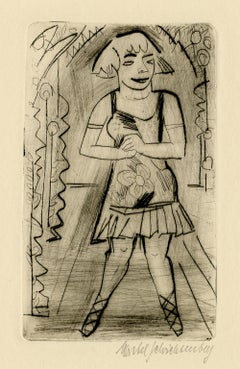
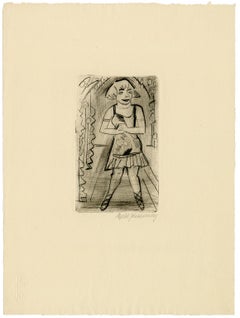
'Varietesoubrette, Schwalbennest' also Dancer — 1920s German Expressionism

'Varietesoubrette, Schwalbennest' also Dancer — 1920s German Expressionism

Located in Myrtle Beach, SC

Martel Schwichtenberg (1896-1945), 'Varietésoubrette, Schwalbennest (Variety Soubrette, Swallow’s Nest), drypoint, 1922. Signed in pencil. A fine, richly-inked impression; the full sheet of cream wove paper, with wide margins (3 3/4 to 5 1/4 inches), in excellent condition. Image size 7 3/16 x 4 5/16 inches; sheet size 16 3/8 x 12 1/8 inches. Archivally matted to museum standards, unframed. Published in Die Schaffenden...

Category

1920s Bauhaus Oskar Schlemmer Art

Materials

Drypoint

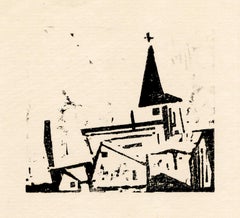
'Church with House and Tree' – Artist's Personal Letterhead, Bauhaus Modernism

'Church with House and Tree' – Artist's Personal Letterhead, Bauhaus Modernism

By Lyonel Feininger

Located in Myrtle Beach, SC

Lyonel Feininger, 'Church with House and Tree (Kirche mit Haus und Baum)', woodcut, 1936, one of a small but unknown number of letterhead proofs; Prasse W290 V. Inscribed 'J. F. note paper', in pencil, in the artist’s hand; with the Feininger estate stamp and catalog no. 'W 859' in pencil. Annotated 'W.290 V state 3609' in pencil, in the bottom right sheet corner. A fine impression, on cream, laid letterhead stock; hinge remains on the left and right top sheet edges, verso, in excellent condition. Very scarce. Image size 2 3/8 x 2 3/4 inches; sheet size 10 x 7 5/16 inches. Archivally sleeved, unmatted. Exhibited: 'Lyonel Feininer, Woodcuts Used As Letterheads'; Associated American Artists; Feb 4 - March 2, 1974; NY, NY. ABOUT THE ARTIST Lyonel Feininger (1871-1956) was born in New York City into a musical family—his father was a violinist and composer, his mother was a singer and pianist. He studied violin with his father, and by the age of 12, he was performing in public. Still, he also drew incessantly, most notably the steamboats and sailing ships on the Hudson and East Rivers, and the landscape around Sharon, Conn., where he spent time on a farm owned by a family friend. At the age of 16 he left New York to study music and art in Germany, from where his parents emigrated. Drawn more to the visual arts, he attended schools in Hamburg, Berlin, and Paris from 1887 to 1892. After completing his studies, Feininger began his artistic career as a cartoonist and illustrator, his originality leading him to great success. In 1906, after working for a dozen years in Germany, he was offered a job as a cartoonist at the Chicago Tribune, the largest circulation newspaper in the Midwest. He worked there for a year, inventing what became the standard design for the comic strip: in the words of John Carlin, “an overall pattern. . . that allowed the page to be read both as a series of elements one after the other, like language and as a group of juxtaposed images, like visual art.” His originality did not end there: he went on to become one of the great abstract painters. Like Kandinsky, music was his model, but Kandinsky only knew music from the outside—as a listener (inspired initially by Wagner, then by Schoenberg)—while Feininger knew it from the inside. He lived in Paris from 1906 to 1908, during which time he met and was influenced by the work of progressive painters Robert Delaunay and Jules Pascin, as well as that of Paul Cezanne and Vincent van Gogh. He began painting full-time, developing his distinctive Iyrical style based on Cubist and Expressionist idioms and a concern for the emotive qualities of light and color. He exhibited with the Der Blaue Reiter group in 1913, and in 1917, he had his first solo exhibition at Galerie Der Sturm in Berlin. One year after his solo exhibition, in 1918, Feininger began making woodcuts. He became enamored with the medium, producing an impressive 117 in his first year of exploring the printmaking medium. In 1919 at the invitation of the architect Walter Gropius, he was appointed the first master at the newly formed Staatliches Bauhaus in Weimar. His woodcut of a cathedral crowned...

Category

1930s Bauhaus Oskar Schlemmer Art
Materials

Woodcut

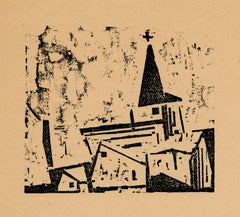
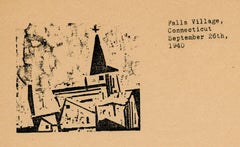
'Church with House and Tree' – Artist's Personal Letterhead, 1940s Modernism

'Church with House and Tree' – Artist's Personal Letterhead, 1940s Modernism

By Lyonel Feininger

Located in Myrtle Beach, SC

Lyonel Feininger, 'Church with House and Tree (Kirche mit Haus und Baum)', woodcut, 1936, one of a small but unknown number of letterhead proofs; Prasse W290 IV. Annotated 'PW 290 state IV / IV 3669', in pencil, in the bottom right sheet corner. With the artist's typed address and date adjacent to the letterhead image: 'Falls Village, Connecticut September 26th, 1940'. A fine impression, on buff, wove letterhead stock; several small losses, and tears, in the sheet edges (not affecting the image area); a crease in the bottom right sheet edge, otherwise in good condition. Very scarce. Image size: 2 3/8 x 2 3/4 inches; sheet size 11 x 8 5/8 inches. Archivally sleeved, unmatted. Feininger moved from Germany to New York City in 1938 and began spending his summers in Falls Village in 1940. Exhibited: 'Lyonel Feininer, Woodcuts Used As Letterheads'; Associated American Artists; Feb 4 - March 2, 1974; New York, NY. ABOUT THE ARTIST Lyonel Feininger (1871-1956) was born in New York City into a musical family—his father was a violinist and composer, his mother was a singer and pianist. He studied violin with his father, and by the age of 12, he was performing in public, but he also drew incessantly, most notably the steamboats and sailing ships on the Hudson and East Rivers, and the landscape around Sharon, Conn., where he spent time on a farm owned by a family friend. At the age of 16 he left New York to study music and art in Germany, from where his parents emigrated. Drawn more to the visual arts, he attended schools in Hamburg, Berlin, and Paris from 1887 to 1892. After completing his studies, Feininger began his artistic career as a cartoonist and illustrator, his originality leading him to great success. In 1906, after working for a dozen years in Germany, he was offered a job as a cartoonist at the Chicago Tribune, the largest circulation newspaper in the Midwest. He worked there for a year, inventing what became the standard design for the comic strip: in the words of John Carlin, “an overall pattern. . . that allowed the page to be read both as a series of elements one after the other, like language and as a group of juxtaposed images, like visual art.” His originality did not end there: he went on to become one of the great abstract painters. Like Kandinsky, music was his model, but Kandinsky only knew music from the outside—as a listener (inspired initially by Wagner, then by Schoenberg)—while Feininger knew it from the inside. He lived in Paris from 1906 to 1908, during which time he met and was influenced by the work of progressive painters Robert Delaunay and Jules Pascin, as well as that of Paul Cezanne and Vincent van Gogh. He began painting full-time, developing his distinctive Iyrical style based on Cubist and Expressionist idioms and a concern for the emotive qualities of light and color. He exhibited with the Der Blaue Reiter group in 1913, and in 1917, he had his first solo exhibition at Galerie Der Sturm in Berlin. One year after his solo exhibition, in 1918, Feininger began making woodcuts. He became enamored with the medium, producing an impressive 117 in his first year of exploring the printmaking medium. In 1919 at the invitation of the architect Walter Gropius, he was appointed the first master at the newly formed Staatliches Bauhaus in Weimar. His woodcut of a cathedral crowned...

Category

1930s Bauhaus Oskar Schlemmer Art
Materials

Woodcut

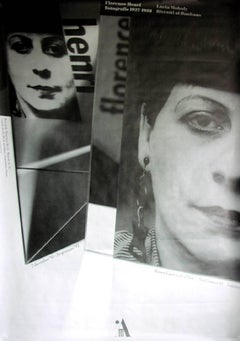
Florence Henri

Bruno MonzuzziFlorence Henri, 1991

$900

H 50.25 in W 35.63 in

Florence Henri

By Bruno Monzuzzi

Located in New York, NY

Ritratti al Bauhaus. Photo-offset poster. Museo cantonale d'arte Lugano Year: 1991. Monguzzi studied in Geneva and London, spent part of his early career in at the studio of Antonio Boggeri, in Milan. The inspiration of the experimental and visually-daring work of the avant garde designers Herbert Bayer, El Lissitsky, Jan Tschichold, Piet Zwart, Paul Schuitema, Ladislav Sutnar...

Category

1990s Bauhaus Oskar Schlemmer Art
Materials

Offset

BENDIX ALUFROID original horizontal French poster

herve morvanBENDIX ALUFROID original horizontal French poster, 1965

$796Sale Price|20% Off

H 43 in W 30.5 in D 0.05 in

BENDIX ALUFROID original horizontal French poster

Located in Spokane, WA

Original Bendix Alufroid French Lithographic Vintage Poster by Hervé Morvan from the 1960s. Archival linen-backed and in very fine condition, ready for framing. Add a touch of cla...

Category

1960s Bauhaus Oskar Schlemmer Art
Materials

Lithograph

Previously Available Items
Roman - Oskar Schlemmer

Roman - Oskar Schlemmer

By Oskar Schlemmer

Located in Winterswijk, NL

Art print on heavy paper After the original from 1925 In great condition

Category

Early 19th Century Oskar Schlemmer Art
Materials

Color

Oskar Schlemmer art for sale on 1stDibs.

Find a wide variety of authentic Oskar Schlemmer art available for sale on 1stDibs. Not every interior allows for large Oskar Schlemmer art, so small editions measuring 28 inches across are available. Customers who are interested in this artist might also find the work of P. Mahler, Philibert-Louis Debucourt, and Jacobus Houbraken . Oskar Schlemmer art prices can differ depending upon medium, time period and other attributes. On 1stDibs, the price for these items starts at $161 and tops out at $161, while the average work can sell for $161.

Artists Similar to Oskar Schlemmer