Paul Balluriau Art

to
1
1
Overall Width
to
Overall Height
to
2
2
1
1
1
1
1
2
1
1
1
2
10,218
2,810
2,500
1,401
2
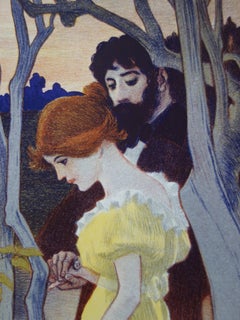
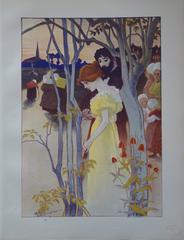
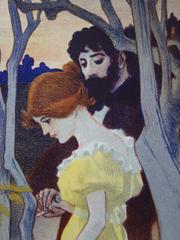
Artist: Paul Balluriau
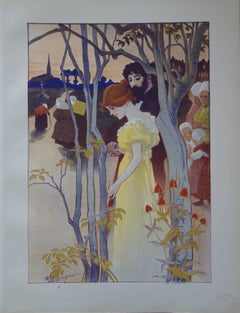
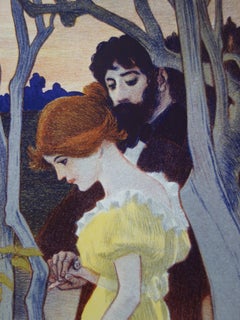
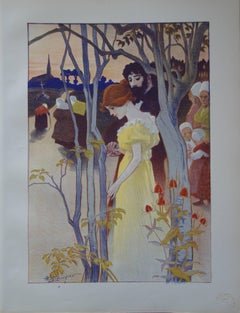
Symbolism : Twilight - Original lithograph (1897/98)

Symbolism : Twilight - Original lithograph (1897/98)

By Paul Balluriau

Located in Paris, IDF

Paul Balluriau Symbolism : Twilight, 1897 Original lithograph (Champenois workshop) Printed signature in the plate On vellum, 40 x 31 cm (c. 16 x 12 in) INFORMATION: Lithograph cre...

Category

1890s Art Nouveau Paul Balluriau Art
Materials

Lithograph

Related Items
Two Fine Prints from the David Suite by Edna Hibel, 1978

Two Fine Prints from the David Suite by Edna Hibel, 1978

By Edna Hibel

Located in New York, NY

Edna Hibel (American, 1917-2015) Two Lithographs from the David Suite, 1978 Hand pulled original lithograph on Japanese rice paper Sheet: 26 x 20 in. Signed lower right: Hibel Number...

Category

1970s Modern Paul Balluriau Art

Materials

Rice Paper, Lithograph

Limited Signed Deluxe Monograph with Slipcase (signed & numbered by Sam Francis)

Limited Signed Deluxe Monograph with Slipcase (signed & numbered by Sam Francis)

By Sam Francis

Located in New York, NY

SAM FRANCIS: Limited Signed Deluxe Edition (Hand signed and numbered by Sam Francis), 1982 Deluxe limited edition hardback monograph with cloth boards, held in special slipcase of ts...

Category

1980s Abstract Expressionist Paul Balluriau Art

Materials

Silk, Paper, Ink, Mixed Media, Lithograph, Offset, Board

Richard Serra Drawing: A Retrospective (hand signed by Richard Serra)

Richard Serra Drawing: A Retrospective (hand signed by Richard Serra)

By Richard Serra

Located in New York, NY

Richard Serra Richard Serra Drawing: A Retrospective (hand signed by Richard Serra), 2011 Hardback monograph with dust jacket (hand signed by Richard Serra) Hand signed by Richard Serra on the title page 12 × 10 × 1 1/2 inches Provenance Strand bookshop New York, official signed copy (see cover) This is the official signed copy from Strand bookshop, NY. bearing the "Signed Copy" stamp on the cover. Makes a superb gift! Published on the occasion of these exhibitions: The Metropolitan Museum of Art(04/11/11-08/28/11) San Francisco Museum of Modern Art (10/15/11-01/16/12) The Menil Collection (03/02/12–06/10/12) Book information: Published by Yale University Press, CO, and The Menil Collection, Houston. English; Hardback; 232 pages with 160 quadratone illustrations Publisher's blurb: As the focal point of numerous high-profile exhibitions, the sculpture of Richard Serra (b. 1939) has drawn international acclaim. Yet even those who have marveled at Serra's intellectually rigorous and large works of sculpture may not be familiar with his equally intriguing drawings. This handsome book brings together for the first time Serra's drawn work, considering the artist's investigation of medium as an activity both independent from and linked to his pioneering sculptural practice. First working in ink, charcoal, and lithographic crayon on paper, Serra originally used drawing as a means to explore form and perceptual relations between his sculpture and the viewer. Over time, his drawings underwent significant shifts in concept, materials, and scale and became fully realized and autonomous works of art. The grand, bold forms he created with black paintstick in his monumental Installation Drawings were designed to disrupt and complement existent spaces and eventually began to occupy entire rooms. In the late 1980s, Serra explored the tension of weight and gravity through layering, and his most recent work experiments with surface effects, using mesh screens as intermediaries between the gesture and the transfer of pigment to paper. More about Richard Serra: Obsession is what it comes down to. It is difficult to think without obsession, and it is impossible to create something without a foundation that is rigorous, incontrovertible, and, in fact, to some degree repetitive. Repetition is the ritual of obsession. Repetition is a way to jumpstart the indecision of beginning. To persevere and to begin over and over again is to continue the obsession with work. Work comes out of work. In order to work you must already be working. —Richard Serra One of the most significant artists of his generation, he has produced large-scale, site-specific sculptures for architectural, urban, and landscape settings spanning the globe, from Iceland to New Zealand. Born in 1938 in San Francisco, Richard Serra lives and works in New York and on the North Fork of Long Island. Serra attended the University of California, Berkeley before transferring to the University of California, Santa Barbara graduating with a BA in English literature; he then studied painting at Yale University, New Haven, Connecticut completing both a BFA and MFA. He began showing with Leo Castelli in 1968, and his first solo exhibition in New York was held at the Leo Castelli Warehouse the following year. His first solo museum exhibition was held at the Pasadena Art Museum, California, in 1970. Serra’s sculptures and drawings have been celebrated with two retrospectives at the Museum of Modern Art, New York, twenty years apart: Richard Serra/Sculpture (1986) and Richard Serra Sculpture: Forty Years (2007). He has had solo exhibitions at the Stedelijk Museum, Amsterdam (1977–78); Kunsthalle Tübingen, Germany (1978); Staatliche Kunsthalle Baden-Baden, Germany (1978); Museum Boijmans Van Beuningen, Rotterdam, Netherlands (1980, 2014, and 2017); Centre Pompidou, Paris (1983–84); Museum Haus Lange, Krefeld, Germany (1985); Louisiana Museum, Humlebæk, Denmark (1986); Westfälisches Landesmuseum für Kunst und Kulturgeschichte, Münster, Germany (1987); Städtische Galerie im Lenbachhaus, Munich (1987); Stedelijk Van Abbemuseum, Eindhoven, Netherlands (1988); Bonnefantenmuseum, Maastricht, Netherlands (1990); Kunsthaus Zürich (1990); CAPC Musée d’Art Contemporain, Bordeaux, France (1990); Museo Nacional Centro de Arte Reina Sofía, Madrid (1992); Kunstsammlung Nordrhein-Westfalen, Düsseldorf, Germany (1992); Dia Center for the Arts, New York (1997); Centro de Arte Hélio Oiticica, Rio de Janeiro (1997–98); Trajan’s Market, Rome (1999–2000); Pulitzer Arts Foundation, St. Louis (2003); and Museo Archeologico Nazionale di Napoli, Naples, Italy (2004). In 2005 The Matter of Time (1994–2005), a series of eight large-scale works, was installed permanently at the Guggenheim Museum Bilbao, Spain. For Monumenta 2008, the major site-specific installation Promenade was shown at the Grand Palais, Paris. Three years later the large-scale, site-specific sculpture 7 was permanently installed opposite the Museum of Islamic Art in Doha, Qatar. A major traveling retrospective dedicated to Serra’s drawings was presented at the Metropolitan Museum of Art, New York, San Francisco Museum of Modern Art, and the Menil Collection, Houston (the organizing venue), from 2011 to 2012. In 2014 the Qatar Museums Authority presented a two-venue retrospective survey of Serra’s work, and East-West/West-East (2014) was permanently installed in the Brouq Nature Reserve, Zekreet, Qatar. In 2017 the Museum Wiesbaden, Germany, presented Richard Serra: Props, Films, Early Works; an overview of Serra’s work in film and video was shown at the Kunstmuseum Basel; and recent drawings were featured at the Museum Boijmans Van Beuningen. Serra has participated in numerous major international exhibitions, including Documenta (1972, 1977, 1982, and 1987), and the Biennale di Venezia (1980, 1984, 2001, and 2013), and his work has been included in many Whitney Annuals and Biennials (1968, 1970, 1973, 1977, 1979, 1981, 1995, and 2006). He is the recipient of the Leone d’Oro for lifetime achievement, Biennale di Venezia, Venice (2001); Orden Pour le Mérite...

Category

2010s Minimalist Paul Balluriau Art

Materials

Paper, Mixed Media, Permanent Marker, Lithograph, Offset

The New Engagement - Lithograph by Umberto Brunelleschi - 1930s

The New Engagement - Lithograph by Umberto Brunelleschi - 1930s

By Umberto Brunelleschi

Located in Roma, IT

 The new engagement is a color lithograph on ivory paper, created by the Italian artist Umberto Brunelleschi (Montemurlo 1879- Paris 1949). Illustration for “Tales and Short Stories...

Category

1930s Art Nouveau Paul Balluriau Art
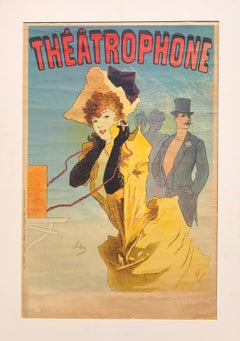
Materials

Lithograph

"Windy Hill" Lawrence Beall Smith, Mid-Century Realist Scene, American Life

"Windy Hill" Lawrence Beall Smith, Mid-Century Realist Scene, American Life

By Lawrence Beall Smith

Located in New York, NY

Lawrence Beall Smith Windy Hill, 1948 Signed in pencil lower right margin Lithograph on wove paper Image 10 3/8 x 13 1/16 inches Sheet 11 15/16 x 16 inches From the edition of 250 ...

Category

1940s American Realist Paul Balluriau Art

Materials

Paper, Lithograph

100 Affiches Pablo Picasso Stone Lithograph Pablo Picasso

100 Affiches Pablo Picasso Stone Lithograph Pablo Picasso

By Pablo Picasso

Located in Dubai, Dubai

100 Affiches Pablo Picasso Lithograph Poster Pablo Picasso was a Spanish painter, sculptor, and co-founder of the Cubist movement, which revolutionized European painting and sculptu...

Category

1960s Contemporary Paul Balluriau Art

Materials

Lithograph, Linen

"Fashionable Boulevard Montmartre, " Original Lithograph Poster by Pierre Brenot

"Fashionable Boulevard Montmartre, " Original Lithograph Poster by Pierre Brenot

By Pierre Laurent Brenot

Located in Milwaukee, WI

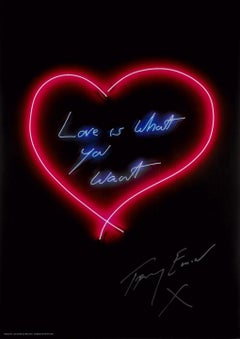
"Fashionable Boulevard Montmartre" is an original lithograph poster by Pierre Laurent Brenot. This piece depicts four figures in fashionable costumes in a variety of dynamic poses. T...

Category

1940s Art Nouveau Paul Balluriau Art
Materials

Lithograph

"Fishing Village" Joe Jones, Mid-Century, American Life, Small Town Scene

"Fishing Village" Joe Jones, Mid-Century, American Life, Small Town Scene

By Joe Jones

Located in New York, NY

Joe Jones Fishing Village, 1949 Signed in pencil lower right margin Lithograph on wove paper Image 9 5/16 x 12 9/16 inches Sheet 12 x 15 15/16 inches From the edition of 250 The initial details of Jones' career are sparse, and this is intentional. The young artist was engaged in a process of self-reinvention, crafting a persona. When he submitted a work to the Sixteen Cities Exhibition at New York City's Museum of Modern Art in 1933, he briefly characterized himself: "Born St. Louis, 1909, self-taught. " Jones intentionally portrayed himself to the art community as an authentic working-class figure, backed by a compelling history. He was the youngest of five children in a family led by a one-armed house painter from St. Louis, a Welsh immigrant, and his German American spouse. At the age of ten, Jones found himself in a Missouri reformatory due to authorities' concerns over his graffiti activities. After completing elementary school, he traveled by freight car to California and back, even being arrested for vagrancy in Pueblo, Colorado. Returning to St. Louis, he attempted to settle down by working alongside his father. Yet, Jones felt a profound restlessness and was drawn toward a more elevated artistic pursuit in his late teenage years. He discovered a local collective of budding artists that formed St. Louis’s "Little Bohemia," sharing a studio and providing mutual support until he managed to secure his own modest workspace in a vacant garage. Jones’s initial creations comprised still lifes, landscapes, and poignant portraits of those close to him. These subjects were not only accessible but also budget-friendly, as hiring models was beyond his means. He depicted himself, his father, mother, and eventually, his wife. In December 1930, at the age of 21, Jones wed Freda Sies, a modern dancer and political activist who was four years older than him. By 1933, Jones had started gaining noteworthy local recognition through a solo exhibition at the Artists’ Guild of Saint Louis. Of the twenty-five paintings on display, one, titled River Front (private collection, previously with Hirschl and Adler Galleries), was selected to illustrate a feature article about his show in The Art Digest (February 15, 1933, p. 9). Shortly before this exhibition, a young surgeon named Dr. Robert Elman took an interest in Jones’s art, purchasing several pieces and forming a group of potential patrons committed to providing the emerging artist with a monthly stipend in exchange for art. This group was officially known as the "Co-operative Art Society," but it was informally dubbed the "Joe Jones Club. " Jones became an active participant in the St. Louis artistic scene, particularly within its bohemian segments. He embraced modernism and was a founding member of the "New Hat" movement in 1931, a playful rebellion against the conservative and traditional mainstream art establishment. The summer of 1933 marked a significant shift in Jones’s journey. Sponsored by a dedicated ally, Mrs. Elizabeth Green, Jones, along with Freda and Green, embarked on an eastward road trip. In Washington, D. C., they explored the Corcoran Gallery of Art, the Freer Gallery (part of the Smithsonian Institution), the Library of Congress, and Mount Vernon. Following this whirlwind of art and American culture, they made their way to New York, where they visited various museums and galleries, including a stop at The New School for Social Research, which featured notable contemporary murals by fellow Missourian Thomas Hart Benton and the politically active Mexican artist, José Clemente Orozco. From June through August, Jones and Freda resided in the artist colony of Provincetown, Massachusetts, later returning home via Detroit to see Diego Rivera’s Detroit Industry mural housed at the Detroit Institute of Fine Arts. While Elizabeth Green allegedly hoped that Jones would refine his artistic skills under the guidance of Charles Hawthorne or Richard Miller in Provincetown, Jones followed a different path. Rather than pursuing conservative mentors, he connected with an engaging network of leftist intellectuals, writers, and artists who dedicated their time to reading Marx and applying his theories to the American landscape. Jones's reaction to the traditional culture of New England was captured in his statement to a reporter from the St. Louis Post Dispatch: “Class consciousness . . . that’s what I got of my trip to New England. Those people [New Englanders] are like the Chinese—ancestor worshipers. They made me realize where I belong” (September 21, 1933). The stark social divisions he witnessed there prompted him to embrace his working-class identity even more fervently. Upon returning to St. Louis, he prominently identified himself as a Communist. This newfound political stance created friction with some of his local supporters. Many of his middle-class advocates withdrew their backing, likely influenced not only by Jones’s politics but also by his flamboyant and confrontational demeanor. In December 1933, Jones initiated a complimentary art class for unemployed individuals in the Old Courthouse of St. Louis, the same location where the Dred Scott case was deliberated and where slave auctions formerly took place. Concurrently, the St. Louis Art League was offering paid courses. Emphasizing the theme of social activism, with a studio adorned with Soviet artwork, Jones’s institution operated for just over a year before being removed from the courthouse by local officials. The school’s political focus and unconventional teaching practices, along with its inclusion of a significant number of African American students during a period marked by rigid racial segregation, certainly contributed to its challenges. Under Jones’s guidance, the class created a large chalk pastel mural on board, measuring 16 by 37 feet, titled Social Unrest in St. Louis. Mural painting posed no challenge for the former housepainter, who was adept at handling large wall surfaces. His first significant commission in St. Louis in late 1931 was a mural that celebrated the city’s industrial and commercial fortitude for the local radio station, KMOX. This mural, aimed at conveying optimism amid severe economic hardship, showcased St. Louis's strengths in a modernist approach. When Jones resumed mural work in late 1933, his worldview had evolved considerably. The mural produced for the school in the courthouse, conceived by Jones, featured scenes of modern St. Louis selected to highlight political messages. Jones had observed the technique of utilizing self-contained scenes to craft visual narratives in the murals he encountered in the East. More locally, this compositional strategy was commonly employed by the renowned Missouri artist...

Category

1940s American Realist Paul Balluriau Art

Materials

Paper, Lithograph

"Les Robes de Paul Poiret racontées par Paul Iribe" - Lithograph - 1908

"Les Robes de Paul Poiret racontées par Paul Iribe" - Lithograph - 1908

By Paul Iribe

Located in Roma, IT

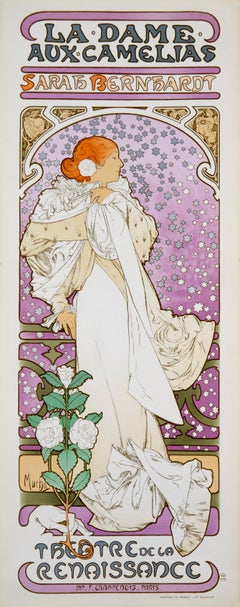
Original lithograph and Pochoir (stencil). One of the beautiful illustrations realized by Paul Iribe for "Les Robes de Paul Poiret" in 1908. Very good condition except for some minor...

Category

Early 1900s Art Nouveau Paul Balluriau Art
Materials

Lithograph

Previously Available Items
Crépuscule (Twilight) - Original lithograph (1897/98)

Crépuscule (Twilight) - Original lithograph (1897/98)

By Paul Balluriau

Located in Paris, IDF

Paul Balluriau Crépuscule (Twilight) Original lithograph Printed signature in the plate 1897/98 Printed on paper Vélin Size 40 x 31 cm (c. 16 x 12") INFORMATION : Published by 'E...

Category

1890s Art Nouveau Paul Balluriau Art
Materials

Lithograph

Crépuscule - Original lithograph (1897/98)

Crépuscule - Original lithograph (1897/98)

By Paul Balluriau

Located in Paris, IDF

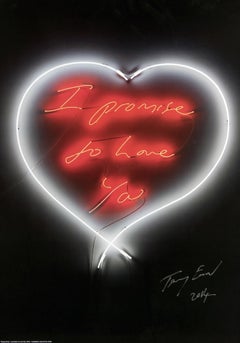
Paul Balluriau Crépuscule Original lithograph Plate signed 1897/98 Printed on paper Vélin Size 40 x 31 cm (c. 16 x 12") INFORMATION : Published by 'Estampe Moderne, Paris, 1...

Category

1890s Art Nouveau Paul Balluriau Art
Materials

Lithograph

Paul Balluriau art for sale on 1stDibs.

Find a wide variety of authentic Paul Balluriau art available for sale on 1stDibs. You can also browse by medium to find art by Paul Balluriau in lithograph and more. Not every interior allows for large Paul Balluriau art, so small editions measuring 12 inches across are available. Customers who are interested in this artist might also find the work of Georges Meunier, Maurice Réalier-Dumas, and Eugene Grasset. Paul Balluriau art prices can differ depending upon medium, time period and other attributes. On 1stDibs, the price for these items starts at $666 and tops out at $666, while the average work can sell for $666.

Artists Similar to Paul Balluriau