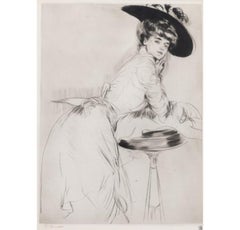
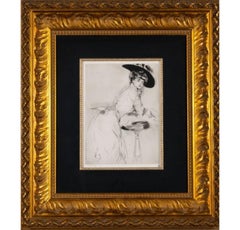
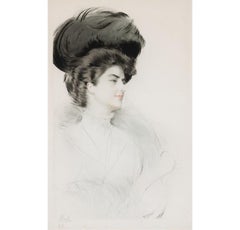
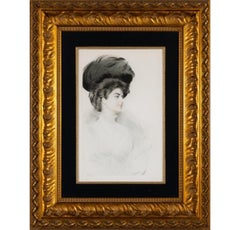
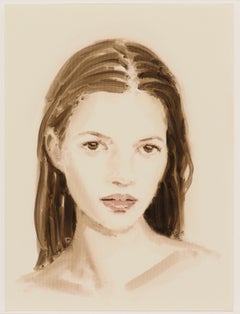
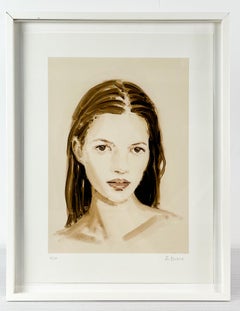
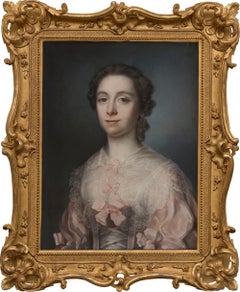
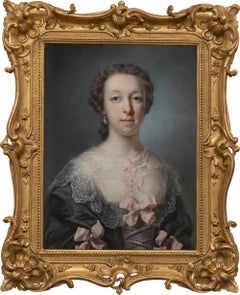
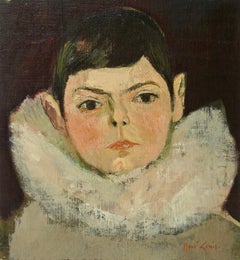
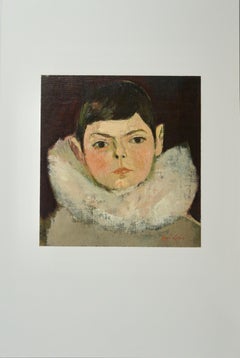
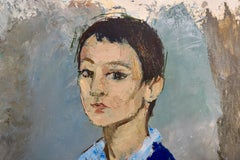
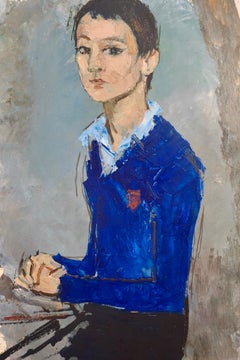
By Paul César Helleu
Located in PARIS, FR
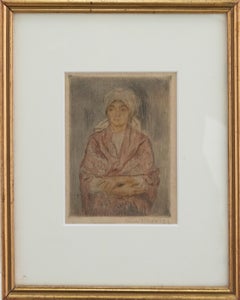
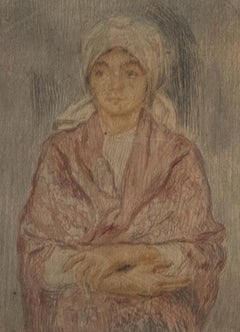
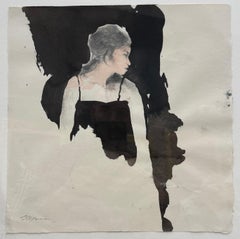
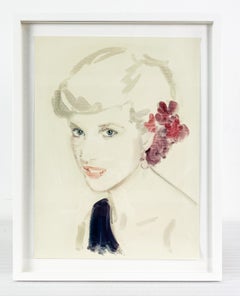
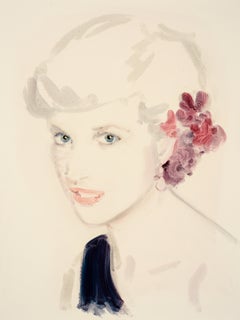
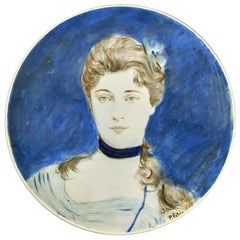
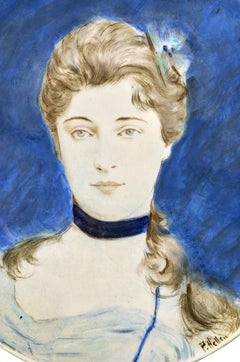
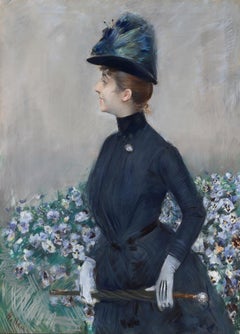
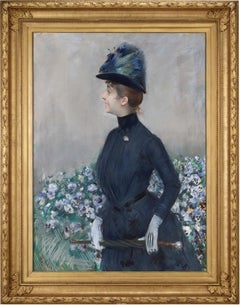
This sumptuous dish, inspired by the bellas of the Italian Renaissance, is a testimony to the fruitful cooperation that began in 1882 between the ceramist Théodore Beck and the young artist Paul Helleu, before the latter became the fashionable portraitist of feminine elegance. This portrait, probably made after a photograph, could be inspired by Alice Louis-Guérin, the woman who became his wife in 1886.
1. Paul Helleu
In 1913 Robert de Montesquiou wrote in his book devoted to the painter: "Helleu was born in Vannes in 1859, of a Breton father and a Parisian mother". He hardly knew his father, who died when he was three years old, and was brought up entirely by his mother, who sent him to continue his studies at the Lycée Chaptal in Paris in 1873.
The discovery of Edouard Manet's Chemin de Fer at the 1874 Salon is reported to be at the origin of his artistic vocation. He worked against his mother's wishes in the studio of the painter Gérôme, also frequented by the painters Giovanni Boldini, Jean-Louis Forain and Antonio de La Gandara. Helleu became friends with John Singer Sargent, with whom he shared a studio for some time, as well as with Claude Monet (1840 - 1926) and Jacques Blanche (1861 - 1942), who accompanied him on a trip to England during which he met the painters Whistler and James Tissot.
When his mother cut off his pension to divert him from painting, Helleu worked in the workshop of the ceramist Théodore Deck, where he decorated ornamental ceramic medallions with women’s faces to pay for his studies at the Paris School of Fine Arts.
In 1884, the Louis-Guérin household commissioned him to paint a portrait of their daughter Alice, aged 14, which was to appear in the Salon of 1885 . Helleu fell madly in love with his model and wished to marry her. Her parents agreed to the wedding subject to three conditions: that it should only take place when Alice turned 16 (!), that she should finish her studies and that the newlyweds should live with them for two years.
From 1886 onwards, a series of happy events and successes followed: his marriage, followed by the birth of his first daughter Ellen in 1887, the participation in the Pastelists' Salon and the first exhibition of his drypoints in New York in 1889. His friendship with Robert de Montesquiou, whom he met in 1887, opened him the doors of the Parisian aristocracy. In 1891 he painted a series of portraits of Montesquiou’s cousin, the Countess Greffulhe, before meeting Marcel Proust in 1895, also thanks to Montesquiou. Proust took much of his inspiration from Helleu for the character of the painter Elstir in A la Recherche du Temps Perdu, a character whose name is said to be a clever alchemy between the names of Helleu and Whistler.
Helleu by then was at the peak of his art and multiplied female portraits, alternating between drypoint, pastels, three-colour pencil drawings whose technique had been inspired by Watteau's, and oil paintings. Commissions for his women’s portraits came from the Parisian High Society as well as from England and the United States, allowing the painter to choose his models.
In parallel to this career as a portrait painter, Helleu produced two large series of paintings concomitantly to Claude Monet's own artistic researches. Since their meeting in 1876, Monet had become a great friend of Helleu (despite an age difference of almost twenty years), and Helleu was one of the two witnesses (the other being the painter Gustave Caillebotte) when Monet, having become a widower, remarried Alice Hoschedé in 1892.
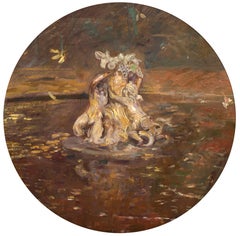
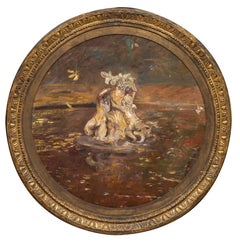
Helleu’s first series was the Cathedrals series, which he began in 1892. While Monet worked in front of the Rouen Cathedral, scrutinising from a fixed point the play of light on the portal, hour after hour and day after day, Helleu was interested in the representation of the cathedrals’ interiors and in particular in the diffusion of light from the stained-glass panels. In 1894 he began outdoor paintings in the park of Versailles. In the description of our painting, we will see how this series can be related to Monet's Water Lilies.
Thanks to his success, Helleu became a real dandy and devoted himself to his passion for yachting. His taste in interior decoration had a lasting influence, since it was Helleu who came up with the idea of abandoning the dark decorations...
Category
1880s Art Nouveau Paul César Helleu Paintings