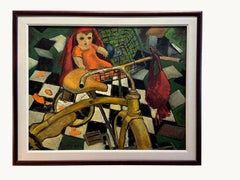
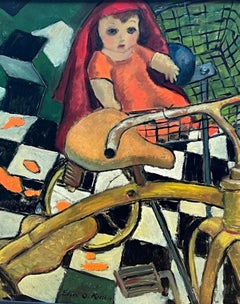
This figurative painting by Edgard Kiechle presents the scenario of a doll who is very surprised to have been abandoned into the basket of her mom's tricycle.
An interesting factor is the pictorial use of angles. The point of view, a little above the stage, probably that of an adult, offers particular perspectives. This approach adds depth to this painting with distinctive compositional appeal.
In contrast to the scene's disorder, a black-and-white tiled floor with a geometric design serves as an antithesis. The careful symmetry of the tiles competing with the surrounding disarray sparks a dialogue about the human need for organization and balance.
In composition, absence is a living element. The exclusion of a physical human figure amplifies the feeling of emptiness, creating a human presence perceived imaginatively.
Edgar O. Kiechle was born in 1911. He was a film illustrator and a painter.
Edgar studied landscape painting with Jean Mannheim and architecture and became an excellent watercolorist. After studying at the Otis Art Institute in Los Angeles, he interned with leading architects and designers. He worked at most major studios, but his career as an illustrator saw him primarily at the Universal Studio Art department.
In 1933, Edgar joined Lwerks as a background artist and worked on many films produced by Animated Picture Corporation through 1935.
In the summer of 1941, Edgar Kiechle...
Category
Mid-20th Century Piero Sansalvadore Paintings