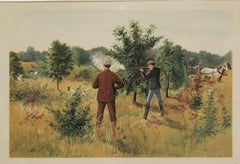
By Rufus Zogbaum
Located in Southampton, NY
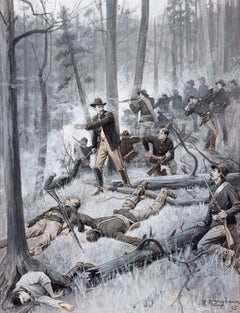
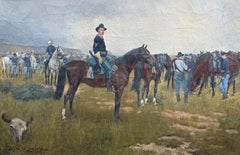
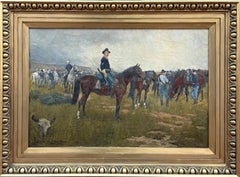
Original oil on canvas painting of the Union Army Calvery in the field by the well known American artist Rofus Fairchild Zogbaum. Signed lower left and dated 1885. Condition is good. Craquelure throughout. Paint is stable. Tiny old repair in middle lower sky (see last photo). The painting is housed in its original gilt wood frame. Overall framed measurements are 20.5 by 30.5 inches. Provenance: A Brooklyn, New York estate.
Best known for his masterful and meticulous scenes of military engagements and nineteenth-century life in the American West, Rufus Zogbaum’s circle of acquaintances was wide and diverse. He mingled with naval commodores as well as emerging luminaries in American art, such as Norman Rockwell, his fellow illustrator and neighbor in the art colony of New Rochelle, New York. When the British writer Rudyard Kipling presented a copy of his first collection of short stories, Plain Tales from the Hills (1888), to Robley D. Evans, then captain of the USS Indiana, in 1896, the gift included a tipped-in original gouache painting by Zogbaum, whom Kipling cited in a brief poem on the leaf opposite the book’s title page. Kipling’s inscription and the four-quatrain poem begins: “Zogbaum draws with a pencil, / And I do things with a pen.”
Born in Charleston, South Carolina, Rufus Fairchild Zogbaum was the son of Ferdinand Zogbaum and Mary Fairchild. The future artist’s father and his paternal uncle, Rufus Fairchild, were partners in a thriving musical instrument manufacturing and import business, first established in 1845 and then relocated to New York in 1853. Although he initially apprenticed in the family office, Rufus enrolled at the Art Students League, where he studied between 1878 and 1879. After pursuing further instruction at Germany’s University of Heidelberg in 1880, he moved on to Paris. During his two-year stay in the French capital, 1880–1882, he was a pupil of Léon Bonnat, a classical realist whose carefully constructed, emotive paintings of peasant life and religious passion reflected academic precepts of the day. The French master’s influence can be seen in Zogbaum’s oeuvre of highly-detailed, heroic paintings.
Upon his return to America, Zogbaum found regular work as an illustrator; between 1883 and 1899, he frequently contributed drawings to popular periodicals like the Saturday Evening Post, North American Review, and Harper’s Monthly, where he eventually earned a staff position. In 1884, he began a run of travels to the western territories, notably Montana. The fruits of these visits were seen in the drawings that accompanied magazine articles informed by the ideals of Manifest Destiny, as well as in finished oil paintings of cowboys...
Category
1880s Academic Rufus Zogbaum Art