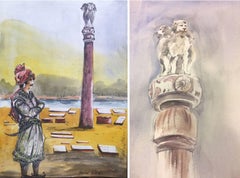
Saikat PatraBuddha, Sarnath Pillar, Qutub Minar, Gupta Empire, Nataraja, Watercolor"In Stock", 2017
$1,705
Buddha, Sarnath Pillar, Qutub Minar, Gupta Empire, Nataraja, Watercolor"In Stock"
By Saikat Patra
Located in Kolkata, West Bengal
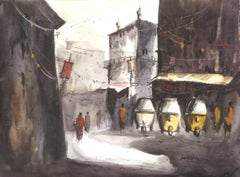
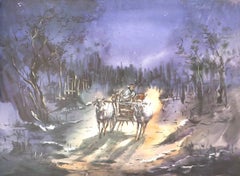
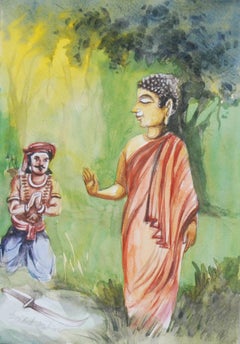
Saikat Patra - Untitled - 15 x 11 inches (unframed size) Watercolour on paper Style : Saikat Patra highly talented water colorist from Bengal. In this series of 10 water colour, Saikat traces few game changing moments in India. From invasion / war to coronation, from spirituality to education Saikat beautifully traces few important moments from Historical India. In order of the series of the events : a) Buddha with Angulimalla : ( 600 – 400 BC ) When Buddha's teaching resonated with the people and the ruthless serial killer redeemed and converted himself to follow the principle of Buddhism. b) Ashoka surveying the Sarnath Pillar : (400 – 200 BC) The Mauryan empire reached the peak of its extent under the rule of Ashoka(reign : 273-232 BCE).Here King Ashoka is scene looking at the Lion Capital of Ashoka, a sculpture of four Asiatic Lions; a graphic representation of which was adopted as the official Emblem of India in 1950. c) Questions of Milinda : (200 – 100 BC) Depicts the Questions of Milinda, a Buddhist text which record a dialogue Buddhist Sage Nagasena and the Indo - Greek King Menander who is set to have converted after meeting Sage Nagasina. d) The Kushan Kings encouraged all religions : One of the most interesting aspects of the Kushan empire is its spirit religious toleration. A broad pantheon of dieties on Kushan coins indicates that the empire was characterized by tremendous religious toleration. We find on Kushan coins, Greek Gods such as Helios and Salene, Iranian gods such as Nana, Mithra , Mao and Athsho, Hindu gods such as Shiva and Kartikeya, the Zoroastrian deity Ahura Mazda and the Buddha. The drawings shown above are also powerful evidence of the syncretic nature of many of the deities which were worshipped from different traditions. e) Gupta Empire : India’s Golden Age Kalidasa : ( 5th century AD ) Poet and playwright Vatsyayana : ( 3rd - 6th century AD) Author of the Kama Sutra Aryabhata : ( 5th century AD ) Mathematician, astronomer The peace and prosperity created under the leadership of the Guptas enabled the pursuit of scientific and artistic endeavours. This period was marked by extensive inventions and discoveries in science & technology, engineering, art, literature, mathematics, astronomy, religion, and philosophy that crystallized the elements of what is known as the Golden Age of India. f) Shiva as a dancing Nataraja, Badami : ( 600 – 750 AD ) The period of Badami Chalukyas the first cave portrays the Tandava-dancing Shiva...
2010s Contemporary Saikat Patra Art
Paper, Watercolor